Indexed by TopGit from live GitHub metadata: alshedivat/al-folio has 16.3k stars, written primarily in HTML. A beautiful, simple, clean, and responsive Jekyll theme for academics
Snapshot summary built from the project's own GitHub metadata — there's no written TopGit review yet. The page will update automatically when a full review is published.
WHY NO REVIEW YET
TopGit writes full reviews for the most-starred, most-requested repositories. This page is a snapshot until then — see the READ ME tab for the original README in full.
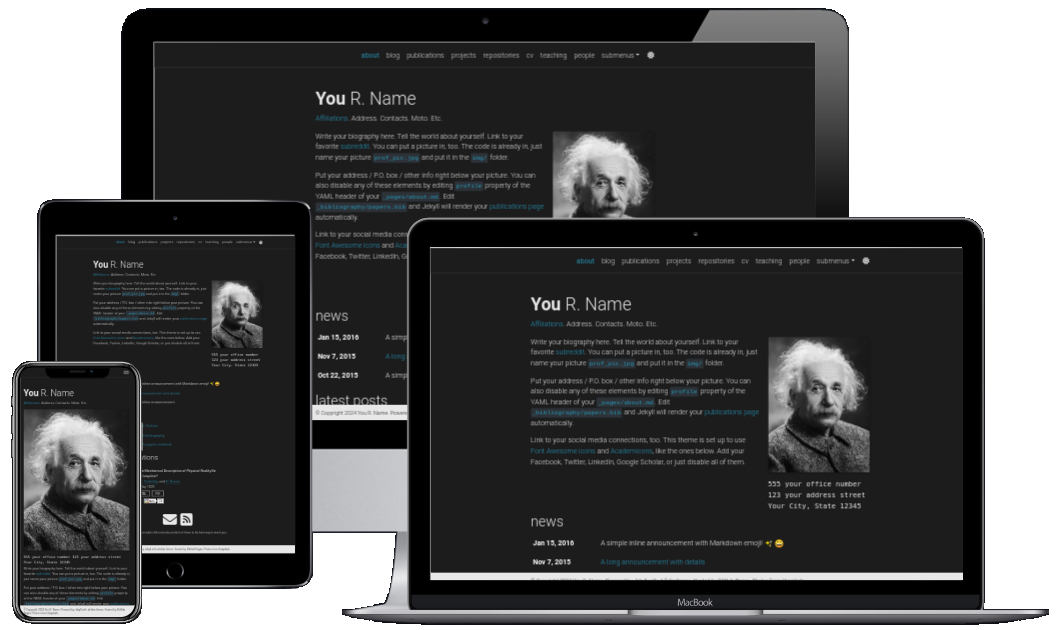
A simple, clean, and responsive Jekyll starter for academic websites.
In v1.x, al-folio is a thin starter, not a theme: the runtime ships as independently versioned plugin gems, so you pick up fixes and features by bumping a pinned version in your Gemfile instead of merging theme internals into your site.
Getting started
⚠️ Important: Use "Use this template" (not fork)
When creating your own website with al-folio, you have two options:
✅ Recommended: Click "Use this template" – This creates a clean copy that is independent from the main al-folio repository. Changes you make to your site won't be accidentally submitted to al-folio as pull requests.
❌ Not recommended: Forking the repository – This keeps a link to the main al-folio repo, making it easy to accidentally submit your personal site changes as contributions to our project.
If you already forked: Don't worry! You can still work with your fork normally. Just make sure to:
Make changes on a dedicated branch (e.g., my-site-updates)
When pushing changes, always verify you're pushing to your own repository, not the main al-folio repository
Never create pull requests to alshedivat/al-folio unless you're intentionally contributing improvements that benefit all users
For quick setup, see docs/QUICKSTART.md.
Want to learn more about Jekyll? Check out this tutorial. Why Jekyll? Read Andrej Karpathy's blog post! Why write a blog? Read Rachel Thomas blog post.
Table Of Contents
al-folio
Getting started
Table Of Contents
Installing and Deploying
Customizing
Plugin Ecosystem
Using AI Agents
Codex
Claude
Copilot And Other Agents
Documentation
Features
Light and dark mode
The pages you get out of the box
Writing
GitHub repositories and stats
User community
Lighthouse PageSpeed Insights
Desktop
Mobile
FAQ
Contributing
Code quality checks
Maintainers
All Contributors
Star History
License
Installing and Deploying
For installation and deployment details please refer to docs/INSTALL.md.
Customizing
For customization details please refer to docs/CUSTOMIZE.md.
Plugin Ecosystem
al-folio is a thin starter in v1.x. Runtime features are plugin-owned and published as Ruby gems.
The catalog page is deliberately kept out of the navbar (nav: false) so the demo site's chrome stays unchanged; reach it through the links above.
Naming convention:
Theme-coupled plugins use al-folio-<feature> repos and al_folio_<feature> gem/plugin ids.
Reusable plugins can use al-<feature> or neutral naming.
Featured plugins and bundled starter plugins are different tracks. Bundling requires explicit updates to Gemfile and _config.yml.
Plugin-owned changes should be made in the owning al-org-dev plugin repository, not by copying runtime assets into this starter.
The bundled v1 plugin repos are:
al-folio-core: shared layouts, includes, style/runtime primitives, and upgrade contracts
al-folio-cv: CV rendering
al-folio-distill: Distill layouts and runtime assets
al-analytics, al-comments, al-cookie, al-img-tools, al-math, al-charts, and al-newsletter: feature-specific runtime and integration behavior
Using AI Agents
al-folio v1.x is designed for agent-assisted setup and migration. Agents should read AGENTS.md first, then use docs/BOUNDARIES.md to route changes to the starter or the owning plugin repo.
For existing customized forks, the recommended migration path is to ask an agent to use the al-folio v1 migration skill. The skill walks through creating a disposable migration branch, bringing site-owned content/config/data onto the v1 starter contract, running al_folio_upgrade, auditing local overrides, and validating the build. This is preferred over a manual file-by-file upgrade because v1 runtime ownership moved into plugins and local overrides need explicit drift tracking.
The canonical skills live in .agents/skills/. They are also exposed through .codex/skills/ and .claude/skills/ symlinks for agents that discover skills from tool-specific directories.
Codex
Codex can use the repo-local skills:
al-folio bootstrap: create and configure a new v1 site.
al-folio v1 migration: migrate customized forks and audit local overrides.
Useful first prompts:
"Use the al-folio bootstrap skill to configure my new site."
"Use the al-folio v1 migration skill to migrate this customized fork and run the override audit."
Claude
Claude should start from CLAUDE.md, which imports AGENTS.md. For setup or migration tasks, use the matching skill from .claude/skills/, which points to the canonical .agents/skills/ directory.
Copilot And Other Agents
Copilot should follow .github/copilot-instructions.md and the specialized agents in .github/agents/. Other agents should follow the same rule: keep starter work in this repo, route runtime behavior to the owning al-org-dev plugin, and run bundle exec al-folio upgrade overrides audit whenever local overrides are added or retained.
Documentation
Comprehensive guides for all aspects of your al-folio website:
Documentation index – All user, maintainer, and migration guides
Quick Start – Get running in 5 minutes
Installation & Deployment – Set up your site on GitHub Pages or other platforms
Customization Guide – Personalize your website (CVs, publications, themes, etc.)
Troubleshooting – Fix common issues (deployment, build, styling, content)
FAQ – Frequently asked questions and solutions
Analytics – Add website analytics and visitor tracking
SEO Guide – Optimize for search engines and improve discoverability
Plugin Catalog – Featured and bundled plugin metadata (page source)
Features
Everything below ships with the starter. Rows marked setup render nothing until you supply a key, ID or credential — bundling a plugin is not the same as switching the feature on. Each feature is owned by a versioned plugin — see docs/BOUNDARIES.md for the full ownership table, and Plugin Ecosystem for how to add or remove one.
GDPR cookie consent, gating analytics until opt-in — setup
al_cookie
GDPR Cookie Consent Dialog
Newsletter signup — setup
al_newsletter
newsletter: in _config.yml
Citation counts, altmetric/dimensions badges
al_citations
Adding a new publication
FontAwesome, Academicons, scholar icons
al_icons
third_party_libraries in _config.yml
Posts syndicated from Medium and other feeds
al_ext_posts
external_sources: in _config.yml
Legacy Bootstrap markup (opt-in, removed in v2.0)
al_folio_bootstrap_compat
al_folio.compat.bootstrap in _config.yml
Upgrade audits and codemods
al_folio_upgrade
bundle exec al-folio upgrade audit
Also included: Open Graph and schema.org previews, an Atom feed at /feed.xml, related posts, tabbed content, typograms, responsive image generation, and a Google Scholar citation-refresh workflow.
Light and dark mode
The theme follows the visitor's system preference and can be toggled with the sun/moon control in the navbar. The choice persists across visits.
The pages you get out of the box
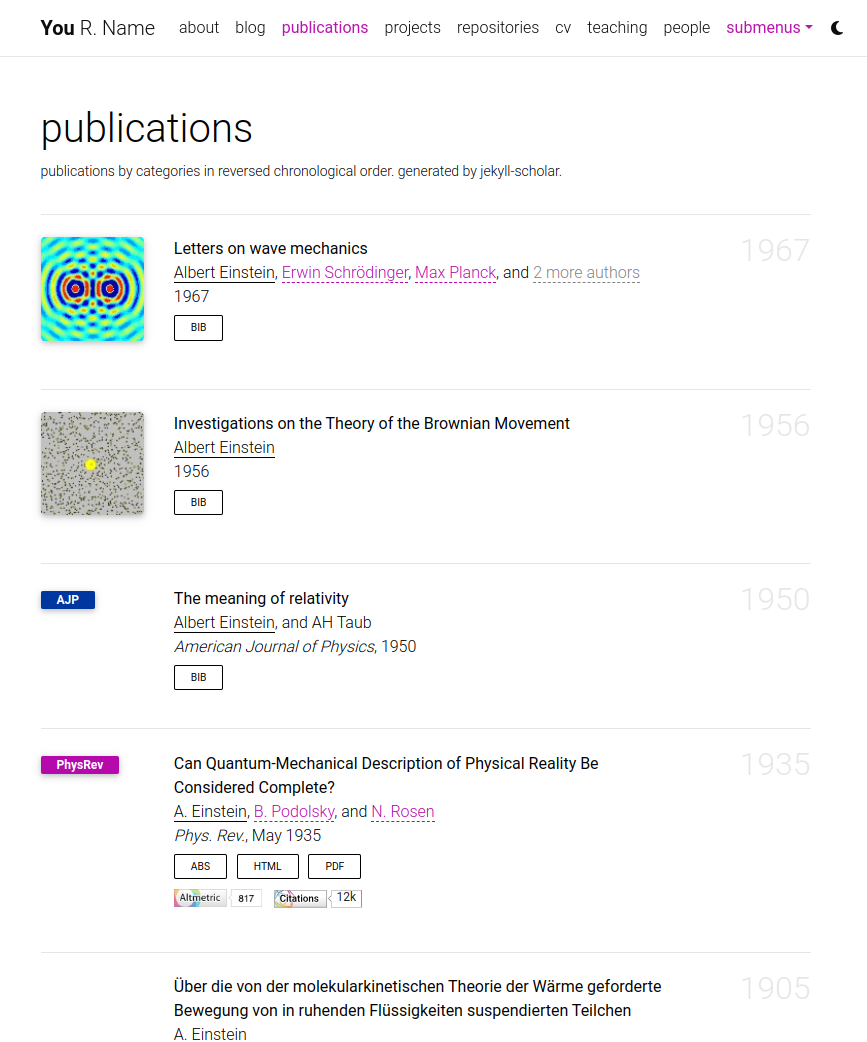
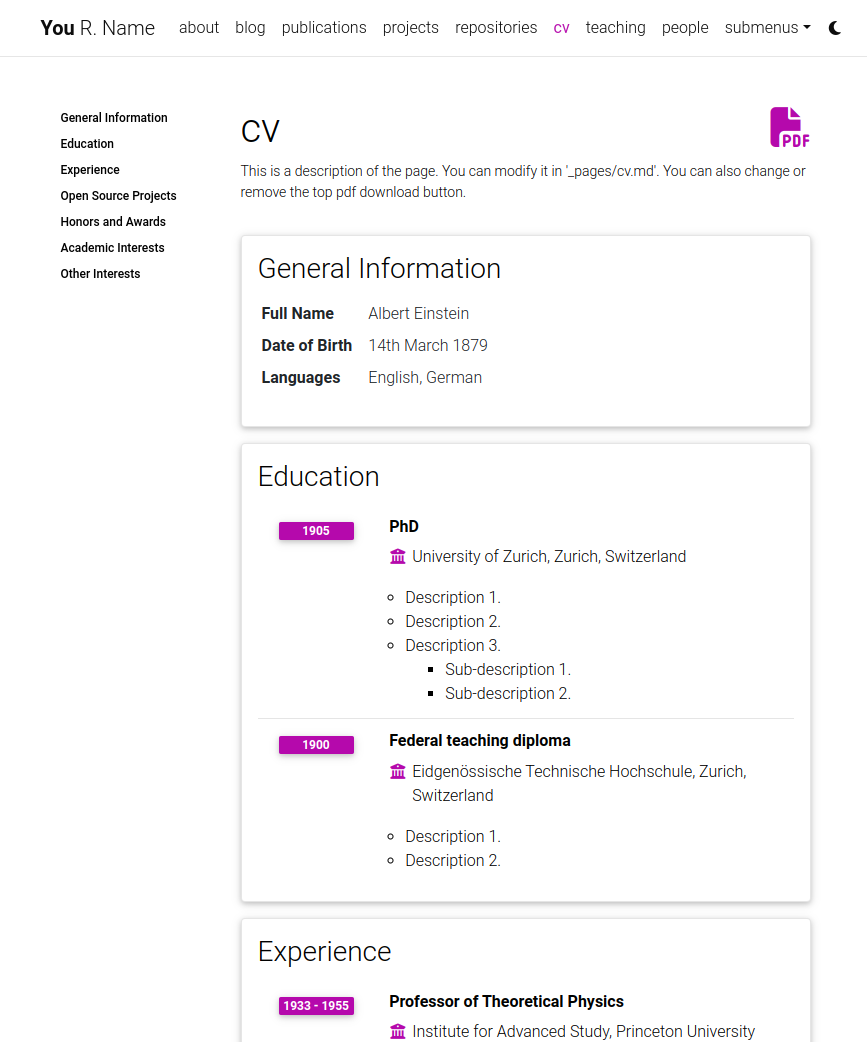
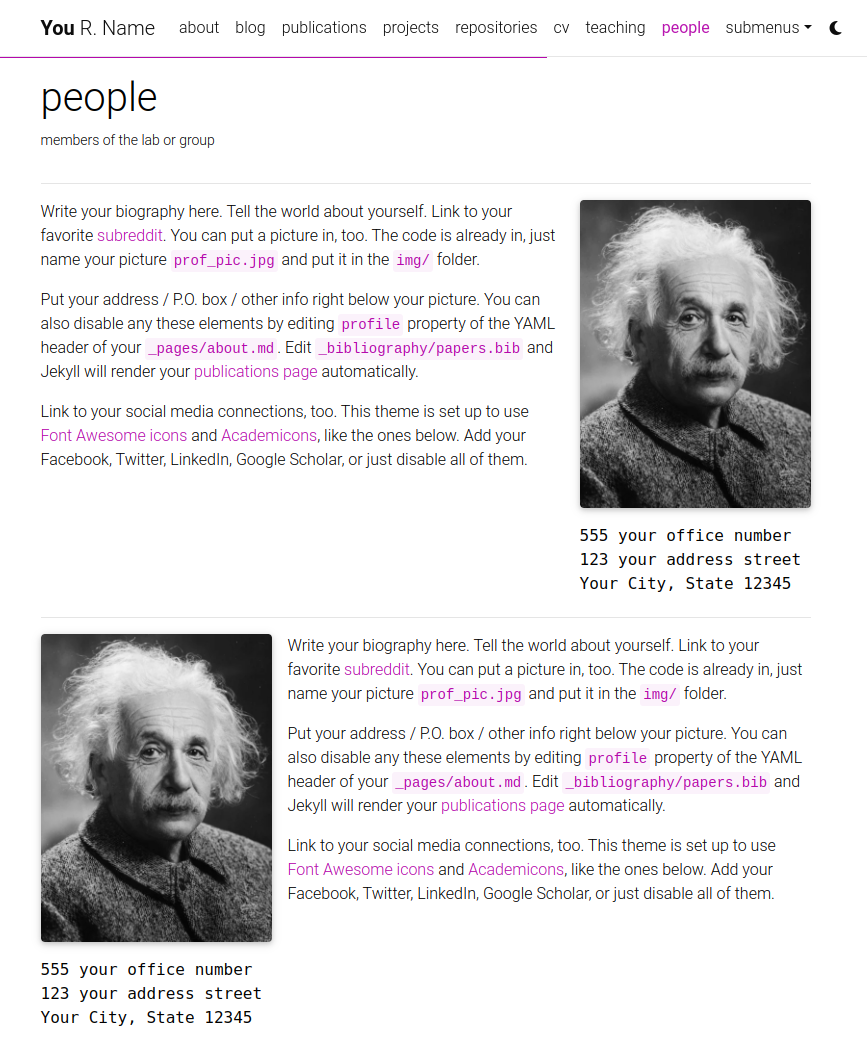
Publications are generated from your BibTeX bibliography, the CV from a single cv.yml or resume.json, and the people page from _data. Everything is content-driven — you edit data files, not templates.
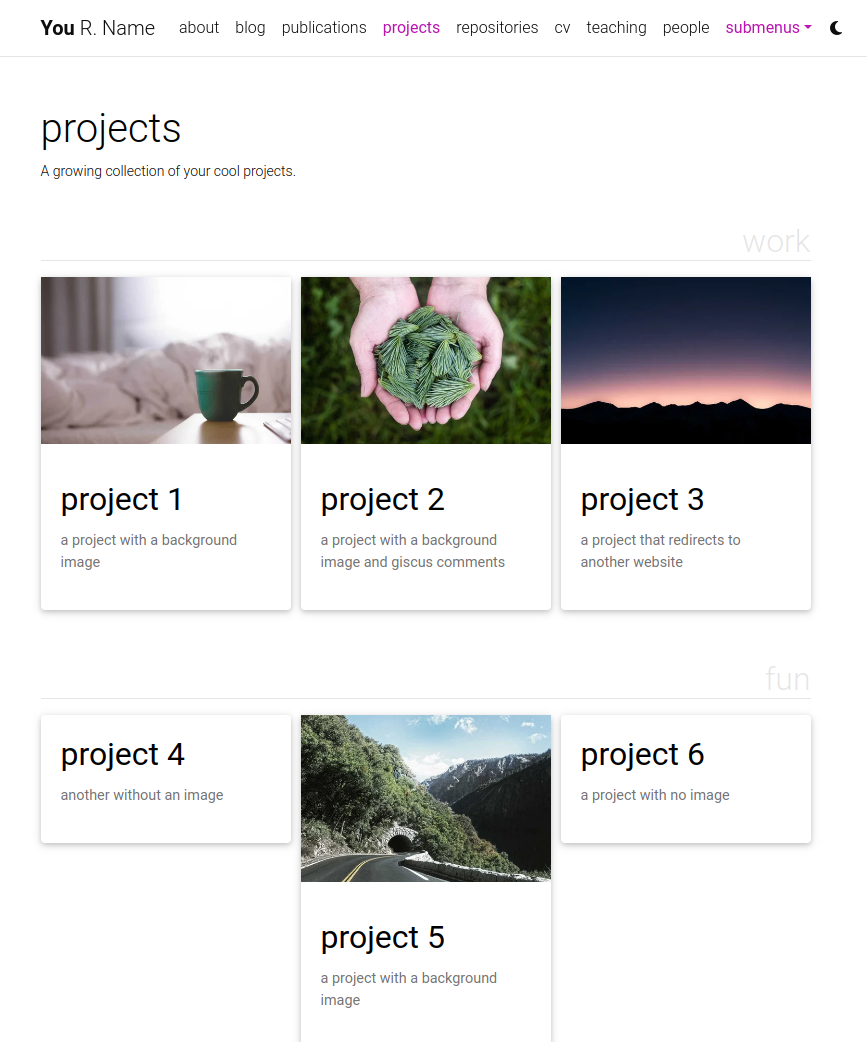
Projects are one of four Jekyll collections the starter ships (news, projects, books, teachings). You can add your own for courses, talks, or anything else — see Adding Collections.
Writing
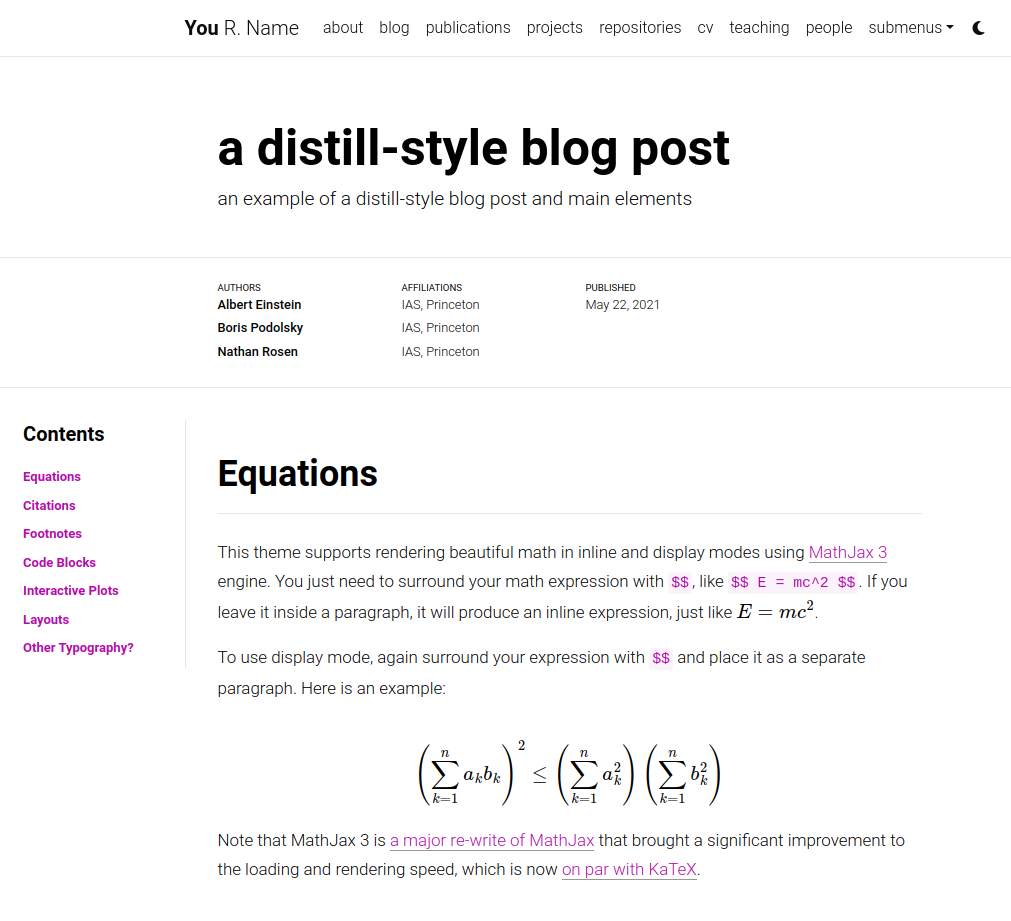
Posts support the distill.pub layout, MathJax and TikZ, syntax-highlighted code, Jupyter notebooks, charts, image galleries, video and audio embeds.
GitHub repositories and stats
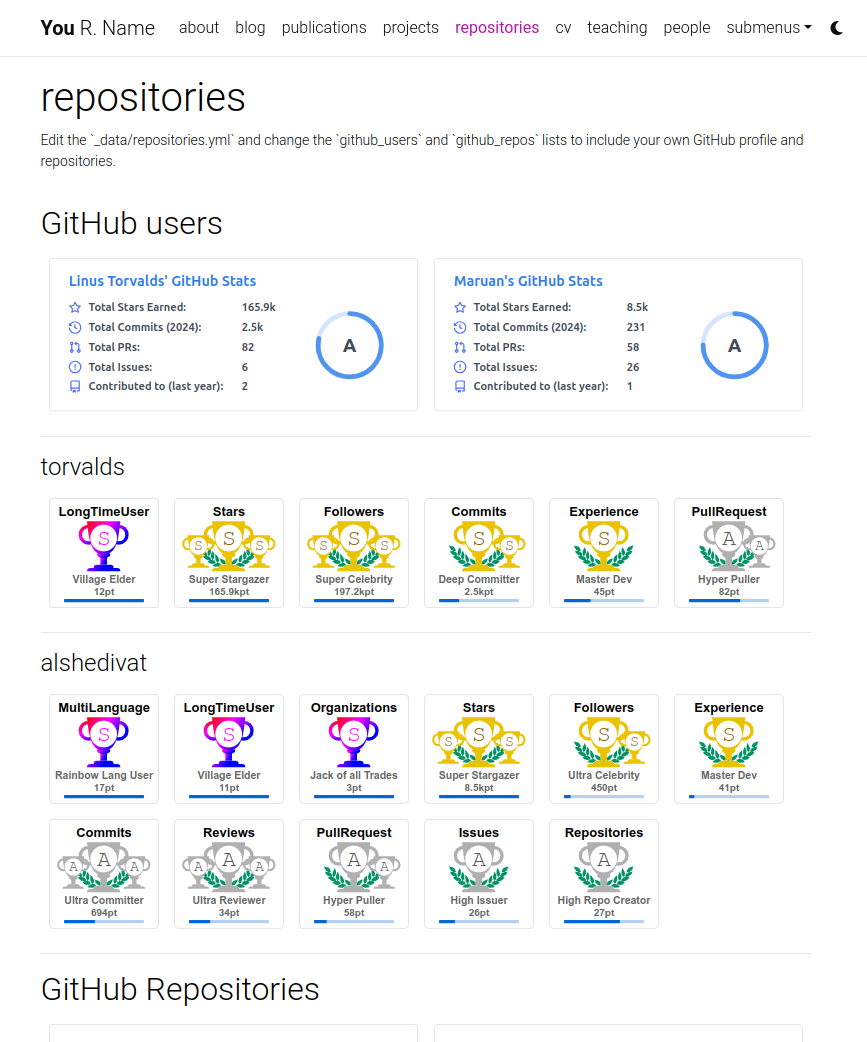
The /repositories/ page renders repository and profile cards via github-stats-extended. Profile trophies via github-profile-trophy are supported but off by default, because that project's free public instance is currently disabled — see docs/CUSTOMIZE.md to self-host and re-enable.
Configure which repositories and profiles appear under Modifying the user and repository information.
User community
Academics around the world use al-folio for their homepages, blogs, and lab pages, as well as webpages for courses, workshops, conferences, meetups, and more.
Browse the showcase →
Want your site listed? Post a request in the Showcase category of GitHub Discussions — we review and add entries periodically. Please do not open a pull request for this.
Lighthouse PageSpeed Insights
Desktop
Run the test yourself: Google Lighthouse PageSpeed Insights
Mobile
Run the test yourself: Google Lighthouse PageSpeed Insights
FAQ
For frequently asked questions, please refer to docs/FAQ.md.
Contributing
Contributions to al-folio are very welcome! Before you get started, please take a look at the guidelines.
If you would like to improve documentation or fix a minor inconsistency or bug, please feel free to send a PR directly to main. For more complex issues/bugs or feature requests, please open an issue using the appropriate template.
Code quality checks
CI runs the following on every pull request:
Prettier — formatting, including Liquid templates
lychee — broken links
npm run lint:style-contract — enforces the thin-starter boundary described in AGENTS.md
the six test/integration_*.sh scripts, and Playwright visual-regression checks
Axe accessibility checks are run manually, because the fixes are not always straightforward for contributors without web development experience.
Maintainers
Our most active contributors are welcome to join the maintainers team. If you are interested, please reach out!
Maruan
Rohan Deb Sarkar
Amir Pourmand
George
All Contributors
Star History
Generated by bin/generate_star_history.py and refreshed automatically by star-history.yml.
License
al-folio is available as open source under the terms of the MIT License.
Originally, al-folio was based on the *folio theme (published by Lia Bogoev and under the MIT license). Since then, it got a full re-write of the styles and many additional cool features.
The most recent commit recorded on alshedivat/al-folio was 2 months ago, based on the GitHub push timestamp. The repository has 13.1k forks — one of the better signals of community interest.
How many stars does alshedivat/al-folio have?
alshedivat/al-folio has 16.3k GitHub stars — refresh the page for the live number, or check github.com/alshedivat/al-folio. TopGit mirrors GitHub's count but does not claim minute-by-minute accuracy.
Is alshedivat/al-folio open source?
Yes — alshedivat/al-folio ships under the MIT license, which makes its source code freely readable (and, depending on license terms, forkable and reusable). Source: github.com/alshedivat/al-folio.
What else is in the UI / UX space?
alshedivat/al-folio is tracked by TopGit under the UI / UX category, alongside 10 GitHub-tagged topics. Trending and Topics pages list peer repositories of comparable stars and language.
What is alshedivat/al-folio?
alshedivat/al-folio (alshedivat/al-folio) is a HTML project on GitHub. From the project's own README: A beautiful, simple, clean, and responsive Jekyll theme for academics
What language is alshedivat/al-folio written in?
alshedivat/al-folio is written primarily in HTML. GitHub's language field is based on the largest share of bytes in the default branch.
What license does alshedivat/al-folio use?
alshedivat/al-folio is released under the MIT license. Always verify the LICENSE file directly on GitHub for the authoritative terms — license strings can be edited out of sync with a project's actual stance.
Where do I read more about alshedivat/al-folio?
This TopGit page is a snapshot — the READ ME tab shows the project's own README content (links stripped, images preserved). The GitHub repository at github.com/alshedivat/al-folio is the definitive source.
Read full README in the tab above.
Curious whether al-folio is right for you?
Let ChatGPT, Claude, or Perplexity look into it — click below and see what AI actually says about al-folio.
 /al-folio