On GitHub, antlr/antlr4 has picked up 19.0k stars, Backend, Java. ANTLR (ANother Tool for Language Recognition) is a powerful parser generator for reading, processing, executing, or translating structured text or binary files.
Snapshot summary built from the project's own GitHub metadata — there's no written TopGit review yet. The page will update automatically when a full review is published.
WHY NO REVIEW YET
TopGit writes full reviews for the most-starred, most-requested repositories. This page is a snapshot until then — see the READ ME tab for the original README in full.
ANTLR (ANother Tool for Language Recognition) is a powerful parser generator for reading, processing, executing, or translating structured text or binary files. It's widely used to build languages, tools, and frameworks. From a grammar, ANTLR generates a parser that can build parse trees and also generates a listener interface (or visitor) that makes it easy to respond to the recognition of phrases of interest.
Dev branch build status
(github actions)
Versioning
ANTLR 4 supports 10 target languages
(Cpp, CSharp, Dart, Java, JavaScript, PHP, Python3, Swift, TypeScript, Go),
and ensuring consistency across these targets is a unique and highly valuable feature.
To ensure proper support of this feature, each release of ANTLR is a complete release of the tool and the 10 runtimes, all with the same version.
As such, ANTLR versioning does not strictly follow semver semantics:
a component may be released with the latest version number even though nothing has changed within that component since the previous release
major version is bumped only when ANTLR is rewritten for a totally new "generation", such as ANTLR3 -> ANTLR4 (LL(*) -> ALL(*) parsing)
minor version updates may include minor breaking changes, the policy is to regenerate parsers with every release (4.11 -> 4.12)
backwards compatibility is only guaranteed for patch version bumps (4.11.1 -> 4.11.2)
If you use a semver verifier in your CI, you probably want to apply special rules for ANTLR, such as treating minor change as a major change.
Repo branch structure
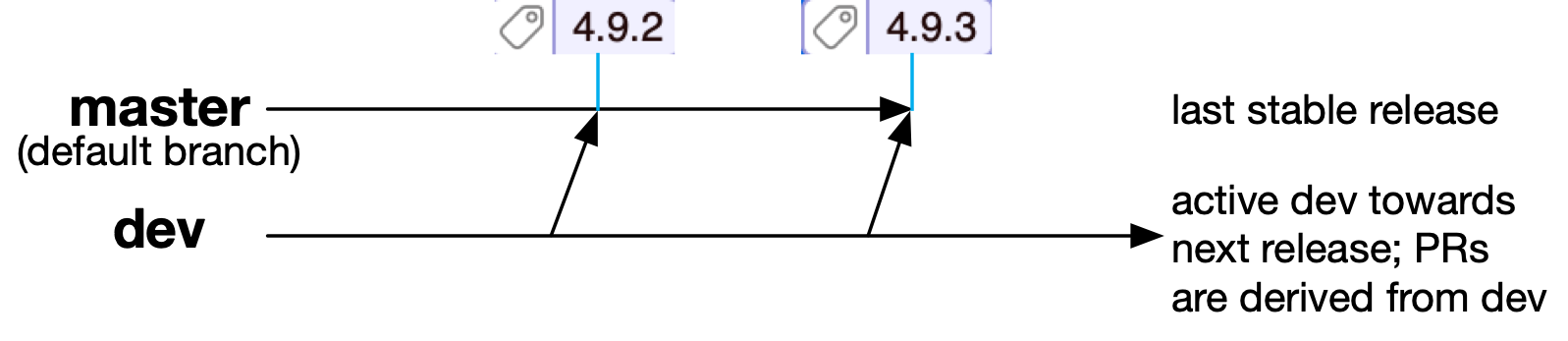
The default branch for this repo is master, which is the latest stable release and has tags for the various releases; e.g., see release tag 4.9.3. Branch dev is where development occurs between releases and all pull requests should be derived from that branch. The dev branch is merged back into master to cut a release and the release state is tagged (e.g., with 4.10-rc1 or 4.10.) Visually our process looks roughly like this:
The Go target now has its own dedicated repo:
$ go get github.com/antlr4-go/antlr
Note
The dedicated Go repo is for go get and import only. Go runtime development is still performed in the main antlr/antlr4 repo.
Authors and major contributors
Terence Parr, [email protected]
ANTLR project lead and supreme dictator for life
University of San Francisco
Sam Harwell (Tool co-author, Java and original C# target)
Eric Vergnaud (Javascript, TypeScript, Python2, Python3 targets and maintenance of C# target)
Peter Boyer (Go target)
Mike Lischke (C++ completed target)
Dan McLaughlin (C++ initial target)
David Sisson (C++ initial target and test)
Janyou (Swift target)
Ewan Mellor, Hanzhou Shi (Swift target merging)
Ben Hamilton (Full Unicode support in serialized ATN and all languages' runtimes for code points > U+FFFF)
Marcos Passos (PHP target)
Lingyu Li (Dart target)
Ivan Kochurkin has made major contributions to overall quality, error handling, and Target performance.
Justin King has done a huge amount of work across multiple targets, but especially for C++.
Ken Domino has a knack for finding bugs/issues and analysis; also a major contributor on the grammars-v4 repo.
Jim Idle has contributed to previous versions of ANTLR and recently jumped back in to solve a major problem with the Go target.
Note: As of version 4.14, we are dropping support for Python 2. We love the Python
community, but Python 2 support was officially halted in Jan 2020. More recently,
GitHub also dropped support for Python 2, which has made it impossible for us to
maintain a consistent level of quality across targets (we use GitHub for our CI).
Long live Python 3!
Java API
ANTLR v3
v3 to v4 Migration, differences
You might also find the following pages useful, particularly if you want to mess around with the various target languages.
How to build ANTLR itself
How we create and deploy an ANTLR release
The Definitive ANTLR 4 Reference
Programmers run into parsing problems all the time. Whether it’s a data format like JSON, a network protocol like SMTP, a server configuration file for Apache, a PostScript/PDF file, or a simple spreadsheet macro language—ANTLR v4 and this book will demystify the process. ANTLR v4 has been rewritten from scratch to make it easier than ever to build parsers and the language applications built on top. This completely rewritten new edition of the bestselling Definitive ANTLR Reference shows you how to take advantage of these new features.
You can buy the book The Definitive ANTLR 4 Reference at amazon or an electronic version at the publisher's site.
You will find the Book source code useful.
Additional grammars
This repository is a collection of grammars without actions where the
root directory name is the all-lowercase name of the language parsed
by the grammar. For example, java, cpp, csharp, c, etc...
The most recent commit recorded on antlr/antlr4 was 9 months ago, based on the GitHub push timestamp. The repository has 3.5k forks — one of the better signals of community interest.
How many stars does antlr/antlr4 have?
antlr/antlr4 has 19.0k GitHub stars — refresh the page for the live number, or check github.com/antlr/antlr4. TopGit mirrors GitHub's count but does not claim minute-by-minute accuracy.
What language is antlr/antlr4 written in?
antlr/antlr4 is written primarily in Java. GitHub's language field is based on the largest share of bytes in the default branch.
What license does antlr/antlr4 use?
antlr/antlr4 is released under the BSD-3-Clause license. Always verify the LICENSE file directly on GitHub for the authoritative terms — license strings can be edited out of sync with a project's actual stance.
The project maintains a homepage at http://antlr.org. The README tab on this page also usually contains screenshots and a quickstart.
Where do I read more about antlr/antlr4?
This TopGit page is a snapshot — the READ ME tab shows the project's own README content (links stripped, images preserved). The GitHub repository at github.com/antlr/antlr4 is the definitive source.
Read full README in the tab above.
Curious whether antlr4 is right for you?
Let ChatGPT, Claude, or Perplexity look into it — click below and see what AI actually says about antlr4.

 /antlr4


 (github actions)