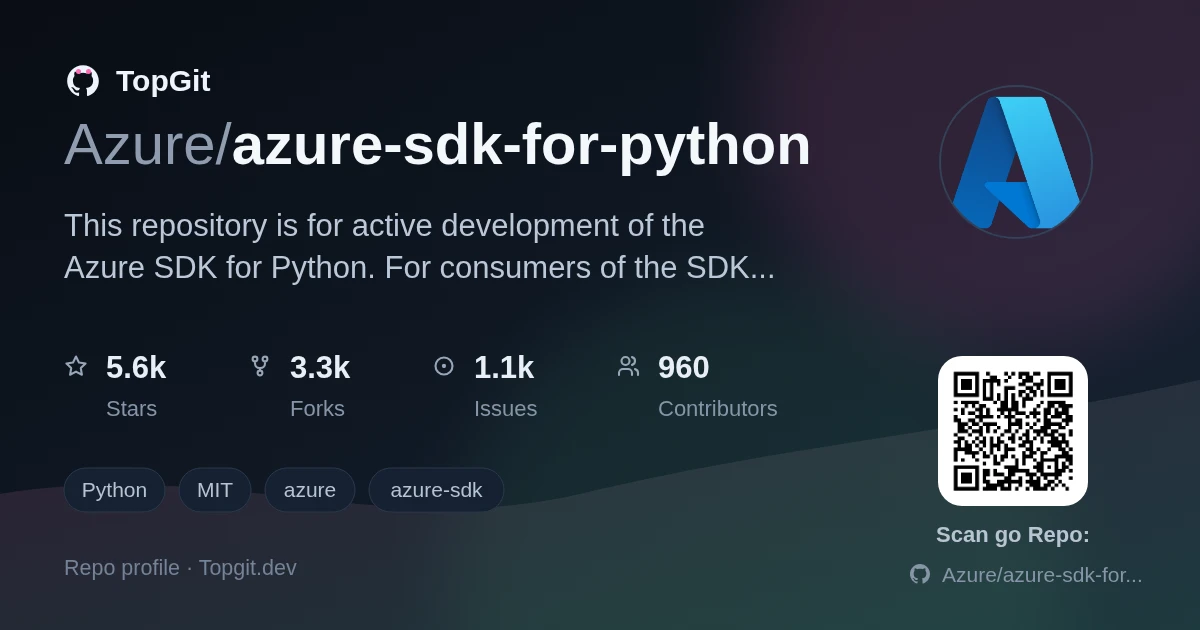
Azure/azure-sdk-for-python sits at 5.6k stars on GitHub, written primarily in Python. This repository is for active development of the Azure SDK for Python. For consumers of the SDK we recommend visiting our public developer docs at https://learn.microsoft.com/python/azure/ or our versioned developer docs at https://azure.github.io/azure-sdk-for-python.
Snapshot summary built from the project's own GitHub metadata — there's no written TopGit review yet. The page will update automatically when a full review is published.
WHY NO REVIEW YET
TopGit writes full reviews for the most-starred, most-requested repositories. This page is a snapshot until then — see the READ ME tab for the original README in full.
This repository is for the active development of the Azure SDK for Python. For consumers of the SDK we recommend visiting our public developer docs or our versioned developer docs.
Getting started
For your convenience, each service has a separate set of libraries that you can choose to use instead of one, large Azure package. To get started with a specific library, see the README.md (or README.rst) file located in the library's project folder.
You can find service libraries in the /sdk directory.
Prerequisites
The client libraries support multiple versions of Python. For more details, please see the Azure SDK for Python version support policy.
Packages available
Each service might have a number of libraries available from each of the following categories:
Client - New Releases
Client - Previous Versions
Management - New Releases
Management - Previous Versions
Client: New Releases
New wave of packages that we are announcing as GA and several that are currently releasing in preview. These libraries allow you to use and consume existing resources and interact with them, for example: upload a blob. These libraries share several core functionalities such as: retries, logging, transport protocols, authentication protocols, etc. that can be found in the azure-core library. You can learn more about these libraries by reading guidelines that they follow here.
You can find the most up to date list of all of the new packages on our page
NOTE: If you need to ensure your code is ready for production use one of the stable, non-preview libraries.
Client: Previous Versions
Last stable versions of packages that have been provided for usage with Azure and are production-ready. These libraries provide you with similar functionalities to the Preview ones as they allow you to use and consume existing resources and interact with them, for example: upload a blob. They might not implement the guidelines or have the same feature set as the November releases. They do however offer wider coverage of services.
Management: New Releases
A new set of management libraries that follow the Azure SDK Design Guidelines for Python are now available. These new libraries provide a number of core capabilities that are shared amongst all Azure SDKs, including the intuitive Azure Identity library, an HTTP Pipeline with custom policies, error-handling, distributed tracing, and much more.
Documentation and code samples for these new libraries can be found here. In addition, a migration guide that shows how to transition from older versions of libraries is located here.
You can find the most up to date list of all of the new packages on our page
NOTE: If you need to ensure your code is ready for production use one of the stable, non-preview libraries. Also, if you are experiencing authentication issues with the management libraries after upgrading certain packages, it's possible that you upgraded to the new versions of SDK without changing the authentication code, please refer to the migration guide mentioned above for proper instructions.
Management: Previous Versions
For a complete list of management libraries that enable you to provision and manage Azure resources, please check here. They might not have the same feature set as the new releases but they do offer wider coverage of services.
Management libraries can be identified by namespaces that start with azure-mgmt-, e.g. azure-mgmt-compute
Need help?
For detailed documentation visit our Azure SDK for Python documentation
File an issue via GitHub Issues
Check previous questions or ask new ones on StackOverflow using azure and python tags.
Data Collection
The software may collect information about you and your use of the software and send it to Microsoft. Microsoft may use this information to provide services and improve our products and services. You may turn off the telemetry as described below. You can learn more about data collection and use in the help documentation and Microsoft’s privacy statement. For more information on the data collected by the Azure SDK, please visit the Telemetry Guidelines page.
Telemetry Configuration
Telemetry collection is on by default.
To opt out, you can disable telemetry at client construction. Define a NoUserAgentPolicy class that is a subclass of UserAgentPolicy with an on_request method that does nothing. Then pass instance of this class as kwargs user_agent_policy=NoUserAgentPolicy() during client creation. This will disable telemetry for all methods in the client. Do this for every new client.
The example below uses the azure-storage-blob package. In your code, you can replace azure-storage-blob with the package you are using.
import os
from azure.identity import ManagedIdentityCredential
from azure.storage.blob import BlobServiceClient
from azure.core.pipeline.policies import UserAgentPolicy


# Create your credential you want to use
mi_credential = ManagedIdentityCredential()

account_url = "https://<storageaccountname>.blob.core.windows.net"

# Set up user-agent override
class NoUserAgentPolicy(UserAgentPolicy):
    def on_request(self, request):
        pass

# Create the BlobServiceClient object
blob_service_client = BlobServiceClient(account_url, credential=mi_credential, user_agent_policy=NoUserAgentPolicy())

container_client = blob_service_client.get_container_client(container=<container_name>)
# TODO: do something with the container client like download blob to a file
Reporting security issues and security bugs
Security issues and bugs should be reported privately, via email, to the Microsoft Security Response Center (MSRC) [email protected]. You should receive a response within 24 hours. If for some reason you do not, please follow up via email to ensure we received your original message. Further information, including the MSRC PGP key, can be found in the Security TechCenter.
Contributing
For details on contributing to this repository, see the contributing guide.
This project welcomes contributions and suggestions. Most contributions require you to agree to a Contributor License Agreement (CLA) declaring that you have the right to, and actually do, grant us the rights to use your contribution. For details, visit
https://cla.microsoft.com.
When you submit a pull request, a CLA-bot will automatically determine whether you need to provide a CLA and decorate the PR appropriately (e.g., label, comment). Simply follow the instructions provided by the bot. You will only need to do this once across all repositories using our CLA.
This project has adopted the Microsoft Open Source Code of Conduct.
For more information see the Code of Conduct FAQ
or contact [email protected] with any additional questions or comments.
Does Azure/azure-sdk-for-python have a project website?
No homepage URL was recorded for Azure/azure-sdk-for-python in TopGit's last sync. The README tab above frequently contains screenshots and demo links, or check the repository description on GitHub.
How active is development on Azure/azure-sdk-for-python?
The most recent commit recorded on Azure/azure-sdk-for-python was 3 months ago, based on the GitHub push timestamp. The repository has 3.4k forks — one of the better signals of community interest.
How many stars does Azure/azure-sdk-for-python have?
Azure/azure-sdk-for-python has 5.6k GitHub stars — refresh the page for the live number, or check github.com/Azure/azure-sdk-for-python. TopGit mirrors GitHub's count but does not claim minute-by-minute accuracy.
Is Azure/azure-sdk-for-python open source?
Yes — Azure/azure-sdk-for-python ships under the MIT license, which makes its source code freely readable (and, depending on license terms, forkable and reusable). Source: github.com/Azure/azure-sdk-for-python.
What else is in the Backend space?
Azure/azure-sdk-for-python is tracked by TopGit under the Backend category, alongside 4 GitHub-tagged topics. Trending and Topics pages list peer repositories of comparable stars and language.
What topics is Azure/azure-sdk-for-python associated with?
GitHub's repository topics for Azure/azure-sdk-for-python: "azure", "azure-sdk", "hacktoberfest", "python". TopGit's editorial category is Backend.
Where do I read more about Azure/azure-sdk-for-python?
This TopGit page is a snapshot — the READ ME tab shows the project's own README content (links stripped, images preserved). The GitHub repository at github.com/Azure/azure-sdk-for-python is the definitive source.
Read full README in the tab above.
Is azure-sdk-for-python worth your time?
ChatGPT, Claude and Perplexity can all read this page. Ask one of them what it makes of azure-sdk-for-python.

 /azure-sdk-for-python