Indexed by TopGit from live GitHub metadata: BishopFox/h2csmuggler has 823 stars, written primarily in Python. HTTP Request Smuggling over HTTP/2 Cleartext (h2c)
Snapshot summary built from the project's own GitHub metadata — there's no written TopGit review yet. The page will update automatically when a full review is published.
WHY NO REVIEW YET
TopGit writes full reviews for the most-starred, most-requested repositories. This page is a snapshot until then — see the READ ME tab for the original README in full.
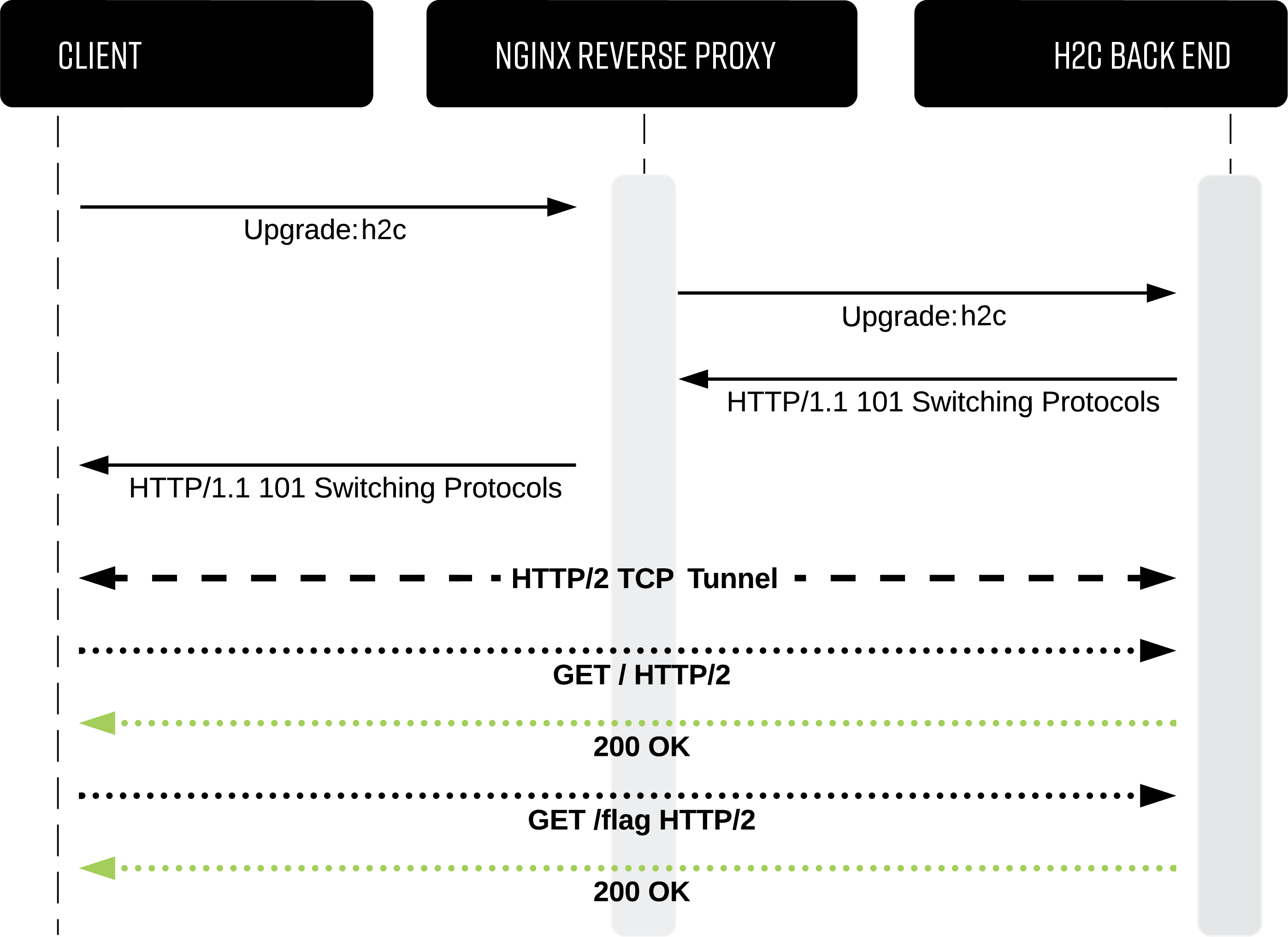
h2cSmuggler smuggles HTTP traffic past insecure edge-server proxy_pass configurations by establishing HTTP/2 cleartext (h2c) communications with h2c-compatible back-end servers, allowing a bypass of proxy rules and access controls.
Any proxy endpoint that forwards h2c upgrade headers can be affected. Because h2c is intended to be performed only on cleartext channels, detection on HTTPS services often yields true positives.
By contrast, HTTP services may result in false positives. For example, h2c-enabled proxies may respond to the upgrade instead of forwarding it to an h2c back end.
Use the --scan-list option to test one or more web servers to look for affected proxy_pass endpoints. Consider using a list of directories discovered from directory enumeration, such as:
urls.txt
https://www.example.com/
https://www.example.com/api/
https://www.example.com/auth/
https://www.example.com/admin/
https://www.example.com/payments/
...omitted for brevity...
Run h2cSmuggler with the list of endpoints and a total number of threads:
Nuclei-Template (Coming soon! Requires this issue to be fixed)
Exploitation
Once you have identified an affected endpoint that can be used for tunneling, you can now access or brute-force internal endpoints on the back-end server and provide custom verbs or headers. In the demo below, we demonstrate accessing an internal /flag endpoint by using h2c smuggling to bypass proxy deny rules.
To remediate, do not forward user-supplied values for Upgrade or Connection headers. See the technical post for additional guidance.
Install Instructions
The only dependency is the Python hyper-h2 library:
pip3 install h2
Test Environment and Demo
The test environment will allow you to experiment with h2cSmuggler in a controlled environment. docker-compose will simulate three chains of proxies that lead to an h2c-enabled Golang back end:
[1] Generate Certificates and spin up the environment with docker-compose:
# Generate certs
./configs/generate-certificates.sh

# Activate services
docker-compose up
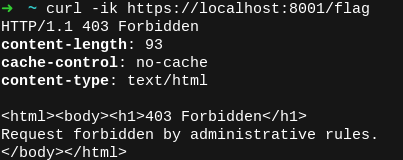
All of the proxies deny access to the /flag endpoint accessible on the h2c back end. Let's attempt to access the forbidden endpoint via the HAProxy server running on port 8001:
We can use h2cSmuggler to confirm the proxy's insecure configuration using --test (or -t):
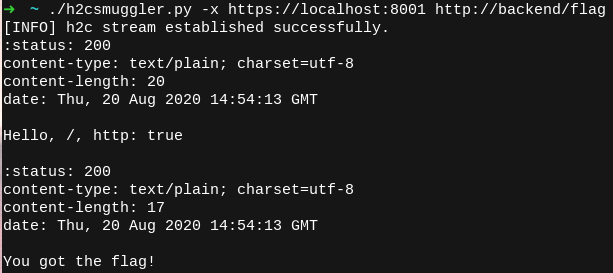
Now, let's use h2cSmuggler to perform an h2c upgrade, tunnel our HTTP/2 traffic through the proxy, and request the /flag endpoint from the back end, bypassing the proxy's access control:
For a deeper explanation of what is happening, check out the technical writeup.
Usage
h2cSmuggler uses a familiar curl-like syntax for describing the smuggled request:
usage: h2csmuggler.py [-h] [--scan-list SCAN_LIST] [--threads THREADS] [--upgrade-only] [-x PROXY] [-i WORDLIST] [-X REQUEST] [-d DATA] [-H HEADER] [-m MAX_TIME] [-t] [-v]
                      [url]

Detect and exploit insecure forwarding of h2c upgrades.

positional arguments:
  url

optional arguments:
  -h, --help            show this help message and exit
  --scan-list SCAN_LIST
                        list of URLs for scanning
  --threads THREADS     # of threads (for use with --scan-list)
  --upgrade-only        drop HTTP2-Settings from outgoing Connection header
  -x PROXY, --proxy PROXY
                        proxy server to try to bypass
  -i WORDLIST, --wordlist WORDLIST
                        list of paths to bruteforce
  -X REQUEST, --request REQUEST
                        smuggled verb
  -d DATA, --data DATA  smuggled data
  -H HEADER, --header HEADER
                        smuggled headers
  -m MAX_TIME, --max-time MAX_TIME
                        socket timeout in seconds (type: float; default 10)
  -t, --test            test a single proxy server
  -v, --verbose
Examples
1. Scanning a list of URLs (e.g., https://example.com:443/api/, https://example.com:443/payments, https://sub.example.com:443/) to identify proxy_pass endpoints that are susceptible to smuggling (be careful with thread counts when testing a single server):
./h2csmuggler.py --scan-list urls.txt --threads 5
Or, to redirect output to a file. Use stderr (2>) and stdout (1>). The stderr stream contains errors (e.g., SSL handshake/timeout issues), while stdout contains results.
Q: Why are there multiple responses from the server?
A: The first response is the data response to the original upgrade request initiated in HTTP/1.1, per the h2c upgrade protocol. The following responses are from the smuggled request.
Q: I received a "101 Switching Protocols" but I'm not receiving any data from the remote server.
A: I observed this behavior in my tests and found that some servers respond with a 101 status even if they do not actually support HTTP/2.
Q: Is establishing an h2c tunnel always a vulnerability?
A: No. Consider a TLS-terminating TCP load balancer (e.g., ELB) proxying directly to an h2c-compatible back end. Although you may be able to establish an h2c connection, if there are no access controls being enforced, then there are no access controls to bypass, or privilege gained by initiating this tunnel.
Q: Why does the smuggled request URI require a scheme? What is it used for?
A: The HTTP/2 protocol requires a :scheme psuedo-header. For our use case, http vs. https likely doesn't matter. For more details, see HTTP/2 RFC: Section 8.1.2.3.
Q: What should I use as the hostname for the back-end server?
A: It's best to start with the same hostname as the edge server. Next, try experimenting with alternative hostname values.
Does BishopFox/h2csmuggler have a project website?
No homepage URL was recorded for BishopFox/h2csmuggler in TopGit's last sync. The README tab above frequently contains screenshots and demo links, or check the repository description on GitHub.
How does BishopFox/h2csmuggler compare to other Security projects?
BishopFox/h2csmuggler is tracked by TopGit in the Security category, with 823 GitHub stars and written in Python. Browse the Security topic page on TopGit to compare it against similar projects by stars and activity.
How many stars does BishopFox/h2csmuggler have?
BishopFox/h2csmuggler has 823 GitHub stars — refresh the page for the live number, or check github.com/BishopFox/h2csmuggler. TopGit mirrors GitHub's count but does not claim minute-by-minute accuracy.
Is BishopFox/h2csmuggler open source?
Yes — BishopFox/h2csmuggler ships under the MIT license, which makes its source code freely readable (and, depending on license terms, forkable and reusable). Source: github.com/BishopFox/h2csmuggler.
What else is in the Security space?
BishopFox/h2csmuggler is tracked by TopGit under the Security category, alongside 4 GitHub-tagged topics. Trending and Topics pages list peer repositories of comparable stars and language.
What is BishopFox/h2csmuggler?
BishopFox/h2csmuggler (BishopFox/h2csmuggler) is a Python project on GitHub. From the project's own README: HTTP Request Smuggling over HTTP/2 Cleartext (h2c)
Where do I read more about BishopFox/h2csmuggler?
This TopGit page is a snapshot — the READ ME tab shows the project's own README content (links stripped, images preserved). The GitHub repository at github.com/BishopFox/h2csmuggler is the definitive source.
Read full README in the tab above.
Still deciding about h2csmuggler?
One click hands the question to an AI along with this page — see what it says about h2csmuggler.

 /h2csmuggler