4.4k GitHub stars and counting — cilium/hubble is a Makefile project TopGit is tracking across repositories on the platform. Hubble - Network, Service & Security Observability for Kubernetes using eBPF
Snapshot summary built from the project's own GitHub metadata — there's no written TopGit review yet. The page will update automatically when a full review is published.
WHY NO REVIEW YET
TopGit writes full reviews for the most-starred, most-requested repositories. This page is a snapshot until then — see the READ ME tab for the original README in full.
Network, Service & Security Observability for Kubernetes
What is Hubble?
Getting Started
Features
Service Dependency Graph
Metrics & Monitoring
Flow Visibility
Get in touch / Community
Authors
What is Hubble?
Hubble is a fully distributed networking and security observability platform
for cloud native workloads. It is built on top of Cilium and eBPF to enable
deep visibility into the communication and behavior of services as well as the
networking infrastructure in a completely transparent manner.
Hubble can answer questions such as:
Service dependencies & communication map:
What services are communicating with each other? How frequently? What does
the service dependency graph look like?
What HTTP calls are being made? What Kafka topics does a service consume
from or produce to?
Operational monitoring & alerting:
Is any network communication failing? Why is communication failing? Is it
DNS? Is it an application or network problem? Is the communication broken on
layer 4 (TCP) or layer 7 (HTTP)?
Which services have experienced a DNS resolution problems in the last 5
minutes? Which services have experienced an interrupted TCP connection
recently or have seen connections timing out? What is the rate of unanswered
TCP SYN requests?
Application monitoring:
What is the rate of 5xx or 4xx HTTP response codes for a particular service
or across all clusters?
What is the 95th and 99th percentile latency between HTTP requests and
responses in my cluster? Which services are performing the worst? What is
the latency between two services?
Security observability:
Which services had connections blocked due to network policy? What services
have been accessed from outside the cluster? Which services have resolved a
particular DNS name?
Why Hubble?
The Linux kernel technology eBPF is enabling visibility into systems and
applications at a granularity and efficiency that was not possible before. It
does so in a completely transparent way, without requiring the application to
change or for the application to hide information. By building on top of
Cilium, Hubble can leverage eBPF for visibility. By leveraging eBPF, all
visibility is programmable and allows for a dynamic approach that minimizes
overhead while providing deep and detailed insight where required. Hubble has
been created and specifically designed to make best use of these new eBPF
powers.
Releases
The Hubble CLI is backward compatible with all supported Cilium releases. For
this reason, only the latest Hubble CLI version is maintained.
Version
Release Date
Maintained
Supported Cilium Version
Artifacts
v1.20
2026-10-01 (v1.20.2)
Yes
Cilium 1.20 and older
GitHub Release
Component Stability
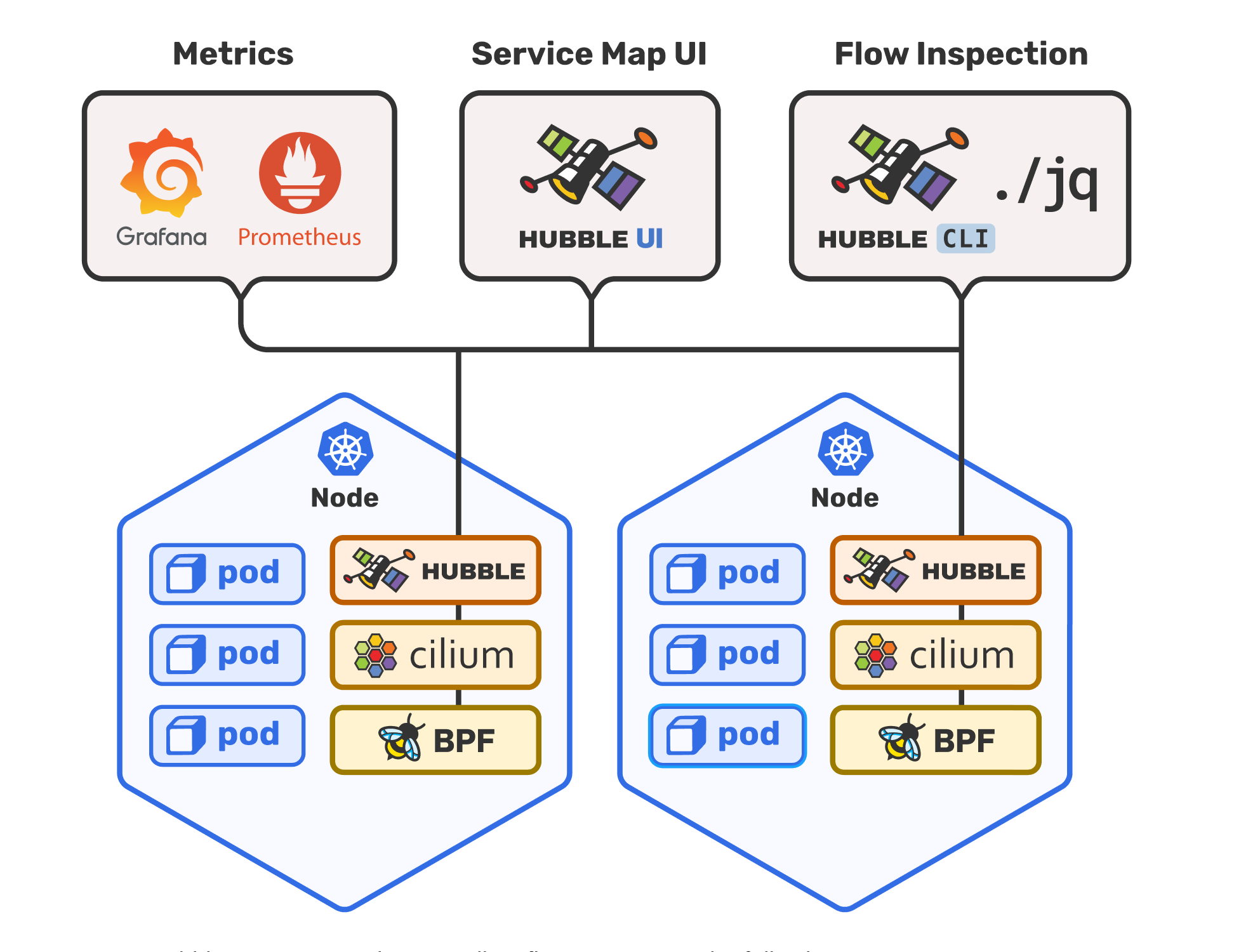
Hubble project consists of several components (see Architecture section).
While the core Hubble components have been running in production in multiple
environments, new components continue to emerge as the project grows and
expands in scope.
Some components, due to their relatively young age, are still considered beta
and have to be used with caution in critical production workloads.
Component
Area
State
Hubble CLI
Core
Stable
Hubble Server
Core
Stable
Hubble Metrics
Core
Stable
Hubble Relay
Multinode
Stable
Hubble UI
UI
Beta
Architecture
Getting Started
Introduction to Cilium & Hubble
Networking and Security Observability with Hubble
Features
Service Dependency Graph
Troubleshooting microservices application connectivity is a challenging task.
Simply looking at "kubectl get pods" does not indicate dependencies between
each service or external APIs or databases.
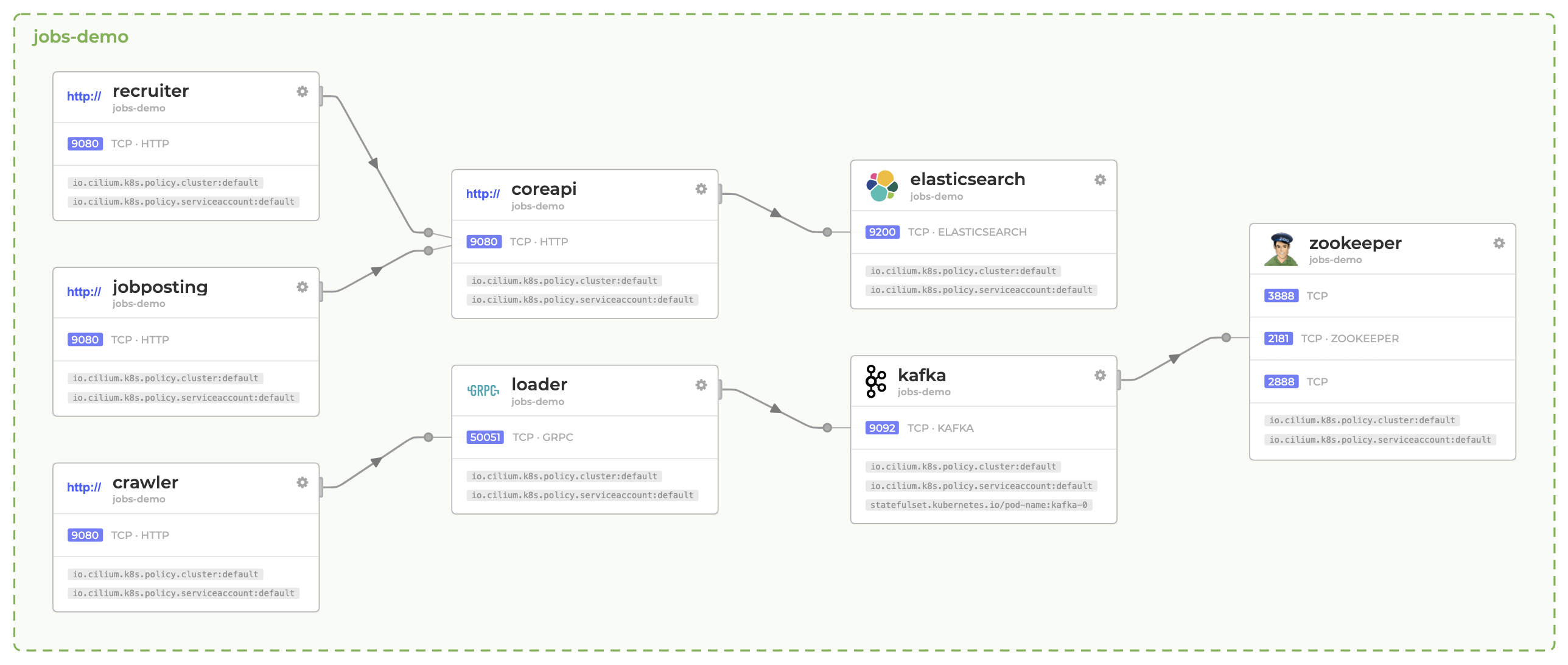
Hubble enables zero-effort automatic discovery of the service dependency graph
for Kubernetes Clusters at L3/L4 and even L7, allowing user-friendly
visualization and filtering of those dataflows as a Service Map.
See Hubble Service Map Tutorial
for more examples.
Metrics & Monitoring
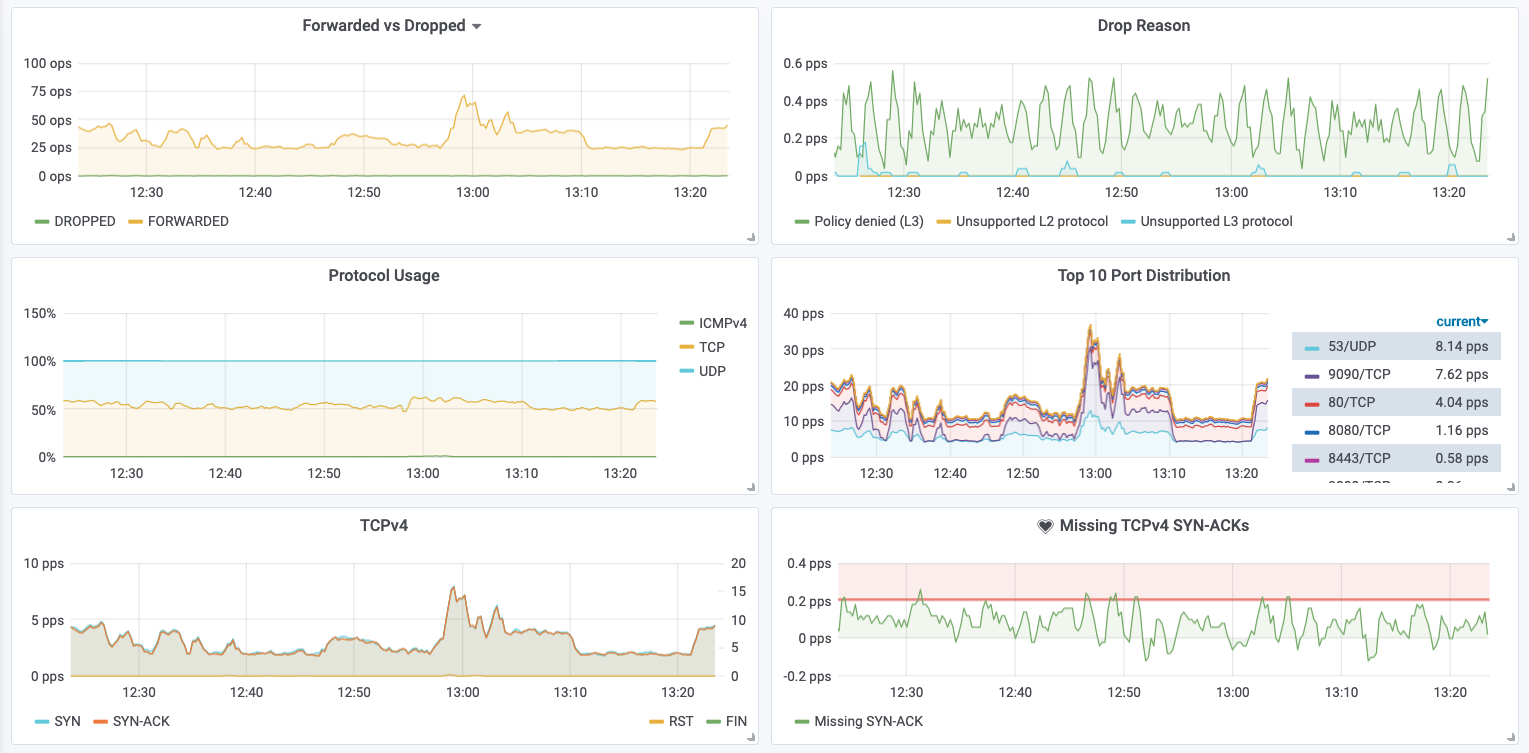
The metrics and monitoring functionality provides an overview of the state of
systems and allow to recognize patterns indicating failure and other scenarios
that require action. The following is a short list of example metrics, for a
more detailed list of examples, see the
Metrics Documentation.
Networking Behavior
Network Policy Observation
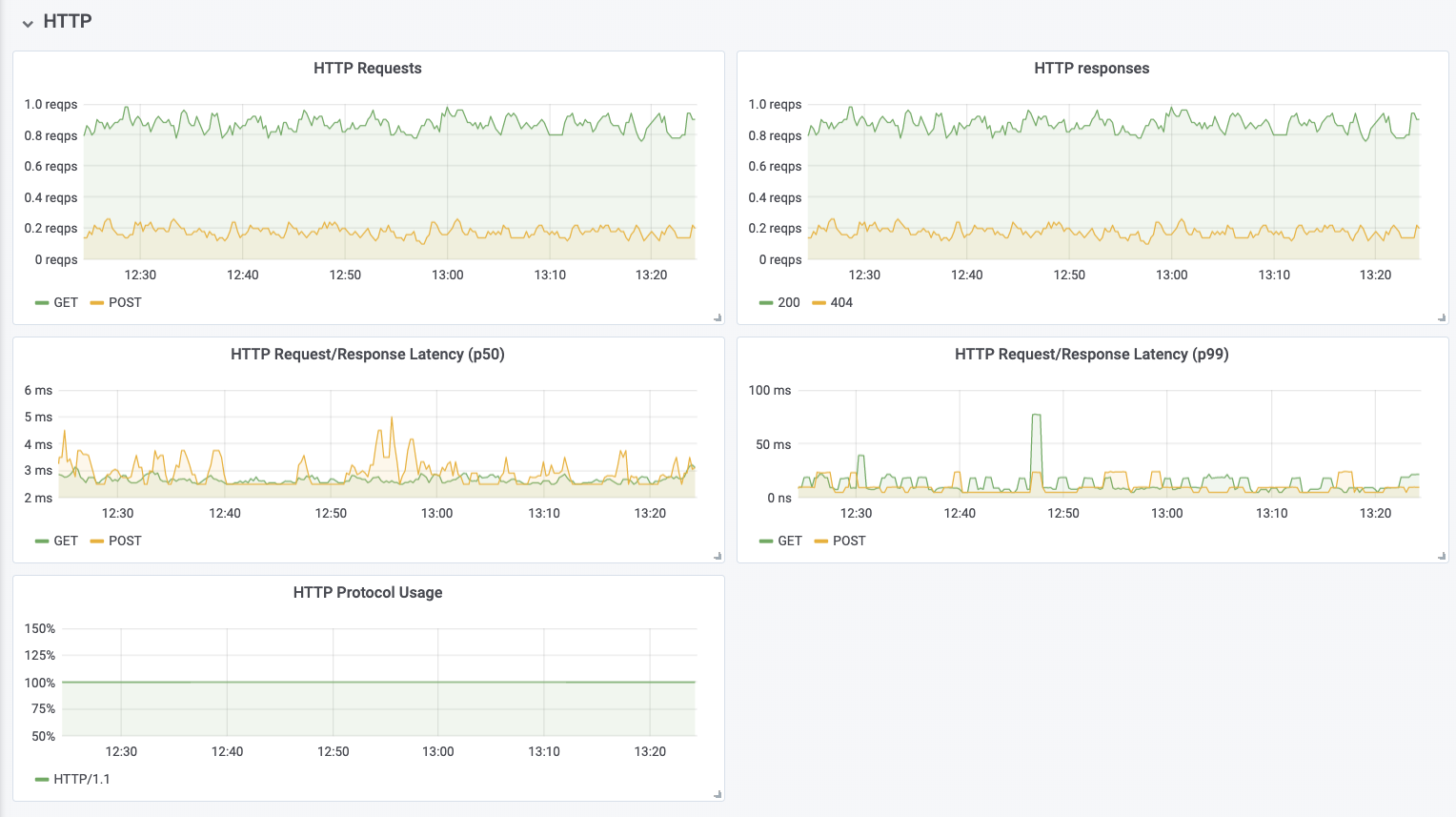
HTTP Request/Response Rate & Latency
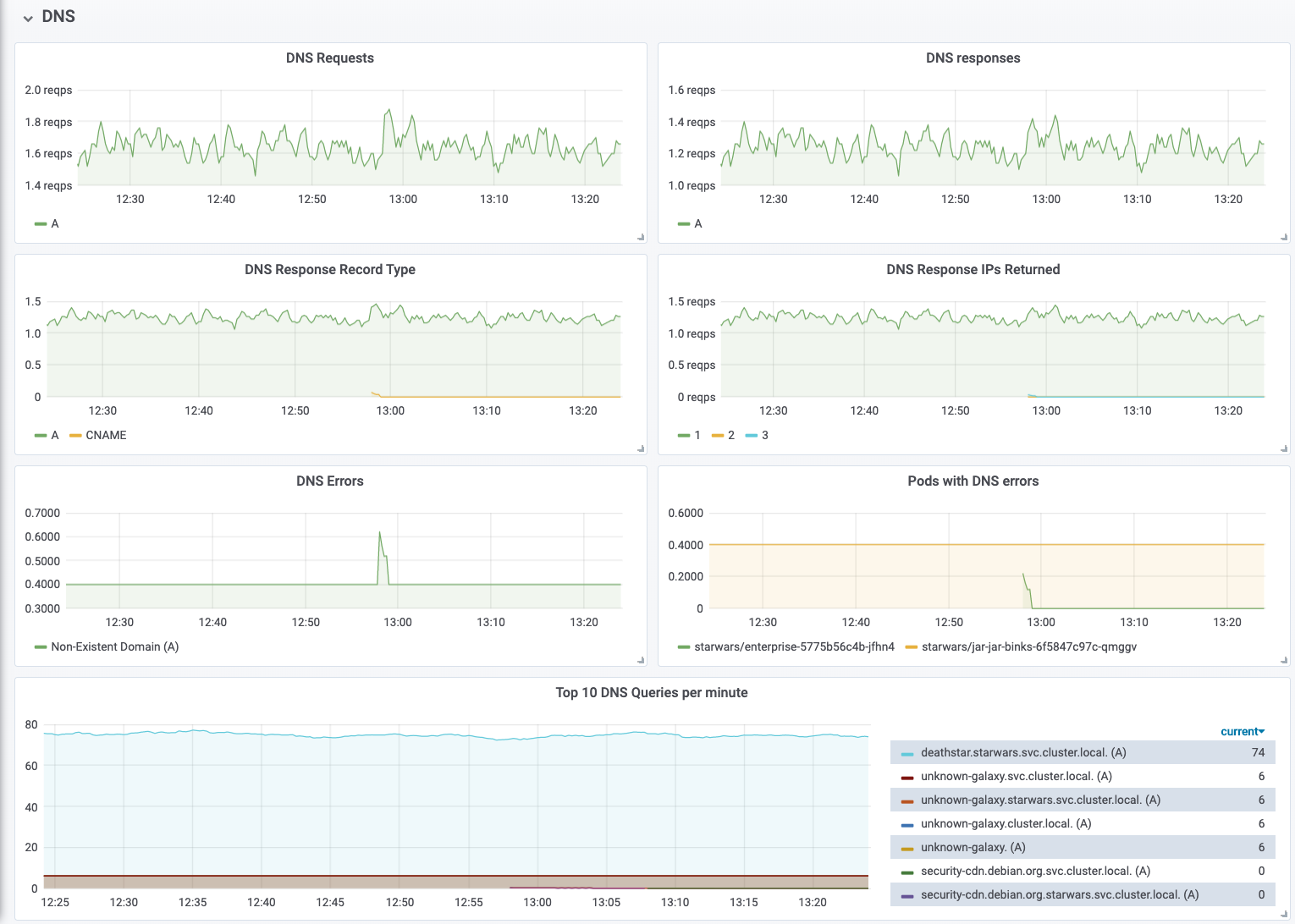
DNS Request/Response Monitoring
Flow Visibility
Flow visibility provides visibility into flow information on the network and
application protocol level. This enables visibility into individual TCP
connections, DNS queries, HTTP requests, Kafka communication, and much more.
DNS Resolution
Identifying pods which have received DNS response indicating failure:
starwars/x-wing-bd86d75c5-njv8k            kube-system/coredns-5c98db65d4-twwdg      DNS Query deathstar.starwars.svc.cluster.local. A
kube-system/coredns-5c98db65d4-twwdg       starwars/x-wing-bd86d75c5-njv8k           DNS Answer "10.110.126.213" TTL: 3 (Query deathstar.starwars.svc.cluster.local. A)
Non-existent domain:
starwars/jar-jar-binks-789c4b695d-ltrzm    kube-system/coredns-5c98db65d4-f4m8n      DNS Query unknown-galaxy.svc.cluster.local. A
starwars/jar-jar-binks-789c4b695d-ltrzm    kube-system/coredns-5c98db65d4-f4m8n      DNS Query unknown-galaxy.svc.cluster.local. AAAA
kube-system/coredns-5c98db65d4-twwdg       starwars/jar-jar-binks-789c4b695d-ltrzm   DNS Answer RCode: Non-Existent Domain TTL: 4294967295 (Query unknown-galaxy.starwars.svc.cluster.local. A)
kube-system/coredns-5c98db65d4-twwdg       starwars/jar-jar-binks-789c4b695d-ltrzm   DNS Answer RCode: Non-Existent Domain TTL: 4294967295 (Query unknown-galaxy.starwars.svc.cluster.local. AAAA)
HTTP Protocol
Successful request & response with latency information:
starwars/x-wing-bd86d75c5-njv8k:53410      starwars/deathstar-695d8f7ddc-lvj84:80    TCP Flags: SYN
deathstar.starwars.svc.cluster.local:80    starwars/x-wing-bd86d75c5-njv8k:53410     TCP Flags: SYN, ACK
starwars/x-wing-bd86d75c5-njv8k:53410      starwars/deathstar-695d8f7ddc-lvj84:80    TCP Flags: ACK, FIN
deathstar.starwars.svc.cluster.local:80    starwars/x-wing-bd86d75c5-njv8k:53410     TCP Flags: ACK, FIN
Connection timeout:
starwars/r2d2-6694d57947-xwhtz:60948   deathstar.starwars.svc.cluster.local:8080     TCP Flags: SYN
starwars/r2d2-6694d57947-xwhtz:60948   deathstar.starwars.svc.cluster.local:8080     TCP Flags: SYN
starwars/r2d2-6694d57947-xwhtz:60948   deathstar.starwars.svc.cluster.local:8080     TCP Flags: SYN
Network Policy Behavior
Denied connection attempt:
starwars/enterprise-5775b56c4b-thtwl:37800   starwars/deathstar-695d8f7ddc-lvj84:80(http)   Policy denied (L3)   TCP Flags: SYN
starwars/enterprise-5775b56c4b-thtwl:37800   starwars/deathstar-695d8f7ddc-lvj84:80(http)   Policy denied (L3)   TCP Flags: SYN
starwars/enterprise-5775b56c4b-thtwl:37800   starwars/deathstar-695d8f7ddc-lvj84:80(http)   Policy denied (L3)   TCP Flags: SYN
Specifying Raw Flow Filters
Hubble supports extensive set of filtering options that can be specified as a combination of
allowlist and denylist. Hubble applies these filters as follows:
for each flow:
  if flow does not match any of the allowlist filters:
    continue
  if flow matches any of the denylist filters:
    continue
  send flow to client
You can pass these filters to hubble observe command as
JSON-encoded
FlowFilters. For
example, to observe flows that match the following conditions:
Either the source or destination identity contains k8s:io.kubernetes.pod.namespace=kube-system
or reserved:host label, AND
Neither the source nor destination identity contains k8s:k8s-app=kube-dns label:
Note that --allowlist and --denylist filters get included in the request in addition to
regular flow filters like --label or --namespace. Use --print-raw-filters flag to verify
the exact filters that the Hubble CLI generates. For example:
Join the Cilium Slack #hubble channel to chat
with Cilium Hubble developers and other Cilium / Hubble users. This is a good
place to learn about Hubble and Cilium, ask questions, and share your
experiences.
Learn more about Cilium.
Authors
Hubble is an open source project licensed under the Apache License. Everybody
is welcome to contribute. The project is following the Governance Rules of
the Cilium project. See CONTRIBUTING for instructions on how to contribute
and details of the Code of Conduct.
How does cilium/hubble compare to other Developer Tools projects?
cilium/hubble is tracked by TopGit in the Developer Tools category, with 4.4k GitHub stars and written in Makefile. Browse the Developer Tools topic page on TopGit to compare it against similar projects by stars and activity.
Is cilium/hubble open source?
Yes — cilium/hubble ships under the Apache-2.0 license, which makes its source code freely readable (and, depending on license terms, forkable and reusable). Source: github.com/cilium/hubble.
What else is in the Developer Tools space?
cilium/hubble is tracked by TopGit under the Developer Tools category, alongside 8 GitHub-tagged topics. Trending and Topics pages list peer repositories of comparable stars and language.
What is cilium/hubble?
cilium/hubble (cilium/hubble) is a Makefile project on GitHub. From the project's own README: Hubble - Network, Service & Security Observability for Kubernetes using eBPF
Where do I read more about cilium/hubble?
This TopGit page is a snapshot — the READ ME tab shows the project's own README content (links stripped, images preserved). The GitHub repository at github.com/cilium/hubble is the definitive source.
Why is cilium/hubble categorized under Developer Tools?
TopGit places cilium/hubble in the Developer Tools category based on its GitHub topics and description (tagged: "cilium", "ebpf", "kubernetes"). Categories are assigned from real repository metadata, not editorial guesswork.
Read full README in the tab above.
Want a second opinion on hubble?
Ask an AI that can read this page — one click and you get its take on hubble.
 /hubble