On GitHub, containerd/containerd has picked up 21.1k stars, Developer Tools, Go. An open and reliable container runtime
Snapshot summary built from the project's own GitHub metadata — there's no written TopGit review yet. The page will update automatically when a full review is published.
WHY NO REVIEW YET
TopGit writes full reviews for the most-starred, most-requested repositories. This page is a snapshot until then — see the READ ME tab for the original README in full.
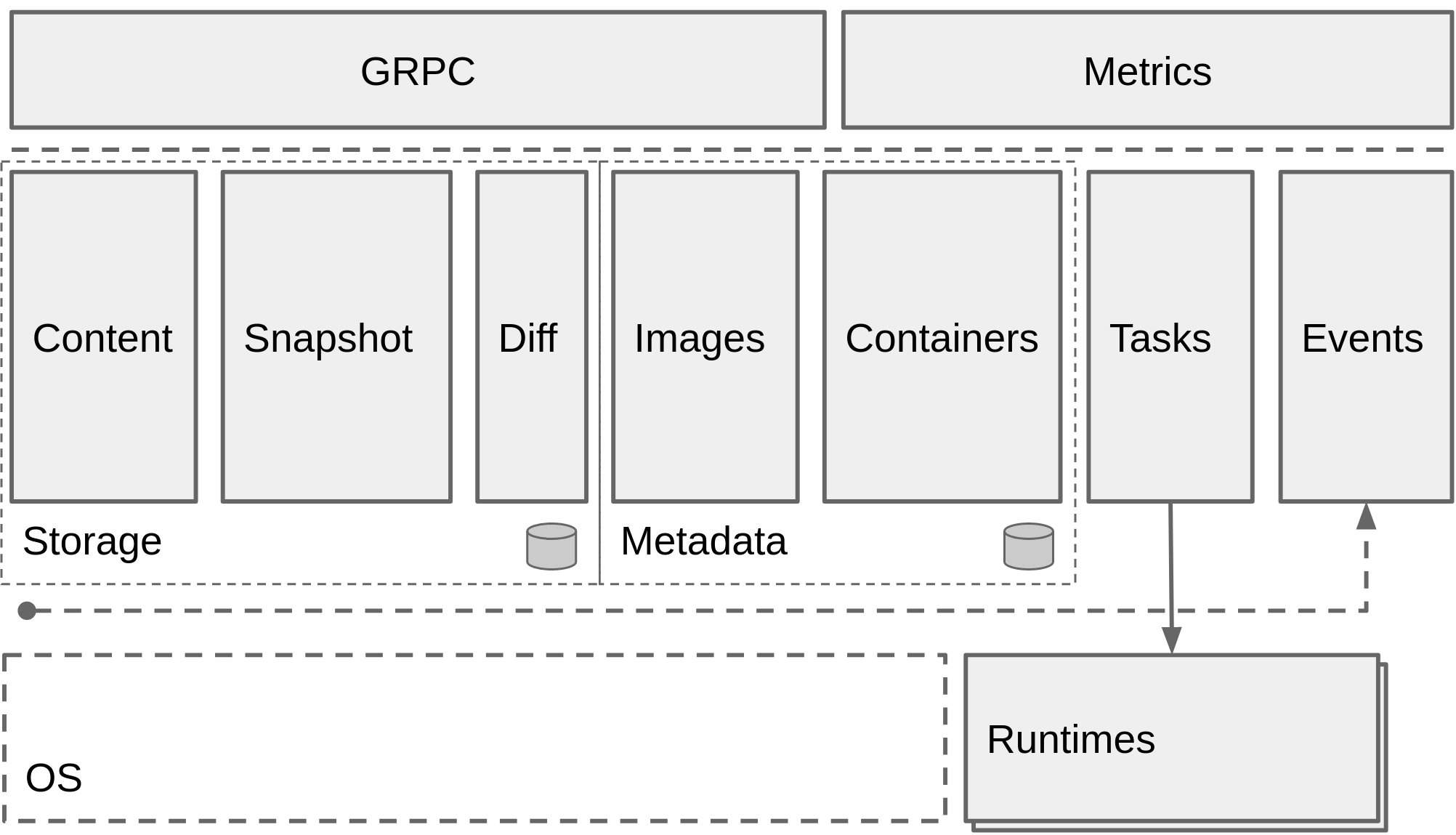
containerd is an industry-standard container runtime with an emphasis on simplicity, robustness, and portability. It is available as a daemon for Linux and Windows, which can manage the complete container lifecycle of its host system: image transfer and storage, container execution and supervision, low-level storage and network attachments, etc.
containerd is a member of CNCF with 'graduated' status.
containerd is designed to be embedded into a larger system, rather than being used directly by developers or end-users.
Announcements
Now Recruiting
We are a large inclusive OSS project that is welcoming help of any kind shape or form:
Documentation help is needed to make the product easier to consume and extend.
We need OSS community outreach/organizing help to get the word out; manage
and create messaging and educational content; and help with social media, community forums/groups, and google groups.
We are actively inviting new security advisors to join the team.
New subprojects are being created, core and non-core that could use additional development help.
Each of the containerd projects has a list of issues currently being worked on or that need help resolving.
If the issue has not already been assigned to someone or has not made recent progress, and you are interested, please inquire.
If you are interested in starting with a smaller/beginner-level issue, look for issues with an exp/beginner tag, for example containerd/containerd beginner issues.
Getting Started
See our documentation on containerd.io:
for ops and admins
namespaces
client options
To get started contributing to containerd, see CONTRIBUTING.
If you are interested in trying out containerd see our example at Getting Started.
Nightly builds
There are nightly builds available for download here.
Binaries are generated from main branch every night for Linux and Windows.
Please be aware: nightly builds might have critical bugs, it's not recommended for use in production and no support provided.
Kubernetes (k8s) CI Dashboard Group
The k8s CI dashboard group for containerd contains test results regarding
the health of kubernetes when run against main and a number of containerd release branches.
containerd-periodics
Runtime Requirements
Runtime requirements for containerd are very minimal. Most interactions with
the Linux and Windows container feature sets are handled via runc and/or
OS-specific libraries (e.g. hcsshim for Microsoft).
The current required version of runc is described in RUNC.md.
There are specific features
used by containerd core code and snapshotters that will require a minimum kernel
version on Linux. With the understood caveat of distro kernel versioning, a
reasonable starting point for Linux is a minimum 4.x kernel version.
The overlay filesystem snapshotter, used by default, uses features that were
finalized in the 4.x kernel series. If you choose to use btrfs, there may
be more flexibility in kernel version (minimum recommended is 3.18), but will
require the btrfs kernel module and btrfs tools to be installed on your Linux
distribution.
To use Linux checkpoint and restore features, you will need criu installed on
your system. See more details in Checkpoint and Restore.
Build requirements for developers are listed in BUILDING.
Supported Registries
Any registry which is compliant with the OCI Distribution Specification
is supported by containerd.
For configuring registries, see registry host configuration documentation
Features
For a detailed overview of containerd's core concepts and the features it supports,
please refer to the FEATURES.MD document.
Releases and API Stability
Please see RELEASES.md for details on versioning and stability
of containerd components.
Downloadable 64-bit Intel/AMD binaries of all official releases are available on
our releases page. Binaries
are published for additional platforms as well; see
Platform Support for the full list of platforms
and the level of support for each.
For other architectures and distribution support, you will find that many
Linux distributions package their own containerd and provide it across several
architectures, such as Canonical's Ubuntu packaging.
Enabling command auto-completion
Starting with containerd 1.4, the urfave client feature for auto-creation of bash and zsh
autocompletion data is enabled. To use the autocomplete feature in a bash shell for example, source
the autocomplete/ctr file in your .bashrc, or manually like:
$ source ./contrib/autocomplete/ctr
Distribution of ctr autocomplete for bash and zsh
For bash, copy the contrib/autocomplete/ctr script into
/etc/bash_completion.d/ and rename it to ctr. The zsh_autocomplete
file is also available and can be used similarly for zsh users.
Provide documentation to users to source this file into their shell if
you don't place the autocomplete file in a location where it is automatically
loaded for the user's shell environment.
CRI
cri is a containerd plugin implementation of the Kubernetes container runtime interface (CRI). With it, you are able to use containerd as the container runtime for a Kubernetes cluster.
CRI Status
cri is a native plugin of containerd. Since containerd 1.1, the cri plugin is built into the release binaries and enabled by default.
The cri plugin has reached GA status, representing that it is:
Feature complete
Works with Kubernetes 1.10 and above
Passes all CRI validation tests.
Passes all node e2e tests.
Passes all e2e tests.
See results on the containerd k8s test dashboard
Validating Your cri Setup
A Kubernetes incubator project, cri-tools, includes programs for exercising CRI implementations. More importantly, cri-tools includes the program critest which is used for running CRI Validation Testing.
CRI Guides
Installing with Ansible and Kubeadm
For Non-Ansible Users, Performing a Custom Installation Using the Release Tarball and Kubeadm
CRI Plugin Testing Guide
Debugging Pods, Containers, and Images with crictl
Configuring cri Plugins
Configuring containerd
Communication
For async communication and long-running discussions please use issues and pull requests on the GitHub repo.
This will be the best place to discuss design and implementation.
For sync communication catch us in the #containerd and #containerd-dev Slack channels on Cloud Native Computing Foundation's (CNCF) Slack - cloud-native.slack.com. Everyone is welcome to join and chat. Get Invite to CNCF Slack.
Join our next community meeting hosted on Zoom. The schedule is posted on the CNCF Calendar (search 'containerd' to filter).
Security audit
Security audits for the containerd project are hosted on our website. Please see the security page at containerd.io for more information.
Reporting security issues
Please follow the instructions at containerd/project
Licenses
The containerd codebase is released under the Apache 2.0 license.
The README.md file and files in the "docs" folder are licensed under the
Creative Commons Attribution 4.0 International License. You may obtain a
copy of the license, titled CC-BY-4.0, at http://creativecommons.org/licenses/by/4.0/.
Project details
containerd is the primary open source project within the broader containerd GitHub organization.
However, all projects within the repo have common maintainership, governance, and contributing
guidelines which are stored in a project repository commonly for all containerd projects.
Please find all these core project documents, including the:
Project governance,
Maintainers,
and Contributing guidelines
information in our containerd/project repository.
Adoption
Interested to see who is using containerd? Are you using containerd in a project?
Please add yourself via pull request to our ADOPTERS.md file.
How active is development on containerd/containerd?
The most recent commit recorded on containerd/containerd was 18 days ago, based on the GitHub push timestamp. The repository has 4.0k forks — one of the better signals of community interest.
How many stars does containerd/containerd have?
containerd/containerd has 21.1k GitHub stars — refresh the page for the live number, or check github.com/containerd/containerd. TopGit mirrors GitHub's count but does not claim minute-by-minute accuracy.
Is containerd/containerd open source?
Yes — containerd/containerd ships under the Apache-2.0 license, which makes its source code freely readable (and, depending on license terms, forkable and reusable). Source: github.com/containerd/containerd.
What else is in the Developer Tools space?
containerd/containerd is tracked by TopGit under the Developer Tools category, alongside 8 GitHub-tagged topics. Trending and Topics pages list peer repositories of comparable stars and language.
What is containerd/containerd?
containerd/containerd (containerd/containerd) is a Go project on GitHub. From the project's own README: An open and reliable container runtime
What language is containerd/containerd written in?
containerd/containerd is written primarily in Go. GitHub's language field is based on the largest share of bytes in the default branch.
What license does containerd/containerd use?
containerd/containerd is released under the Apache-2.0 license. Always verify the LICENSE file directly on GitHub for the authoritative terms — license strings can be edited out of sync with a project's actual stance.
Where do I read more about containerd/containerd?
This TopGit page is a snapshot — the READ ME tab shows the project's own README content (links stripped, images preserved). The GitHub repository at github.com/containerd/containerd is the definitive source.
Read full README in the tab above.
Curious whether containerd is right for you?
Let ChatGPT, Claude, or Perplexity look into it — click below and see what AI actually says about containerd.
 /containerd