5.1k GitHub stars and counting — CSAILVision/semantic-segmentation-pytorch is a Python project TopGit is tracking across repositories on the platform. Pytorch implementation for Semantic Segmentation/Scene Parsing on MIT ADE20K dataset
Snapshot summary built from the project's own GitHub metadata — there's no written TopGit review yet. The page will update automatically when a full review is published.
WHY NO REVIEW YET
TopGit writes full reviews for the most-starred, most-requested repositories. This page is a snapshot until then — see the READ ME tab for the original README in full.
Semantic Segmentation on MIT ADE20K dataset in PyTorch
This is a PyTorch implementation of semantic segmentation models on MIT ADE20K scene parsing dataset (http://sceneparsing.csail.mit.edu/).
ADE20K is the largest open source dataset for semantic segmentation and scene parsing, released by MIT Computer Vision team. Follow the link below to find the repository for our dataset and implementations on Caffe and Torch7:
https://github.com/CSAILVision/sceneparsing
If you simply want to play with our demo, please try this link: http://scenesegmentation.csail.mit.edu You can upload your own photo and parse it!
You can also use this colab notebook playground here to tinker with the code for segmenting an image.
All pretrained models can be found at:
http://sceneparsing.csail.mit.edu/model/pytorch
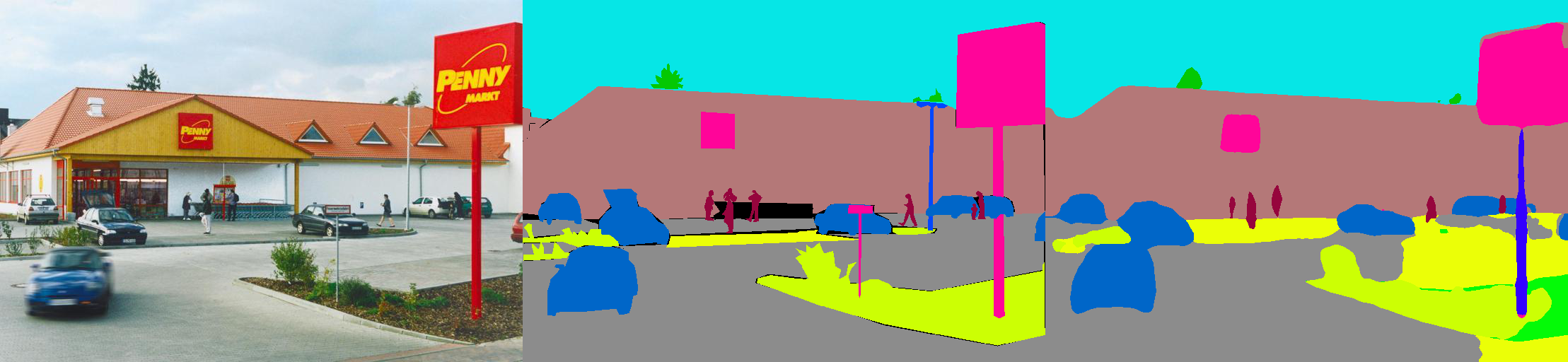
[From left to right: Test Image, Ground Truth, Predicted Result]
Color encoding of semantic categories can be found here:
https://docs.google.com/spreadsheets/d/1se8YEtb2detS7OuPE86fXGyD269pMycAWe2mtKUj2W8/edit?usp=sharing
Updates
HRNet model is now supported.
We use configuration files to store most options which were in argument parser. The definitions of options are detailed in config/defaults.py.
We conform to Pytorch practice in data preprocessing (RGB [0, 1], substract mean, divide std).
Highlights
Syncronized Batch Normalization on PyTorch
This module computes the mean and standard-deviation across all devices during training. We empirically find that a reasonable large batch size is important for segmentation. We thank Jiayuan Mao for his kind contributions, please refer to Synchronized-BatchNorm-PyTorch for details.
The implementation is easy to use as:
It is pure-python, no C++ extra extension libs.
It is completely compatible with PyTorch's implementation. Specifically, it uses unbiased variance to update the moving average, and use sqrt(max(var, eps)) instead of sqrt(var + eps).
It is efficient, only 20% to 30% slower than UnsyncBN.
Dynamic scales of input for training with multiple GPUs
For the task of semantic segmentation, it is good to keep aspect ratio of images during training. So we re-implement the DataParallel module, and make it support distributing data to multiple GPUs in python dict, so that each gpu can process images of different sizes. At the same time, the dataloader also operates differently.
Now the batch size of a dataloader always equals to the number of GPUs, each element will be sent to a GPU. It is also compatible with multi-processing. Note that the file index for the multi-processing dataloader is stored on the master process, which is in contradict to our goal that each worker maintains its own file list. So we use a trick that although the master process still gives dataloader an index for __getitem__ function, we just ignore such request and send a random batch dict. Also, the multiple workers forked by the dataloader all have the same seed, you will find that multiple workers will yield exactly the same data, if we use the above-mentioned trick directly. Therefore, we add one line of code which sets the defaut seed for numpy.random before activating multiple worker in dataloader.
State-of-the-Art models
PSPNet is scene parsing network that aggregates global representation with Pyramid Pooling Module (PPM). It is the winner model of ILSVRC'16 MIT Scene Parsing Challenge. Please refer to https://arxiv.org/abs/1612.01105 for details.
UPerNet is a model based on Feature Pyramid Network (FPN) and Pyramid Pooling Module (PPM). It doesn't need dilated convolution, an operator that is time-and-memory consuming. Without bells and whistles, it is comparable or even better compared with PSPNet, while requiring much shorter training time and less GPU memory. Please refer to https://arxiv.org/abs/1807.10221 for details.
HRNet is a recently proposed model that retains high resolution representations throughout the model, without the traditional bottleneck design. It achieves the SOTA performance on a series of pixel labeling tasks. Please refer to https://arxiv.org/abs/1904.04514 for details.
Supported models
We split our models into encoder and decoder, where encoders are usually modified directly from classification networks, and decoders consist of final convolutions and upsampling. We have provided some pre-configured models in the config folder.
Encoder:
MobileNetV2dilated
ResNet18/ResNet18dilated
ResNet50/ResNet50dilated
ResNet101/ResNet101dilated
HRNetV2 (W48)
Decoder:
C1 (one convolution module)
C1_deepsup (C1 + deep supervision trick)
PPM (Pyramid Pooling Module, see PSPNet paper for details.)
PPM_deepsup (PPM + deep supervision trick)
UPerNet (Pyramid Pooling + FPN head, see UperNet for details.)
Performance:
IMPORTANT: The base ResNet in our repository is a customized (different from the one in torchvision). The base models will be automatically downloaded when needed.
Architecture
MultiScale Testing
Mean IoU
Pixel Accuracy(%)
Overall Score
Inference Speed(fps)
MobileNetV2dilated + C1_deepsup
No
34.84
75.75
54.07
17.2
Yes
33.84
76.80
55.32
10.3
MobileNetV2dilated + PPM_deepsup
No
35.76
77.77
56.27
14.9
Yes
36.28
78.26
57.27
6.7
ResNet18dilated + C1_deepsup
No
33.82
76.05
54.94
13.9
Yes
35.34
77.41
56.38
5.8
ResNet18dilated + PPM_deepsup
No
38.00
78.64
58.32
11.7
Yes
38.81
79.29
59.05
4.2
ResNet50dilated + PPM_deepsup
No
41.26
79.73
60.50
8.3
Yes
42.14
80.13
61.14
2.6
ResNet101dilated + PPM_deepsup
No
42.19
80.59
61.39
6.8
Yes
42.53
80.91
61.72
2.0
UperNet50
No
40.44
79.80
60.12
8.4
Yes
41.55
80.23
60.89
2.9
UperNet101
No
42.00
80.79
61.40
7.8
Yes
42.66
81.01
61.84
2.3
HRNetV2
No
42.03
80.77
61.40
5.8
Yes
43.20
81.47
62.34
1.9
The training is benchmarked on a server with 8 NVIDIA Pascal Titan Xp GPUs (12GB GPU memory), the inference speed is benchmarked a single NVIDIA Pascal Titan Xp GPU, without visualization.
Environment
The code is developed under the following configurations.
Hardware: >=4 GPUs for training, >=1 GPU for testing (set [--gpus GPUS] accordingly)
Quick start: Test on an image using our trained model
Here is a simple demo to do inference on a single image:
chmod +x demo_test.sh
./demo_test.sh
This script downloads a trained model (ResNet50dilated + PPM_deepsup) and a test image, runs the test script, and saves predicted segmentation (.png) to the working directory.
To test on an image or a folder of images ($PATH_IMG), you can simply do the following:
Now this library can easily be consumed programmatically. For example
from mit_semseg.config import cfg
from mit_semseg.dataset import TestDataset
from mit_semseg.models import ModelBuilder, SegmentationModule
Reference
If you find the code or pre-trained models useful, please cite the following papers:
Semantic Understanding of Scenes through ADE20K Dataset. B. Zhou, H. Zhao, X. Puig, T. Xiao, S. Fidler, A. Barriuso and A. Torralba. International Journal on Computer Vision (IJCV), 2018. (https://arxiv.org/pdf/1608.05442.pdf)
@article{zhou2018semantic,
  title={Semantic understanding of scenes through the ade20k dataset},
  author={Zhou, Bolei and Zhao, Hang and Puig, Xavier and Xiao, Tete and Fidler, Sanja and Barriuso, Adela and Torralba, Antonio},
  journal={International Journal on Computer Vision},
  year={2018}
}
Scene Parsing through ADE20K Dataset. B. Zhou, H. Zhao, X. Puig, S. Fidler, A. Barriuso and A. Torralba. Computer Vision and Pattern Recognition (CVPR), 2017. (http://people.csail.mit.edu/bzhou/publication/scene-parse-camera-ready.pdf)
@inproceedings{zhou2017scene,
    title={Scene Parsing through ADE20K Dataset},
    author={Zhou, Bolei and Zhao, Hang and Puig, Xavier and Fidler, Sanja and Barriuso, Adela and Torralba, Antonio},
    booktitle={Proceedings of the IEEE Conference on Computer Vision and Pattern Recognition},
    year={2017}
}
How active is development on CSAILVision/semantic-segmentation-pytorch?
The most recent commit recorded on CSAILVision/semantic-segmentation-pytorch was 2.8 years ago, based on the GitHub push timestamp. The repository has 1.1k forks — one of the better signals of community interest.
How does CSAILVision/semantic-segmentation-pytorch compare to other AI Tools projects?
CSAILVision/semantic-segmentation-pytorch is tracked by TopGit in the AI Tools category, with 5.1k GitHub stars and written in Python. Browse the AI Tools topic page on TopGit to compare it against similar projects by stars and activity.
How many stars does CSAILVision/semantic-segmentation-pytorch have?
CSAILVision/semantic-segmentation-pytorch has 5.1k GitHub stars — refresh the page for the live number, or check github.com/CSAILVision/semantic-segmentation-pytorch. TopGit mirrors GitHub's count but does not claim minute-by-minute accuracy.
Is CSAILVision/semantic-segmentation-pytorch open source?
Yes — CSAILVision/semantic-segmentation-pytorch ships under the BSD-3-Clause license, which makes its source code freely readable (and, depending on license terms, forkable and reusable). Source: github.com/CSAILVision/semantic-segmentation-pytorch.
What is CSAILVision/semantic-segmentation-pytorch?
CSAILVision/semantic-segmentation-pytorch (CSAILVision/semantic-segmentation-pytorch) is a Python project on GitHub. From the project's own README: Pytorch implementation for Semantic Segmentation/Scene Parsing on MIT ADE20K dataset
Where do I read more about CSAILVision/semantic-segmentation-pytorch?
This TopGit page is a snapshot — the READ ME tab shows the project's own README content (links stripped, images preserved). The GitHub repository at github.com/CSAILVision/semantic-segmentation-pytorch is the definitive source.
Read full README in the tab above.
Want a second opinion on semantic-segmentation-pytorch?
Ask an AI that can read this page — one click and you get its take on semantic-segmentation-pytorch.

 /semantic-segmentation-pytorch
 [From left to right: Test Image, Ground Truth, Predicted Result]