Snapshot of cytoscape/cytoscape.js: 11.3k★, JavaScript, Frontend. Graph theory (network) library for visualisation and analysis
Snapshot summary built from the project's own GitHub metadata — there's no written TopGit review yet. The page will update automatically when a full review is published.
WHY NO REVIEW YET
TopGit writes full reviews for the most-starred, most-requested repositories. This page is a snapshot until then — see the READ ME tab for the original README in full.
Created at the University of Toronto and published in Oxford Bioinformatics (2016, 2023).
Authored by: Max Franz, Christian Lopes, Dylan Fong, Mike Kucera, ..., Gary Bader
Cytoscape.js
Graph theory (network) library for visualisation and analysis : https://js.cytoscape.org
Description
Cytoscape.js is a fully featured graph theory library. Do you need to model and/or visualise relational data, like biological data or social networks? If so, Cytoscape.js is just what you need.
Cytoscape.js contains a graph theory model and an optional renderer to display interactive graphs. This library was designed to make it as easy as possible for programmers and scientists to use graph theory in their apps, whether it's for server-side analysis in a Node.js app or for a rich user interface.
You can get started with Cytoscape.js with one line:
var cy = cytoscape({ elements: myElements, container: myDiv });
Learn more about the features of Cytoscape.js by reading its documentation.
Example
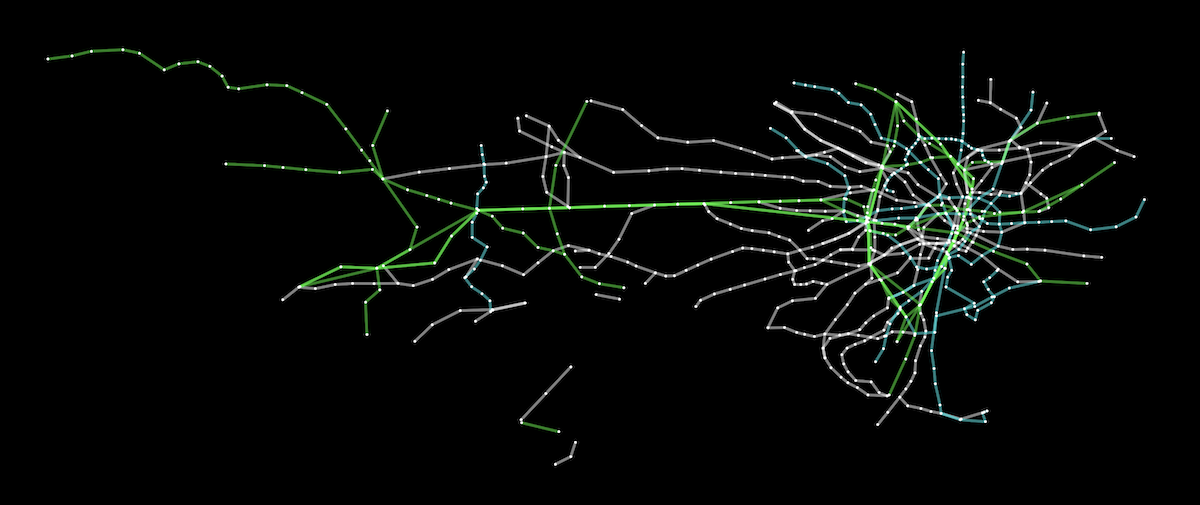
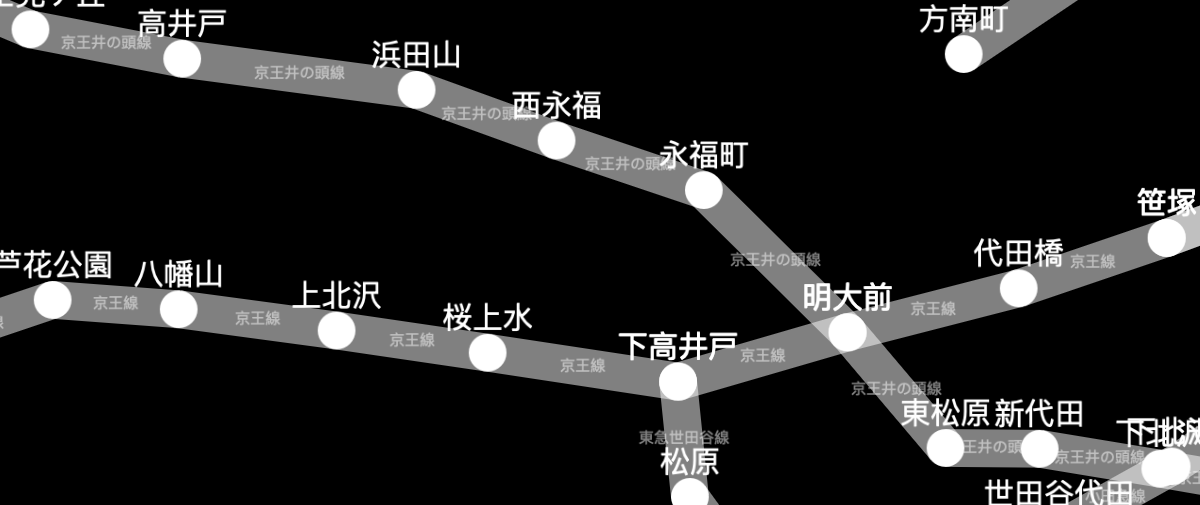
The Tokyo railway stations network can be visualised with Cytoscape:
A live demo and source code are available for the Tokyo railway stations graph. More demos are available in the documentation.
Documentation
You can find the documentation and downloads on the project website.
Roadmap
Future versions of Cytoscape.js are planned in the milestones of the Github issue tracker. You can use the milestones to see what's currently planned for future releases.
Contributing to Cytoscape.js
Would you like to become a Cytoscape.js contributor? You can contribute in technical roles (e.g. features, testing) or non-technical roles (e.g. documentation, outreach), depending on your interests. Get in touch with us by posting a GitHub discussion.
For the mechanics of contributing a pull request, refer to CONTRIBUTING.md.
Feature releases are made monthly, while patch releases are made weekly. This allows for rapid releases of first- and third-party contributions.
Citation
To cite Cytoscape.js in a paper, please cite the Oxford Bioinformatics issue:
Cytoscape.js: a graph theory library for visualisation and analysis
Franz M, Lopes CT, Huck G, Dong Y, Sumer O, Bader GD
Bioinformatics (2016) 32 (2): 309-311 first published online September 28, 2015 doi:10.1093/bioinformatics/btv557 (PDF)
PubMed abstract for the original 2016 article
PubMed abstract for the 2023 update article
Build dependencies
Install node and npm. Run npm install before using npm run.
Build instructions
Run npm run <target> in the console. The main targets are:
Building:
build: do all builds of the library (umd, min, cjs, esm)
build:min : do the unminified build with bundled dependencies (for simple html pages, good for novices)
build:umd : do the umd (cjs/amd/globals) build
build:esm : do the esm (ES 2015 modules) build
clean : clean the build directory
docs : build the docs into documentation
release : build all release artifacts
watch : automatically build lib for debugging (with sourcemap, no babel, very quick)
good for general testing on debug/index.html
served on http://localhost:8080 or the first available port thereafter, with livereload on debug/index.html
watch:babel : automatically build lib for debugging (with sourcemap, with babel, a bit slower)
good for testing performance or for testing out of date browsers
served on http://localhost:8080 or the first available port thereafter, with livereload on debug/index.html
watch:umd : automatically build prod umd bundle (no sourcemap, with babel)
good for testing cytoscape in another project (with a "cytoscape": "file:./path/to/cytoscape" reference in your project's package.json)
no http server
dist : update the distribution js for npm etc.
Testing:
The default test scripts run directly against the source code. Tests can alternatively be run on a built bundle. The library can be built on node>=6, but the library's bundle can be tested on node>=0.10.
test : run all testing & linting
test:js : run the mocha tests on the public API of the lib (directly on source files)
npm run test:js -- -g "my test name" runs tests on only the matching test cases
test:build : run the mocha tests on the public API of the lib (on a built bundle)
npm run build should be run beforehand on a recent version of node
npm run test:build -- -g "my test name" runs build tests on only the matching test cases
test:modules : run unit tests on private, internal API
npm run test:modules -- -g "my test name" runs modules tests on only the matching test cases
lint : lint the js sources via eslint
benchmark : run all benchmarks
benchmark:single : run benchmarks only for the suite specified in benchmark/single
Release instructions
Background
Ensure that a milestone exists for the release you want to make, with all the issues for that release assigned in the milestone.
Bug fixes should be applied to both the master and unstable branches. PRs can go on either branch, with the patch applied to the other branch after merging.
When a patch release is made concurrently with a feature release, the patch release should be made first. Wait 5 minutes after the patch release completes before starting the feature release -- otherwise Zenodo doesn't pick up releases properly.
Patch version
Go to Actions > Release
Go to the 'Run workflow' dropdown
Select 'patch' in the 'Release type' dropdown
Press the green 'Run workflow' button
Close the milestone for the release
Feature version
Go to Actions > Release
Go to the 'Run workflow' dropdown
Select 'feature' in the 'Release type' dropdown
Press the green 'Run workflow' button
Close the milestone for the release
Make the release announcement on the blog
Notes on GitHub Actions UI
'Use workflow from' in the GitHub UI selects the branch from which the workflow YML file is selected. Since the workflow files should usually be the same on the master and unstable branches, it shouldn't matter what's selected.
The release workflow itself checks out the right branches for the selected release type; you don't need to select a branch.
Recovering from a failed npm publish
If the 'npm publish' job fails after the release job succeeded (e.g. a transient npm registry error), open the failed run and use 'Re-run failed jobs'. Do not dispatch a new release: the version bump has already been committed and pushed, so a fresh dispatch would bump the version again and leave the previous version unpublished on npm.
Tests
Mocha tests are found in the test directory. The tests can be run in the browser or they can be run via Node.js (npm run test:js).
Yes — cytoscape/cytoscape.js ships under the MIT license, which makes its source code freely readable (and, depending on license terms, forkable and reusable). Source: github.com/cytoscape/cytoscape.js.
What else is in the Frontend space?
cytoscape/cytoscape.js is tracked by TopGit under the Frontend category, alongside 7 GitHub-tagged topics. Trending and Topics pages list peer repositories of comparable stars and language.
What is cytoscape/cytoscape.js?
cytoscape/cytoscape.js (cytoscape/cytoscape.js) is a JavaScript project on GitHub. From the project's own README: Graph theory (network) library for visualisation and analysis
What license does cytoscape/cytoscape.js use?
cytoscape/cytoscape.js is released under the MIT license. Always verify the LICENSE file directly on GitHub for the authoritative terms — license strings can be edited out of sync with a project's actual stance.
Where can I see cytoscape/cytoscape.js in action?
The project maintains a homepage at https://js.cytoscape.org. The README tab on this page also usually contains screenshots and a quickstart.
Where do I read more about cytoscape/cytoscape.js?
This TopGit page is a snapshot — the READ ME tab shows the project's own README content (links stripped, images preserved). The GitHub repository at github.com/cytoscape/cytoscape.js is the definitive source.
Why is cytoscape/cytoscape.js categorized under Frontend?
TopGit places cytoscape/cytoscape.js in the Frontend category based on its GitHub topics and description (tagged: "analysis", "cytoscapejs", "graph-theory"). Categories are assigned from real repository metadata, not editorial guesswork.
Read full README in the tab above.
Is cytoscape.js worth your time?
ChatGPT, Claude and Perplexity can all read this page. Ask one of them what it makes of cytoscape.js.

 /cytoscape.js