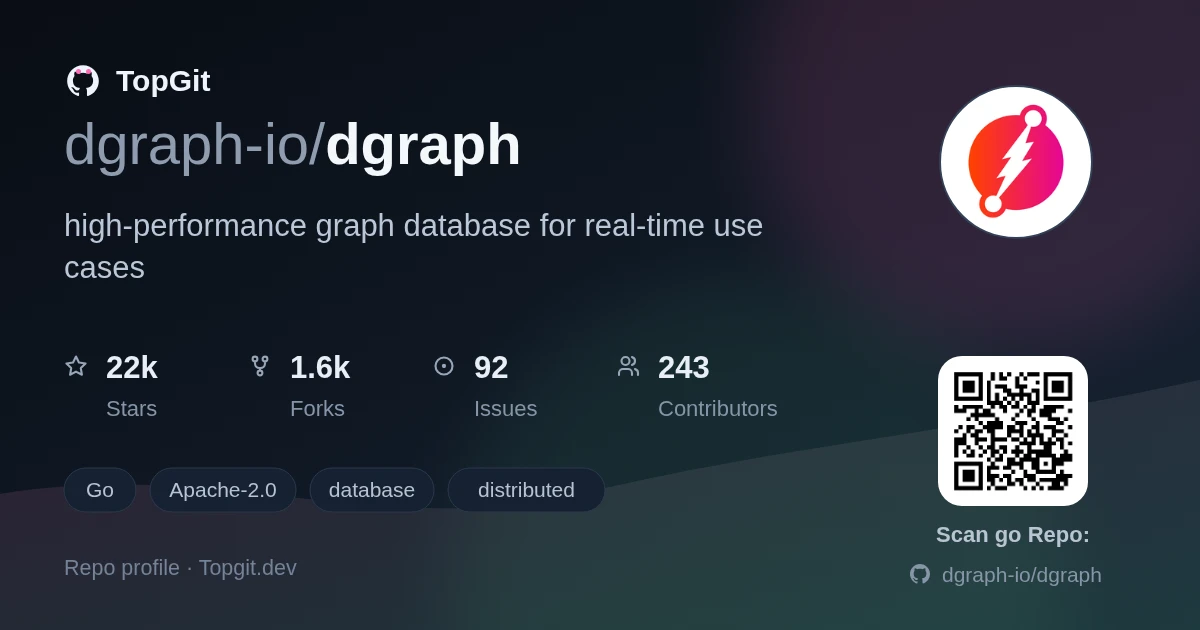
Snapshot of dgraph-io/dgraph: 21.8k★, Go, Data. high-performance graph database for real-time use cases
Snapshot summary built from the project's own GitHub metadata — there's no written TopGit review yet. The page will update automatically when a full review is published.
WHY NO REVIEW YET
TopGit writes full reviews for the most-starred, most-requested repositories. This page is a snapshot until then — see the READ ME tab for the original README in full.
Dgraph is a horizontally scalable and distributed GraphQL database with a graph backend. It provides
ACID transactions, consistent replication, and linearizable reads. It's built from the ground up to
perform a rich set of queries. Being a native GraphQL database, it tightly controls how the data is
arranged on disk to optimize for query performance and throughput, reducing disk seeks and network
calls in a cluster.
Dgraph's goal is to provide Google production-level scale and throughput, with low enough latency to
serve real-time user queries over terabytes of structured data. Dgraph supports
GraphQL query syntax, and responds in JSON
and Protocol Buffers over
GRPC and HTTP. Dgraph is written using the Go Programming Language.
Status
Dgraph is at version v25 and is production-ready. Apart from the vast open source community,
it is being used in production at multiple Fortune 500 companies.
Supported Platforms
Dgraph officially supports the Linux/amd64 and Linux/arm64 architectures. In order to take advantage
of memory performance gains and other architecture-specific advancements in Linux, we dropped
official support for Mac and Windows in 2021, see
this blog post for more
information. You can still build and use Dgraph on other platforms (for live or bulk loading for
instance), but support for platforms other than Linux/amd64 and Linux/arm64 is not available.
Running Dgraph in a Docker environment is the recommended testing and deployment method.
Install with Docker
If you're using Docker, you can use the
official Dgraph image.
docker pull dgraph/dgraph:latest
For more information on a variety Docker deployment methods including Docker Compose and Kubernetes,
see the docs.
Run a Quick Standalone Cluster
docker run -it -p 8080:8080 -p 9080:9080 -v ~/dgraph:/dgraph dgraph/standalone:latest
Install from Source
If you want to install from source, install Go 1.27+ or later and the following dependencies:
Then clone the Dgraph repository and use make install to install the Dgraph binary in the
directory named by the GOBIN environment variable, which defaults to $GOPATH/bin or $HOME/go/bin if
the GOPATH environment variable is not set.
git clone https://github.com/dgraph-io/dgraph.git
cd dgraph
make setup
make install
Get Started
To get started with Dgraph, follow:
Installation to queries in 4 quick steps.
Tutorial and presentation videos on
YouTube channel.
Is Dgraph the right choice for me?
Do you have more than 10 SQL tables connected via foreign keys?
Do you have sparse data, which doesn't elegantly fit into SQL tables?
Do you want a simple and flexible schema, which is readable and maintainable over time?
Do you care about speed and performance at scale?
If the answers to the above are YES, then Dgraph would be a great fit for your application. Dgraph
provides NoSQL like scalability while providing SQL like transactions and the ability to select,
filter, and aggregate data points. It combines that with distributed joins, traversals, and graph
operations, which makes it easy to build applications with it.
Dgraph compared to other graph DBs
Features
Dgraph
Neo4j
Janus Graph
Architecture
Sharded and Distributed
Single server (+ replicas in enterprise)
Layer on top of other distributed DBs
Replication
Consistent
None in community edition (only available in enterprise)
Via underlying DB
Data movement for shard rebalancing
Automatic
Not applicable (all data lies on each server)
Via underlying DB
Language
GraphQL inspired
Cypher
Gremlin
Protocols
Grpc / HTTP + JSON / RDF
Bolt + Cypher
Websocket / HTTP
Transactions
Distributed ACID transactions
Single server ACID transactions
Not typically ACID
Full-Text Search
Native support
Native support
Via External Indexing System
Regular Expressions
Native support
Native support
Via External Indexing System
Geo Search
Native support
External support only
Via External Indexing System
License
Apache 2.0
GPL v3
Apache 2.0
Users
Dgraph official documentation is present at docs.dgraph.io.
For general information and questions, visit
Github discussions.
Please see releases tab to find the latest release
and corresponding release notes.
Developers
Please see Contributing to Dgraph
for guidelines on contributions.
Client Libraries
The Dgraph team maintains several
officially supported client libraries. There are also libraries
contributed by the community
unofficial client libraries.
Contact
Please use Github discussions for questions,
feature requests and discussions.
Please use GitHub Issues for filing bugs or feature
requests.
Yes — dgraph-io/dgraph ships under the Apache-2.0 license, which makes its source code freely readable (and, depending on license terms, forkable and reusable). Source: github.com/dgraph-io/dgraph.
What else is in the Data space?
dgraph-io/dgraph is tracked by TopGit under the Data category, alongside 4 GitHub-tagged topics. Trending and Topics pages list peer repositories of comparable stars and language.
What is dgraph-io/dgraph?
dgraph-io/dgraph (dgraph-io/dgraph) is a Go project on GitHub. From the project's own README: high-performance graph database for real-time use cases
What license does dgraph-io/dgraph use?
dgraph-io/dgraph is released under the Apache-2.0 license. Always verify the LICENSE file directly on GitHub for the authoritative terms — license strings can be edited out of sync with a project's actual stance.
Where can I see dgraph-io/dgraph in action?
The project maintains a homepage at https://dgraph.io. The README tab on this page also usually contains screenshots and a quickstart.
Where do I read more about dgraph-io/dgraph?
This TopGit page is a snapshot — the READ ME tab shows the project's own README content (links stripped, images preserved). The GitHub repository at github.com/dgraph-io/dgraph is the definitive source.
Why is dgraph-io/dgraph categorized under Data?
TopGit places dgraph-io/dgraph in the Data category based on its GitHub topics and description (tagged: "database", "distributed", "go"). Categories are assigned from real repository metadata, not editorial guesswork.
Read full README in the tab above.
Still deciding about dgraph?
One click hands the question to an AI along with this page — see what it says about dgraph.

 /dgraph