Doocs LeetCode: LeetCode solutions in many languages
 /leetcode
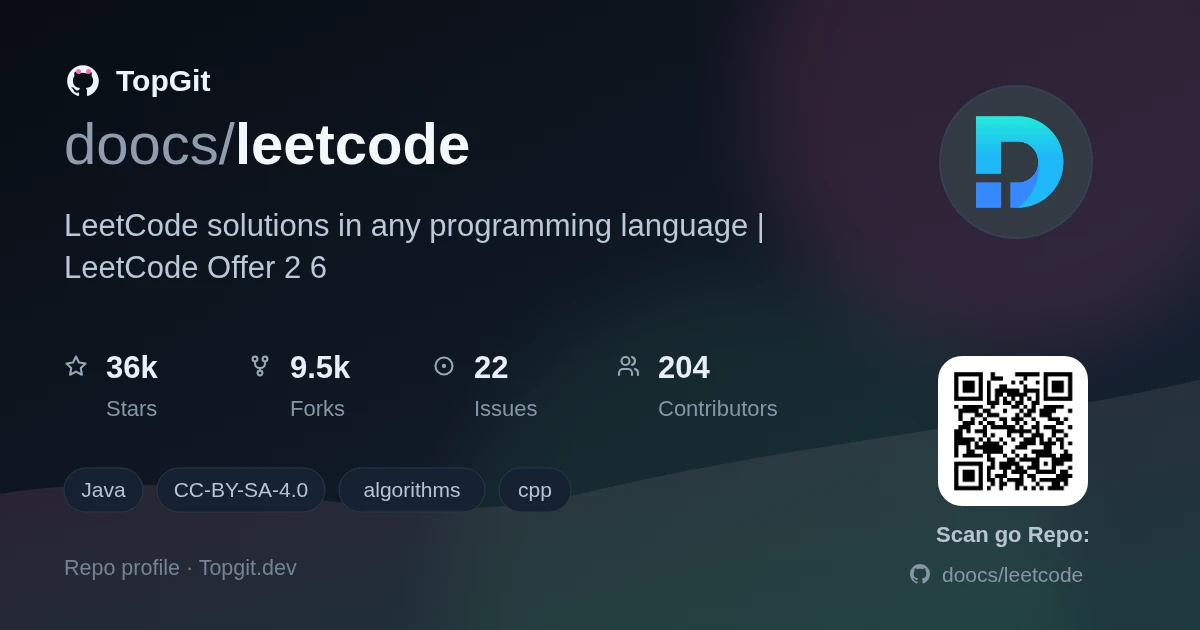
Doocs LeetCode is a solutions repository, not a course. Each problem ships working code in several languages plus a named technique tag like monotonic stack or digit DP. That's a fast reference once you already know which pattern you're stuck on, but it won't teach the pattern from scratch — pair it with a study plan instead of using it as one.
What the Doocs LeetCode repository is
Doocs LeetCode is a GitHub repository collecting solutions to LeetCode problems plus two Chinese interview-prep books, 剑指 Offer (a 2nd edition and a special-topic edition) and 程序员面试金典 (6th edition). Solutions are written in multiple languages — the README lists Java, Python, C++, Go, TypeScript, and Rust — and organized by the underlying algorithm technique rather than just problem number.
What algorithm topics are covered
- ✓Six algorithm tracks — basic algorithms, data structures, search (BFS/DFS), dynamic programming, advanced data structures, and graph theory — each with named worked examples like 'monotonic stack' or 'digit DP'.
- ✓Solutions for three separate problem sets: standard LeetCode, 剑指 Offer (2nd edition and a special-topic edition), and 程序员面试金典 (6th edition).
- ✓A dedicated JavaScript practice section and a separate database (SQL) practice section, alongside the main solution tree.
- ✓An archive of past LeetCode contest problems (往期竞赛合集), collected separately from the main topic tree.
- ✓Each linked solution folder groups the multi-language code for that one problem, so Java, Python, C++, Go, TypeScript, and Rust versions sit side by side.
- ✓An English-language version of the README (README_EN.md) alongside the primary Chinese docs.
How developers use this collection for interview prep
- •Drilling one technique at a time — jump straight to the '单调栈' (monotonic stack) or '数位 DP' (digit DP) subsection instead of solving problems in random order.
- •Checking a finished solution against a specific language's idioms before an interview in that language, since most problems carry parallel Java, Python, C++, Go, TypeScript, and Rust code.
- •Working through 剑指 Offer or 程序员面试金典 as a supplement to standard LeetCode practice when prepping for interviews at companies that reference those books.
- •Practicing SQL interview questions through the dedicated database practice section instead of digging them out of the general problem list.
Strengths
- ✓Most problem folders carry parallel solutions in several languages, so you can compare how the same algorithm reads in Java versus Go versus Rust without hunting across separate repos.
- ✓Problems are tagged with the actual technique (单调栈, 数位 DP, 并查集), which makes it fast to drill one algorithm pattern instead of solving in random order.
- ✓Coverage extends past standard LeetCode into 剑指 Offer and 程序员面试金典, useful if a target company's interview draws on those specific books.
- ✓Contributions are accepted via ordinary GitHub PRs, and the existing C# solutions came from exactly that process, so the multi-language scope keeps growing through outside contributors.
What this repository does not cover
- △All explanatory text and problem titles are in Chinese; only the README itself has an English translation (README_EN.md), so for most entries you're reading translated file names and code, not a translated write-up.
- △Not every problem has every language filled in — the README describes the language list as 'including but not limited to' Java, Python, C++, Go, TypeScript, and Rust, so coverage per language is uneven rather than complete.
- △There's no install step or CLI — this is a static tree of markdown and source files browsed on GitHub or the companion site, not a package or tool you run.
- △No difficulty filter or study-plan sequencing is documented — you navigate by algorithm category and book edition, not by a suggested order or difficulty ramp.
Other LeetCode solution repos and study platforms
Who should use this collection
Best for developers already comfortable reading Chinese who are grinding LeetCode, 剑指 Offer, or 程序员面试金典 problems and want a same-language reference or a version of a known problem solved in a language they haven't practiced yet. Less useful if you need English explanations of each solution's reasoning, since only the top-level README is translated.
Frequently asked questions
Doocs LeetCode doesn't cap the language list — the README says solutions come in Java, Python, C++, Go, TypeScript, and Rust, 'including but not limited to' those, so the exact number varies by problem rather than being fixed across the repository.
Doocs LeetCode includes solutions for both 剑指 Offer — in its 2nd-edition and special-topic-edition forms — and 程序员面试金典 (6th edition), each organized in its own section separate from the main LeetCode problem tree.
Doocs LeetCode is released under the CC-BY-SA-4.0 license, so it's free to read and reuse with attribution; the README adds that commercial reprints need the maintainer's authorization while non-commercial reprints just need to credit the source.
Doocs LeetCode accepts contributions through GitHub pull requests: fork the repository, clone it locally, create a new branch, commit your changes, push to your fork, and open a PR for review — the same workflow a contributor used to add the project's existing C# solutions.
Doocs LeetCode groups problems into six tracks: basic algorithms (binary search, prefix sums, two pointers), data structures (linked lists, monotonic stacks and queues, string hashing), search (BFS/DFS and shortest-path models), dynamic programming, advanced data structures (union-find, Fenwick trees, segment trees), and graph theory.
Doocs LeetCode is an independent, community-maintained project under the GitHub group 'Doocs,' not something operated or endorsed by LeetCode itself — it's a third-party collection of worked solutions and companion book problem sets, not an official one.
Related repositories
Curious whether leetcode is right for you?
Let ChatGPT, Claude, or Perplexity look into it — click below and see what AI actually says about leetcode.