applied-ml: ML in production case studies
 /applied-ml
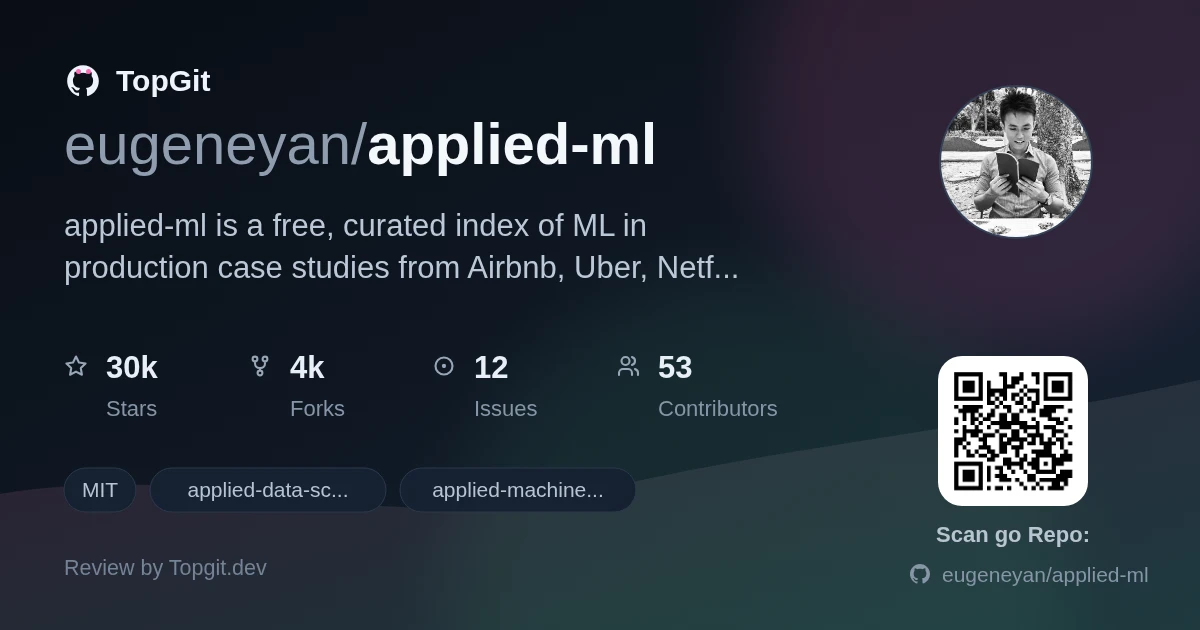
applied-ml is the fastest way to see how several companies solved the same ML problem before you design your own — that's the real value, not the reading itself. The catch: it's an index, not a tutorial, so you still click through to Airbnb's or Uber's original post and do the reading yourself. It beats a generic 'awesome ML' list of libraries because every link describes a real production system, not a package README.
What is applied-ml?
applied-ml is a GitHub reading list of papers, talks, and engineering blog posts about how companies build data science and machine learning systems in production. Eugene Yan organizes it into 31 topic sections — from data quality through feature stores, forecasting, and ethics — with each entry tagged by the company and, mostly, the year it was published.
What's inside: 31 topic sections from data quality to ethics
- ✓31 topic sections spanning the ML lifecycle, from Data Quality and Data Engineering through Feature Stores, Classification, Forecasting, Recommendation, and Search & Ranking.
- ✓Deep-learning-adjacent categories get their own sections too: Embeddings, Natural Language Processing, Sequence Modelling, Computer Vision, Reinforcement Learning, and Generation.
- ✓Operational sections most 'awesome ML' lists skip entirely: Data Discovery, Weak Supervision, Anomaly Detection, Privacy-Preserving Machine Learning, and Validation and A/B Testing.
- ✓A Team Structure section on how ML orgs staff themselves, and a Fails section of postmortems on what didn't work — not just wins.
- ✓Every entry is tagged with the company and, mostly, the year it was published, so a 2016 Airbnb ingestion post reads distinctly from a 2022 DoorDash one.
- ✓Entries under Feature Stores alone include write-ups from Netflix, LinkedIn, Airbnb, Uber, Twitter, Gojek, DoorDash, Monzo Bank, QuintoAndar, and Constructor.io, published across several years.
Strengths
- ✓Organized by ML problem type instead of by company or date — the actual axis you search on when you're stuck on 'how do other teams do forecasting,' not 'what did Uber publish this year.'
- ✓Each entry names the company and links straight to the primary source, not a secondhand summary of someone else's summary.
- ✓Covers the unglamorous production concerns most curated ML lists skip: data quality, feature stores, model management, and postmortems in the Fails section.
- ✓Free to browse on GitHub with no signup, and MIT-licensed if you want to fork the structure for your own reading list.
What applied-ml doesn't cover
- △It's a link list, not a course.
- △No synthesis beyond each title — every entry sends you out to the company's own blog, talk, or paper, with nothing summarized in applied-ml itself.
- △Coverage is uneven across sections: Feature Stores and Data Engineering carry dozens of entries across years, while sections like Regression or Graph list only a handful.
- △Sections are ordered by ML problem type, not by date, so scanning one section top to bottom mixes an old paper with a recent write-up.
- △External links rot — entries point to Medium posts, YouTube talks, and company blogs that can move or disappear, and applied-ml doesn't mirror the content itself.
Similar curated ML reading lists and resources
Frequently asked questions
applied-ml has added new entries over multiple years — its Feature Stores section, for example, includes write-ups through 2023 — but it's a personal reading list curated by one maintainer, Eugene Yan, rather than a project on a fixed release schedule, so updates land irregularly.
Most articles linked from applied-ml assume you already know ML terminology like feature stores, embeddings, and A/B testing, since they're engineering blog posts written by practitioners for practitioners rather than tutorials. applied-ml itself adds no background explanation, just the links.
Most links in applied-ml go to free company engineering blogs and conference talks — domains like netflixtechblog.com, eng.uber.com, and Medium posts — though a handful point to ACM- or IEEE-hosted papers that can sit behind a paywall depending on your institutional access.
Papers with Code pairs academic papers with their code implementations and benchmark leaderboards. applied-ml skips code and benchmarks entirely and instead curates engineering blog posts and papers about how companies deployed ML in production, organized by problem type rather than by dataset or task.
Uber, Airbnb, Netflix, DoorDash, and LinkedIn contribute the most entries across applied-ml's sections, appearing repeatedly in Feature Stores, Data Engineering, and Forecasting alongside posts from Google, Amazon, Meta, Twitter, Lyft, and Shopify.
Best use cases
- •Scoping a new ML feature: read the section matching your problem (recsys, forecasting, anomaly detection) before writing a design doc, to see how a few companies already solved it.
- •Prepping for an ML system design interview: the Feature Stores and Model Management sections read like a crash course in what interviewers actually ask about.
- •Benchmarking your own team's practices against the Team Structure and Practices sections when your org is deciding how to structure an ML team.
- •Finding prior art before proposing a feature store or validation pipeline, so the write-up cites what Airbnb, Uber, or LinkedIn already tried instead of starting from zero.
Who should try it — and who should skip
applied-ml suits ML engineers and data scientists who already know the vocabulary — recsys, feature store, A/B testing — and want to see how several companies solved the exact problem they're stuck on before designing their own. Engineering managers scoping what 'production ML' actually involves before a team-structure decision get value from it too. Skip it if you're starting from zero. There's no explainer for what a feature store even is here, just links that assume you already know, and skip it as well if you wanted runnable code instead of reading.
Related repositories
Want a second opinion on applied-ml?
Ask an AI that can read this page — one click and you get its take on applied-ml.