On GitHub, fsprojects/Rezoom.SQL has picked up 679 stars, Data, F#. Statically typechecks a common SQL dialect and translates it to various RDBMS backends
Snapshot summary built from the project's own GitHub metadata — there's no written TopGit review yet. The page will update automatically when a full review is published.
WHY NO REVIEW YET
TopGit writes full reviews for the most-starred, most-requested repositories. This page is a snapshot until then — see the READ ME tab for the original README in full.
Documentation: Tutorial | Using Rezoom | Configuration | Language | UserTypes | API
Query playground -- try out the SQL dialect live!
Statically typed SQL for F#, new and improved for 2026
Rezoom.SQL is an F# ORM for SQL databases.
It integrates with the F# compiler via a generative type provider to statically
typecheck its own dialect of SQL. It knows how to translate this SQL dialect to
various backends. Currently it supports SQLite, SQL Server, and PostgreSQL.
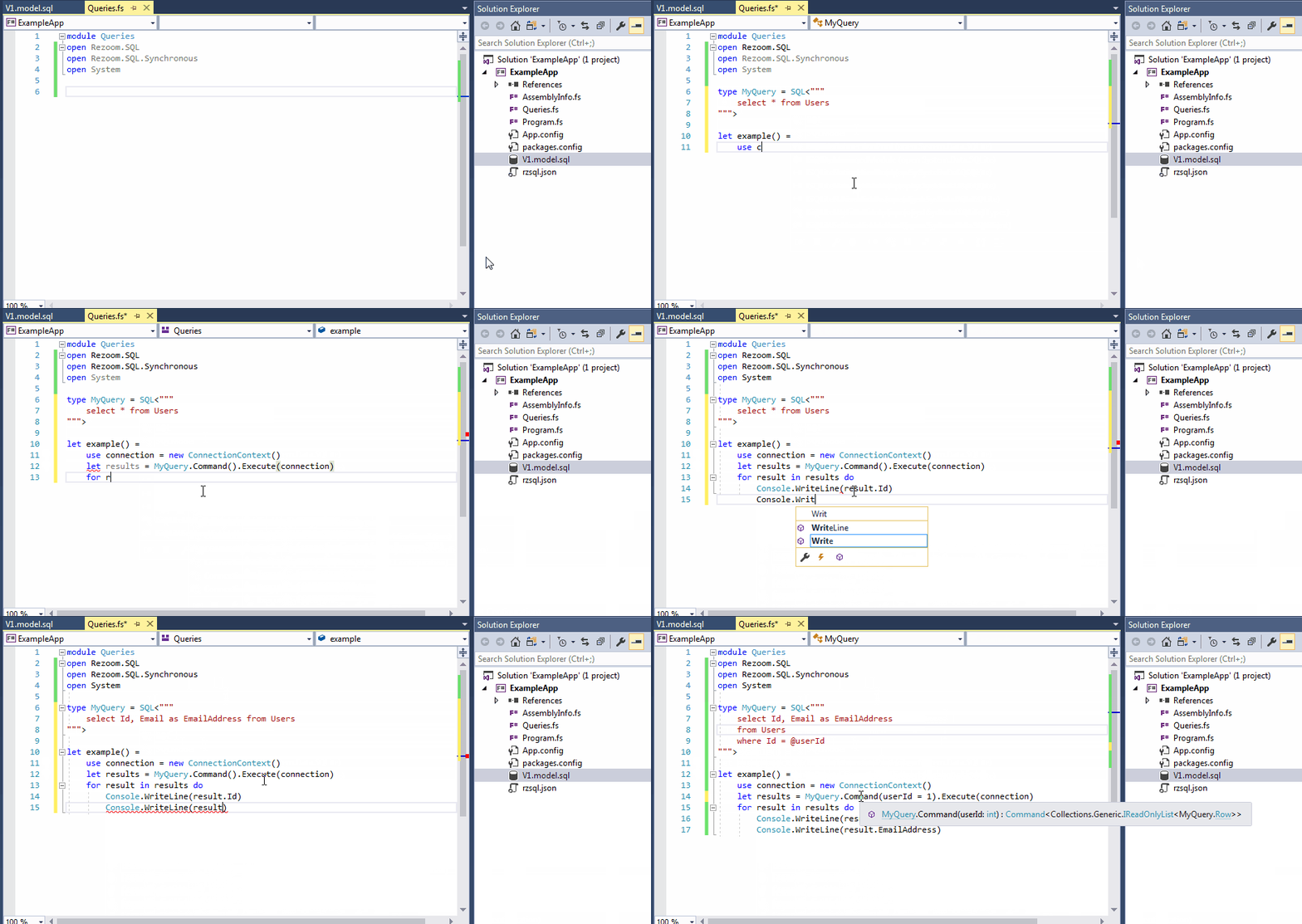
The type provider makes it fast and easy to write SQL statements, run them, and
consume their results from your F# code with full type safety. You don't need to
install any editor extensions or custom tooling, just add a NuGet package and
you're off and running writing code like this:
Database schema inferred from migration scripts
In order to typecheck your queries, Rezoom.SQL has to know your database schema
(so it can know, for example, that the Id column in the Users table is an
int). It learns the schema by reading your migration scripts and observing what
tables and views are created, columns added, and so on.
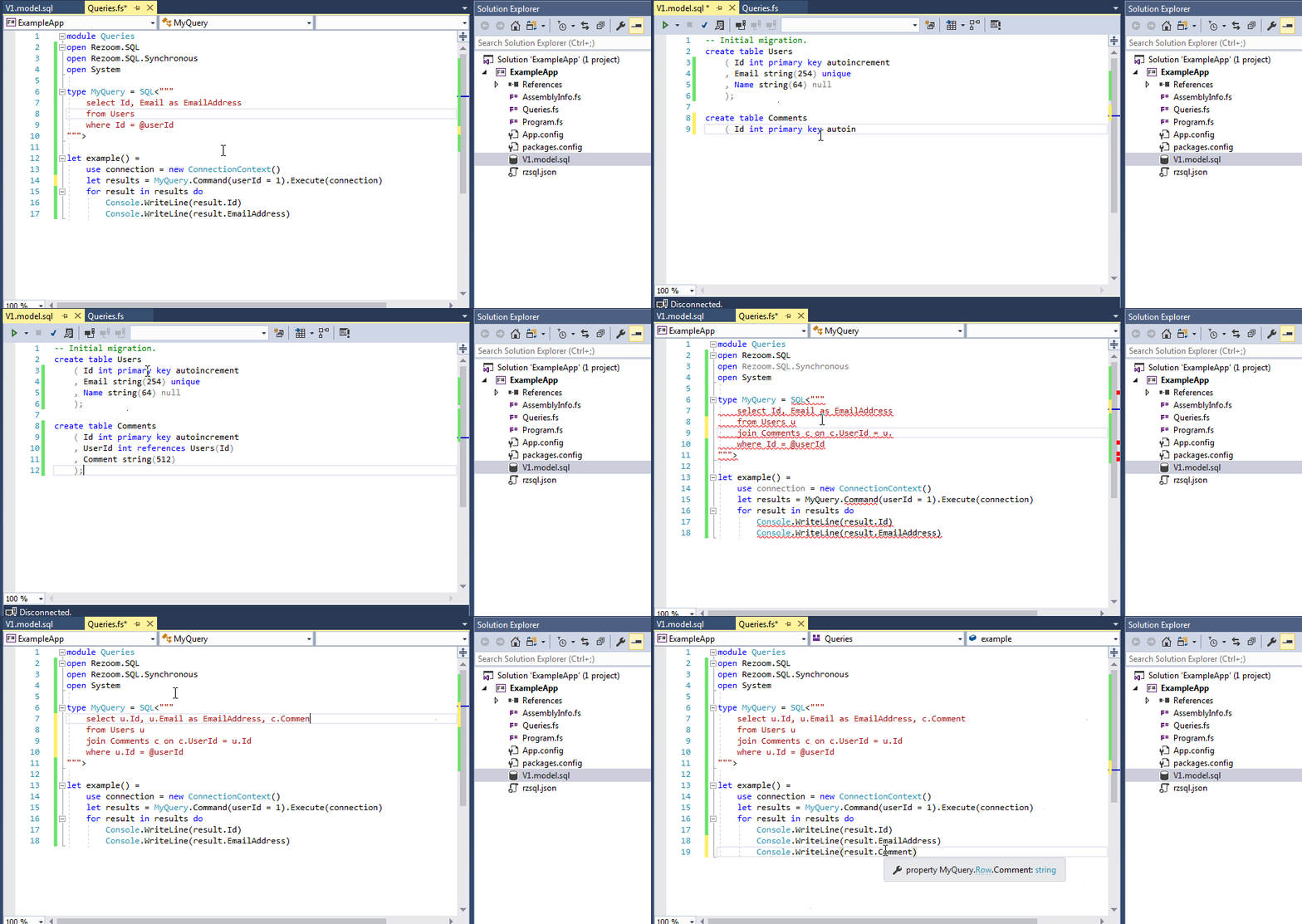
When developing the first iteration of your application (or a new feature with
its own migration script), it's easy to sketch out a model then go back and
change it as you code, without having to touch a real database until you're
ready to run.
Here's an example. You might want to refresh the page to start the GIF from the
beginning.
Because this is a generative type provider, it makes plain old .NET types you
can use from other languages. That is, you can write an F# project that uses
Rezoom.SQL and defines your migrations and queries, then reference that from C#
or VB.NET projects and use the generated query types with no problem in those
langages. There is even an option to represent nullable types with C#-style
System.Nullable<T> instead of FSharpOption<T> to make this scenario work
extra smoothly.
Check out the query
playground to see
what kinds of SQL you can write.
The productivity of static typing
When you make schema changes -- for example, replacing FirstName and
LastName fields with a single FullName field -- it's comforting to know the
compiler will point out the queries you need to update.
The typechecker also tightens up the feedback loop, so you don't waste your time
tracking down typos and trivial SQL mistakes you'd normally only encounter at runtime.
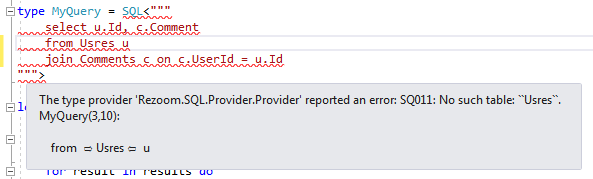
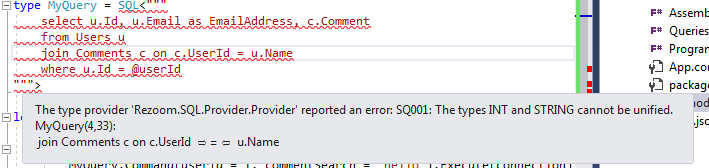
Here are just a handful of possible errors you'll be informed of at compile time
and can fix in seconds. There are currently over 45 different error types that
can be detected at compile time.
Mistyped table names
Incompatible data types
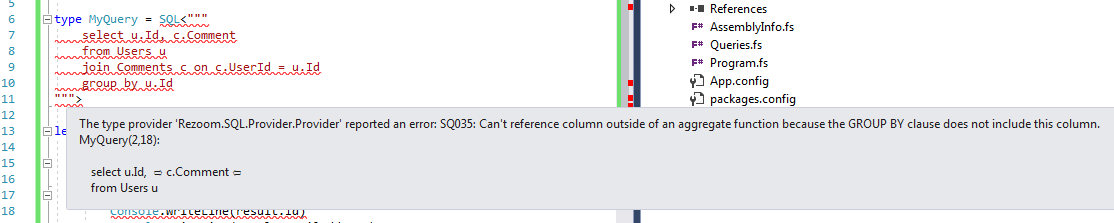
Selecting columns not included in a GROUP BY clause
Flexible migration order for working in teams
Since Rezoom.SQL understands the language, it knows that some migrations like
alter table X add column Y and alter table X add column Z can be run in any
order and produce the same effects.
When you're working with a team, you can take advantage of this to add the
tables and columns you need for the feature you're coding, while your other team
members do the same for their features -- without having to decide the One
True Migration Order when you merge.
See details here.
Integration with Rezoom
You can use Rezoom.SQL by itself, as in the example code above.
But as the name implies, it's designed to work with
Rezoom. When you use it with Rezoom, you can
take advantage of automatic caching and combine units of business logic to share round trips
to the database.
Automatic batching
With Rezoom, you build up a Plan to represent a transaction, which may involve
multiple SQL commands (or web API calls, or other high-latency data manipulation).
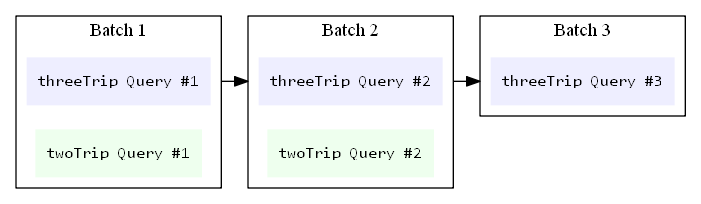
If you have one Plan called threeTrip that makes 3 queries, and another
called twoTrip that makes 2 queries, you can choose whether to combine them
sequentially for 5 round trips to the database...
let sequential =
    plan {
        let! x = threeTrip
        let! y = twoTrip
        return (x, y)
    }
Or concurrently, for 3 round trips to the database. The first two query batches
sent to the database will include pending queries from boththreePlan and
twoTrip:
let concurrent =
    plan {
        let! x, y = threeTrip, twoTrip
        return (x, y)
    }
Automatic caching
Each statically typed query comes with some useful info for caching:
A compiler-generated ID
A boolean indicating whether it could make sense to cache (has no side effects, does not use rand(), newid(), etc)
A bitmask of the tables it reads from
A bitmask of the tables it writes to
Rezoom uses this cache info to avoid unnecessarily re-querying for the same data
during the execution of a Plan (i.e. within a transaction).
This means if you have 30 different functions that call
LoadUserPermissions(currentUserId), only 1 query for permissions will actually
be run when you use those functions together in a transaction. Unless, of
course, you edit the permissions table during the course of the transaction, in
which case the cached result will automatically be invalidated and the
permissions re-queried next time they are requested.
This lets you safely check all the invariants you need for each method in your
domain layer, without fear of causing mountains of redundant queries, and
without any of the effort of writing your own caching layer.
Get started
To get started using RZSQL, read the
tutorial. It'll get you
up and running in 5 minutes or your money back.
How does fsprojects/Rezoom.SQL compare to other Data projects?
fsprojects/Rezoom.SQL is tracked by TopGit in the Data category, with 679 GitHub stars and written in F#. Browse the Data topic page on TopGit to compare it against similar projects by stars and activity.
Is fsprojects/Rezoom.SQL open source?
Yes — fsprojects/Rezoom.SQL ships under the MIT license, which makes its source code freely readable (and, depending on license terms, forkable and reusable). Source: github.com/fsprojects/Rezoom.SQL.
What else is in the Data space?
fsprojects/Rezoom.SQL is tracked by TopGit under the Data category, alongside 8 GitHub-tagged topics. Trending and Topics pages list peer repositories of comparable stars and language.
What is fsprojects/Rezoom.SQL?
fsprojects/Rezoom.SQL (fsprojects/Rezoom.SQL) is a F# project on GitHub. From the project's own README: Statically typechecks a common SQL dialect and translates it to various RDBMS backends
Where do I read more about fsprojects/Rezoom.SQL?
This TopGit page is a snapshot — the READ ME tab shows the project's own README content (links stripped, images preserved). The GitHub repository at github.com/fsprojects/Rezoom.SQL is the definitive source.
Why is fsprojects/Rezoom.SQL categorized under Data?
TopGit places fsprojects/Rezoom.SQL in the Data category based on its GitHub topics and description (tagged: "compiler", "fsharp", "postgresql"). Categories are assigned from real repository metadata, not editorial guesswork.
Read full README in the tab above.
Curious whether Rezoom.SQL is right for you?
Let ChatGPT, Claude, or Perplexity look into it — click below and see what AI actually says about Rezoom.SQL.