
Node.js Best Practices: A Curated Guide for Developers
 /nodebestpractices
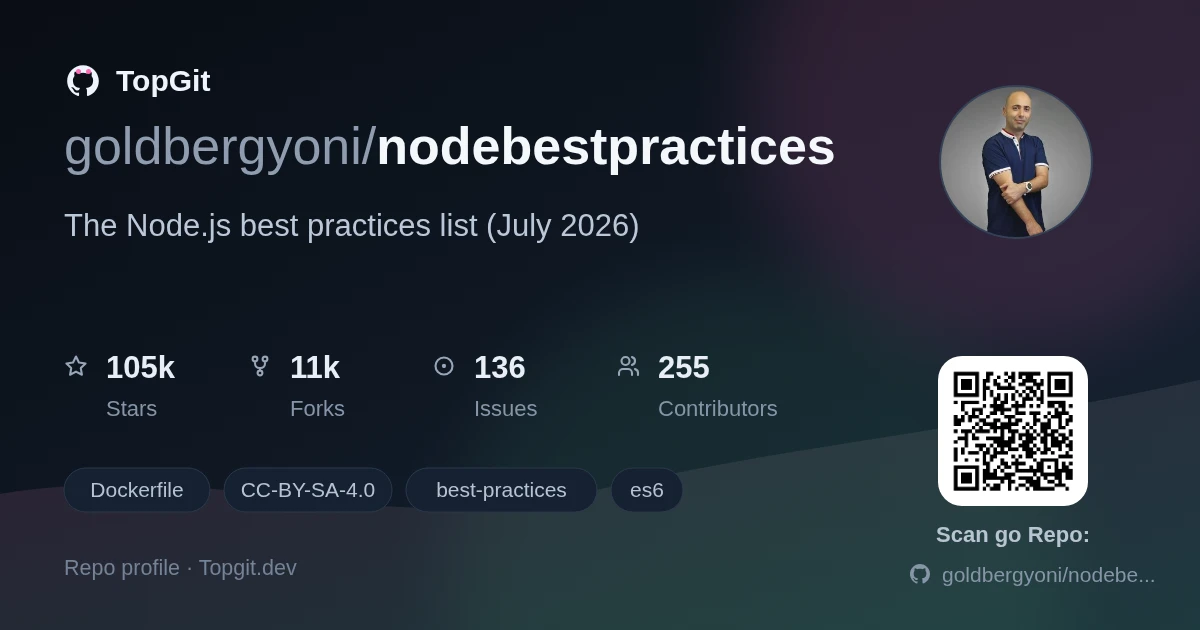
Node.js Best Practices is a checklist repository that distills recommendations for building and shipping Node.js applications into more than 80 entries across eight categories. Reach for it when you're about to harden a service for production or want documented reasoning behind a code review comment; skip it if you're after a step-by-step course, since this is reference material you dip into, not a tutorial you follow start to finish.
What is the Node.js Best Practices Guide?
Node.js Best Practices is a single GitHub repository, goldbergyoni/nodebestpractices, that gathers Node.js recommendations into more than 80 numbered practices spread across eight categories. Each practice pairs a short recommendation with an 'Otherwise' note explaining what tends to go wrong without it, plus a Read More link into a longer write-up with code examples.
Why This Guide is a Top Node.js Resource
The repository carries a substantial number of GitHub stars and forks, a sign that a large number of Node.js developers have starred or forked it for reference. The README labels the current edition '2026' and tags individual practices #new or #updated as they change, and the guide has been translated into Chinese, French, Brazilian Portuguese, Russian, Polish, Japanese, and Basque, with Spanish, Hebrew, Korean, and Turkish translations in progress.
Who Benefits from These Node.js Practices?
Backend developers preparing a Node.js service for production get the most out of the Going To Production and Security categories specifically. Tech leads writing an internal style guide can lift the Code Style and Architecture sections as a starting point instead of drafting rules from scratch. Skip it if you're brand new to Node.js and need a structured course with exercises: this guide assumes you already know how to write a Node.js app and want to sharpen how you write it.
Key Areas Covered by the Guide
- ✓Project Architecture Practices (6 entries) covering component-based folder structure, three-tier layering, hierarchical config, and when to reach for TypeScript.
- ✓Error Handling Practices (12 entries) covering async/await error handling, extending the built-in Error object, and catching unhandled promise rejections.
- ✓Code Style Practices (12 entries) covering ESLint setup, naming conventions, const over let, and async/await over callbacks.
- ✓Testing And Overall Quality Practices (13 entries) covering API-level component testing, the AAA test structure, and mocking external HTTP services.
- ✓Going To Production Practices (19 entries) covering monitoring, structured logging, dependency locking, and running Node.js statelessly.
- ✓Security Practices (25 entries) covering linter security rules, ORM/ODM use to block query injection, bcrypt/scrypt for secrets, and JWT blocklisting.
- ✓Performance Practices (2 entries, flagged 'Work In Progress' in the README) covering not blocking the event loop and preferring native JS methods over Lodash.
- ✓Docker Practices (15 entries) covering multi-stage builds, .dockerignore, running as a non-root user, and setting memory limits in both Docker and V8.
Applying Node.js Best Practices in Your Projects
- •Working through the Going To Production and Security categories as a pre-launch checklist before a Node.js service goes live.
- •Picking one category, like Error Handling, to retrofit into an existing codebase during a refactor.
- •Citing a practice's 'Otherwise' explanation in a pull request review to justify a requested change instead of just asserting an opinion.
- •Reading alongside Practica.js, the companion example application and boilerplate the README links to, to see practices applied as code.
- •Reading the guide in Chinese, French, Brazilian Portuguese, Russian, Polish, Japanese, or Basque if English isn't your team's first language.
Strengths
- ✓Each practice is annotated, not just linked: a TL;DR recommendation, an 'Otherwise' section on the consequence of skipping it, and a Read More link with code examples.
- ✓GitHub shows years of scrutiny from working Node.js developers, not a brand-new list.
- ✓Coverage runs deep and specific, from six architecture practices down to twenty-five security practices, rather than staying at a surface level.
- ✓Actively maintained: the README labels the current edition '2026' and tags individual entries #new or #updated instead of leaving stale advice unmarked.
- ✓A companion project, Practica.js, turns a subset of the practices into runnable example code instead of leaving them purely theoretical.
Considerations When Using the Guide
- △The Performance Practices category has only 2 entries and the README itself flags it 'Work In Progress,' so it's the thinnest section in the guide.
- △The CC-BY-SA-4.0 license covers the content itself: reusing or adapting sections elsewhere requires attribution and sharing your version under the same license, unlike a permissive code license.
- △Spanish, Hebrew, Korean, and Turkish translations are listed as still in progress, so readers in those languages are working from an incomplete version.
- △GitHub lists Dockerfile as the repository's primary language, a reminder that this is reading material with example snippets, not an installable package.
- △With more than 80 entries across eight categories, it's built to be referenced by topic, not read start to finish in one sitting.
Other Resources for Node.js Guidance
Frequently Asked Questions
Yes. The README labels the current edition '2026,' tags individual entries #new or #updated as they change, and notes that issues and pull requests get opened against the repository daily.
Node.js Best Practices covers eight categories: project architecture, error handling, code style, testing and quality, going to production, security, performance, and Docker.
Yes. Node.js Best Practices is translated into Chinese, French, Brazilian Portuguese, Russian, Polish, Japanese, and Basque, with Spanish, Hebrew, Korean, and Turkish translations listed as in progress.
Yes. The README points to Practica.js, described as a beta application example and boilerplate from the same maintainer for seeing some of the practices applied in code.
Node.js Best Practices is released under the CC-BY-SA-4.0 license, per its GitHub repository page.
Node.js Best Practices takes contributions through GitHub issues and pull requests, following the writing guidelines document linked from the README.
Related repositories
Curious whether nodebestpractices is right for you?
Let ChatGPT, Claude, or Perplexity look into it — click below and see what AI actually says about nodebestpractices.