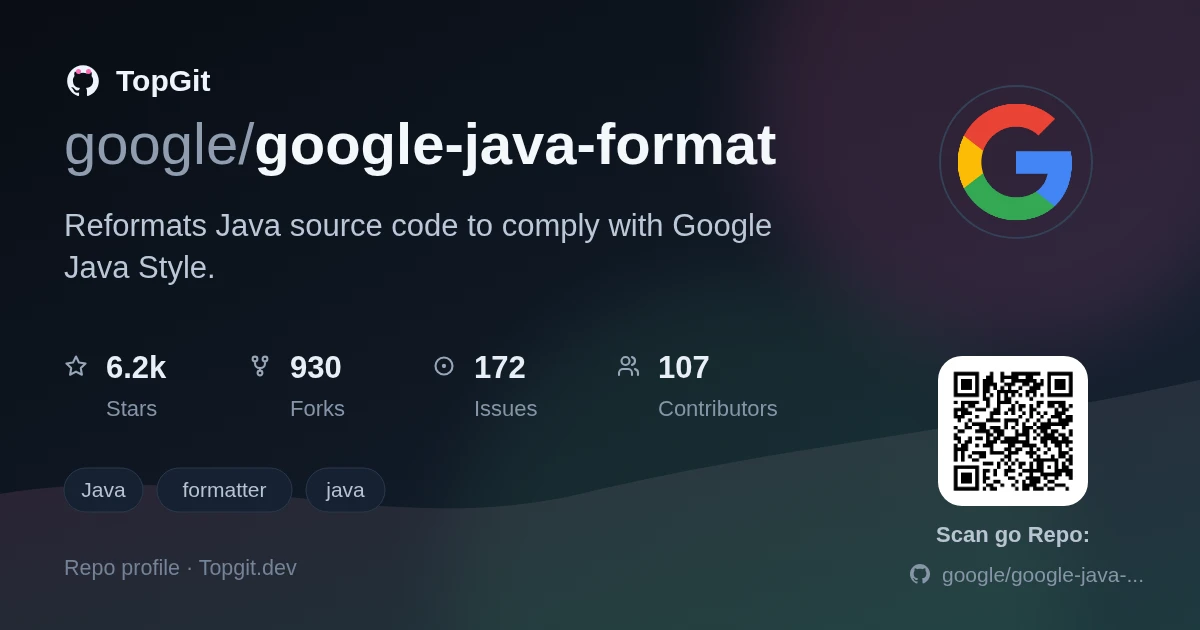
6.2k GitHub stars and counting — google/google-java-format is a Java project TopGit is tracking across repositories on the platform. Reformats Java source code to comply with Google Java Style.
Snapshot summary built from the project's own GitHub metadata — there's no written TopGit review yet. The page will update automatically when a full review is published.
WHY NO REVIEW YET
TopGit writes full reviews for the most-starred, most-requested repositories. This page is a snapshot until then — see the READ ME tab for the original README in full.
Note that it uses the jdk.compiler module to parse the Java source code. The
java binary version used must therefore be from a JDK (not JRE) with a version
equal to or newer than the Java language version of the files being formatted.
The minimum Java version can be found in
pom.xml
(currently Java 21). An alternative is to use the available GraalVM based native
binaries instead.
The formatter can act on whole files, on limited lines (--lines), on specific
offsets (--offset), passing through to standard-out (default) or altered
in-place (--replace).
Option --help will print full usage details; including built-in documentation
about other flags, such as --style, --max-line-length, --fix-imports-only,
--skip-sorting-imports, --skip-removing-unused-import,
--skip-reflowing-long-strings, --skip-javadoc-formatting, or the --dry-run
and --set-exit-if-changed.
Using @<filename> reads options and filenames from a file, instead of
arguments.
To reformat changed lines in a specific patch, use
google-java-format-diff.py.
Note:There is almost no configurability as to the formatter's algorithm
for formatting. This is a deliberate design decision to unify our code
formatting on a single format. See Configuration for the few
options that are available.
IntelliJ, Android Studio, and other JetBrains IDEs
A
google-java-format IntelliJ plugin
is available from the plugin repository. To install it, go to your IDE's
settings and select the Plugins category. Click the Marketplace tab, search
for the google-java-format plugin, and click the Install button.
The plugin will be disabled by default. To enable,
open the Project settings,
then click "google-java-format Settings" and check the "Enable
google-java-format" checkbox.
To enable it by default in new projects,
open the default settings for new projects
and configure it under "Other Settings/google-java-format Settings".
When enabled, it will replace the normal Reformat Code and Optimize Imports
actions.
IntelliJ JRE Config
The google-java-format plugin uses some internal classes that aren't available
without extra configuration. To use the plugin, you need to
add some options to your IDE's Java runtime.
To do that, go to Help→Edit Custom VM Options... and paste in these lines:
The latest version of the google-java-format Eclipse plugin can be downloaded
from the releases page.
Drop it into the Eclipse
drop-ins folder
to activate the plugin.
The plugin adds two formatter implementations:
google-java-format: using 2 spaces indent
aosp-java-format: using 4 spaces indent
These that can be selected in "Window" > "Preferences" > "Java" > "Code Style" >
"Formatter" > "Formatter Implementation".
Eclipse JRE Config
The plugin uses some internal classes that aren't available without extra
configuration. To use the plugin, you will need to edit the
eclipse.ini file.
Open the eclipse.ini file in any editor and paste in these lines towards the
end (but anywhere after -vmargs will do):
Cosium/maven-git-code-format:
A maven plugin that automatically deploys google-java-format as a
pre-commit git hook.
SBT plugins
sbt/sbt-java-formatter
Github Actions
googlejavaformat-action:
Automatically format your Java files when you push on github
as a library
The formatter can be used in software which generates java to output more
legible java code. Just include the library in your maven/gradle/etc.
configuration.
google-java-format uses internal javac APIs for parsing Java source. The
following JVM flags are required when running on JDK 16 and newer, due to
JEP 396: Strongly Encapsulate JDK Internals by Default:
Your starting point should be the instance methods of
com.google.googlejavaformat.java.Formatter.
Configuration
google-java-format is an opinionated formatter with very little configuration.
Its core formatting decisions, like where lines break and how much continuation
lines are indented, are deliberately not configurable. See also
this FAQ entry
for more details.
There are a few configuration options for projects that need them:
--style=google|aosp selects the code style. The default, google, follows
Google Java Style. aosp follows the
AOSP Java code style:
it indents blocks by 4 spaces and continuation lines by 8, instead of 2
and 4. Line breaking is otherwise the same as Google style, so
--style=aosp is also an option for projects that want 4-space indentation
without otherwise following AOSP conventions. (--google-style and --aosp
are equivalent shorthands.)
--max-line-length=N sets the column limit. The default is 100.
Besides layout, the formatter makes some changes that aren't just whitespace,
and each of them can be turned off:
--cleanup=false disables small cleanups such as removing redundant
semicolons, empty annotation parentheses (@Foo() to @Foo), and
parentheses around a single lambda parameter ((x) -> ... to x -> ...).
Cleanups are enabled by default, and only apply to the lines being
formatted.
--skip-sorting-imports and --skip-removing-unused-imports disable import
sorting and unused import removal (--fix-imports-only does only those, and
no other formatting).
--skip-reordering-modifiers keeps modifiers in their existing order.
--skip-reflowing-long-strings disables splitting string literals that
exceed the column limit.
Run google-java-format --help for the full command-line reference. When using
the formatter as a library, JavaFormatterOptions.builder() and
JavaFormatterOptions.Style.builder() provide the corresponding options.
Building from source
mvn install
Contributing
Please see the contributors guide for details.
License
Copyright 2015 Google Inc.

Licensed under the Apache License, Version 2.0 (the "License"); you may not
use this file except in compliance with the License. You may obtain a copy of
the License at

    http://www.apache.org/licenses/LICENSE-2.0

Unless required by applicable law or agreed to in writing, software
distributed under the License is distributed on an "AS IS" BASIS, WITHOUT
WARRANTIES OR CONDITIONS OF ANY KIND, either express or implied. See the
License for the specific language governing permissions and limitations under
the License.
How active is development on google/google-java-format?
The most recent commit recorded on google/google-java-format was 3 months ago, based on the GitHub push timestamp. The repository has 946 forks — one of the better signals of community interest.
How does google/google-java-format compare to other Developer Tools projects?
google/google-java-format is tracked by TopGit in the Developer Tools category, with 6.2k GitHub stars and written in Java. Browse the Developer Tools topic page on TopGit to compare it against similar projects by stars and activity.
How many stars does google/google-java-format have?
google/google-java-format has 6.2k GitHub stars — refresh the page for the live number, or check github.com/google/google-java-format. TopGit mirrors GitHub's count but does not claim minute-by-minute accuracy.
What is google/google-java-format?
google/google-java-format (google/google-java-format) is a Java project on GitHub. From the project's own README: Reformats Java source code to comply with Google Java Style.
What language is google/google-java-format written in?
google/google-java-format is written primarily in Java. GitHub's language field is based on the largest share of bytes in the default branch.
What topics is google/google-java-format associated with?
GitHub's repository topics for google/google-java-format: "formatter", "java". TopGit's editorial category is Developer Tools.
Why is google/google-java-format categorized under Developer Tools?
TopGit places google/google-java-format in the Developer Tools category based on its GitHub topics and description (tagged: "formatter", "java"). Categories are assigned from real repository metadata, not editorial guesswork.
Read full README in the tab above.
Is google-java-format worth your time?
ChatGPT, Claude and Perplexity can all read this page. Ask one of them what it makes of google-java-format.

 /google-java-format