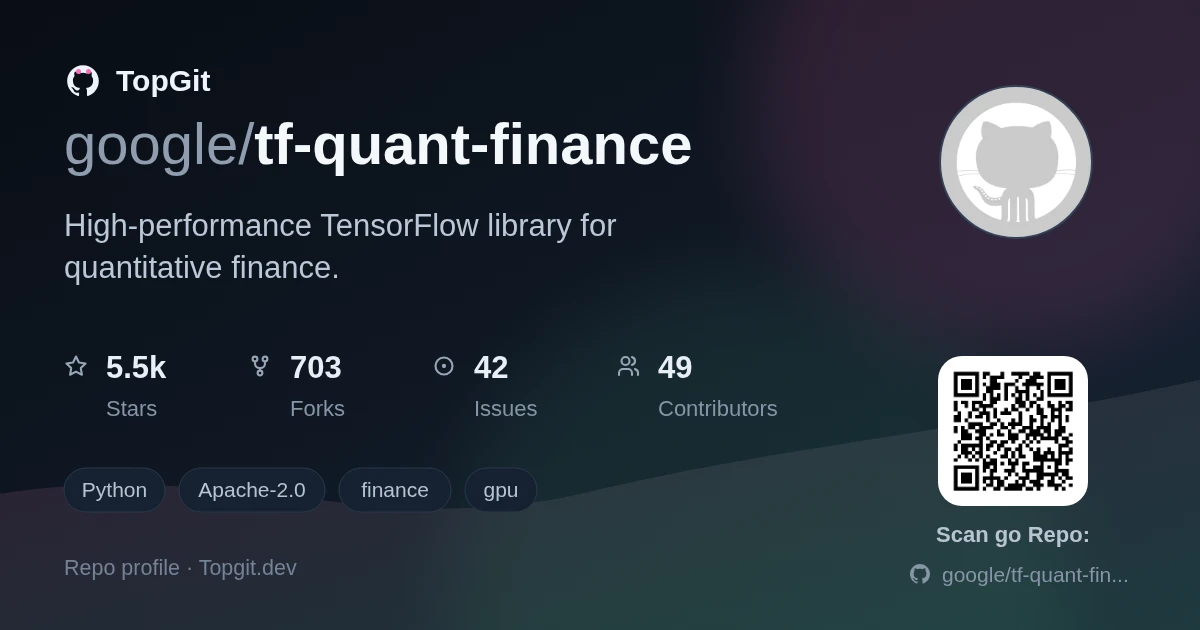
A look at google/tf-quant-finance: 5.6k stars on GitHub, written primarily in Python, tracked under the Backend category. High-performance TensorFlow library for quantitative finance.
Snapshot summary built from the project's own GitHub metadata — there's no written TopGit review yet. The page will update automatically when a full review is published.
WHY NO REVIEW YET
TopGit writes full reviews for the most-starred, most-requested repositories. This page is a snapshot until then — see the READ ME tab for the original README in full.
TF Quant Finance: TensorFlow based Quant Finance Library (ARCHIVED)
[!IMPORTANT]
This library is no longer maintained and has been archived. If you depend on
the functionality provided by this library, we suggest to fork it and continue
development elsewhere.
Table of contents
Introduction
Installation
TensorFlow training
Development roadmap
Examples
Contributing
Development
Community
Disclaimers
License
Introduction
This library provides high-performance components leveraging the hardware
acceleration support and automatic differentiation of TensorFlow. The
library will provide TensorFlow support for foundational mathematical methods,
mid-level methods, and specific pricing models. The coverage is being
expanded over the next few months.
The library is structured along three tiers:
Foundational methods.
Core mathematical methods - optimisation, interpolation, root finders,
linear algebra, random and quasi-random number generation, etc.
Mid-level methods.
ODE & PDE solvers, Ito process framework, Diffusion Path Generators,
Copula samplers etc.
Pricing methods and other quant finance specific utilities.
Specific Pricing models (e.g., Local Vol (LV), Stochastic Vol (SV),
Stochastic Local Vol (SLV), Hull-White (HW)) and their calibration.
Rate curve building, payoff descriptions, and schedule generation.
We aim for the library components to be easily accessible at each level. Each layer will be accompanied by many examples that can run independently of
higher-level components.
Installation
The easiest way to get started with the library is via the pip package.
Note that the library requires Python 3.7 and Tensorflow >= 2.7.
First, please install the most recent version of TensorFlow by following
the TensorFlow installation instructions.
For example, you could install TensorFlow
pip3 install --upgrade tensorflow
Then run
pip3 install --upgrade tf-quant-finance
You maybe also have to use the option --user.
TensorFlow training
If you are not familiar with TensorFlow, an excellent place to get started is with the
following self-study introduction to TensorFlow notebooks:
Introduction to TensorFlow Part 1 - Basics.
Introduction to TensorFlow Part 2 - Debugging and Control Flow.
Introduction to TensorFlow Part 3 - Advanced Tensor Manipulation.
Development roadmap
We are working on expanding the coverage of the library. Areas under active development are:
Ito Processes: Framework for defining Ito processes.
Includes methods for sampling paths from a process and for solving the
associated backward Kolmogorov equation.
Implementation of the following specific processes/models:
Brownian Motion
Geometric Brownian Motion
Ornstein-Uhlenbeck
One-Factor Hull-White model
Heston model
Local volatility model.
Quadratic Local Vol model.
SABR model
Copulas: Support for defining and sampling from copulas.
Model Calibration:
Dupire local vol calibration.
SABR model calibration.
Rate curve fitting: Hagan-West algorithm for yield curve bootstrapping and the Monotone Convex interpolation scheme.
Support for dates, day-count conventions, holidays, etc.
Examples
See tf_quant_finance/examples/
for end-to-end examples. It includes tutorial notebooks such as:
American Option pricing under the Black-Scholes model
Monte Carlo via Euler Scheme
Black Scholes: Price and Implied Vol
Forward and Backward mode gradients in TFF
Root search using Brent's method
Optimization
Swap Curve Fitting
Vectorization and XLA compilation
The above links will open Jupyter Notebooks in Colab.
Contributing
We're eager to collaborate with you! See CONTRIBUTING.md for a guide on how to contribute. This project adheres to TensorFlow's code of conduct. By participating, you are expected to uphold this code.
Development
This section is for developers who want to contribute code to the
library. If you are only interested in using the library, please follow the
instructions in the Installation section.
Development dependencies
This library has the following dependencies:
Bazel
Python 3 (Bazel uses Python 3 by default)
TensorFlow version >= 2.7
TensorFlow Probability version between v0.11.0 and v0.12.1
Numpy version 1.21 or higher
Attrs
Dataclasses (not needed if your Python version >= 3.7)
This library requires the
Bazel build system. Please follow the
Bazel installation instructions
for your platform.
You can install TensorFlow and related dependencies using the pip3 install
command:
GitHub repository: Report bugs or make feature requests.
TensorFlow Blog: Stay up to date on content from the TensorFlow team and best articles from the community.
[email protected]: Open mailing list for discussion and questions of this library.
TensorFlow Probability: This library will leverage methods from TensorFlow Probability (TFP).
Disclaimers
Google does not officially support this product. This library is under active development, and interfaces may change at any time.
License
This library is licensed under the Apache 2 license (see LICENSE). This library uses Sobol primitive polynomials and initial direction numbers
which are licensed under the BSD license.
Does google/tf-quant-finance have a project website?
No homepage URL was recorded for google/tf-quant-finance in TopGit's last sync. The README tab above frequently contains screenshots and demo links, or check the repository description on GitHub.
How active is development on google/tf-quant-finance?
The most recent commit recorded on google/tf-quant-finance was 9 months ago, based on the GitHub push timestamp. The repository has 705 forks — one of the better signals of community interest.
How many stars does google/tf-quant-finance have?
google/tf-quant-finance has 5.6k GitHub stars — refresh the page for the live number, or check github.com/google/tf-quant-finance. TopGit mirrors GitHub's count but does not claim minute-by-minute accuracy.
What language is google/tf-quant-finance written in?
google/tf-quant-finance is written primarily in Python. GitHub's language field is based on the largest share of bytes in the default branch.
What license does google/tf-quant-finance use?
google/tf-quant-finance is released under the Apache-2.0 license. Always verify the LICENSE file directly on GitHub for the authoritative terms — license strings can be edited out of sync with a project's actual stance.
What topics is google/tf-quant-finance associated with?
Where do I read more about google/tf-quant-finance?
This TopGit page is a snapshot — the READ ME tab shows the project's own README content (links stripped, images preserved). The GitHub repository at github.com/google/tf-quant-finance is the definitive source.
Read full README in the tab above.
Still deciding about tf-quant-finance?
One click hands the question to an AI along with this page — see what it says about tf-quant-finance.

 /tf-quant-finance