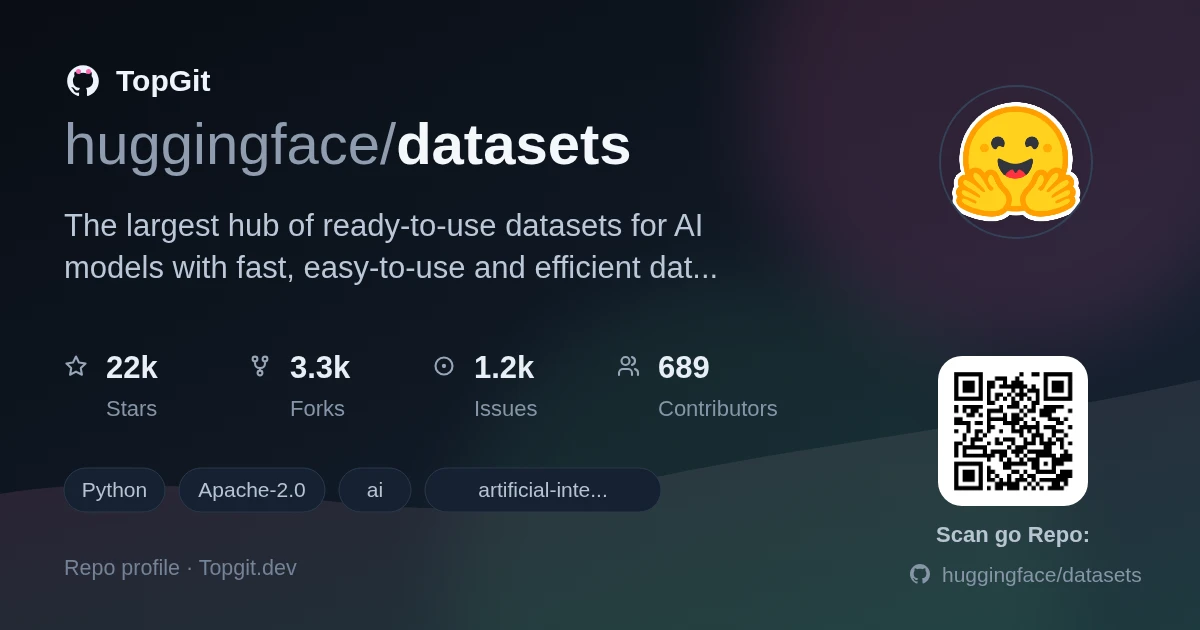
As an AI tool, huggingface/datasets has picked up 21.8k stars on GitHub (Python). 🤗 The largest hub of ready-to-use datasets for AI models with fast, easy-to-use and efficient data manipulation tools
Snapshot summary built from the project's own GitHub metadata — there's no written TopGit review yet. The page will update automatically when a full review is published.
WHY NO REVIEW YET
TopGit writes full reviews for the most-starred, most-requested repositories. This page is a snapshot until then — see the READ ME tab for the original README in full.
🤗 Datasets is a lightweight library providing two main features:
one-line dataloaders for many public datasets: one-liners to download and pre-process any of the major public datasets (image datasets, audio datasets, text datasets in 467 languages and dialects, 3D medical images, video datasets, agent traces, etc.) provided on the HuggingFace Datasets Hub. With a simple command like squad_dataset = load_dataset("rajpurkar/squad"), get any of these datasets ready to use in a dataloader for training/evaluating a ML model (Numpy/Pandas/PyTorch/TensorFlow/JAX/Polars),
efficient data pre-processing: simple, fast and reproducible data pre-processing for the public datasets as well as your own local datasets in CSV, JSON, JSONL, Parquet, HDF5, XML, text, PNG, JPEG, WAV, MP3, PDF, NIfTI, and more. With simple commands like processed_dataset = dataset.map(process_example), efficiently prepare the dataset for inspection and ML model evaluation and training.
🎓 Documentation 🔎 Find a dataset in the Hub 🌟 Share a dataset on the Hub
🚀 Key Features
🤗 Datasets is designed to let the community easily add and share new datasets, and provides powerful capabilities for data manipulation:
Feature
Description
📦 One-line dataset loading
Load AI-ready datasets from the Hugging Face Hub or local files with load_dataset()
🔍 Multiple formats
Native support for CSV, JSON, JSONL, Parquet, Arrow, XML, Text, Webdataset, and more
🖼️ Multi-modal data
Built-in support for text, audio, image, video, PDF, and NIfTI (3D medical) data
🚀 Streaming mode
Stream datasets without downloading — iterate over data on-the-fly with streaming=True (now up to 100x faster with Xet backend)
💾 HF Storage Buckets
Read and write directly from/to Hugging Face Storage Buckets for mutable, large-scale raw data
🧠 AI Agent Traces
Load and process AI agent traces (prompts, tool calls, responses) from the Hub
⚡ Apache Arrow backend
Zero-copy memory-mapped storage — datasets naturally free you from RAM limitations
🔄 Smart caching
Never wait for your data to process twice — cached results are automatically reused
🤗 Datasets supports various optional features via extras:
# For audio (torchcodec)
pip install datasets[audio]

# For image/video (Pillow, torchcodec)
pip install datasets[vision]

# For PDFs/NIfTI (pdfplumber, nibabel)
pip install datasets[pdfs,nibabel]

# For PyTorch/TensorFlow/JAX integration
pip install datasets[torch,tensorflow,jax]
For more details on installation, check the installation page.
Quick Start
🤗 Datasets is made to be very simple to use — the API is centered around a single function, datasets.load_dataset(dataset_name, **kwargs), that instantiates a dataset.
Here is a quick example:
from datasets import load_dataset

# Load a dataset and print the first example in the training set
squad_dataset = load_dataset('rajpurkar/squad')
print(squad_dataset['train'][0])

# Process the dataset - add a column with the length of the context texts
dataset_with_length = squad_dataset.map(lambda x: {"length": len(x["context"])})

# Tokenize the context texts (using a tokenizer from the 🤗 Transformers library)
from transformers import AutoTokenizer
tokenizer = AutoTokenizer.from_pretrained('bert-base-cased')

tokenized_dataset = squad_dataset.map(lambda x: tokenizer(x['context']), batched=True)

# Tokenize chat conversations with a chat template (using a model that supports chat templates)
# This is useful for fine-tuning instruction/chat models

# Load a popular chat dataset (ultrachat_200k contains ~200k AI assistant conversations)
chat_dataset = load_dataset('HuggingFaceH4/ultrachat_200k', split='train_sft')

chat_tokenizer = AutoTokenizer.from_pretrained('Qwen/Qwen2.5-7B-Instruct')

def tokenize_chat(examples):
    # Apply the chat template and tokenize in one step
    return chat_tokenizer.apply_chat_template(examples["messages"])

tokenized_chat_dataset = chat_dataset.map(tokenize_chat, batched=True)
Streaming mode
If your dataset is bigger than your disk or if you don't want to wait to download the data, you can use streaming:
# Stream the dataset without downloading anything
image_dataset = load_dataset('timm/imagenet-1k-wds', streaming=True)
for example in image_dataset["train"]:
    print(example["image"])
    break
Multi-modal data
🤗 Datasets supports a wide variety of data types out of the box:
# Load from local CSV
dataset = load_dataset('csv', data_files='my_data.csv')

# Load from local Parquet
dataset = load_dataset('parquet', data_files='data/*.parquet')

# Load from a local directory (auto-detect format)
dataset = load_dataset('./path/to/data')
From Python objects
from datasets import Dataset

# From a dictionary
dataset = Dataset.from_dict({"text": ["Hello world", "How are you?"]})

# From a list
dataset = Dataset.from_list([{"text": "Hello world"}, {"text": "How are you?"}])

# From Pandas
import pandas as pd
df = pd.DataFrame({"col1": [1, 2, 3], "col2": ["a", "b", "c"]})
dataset = Dataset.from_pandas(df)

# From a generator
def gen():
    for i in range(10):
        yield {"value": i}
dataset = Dataset.from_generator(gen)
For more details on using the library, check the quick start guide and the specific pages on:
Loading a dataset
What's in a Dataset
Processing data with 🤗 Datasets
Processing audio data
Processing image data
Processing text data
Processing PDF data
Processing video data
Streaming a dataset
Core Classes
The library provides two main dataset classes:
Class
Description
Dataset
In-memory / memory-mapped dataset backed by Apache Arrow. Supports indexing, slicing, random access and caching.
IterableDataset
Lazy, streamable dataset for large-scale / out-of-core processing. Supports streaming and infinite iteration.
Both are wrapped in DatasetDict / IterableDatasetDict for multi-split datasets (e.g., train/test/val).
Add a new dataset to the Hub
We have a very detailed step-by-step guide to add a new dataset to the datasets already provided on the HuggingFace Datasets Hub.
You can find:
how to upload a dataset to the Hub using your web browser or Python and also
how to upload it using Git.
Disclaimers
You can use 🤗 Datasets to load datasets based on versioned git repositories maintained by the dataset authors. For reproducibility reasons, we ask users to pin the revision of the repositories they use.
If you're a dataset owner and wish to update any part of it (description, citation, license, etc.), or do not want your dataset to be included in the Hugging Face Hub, please get in touch by opening a discussion or a pull request in the Community tab of the dataset page. Thanks for your contribution to the ML community!
Contributing
We welcome contributions! Please see our Contributing Guide for details on:
How to submit issues and pull requests
Code style guidelines (we use Ruff)
Testing requirements
Documentation standards
BibTeX
If you want to cite our 🤗 Datasets library, you can use our paper:
@inproceedings{lhoest-etal-2021-datasets,
    title = "Datasets: A Community Library for Natural Language Processing",
    author = "Lhoest, Quentin  and
      Villanova del Moral, Albert  and
      Jernite, Yacine  and
      Thakur, Abhishek  and
      von Platen, Patrick  and
      Patil, Suraj  and
      Chaumond, Julien  and
      Drame, Mariama  and
      Plu, Julien  and
      Tunstall, Lewis  and
      Davison, Joe  and
      {\v{S}}a{\v{s}}ko, Mario  and
      Chhablani, Gunjan  and
      Malik, Bhavitvya  and
      Brandeis, Simon  and
      Le Scao, Teven  and
      Sanh, Victor  and
      Xu, Canwen  and
      Patry, Nicolas  and
      McMillan-Major, Angelina  and
      Schmid, Philipp  and
      Gugger, Sylvain  and
      Delangue, Cl{\'e}ment  and
      Matussi{\`e}re, Th{\'e}o  and
      Debut, Lysandre  and
      Bekman, Stas  and
      Cistac, Pierric  and
      Goehringer, Thibault  and
      Mustar, Victor  and
      Lagunas, Fran{\c{c}}ois  and
      Rush, Alexander  and
      Wolf, Thomas",
    booktitle = "Proceedings of the 2021 Conference on Empirical Methods in Natural Language Processing: System Demonstrations",
    month = nov,
    year = "2021",
    address = "Online and Punta Cana, Dominican Republic",
    publisher = "Association for Computational Linguistics",
    url = "https://aclanthology.org/2021.emnlp-demo.21",
    pages = "175--184",
    abstract = "The scale, variety, and quantity of publicly-available NLP datasets has grown rapidly as researchers propose new tasks, larger models, and novel benchmarks. Datasets is a community library for contemporary NLP designed to support this ecosystem. Datasets aims to standardize end-user interfaces, versioning, and documentation, while providing a lightweight front-end that behaves similarly for small datasets as for internet-scale corpora. The design of the library incorporates a distributed, community-driven approach to adding datasets and documenting usage. After a year of development, the library now includes more than 650 unique datasets, has more than 250 contributors, and has helped support a variety of novel cross-dataset research projects and shared tasks. The library is available at https://github.com/huggingface/datasets.",
    eprint={2109.02846},
    archivePrefix={arXiv},
    primaryClass={cs.CL},
}
If you need to cite a specific version of our 🤗 Datasets library for reproducibility, you can use the corresponding version Zenodo DOI from this list.
How does huggingface/datasets compare to other AI Tools projects?
huggingface/datasets is tracked by TopGit in the AI Tools category, with 21.8k GitHub stars and written in Python. Browse the AI Tools topic page on TopGit to compare it against similar projects by stars and activity.
Is huggingface/datasets open source?
Yes — huggingface/datasets ships under the Apache-2.0 license, which makes its source code freely readable (and, depending on license terms, forkable and reusable). Source: github.com/huggingface/datasets.
What else is in the AI Tools space?
huggingface/datasets is tracked by TopGit under the AI Tools category, alongside 16 GitHub-tagged topics. Trending and Topics pages list peer repositories of comparable stars and language.
What is huggingface/datasets?
huggingface/datasets (huggingface/datasets) is a Python project on GitHub. From the project's own README: 🤗 The largest hub of ready-to-use datasets for AI models with fast, easy-to-use and efficient data manipulation tools
Where do I read more about huggingface/datasets?
This TopGit page is a snapshot — the READ ME tab shows the project's own README content (links stripped, images preserved). The GitHub repository at github.com/huggingface/datasets is the definitive source.
Why is huggingface/datasets categorized under AI Tools?
TopGit places huggingface/datasets in the AI Tools category based on its GitHub topics and description (tagged: "ai", "artificial-intelligence", "computer-vision"). Categories are assigned from real repository metadata, not editorial guesswork.