A data-focused entry in TopGit's GitHub warehouse: ibis-project/ibis, 6.6k stars, Data, Python. the portable Python dataframe library
Snapshot summary built from the project's own GitHub metadata — there's no written TopGit review yet. The page will update automatically when a full review is published.
WHY NO REVIEW YET
TopGit writes full reviews for the most-starred, most-requested repositories. This page is a snapshot until then — see the READ ME tab for the original README in full.
See the getting started tutorial for a full introduction to Ibis.
Python + SQL: better together
For most backends, Ibis works by compiling its dataframe expressions into SQL:
>>> ibis.to_sql(g)
SELECT
  "t1"."species",
  "t1"."island",
  "t1"."count"
FROM (
  SELECT
    "t0"."species",
    "t0"."island",
    COUNT(*) AS "count"
  FROM "penguins" AS "t0"
  GROUP BY
    1,
    2
) AS "t1"
ORDER BY
  "t1"."count" ASC
You can mix SQL and Python code:
>>> a = t.sql("SELECT species, island, count(*) AS count FROM penguins GROUP BY 1, 2")
>>> a
┏━━━━━━━━━━━┳━━━━━━━━━━━┳━━━━━━━┓
┃ species   ┃ island    ┃ count ┃
┡━━━━━━━━━━━╇━━━━━━━━━━━╇━━━━━━━┩
│ string    │ string    │ int64 │
├───────────┼───────────┼───────┤
│ Adelie    │ Torgersen │    52 │
│ Adelie    │ Biscoe    │    44 │
│ Adelie    │ Dream     │    56 │
│ Gentoo    │ Biscoe    │   124 │
│ Chinstrap │ Dream     │    68 │
└───────────┴───────────┴───────┘
>>> b = a.order_by("count")
>>> b
┏━━━━━━━━━━━┳━━━━━━━━━━━┳━━━━━━━┓
┃ species   ┃ island    ┃ count ┃
┡━━━━━━━━━━━╇━━━━━━━━━━━╇━━━━━━━┩
│ string    │ string    │ int64 │
├───────────┼───────────┼───────┤
│ Adelie    │ Biscoe    │    44 │
│ Adelie    │ Torgersen │    52 │
│ Adelie    │ Dream     │    56 │
│ Chinstrap │ Dream     │    68 │
│ Gentoo    │ Biscoe    │   124 │
└───────────┴───────────┴───────┘
This allows you to combine the flexibility of Python with the scale and performance of modern SQL.
Backends
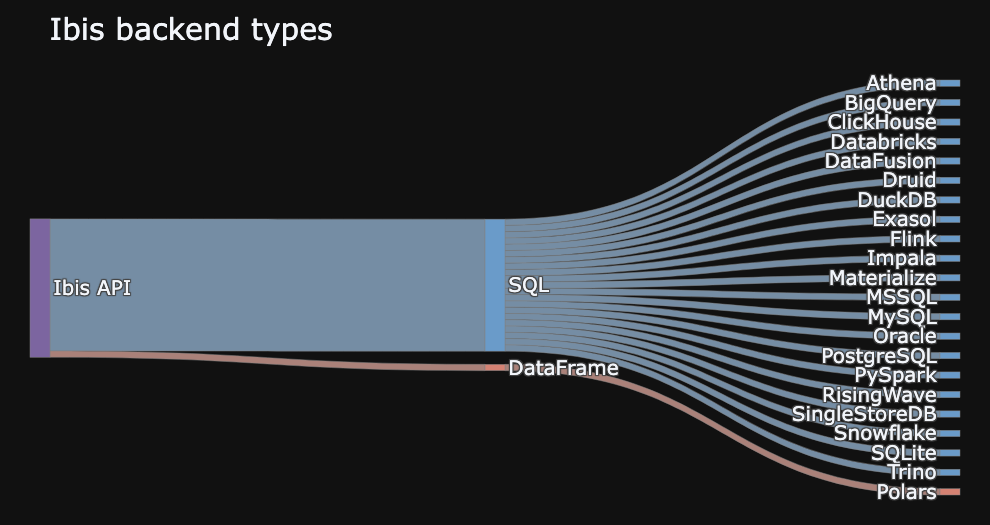
Ibis supports more than 20 backends:
Apache DataFusion
Apache Druid
Apache Flink
Apache Impala
Apache PySpark
Athena
BigQuery
ClickHouse
Databricks
DuckDB
Exasol
Materialize
MySQL/MariaDB
Oracle
Polars
PostgreSQL
RisingWave
SingleStoreDB
SQL Server
SQLite
Snowflake
Trino
How it works
Most Python dataframes are tightly coupled to their execution engine. And many databases only support SQL, with no Python API. Ibis solves this problem by providing a common API for data manipulation in Python, and compiling that API into the backend’s native language. This means you can learn a single API and use it across any supported backend (execution engine).
Ibis broadly supports two types of backend:
SQL-generating backends
DataFrame-generating backends
Portability
To use different backends, you can set the backend Ibis uses:
>>> con = ibis.duckdb.connect()
>>> con = ibis.polars.connect()
>>> con = ibis.datafusion.connect()
And work with tables in that backend:
>>> con.list_tables()
['penguins']
>>> t = con.table("penguins")
You can also read from common file formats like CSV or Apache Parquet:
>>> t = con.read_csv("penguins.csv")
>>> t = con.read_parquet("penguins.parquet")
This allows you to iterate locally and deploy remotely by changing a single line of code.
💡 Tip
Check out the blog on backend agnostic arrays for one example using the same code across DuckDB and BigQuery.
Community and contributing
Ibis is an open source project and welcomes contributions from anyone in the community.
Read the contributing guide.
We care about keeping the community welcoming for all. Check out the code of conduct.
The Ibis project is open sourced under the Apache License.
Join our community by interacting on GitHub or chatting with us on Zulip.
For more information visit https://ibis-project.org/.
Governance
The Ibis project is an independently governed open source community project to build and maintain the portable Python dataframe library. Ibis has contributors across a range of data companies and institutions.
The most recent commit recorded on ibis-project/ibis was 16 days ago, based on the GitHub push timestamp. The repository has 751 forks — one of the better signals of community interest.
How many stars does ibis-project/ibis have?
ibis-project/ibis has 6.6k GitHub stars — refresh the page for the live number, or check github.com/ibis-project/ibis. TopGit mirrors GitHub's count but does not claim minute-by-minute accuracy.
Is ibis-project/ibis open source?
Yes — ibis-project/ibis ships under the Apache-2.0 license, which makes its source code freely readable (and, depending on license terms, forkable and reusable). Source: github.com/ibis-project/ibis.
What else is in the Data space?
ibis-project/ibis is tracked by TopGit under the Data category, alongside 18 GitHub-tagged topics. Trending and Topics pages list peer repositories of comparable stars and language.
What is ibis-project/ibis?
ibis-project/ibis (ibis-project/ibis) is a Python project on GitHub. From the project's own README: the portable Python dataframe library
What language is ibis-project/ibis written in?
ibis-project/ibis is written primarily in Python. GitHub's language field is based on the largest share of bytes in the default branch.
What license does ibis-project/ibis use?
ibis-project/ibis is released under the Apache-2.0 license. Always verify the LICENSE file directly on GitHub for the authoritative terms — license strings can be edited out of sync with a project's actual stance.
Where do I read more about ibis-project/ibis?
This TopGit page is a snapshot — the READ ME tab shows the project's own README content (links stripped, images preserved). The GitHub repository at github.com/ibis-project/ibis is the definitive source.
Read full README in the tab above.
Curious whether ibis is right for you?
Let ChatGPT, Claude, or Perplexity look into it — click below and see what AI actually says about ibis.