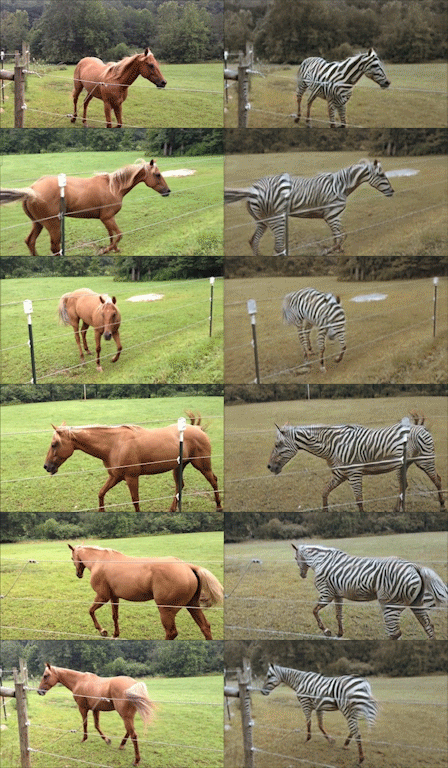
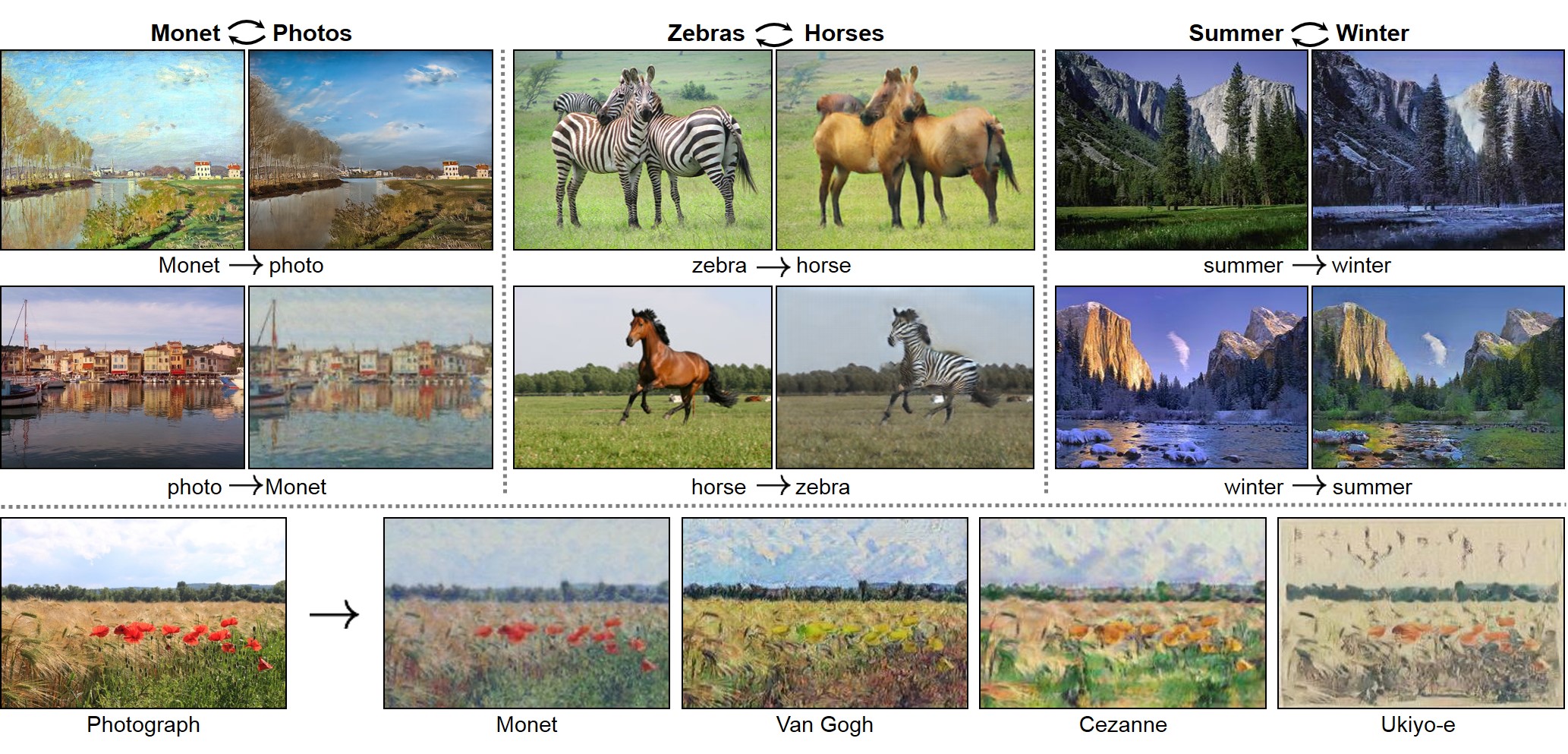
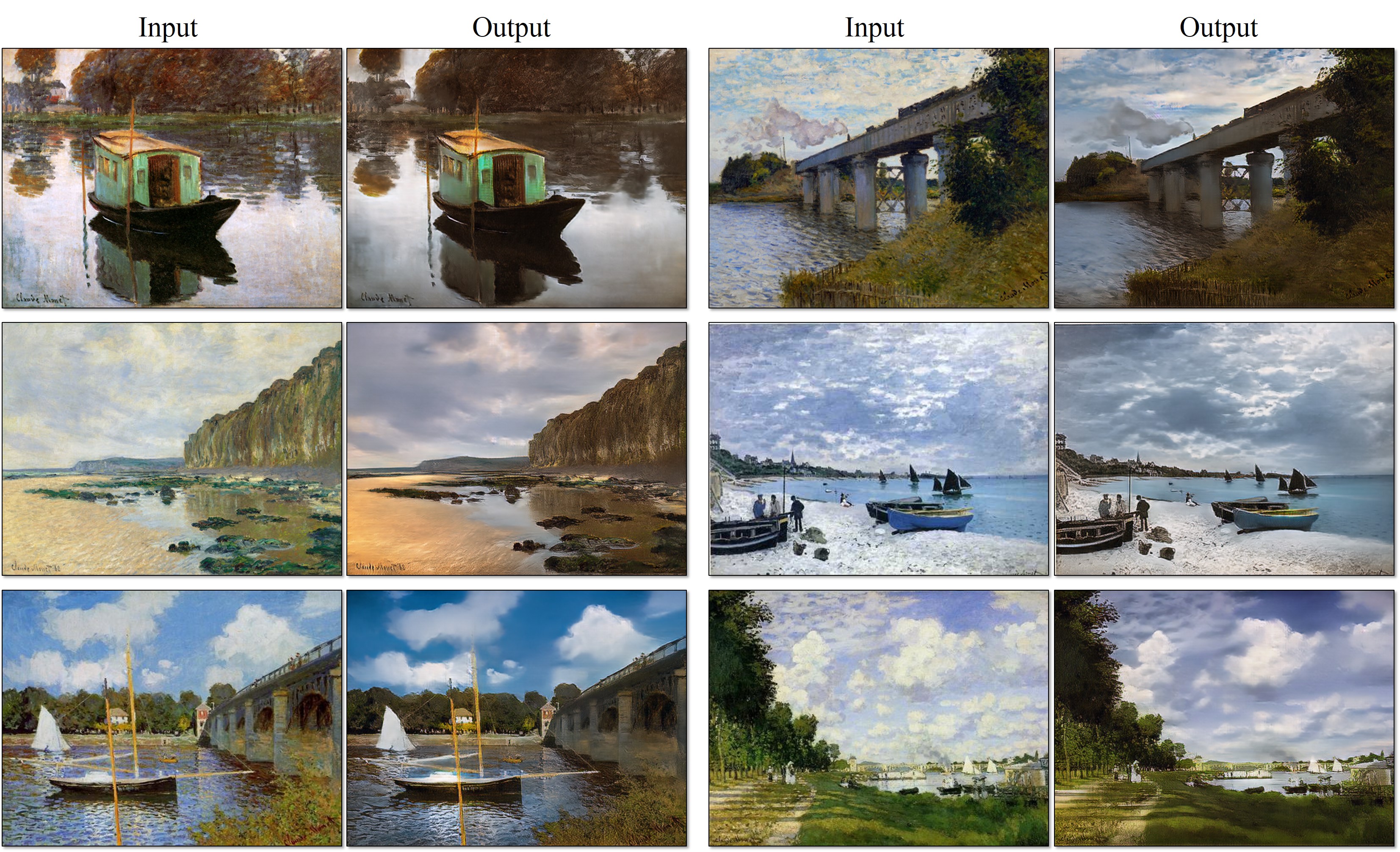
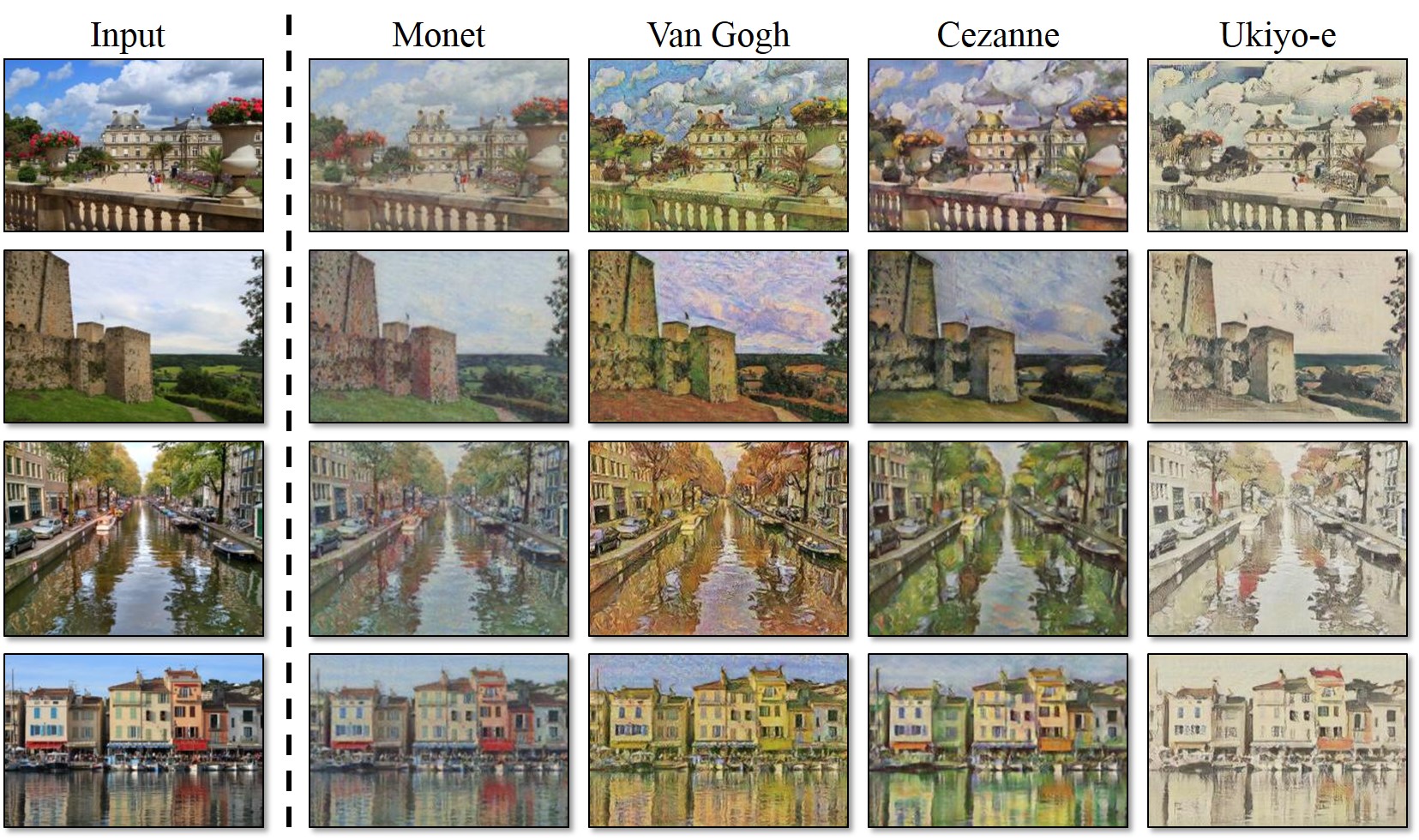
junyanz/CycleGAN sits at 12.9k stars on GitHub, written primarily in Lua. Software that can generate photos from paintings, turn horses into zebras, perform style transfer, and more.
Snapshot summary built from the project's own GitHub metadata — there's no written TopGit review yet. The page will update automatically when a full review is published.
WHY NO REVIEW YET
TopGit writes full reviews for the most-starred, most-requested repositories. This page is a snapshot until then — see the READ ME tab for the original README in full.
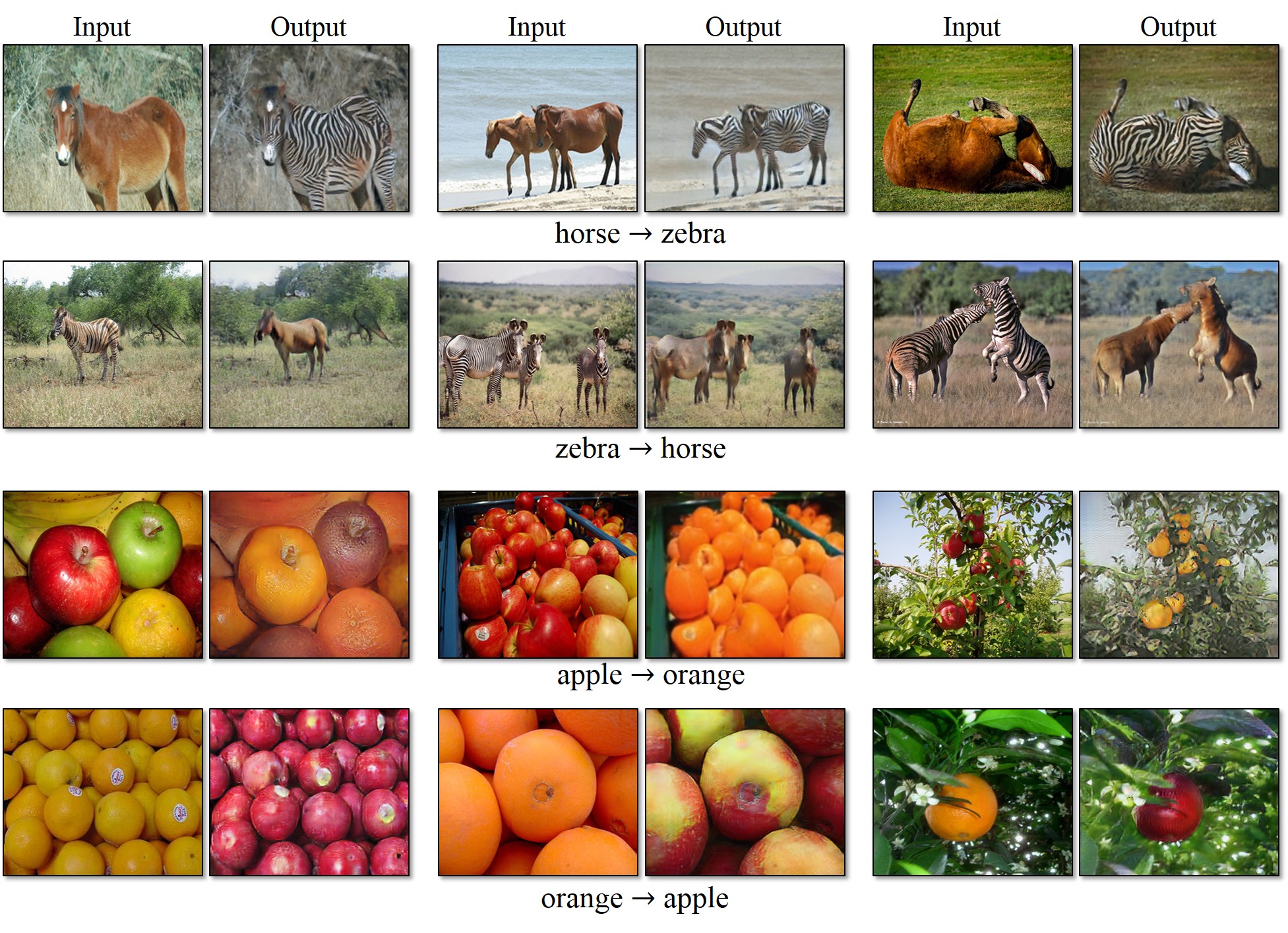
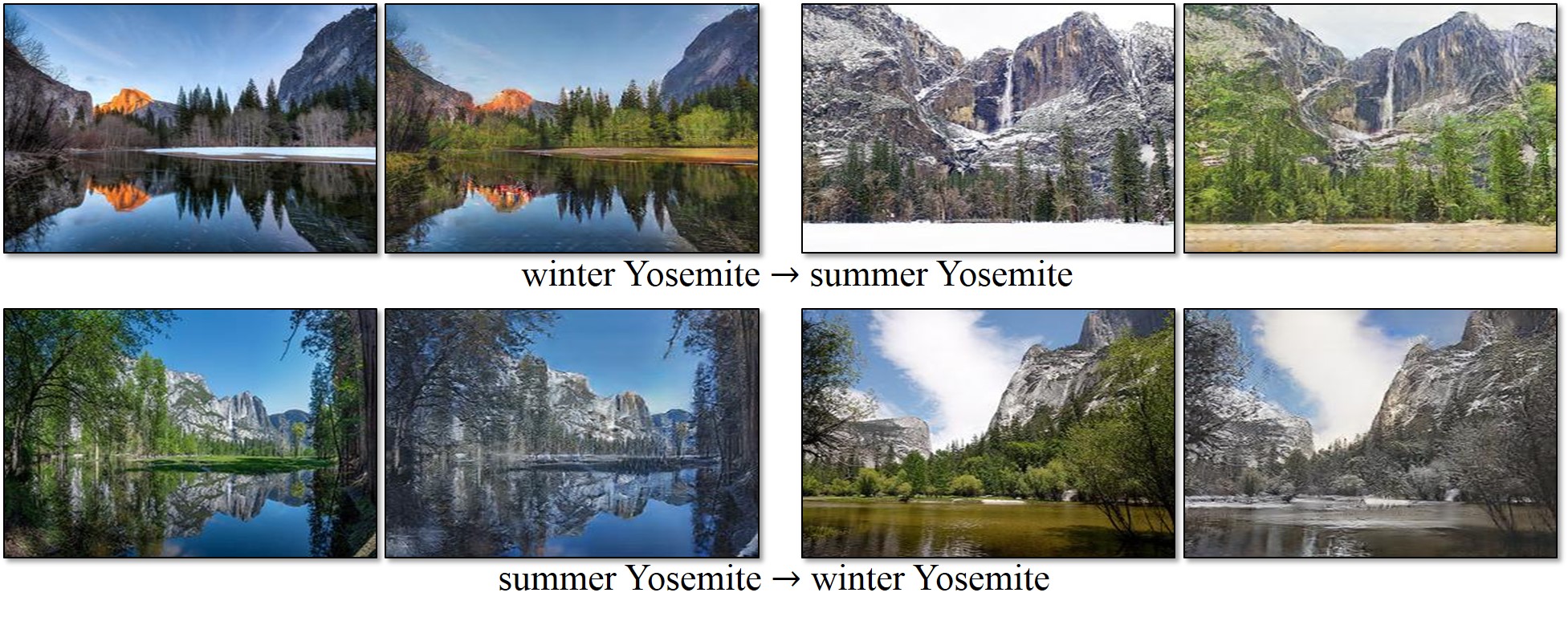
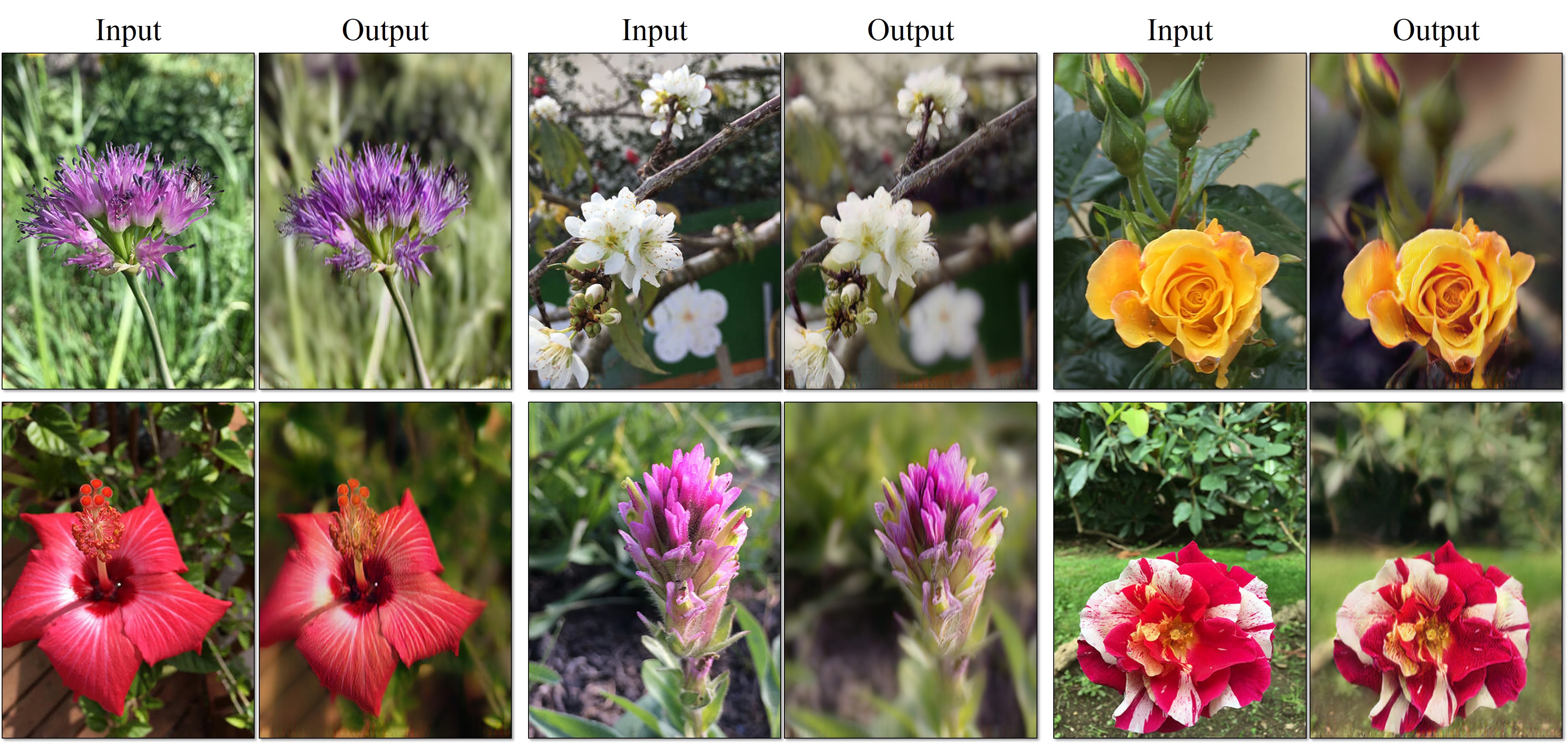
Torch implementation for learning an image-to-image translation (i.e. pix2pix) without input-output pairs, for example:
New: Please check out contrastive-unpaired-translation (CUT), our new unpaired image-to-image translation model that enables fast and memory-efficient training.
Unpaired Image-to-Image Translation using Cycle-Consistent Adversarial Networks
Jun-Yan Zhu*, Taesung Park*, Phillip Isola, Alexei A. Efros
Berkeley AI Research Lab, UC Berkeley
In ICCV 2017. (* equal contributions)
This package includes CycleGAN, pix2pix, as well as other methods like BiGAN/ALI and Apple's paper S+U learning.
The code was written by Jun-Yan Zhu and Taesung Park. Update: Please check out PyTorch implementation for CycleGAN and pix2pix.
The PyTorch version is under active development and can produce results comparable or better than this Torch version.
The test results will be saved to ./results/style_cezanne_pretrained/latest_test/index.html.
Please refer to Model Zoo for more pre-trained models.
./examples/test_vangogh_style_on_ae_photos.sh is an example script that downloads the pretrained Van Gogh style network and runs it on Efros's photos.
Train
Download a dataset (e.g. zebra and horse images from ImageNet):
Models are saved to ./checkpoints/expt_name (can be changed by passing checkpoint_dir=your_dir in train.lua).
See opt_train in options.lua for additional training options.
This will run the model named expt_name in both directions on all images in /path/to/data/testA and /path/to/data/testB.
A webpage with result images will be saved to ./results/expt_name (can be changed by passing results_dir=your_dir in test.lua).
See opt_test in options.lua for additional test options. Please use model=one_direction_test if you only would like to generate outputs of the trained network in only one direction, and specify which_direction=AtoB or which_direction=BtoA to set the direction.
There are other options that can be used. For example, you can specify resize_or_crop=crop option to avoid resizing the image to squares. This is indeed how we trained GTA2Cityscapes model in the projet webpage and Cycada model. We prepared the images at 1024px resolution, and used resize_or_crop=crop fineSize=360 to work with the cropped images of size 360x360. We also used lambda_identity=1.0.
Datasets
Download the datasets using the following script. Many of the datasets were collected by other researchers. Please cite their papers if you use the data.
bash ./datasets/download_dataset.sh dataset_name
facades: 400 images from the CMP Facades dataset. [Citation]
cityscapes: 2975 images from the Cityscapes training set. [Citation]. Note: Due to license issue, we do not host the dataset on our repo. Please download the dataset directly from the Cityscapes webpage. Please refer to ./datasets/prepare_cityscapes_dataset.py for more detail.
maps: 1096 training images scraped from Google Maps.
horse2zebra: 939 horse images and 1177 zebra images downloaded from ImageNet using the keywords wild horse and zebra
apple2orange: 996 apple images and 1020 orange images downloaded from ImageNet using the keywords apple and navel orange.
summer2winter_yosemite: 1273 summer Yosemite images and 854 winter Yosemite images were downloaded using Flickr API. See more details in our paper.
monet2photo, vangogh2photo, ukiyoe2photo, cezanne2photo: The art images were downloaded from Wikiart. The real photos are downloaded from Flickr using the combination of the tags landscape and landscapephotography. The training set size of each class is Monet:1074, Cezanne:584, Van Gogh:401, Ukiyo-e:1433, Photographs:6853.
iphone2dslr_flower: both classes of images were downloaded from Flickr. The training set size of each class is iPhone:1813, DSLR:3316. See more details in our paper.
Display UI
Optionally, for displaying images during training and test, use the display package.
Install it with: luarocks install https://raw.githubusercontent.com/szym/display/master/display-scm-0.rockspec
Then start the server with: th -ldisplay.start
Open this URL in your browser: http://localhost:8000
By default, the server listens on localhost. Pass 0.0.0.0 to allow external connections on any interface:
th -ldisplay.start 8000 0.0.0.0
Then open http://(hostname):(port)/ in your browser to load the remote desktop.
Setup Training and Test data
To train CycleGAN model on your own datasets, you need to create a data folder with two subdirectories trainA and trainB that contain images from domain A and B. You can test your model on your training set by setting phase='train' in test.lua. You can also create subdirectories testA and testB if you have test data.
You should not expect our method to work on just any random combination of input and output datasets (e.g. cats<->keyboards). From our experiments, we find it works better if two datasets share similar visual content. For example, landscape painting<->landscape photographs works much better than portrait painting <-> landscape photographs. zebras<->horses achieves compelling results while cats<->dogs completely fails. See the following section for more discussion.
Failure cases
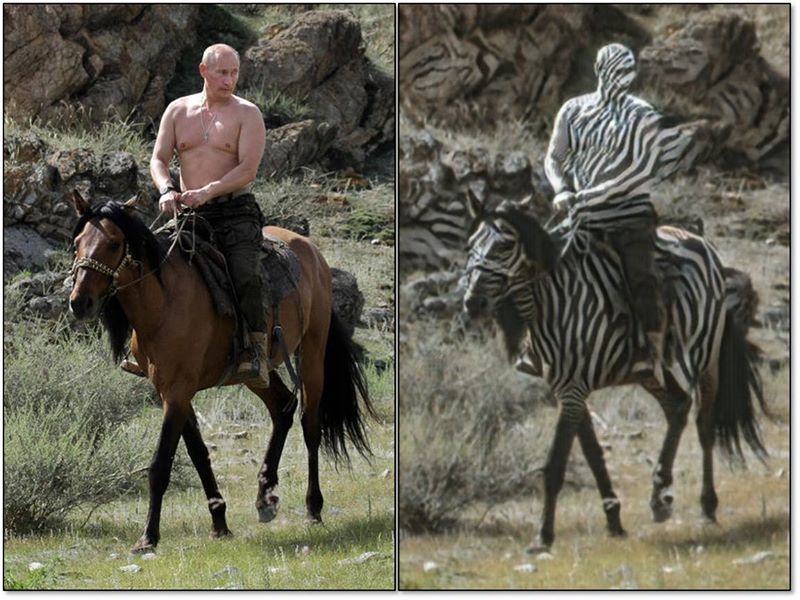
Our model does not work well when the test image is rather different from the images on which the model is trained, as is the case in the figure to the left (we trained on horses and zebras without riders, but test here one a horse with a rider). See additional typical failure cases here. On translation tasks that involve color and texture changes, like many of those reported above, the method often succeeds. We have also explored tasks that require geometric changes, with little success. For example, on the task of dog<->cat transfiguration, the learned translation degenerates into making minimal changes to the input. We also observe a lingering gap between the results achievable with paired training data and those achieved by our unpaired method. In some cases, this gap may be very hard -- or even impossible,-- to close: for example, our method sometimes permutes the labels for tree and building in the output of the cityscapes photos->labels task.
Citation
If you use this code for your research, please cite our paper:
@inproceedings{CycleGAN2017,
  title={Unpaired Image-to-Image Translation using Cycle-Consistent Adversarial Networkss},
  author={Zhu, Jun-Yan and Park, Taesung and Isola, Phillip and Efros, Alexei A},
  booktitle={Computer Vision (ICCV), 2017 IEEE International Conference on},
  year={2017}
}
Related Projects:
contrastive-unpaired-translation (CUT) pix2pix-Torch | pix2pixHD |
BicycleGAN | vid2vid | SPADE/GauGAN iGAN | GAN Dissection | GAN Paint
Cat Paper Collection
If you love cats, and love reading cool graphics, vision, and ML papers, please check out the Cat Paper Collection.
Acknowledgments
Code borrows from pix2pix and DCGAN. The data loader is modified from DCGAN and Context-Encoder. The generative network is adopted from neural-style with Instance Normalization.
How does junyanz/CycleGAN compare to other AI Tools projects?
junyanz/CycleGAN is tracked by TopGit in the AI Tools category, with 12.9k GitHub stars and written in Lua. Browse the AI Tools topic page on TopGit to compare it against similar projects by stars and activity.
Is junyanz/CycleGAN open source?
TopGit's metadata for junyanz/CycleGAN does not record a license. Most public repositories on GitHub ARE open source, but the exact terms vary — verify by opening the LICENSE file directly.
What else is in the AI Tools space?
junyanz/CycleGAN is tracked by TopGit under the AI Tools category, alongside 11 GitHub-tagged topics. Trending and Topics pages list peer repositories of comparable stars and language.
What is junyanz/CycleGAN?
junyanz/CycleGAN (junyanz/CycleGAN) is a Lua project on GitHub. From the project's own README: Software that can generate photos from paintings, turn horses into zebras, perform style transfer, and more.
Where do I read more about junyanz/CycleGAN?
This TopGit page is a snapshot — the READ ME tab shows the project's own README content (links stripped, images preserved). The GitHub repository at github.com/junyanz/CycleGAN is the definitive source.
Why is junyanz/CycleGAN categorized under AI Tools?
TopGit places junyanz/CycleGAN in the AI Tools category based on its GitHub topics and description (tagged: "computer-graphics", "computer-vision", "cyclegan"). Categories are assigned from real repository metadata, not editorial guesswork.
Read full README in the tab above.
Want a second opinion on CycleGAN?
Ask an AI that can read this page — one click and you get its take on CycleGAN.

 /CycleGAN