Kuberwastaken/claurst — 10.3k★ on GitHub (Rust). Agentic Coding for Builders who Ship
Snapshot summary built from the project's own GitHub metadata — there's no written TopGit review yet. The page will update automatically when a full review is published.
WHY NO REVIEW YET
TopGit writes full reviews for the most-starred, most-requested repositories. This page is a snapshot until then — see the READ ME tab for the original README in full.
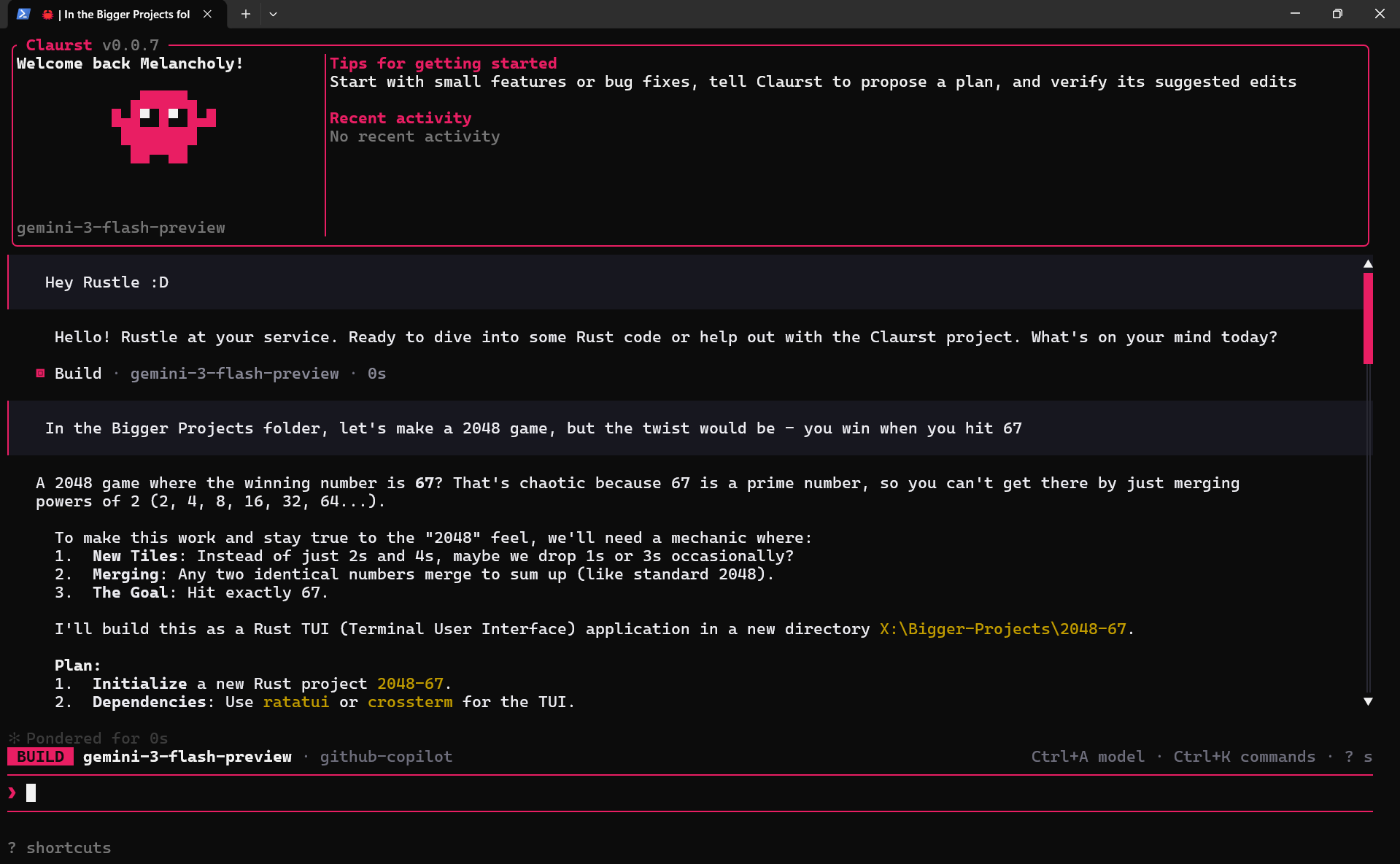
Claurst is an open-source, multi-provider terminal coding agent built from the ground up in Rust. It started as a clean-room reimplementation of Claude Code's behavior (from spec) and has since evolved into an amazing TUI pair programmer with multi-provider support, a rich UI, plugin system, a companion named Rustle, chat forking, memory consolidation, and much more.
It's fast, it's memory-efficient, it's yours to run however you want, and there's no tracking or telemetry.
[!IMPORTANT]
Claurst is now officially in Beta (v0.2.1). The core agent, multi-provider routing, and TUI are stable enough for daily driving — expect rough edges around experimental features (flagged below). Bug reports and PRs welcome.
[!NOTE]
Recent Updates (v0.2.0, see the changelog):
Sandbox and permissions: on macOS, Bash commands run in a Seatbelt sandbox that limits writes to the workspace and blocks network by default (/sandbox-toggle). Bash approvals are matched per command, approvals can be saved for the current project, and --allowed-tools / --disallowed-tools are enforced. See Permission rules and Shell Sandbox.
Hooks: Claude Code's hooks contract (settings shape, events, JSON stdin/stdout, exit code 2, timeouts), including plugin hooks. See Hooks.
Skills and instruction files:AGENTS.md and CLAUDE.md files are loaded from the git root down to the working directory, with @include; skills from .claurst/skills, .agents/skills and .claude/skills are listed to the model. See Instruction files and Skills.
Headless runs: typed stream-json events, documented exit codes, --resume / --continue, and --json-schema for a structured answer. See Headless mode.
Providers: Anthropic prompt caching and adaptive thinking; ChatGPT (Codex) subscription token refresh, prompt caching and reasoning replay; one retry policy and context compaction for every provider.
/share support: Use /share to share chat sessions with others via unlisted GitHub Gists. [EXPERIMENTAL]
Free Mode: Try out Free in '/connect' to get a great agentic coding experience in Claurst for absolutely free (or as good as free gets you :P). [EXPERIMENTAL]
/goal support: Try out /goal <objective> to see claurst keep working an objective, spanning multiple turns instead of stopping after one normal turn. [EXPERIMENTAL]
ultracode: The highest effort level — pick it in the effort selector (/effort, where it sits past max on the "Smarter" end with an animated purple spectrum) or just type ultracode anywhere in your prompt. The keyword lights up with a purple gradient (claurst's take on Claude Code's ultrathink) and that turn runs at the model's top reasoning plus a disciplined plan → delegate → integrate → verify workflow that fans bounded packets out across native subagents (Agent), swarms (TeamCreate), and background tasks (TaskCreate). Composes with /goal for sustained multi-turn objectives. [EXPERIMENTAL]
This drops claurst into ~/.local/bin (or %LOCALAPPDATA%\Programs\claurst on Windows; Git Bash uses the same Windows path) and adds it to your PATH automatically. Open a new terminal and run claurst.
Via npm / bun
If you have Node.js or Bun installed, you can install Claurst as a global package. The postinstall script automatically downloads the right pre-built binary for your platform.
# npm
npm install -g claurst

# bun
bun install -g claurst

# or run without installing
npx claurst
bunx claurst
To upgrade later, run:
claurst upgrade
Pin a specific version with --version 0.1.0 on either installer, or claurst upgrade --version 0.1.0.
Manual download
If you'd rather grab the binary yourself, the latest archives are on GitHub Releases:
Platform
Archive
Windows x86_64
claurst-windows-x86_64.zip
Linux x86_64
claurst-linux-x86_64.tar.gz
Linux aarch64
claurst-linux-aarch64.tar.gz
macOS Intel
claurst-macos-x86_64.tar.gz
macOS Apple Silicon
claurst-macos-aarch64.tar.gz
Each archive contains a single claurst (or claurst.exe) binary. Extract it and put it on your PATH.
Build from source
git clone https://github.com/kuberwastaken/claurst.git
cd claurst/src-rust
cargo build --release --package claurst

# Binary is at target/release/claurst
Raspberry Pi / systems without ALSA (e.g. Debian Trixie, headless servers):
# Build without voice/microphone support — no libasound2-dev required
cargo build --release --package claurst --no-default-features
First run
# Set your API key (or use /connect inside Claurst to configure)
export ANTHROPIC_API_KEY=sk-ant-...

# Or sign in with a ChatGPT subscription (Codex)
claurst codex login

# Start Claurst
claurst

# Or run a one-shot headless query
claurst -p "explain this codebase"

# Headless with one JSON event per line, or a structured answer
claurst -p --output-format stream-json "fix the failing test"
claurst -p --output-format json --json-schema schema.json "is this branch ready to merge?"
Claurst asks before running commands and editing files; see Permission modes. Project instructions go in AGENTS.md or CLAUDE.md at the repository root.
Devcontainer setup
After cloning this repository, open it in VS Code and use Reopen in Container to start the development environment.
Prerequisites:
Docker installed on your host machine: https://www.docker.com/products/docker-desktop/
GPG and SSH forwarding is enabled in the devcontainer, given you have it set up on your host machine. Follow this guide if you need help with that.
Devcontainer features
Base image: rust:1-bullseye.
Preinstalled build dependencies: gnupg2, libasound2-dev, libxdo-dev, and pkg-config.
Devcontainer features enabled: common-utils (with vscode user uid/gid 1000 and Zsh install disabled), git, and docker-outside-of-docker (moby: false).
Runs as vscode user by default.
Persistent Cargo caches via named volumes for /usr/local/cargo/registry and /usr/local/cargo/git.
Binds local .claurst into /home/vscode/.claurst for local settings/session history access.
Sets GNUPGHOME=/home/vscode/.gnupg and prepends src-rust/target/debug and src-rust/target/release to PATH.
Post-create setup creates and permissions .gnupg, and fixes ownership for /usr/local/cargo.
VS Code setting terminal.integrated.inheritEnv is enabled.
Editor integration (Agent Client Protocol)
Claurst speaks the Agent Client Protocol (ACP) — the open protocol pioneered by Zed for editor-to-agent communication. Any ACP-compatible editor (Zed, Neovim, JetBrains plugins, …) can drive Claurst as a subprocess and present it in the editor's native chat UI.
To use Claurst as the agent in your editor, point its ACP integration at:
Claurst will run in JSON-RPC 2.0 mode over stdio. It implements initialize, session/new, session/prompt, and session/cancel, streams session/update notifications (text deltas, agent thinking, tool calls with their progress + results), and evaluates tool permissions with the same rules as the TUI, sending only the calls that need approval to session/request_permission so the editor can show a native approval dialog. Each session uses the settings, instruction files and trusted MCP servers of its working directory.
Configure your provider / API key in ~/.claurst/settings.json (or claurst auth login, claurst codex login, or /connect inside the TUI) before launching — the ACP agent uses the same credentials and providers as the interactive TUI.
Enable verbose ACP logging (to stderr — never stdout, which would corrupt the protocol) by setting CLAURST_ACP_LOG=debug.
Listing on the ACP Registry
The Agent Client Protocol registry is the canonical directory editors look up when offering "available agents". To get Claurst listed:
Fork agentclientprotocol/registry.
Create a claurst/ folder at the repo root and drop in the prepared manifest from this repo: src-rust/crates/acp/registry-template/agent.json. Bump the version and release-archive URLs to match the latest GitHub release.
Add claurst/icon.svg (16×16 recommended) — the Rustle logo from public/ is a fine starting point.
Open a PR to the registry. The registry CI validates agent.json against the schema before merge.
After merge, Zed and other ACP-aware editors will pick up Claurst on their next registry refresh.
Documentation
For more info on how to configure Claurst, head over to our docs.
PS: The original breakdown of the findings from Claude Code's source that started this project is on my blog - the full technical writeup of what was found, how the leak happened, and what it revealed.
Contributing
Claurst is built for the community, by the community and we'd love your help making it better.
Please see and include AGENTS.md for project-specific rules (for both humans and agents).
Open an issue for bugs, ideas, or questions, or Raise a PR to fix bugs, add features, or improve documentation.
Important Notice
This repository does not hold a copy of the proprietary Claude Code TypeScript source code.
This is a clean-room Rust reimplementation of Claude Code's behavior.
The process was explicitly two-phase:
Specificationspec/ — An AI agent analyzed the source and produced exhaustive behavioral specifications and improvements, deviated from the original: architecture, data flows, tool contracts, system designs. No source code was carried forward.
Implementationsrc-rust/ — A separate AI agent implemented from the spec alone, never referencing the original TypeScript. The output is idiomatic Rust that reproduces the behavior, not the expression.
This mirrors the legal precedent established by Phoenix Technologies v. IBM (1984) — clean-room engineering of the BIOS — and the principle from Baker v. Selden (1879) that copyright protects expression, not ideas or behavior.
How active is development on Kuberwastaken/claurst?
The most recent commit recorded on Kuberwastaken/claurst was 25 days ago, based on the GitHub push timestamp. The repository has 7.7k forks — one of the better signals of community interest.
How does Kuberwastaken/claurst compare to other Developer Tools projects?
Kuberwastaken/claurst is tracked by TopGit in the Developer Tools category, with 10.3k GitHub stars and written in Rust. Browse the Developer Tools topic page on TopGit to compare it against similar projects by stars and activity.
How many stars does Kuberwastaken/claurst have?
Kuberwastaken/claurst has 10.3k GitHub stars — refresh the page for the live number, or check github.com/Kuberwastaken/claurst. TopGit mirrors GitHub's count but does not claim minute-by-minute accuracy.
Is Kuberwastaken/claurst open source?
Yes — Kuberwastaken/claurst ships under the GPL-3.0 license, which makes its source code freely readable (and, depending on license terms, forkable and reusable). Source: github.com/Kuberwastaken/claurst.
What is Kuberwastaken/claurst?
Kuberwastaken/claurst (Kuberwastaken/claurst) is a Rust project on GitHub. From the project's own README: Agentic Coding for Builders who Ship
Where do I read more about Kuberwastaken/claurst?
This TopGit page is a snapshot — the READ ME tab shows the project's own README content (links stripped, images preserved). The GitHub repository at github.com/Kuberwastaken/claurst is the definitive source.
Read full README in the tab above.
Want a second opinion on claurst?
Ask an AI that can read this page — one click and you get its take on claurst.

 /claurst