meituan/YOLOv6 is a Jupyter Notebook project with 5.9k stars in the AI Tools space. YOLOv6: a single-stage object detection framework dedicated to industrial applications.
Snapshot summary built from the project's own GitHub metadata — there's no written TopGit review yet. The page will update automatically when a full review is published.
WHY NO REVIEW YET
TopGit writes full reviews for the most-starred, most-requested repositories. This page is a snapshot until then — see the READ ME tab for the original README in full.
[2022.09.05] Release M/L models and update N/T/S models with enhanced performance.
[2022.06.23] Release N/T/S models with excellent performance.
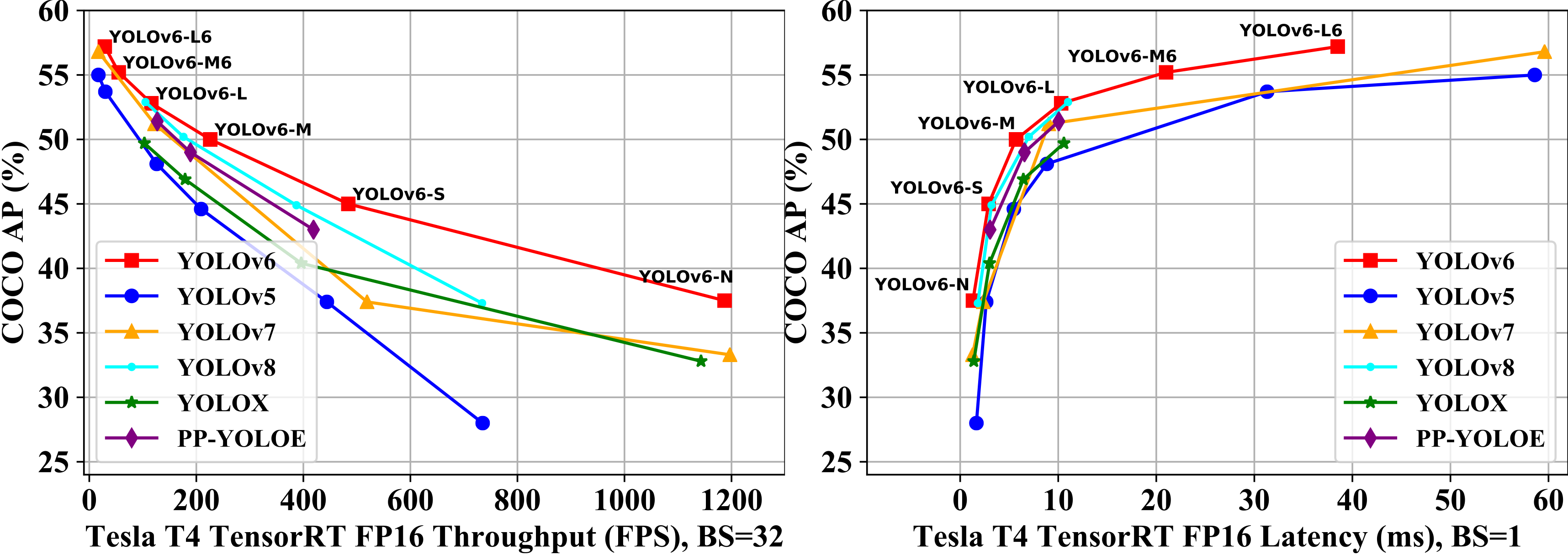
Benchmark
Model
Size
mAPval 0.5:0.95
SpeedT4 trt fp16 b1 (fps)
SpeedT4 trt fp16 b32 (fps)
Params (M)
FLOPs (G)
YOLOv6-N
640
37.5
779
1187
4.7
11.4
YOLOv6-S
640
45.0
339
484
18.5
45.3
YOLOv6-M
640
50.0
175
226
34.9
85.8
YOLOv6-L
640
52.8
98
116
59.6
150.7
YOLOv6-N6
1280
44.9
228
281
10.4
49.8
YOLOv6-S6
1280
50.3
98
108
41.4
198.0
YOLOv6-M6
1280
55.2
47
55
79.6
379.5
YOLOv6-L6
1280
57.2
26
29
140.4
673.4
Table Notes
All checkpoints are trained with self-distillation except for YOLOv6-N6/S6 models trained to 300 epochs without distillation.
Results of the mAP and speed are evaluated on COCO val2017 dataset with the input resolution of 640×640 for P5 models and 1280x1280 for P6 models.
Speed is tested with TensorRT 7.2 on T4.
Refer to Test speed tutorial to reproduce the speed results of YOLOv6.
Params and FLOPs of YOLOv6 are estimated on deployed models.
Legacy models
Model
Size
mAPval 0.5:0.95
SpeedT4 trt fp16 b1 (fps)
SpeedT4 trt fp16 b32 (fps)
Params (M)
FLOPs (G)
YOLOv6-N
640
35.9300e 36.3400e
802
1234
4.3
11.1
YOLOv6-T
640
40.3300e 41.1400e
449
659
15.0
36.7
YOLOv6-S
640
43.5300e 43.8400e
358
495
17.2
44.2
YOLOv6-M
640
49.5
179
233
34.3
82.2
YOLOv6-L-ReLU
640
51.7
113
149
58.5
144.0
YOLOv6-L
640
52.5
98
121
58.5
144.0
Speed is tested with TensorRT 7.2 on T4.
Quantized model 🚀
Model
Size
Precision
mAPval 0.5:0.95
SpeedT4 trt b1 (fps)
SpeedT4 trt b32 (fps)
YOLOv6-N RepOpt
640
INT8
34.8
1114
1828
YOLOv6-N
640
FP16
35.9
802
1234
YOLOv6-T RepOpt
640
INT8
39.8
741
1167
YOLOv6-T
640
FP16
40.3
449
659
YOLOv6-S RepOpt
640
INT8
43.3
619
924
YOLOv6-S
640
FP16
43.5
377
541
Speed is tested with TensorRT 8.4 on T4.
Precision is figured on models for 300 epochs.
Mobile Benchmark
Model
Size
mAPval 0.5:0.95
sm8350 (ms)
mt6853 (ms)
sdm660 (ms)
Params (M)
FLOPs (G)
YOLOv6Lite-S
320*320
22.4
7.99
11.99
41.86
0.55
0.56
YOLOv6Lite-M
320*320
25.1
9.08
13.27
47.95
0.79
0.67
YOLOv6Lite-L
320*320
28.0
11.37
16.20
61.40
1.09
0.87
YOLOv6Lite-L
320*192
25.0
7.02
9.66
36.13
1.09
0.52
YOLOv6Lite-L
224*128
18.9
3.63
4.99
17.76
1.09
0.24
Table Notes
From the perspective of model size and input image ratio, we have built a series of models on the mobile terminal to facilitate flexible applications in different scenarios.
All checkpoints are trained with 400 epochs without distillation.
Results of the mAP and speed are evaluated on COCO val2017 dataset, and the input resolution is the Size in the table.
Speed is tested on MNN 2.3.0 AArch64 with 2 threads by arm82 acceleration. The inference warm-up is performed 10 times, and the cycle is performed 100 times.
Qualcomm 888(sm8350), Dimensity 720(mt6853) and Qualcomm 660(sdm660) correspond to chips with different performances at the high, middle and low end respectively, which can be used as a reference for model capabilities under different chips.
Refer to Test NCNN Speed tutorial to reproduce the NCNN speed results of YOLOv6Lite.
Quick Start
Install
git clone https://github.com/meituan/YOLOv6
cd YOLOv6
pip install -r requirements.txt
fuse_ab: add anchor-based auxiliary branch and use Anchor Aided Training Mode (Not supported on P6 models currently)
conf: select config file to specify network/optimizer/hyperparameters. We recommend to apply yolov6n/s/m/l_finetune.py when training on your custom dataset.
data: prepare dataset and specify dataset paths in data.yaml ( COCO, YOLO format coco labels )
The most recent commit recorded on meituan/YOLOv6 was 2.3 years ago, based on the GitHub push timestamp. The repository has 1.1k forks — one of the better signals of community interest.
How many stars does meituan/YOLOv6 have?
meituan/YOLOv6 has 5.9k GitHub stars — refresh the page for the live number, or check github.com/meituan/YOLOv6. TopGit mirrors GitHub's count but does not claim minute-by-minute accuracy.
Is meituan/YOLOv6 open source?
Yes — meituan/YOLOv6 ships under the GPL-3.0 license, which makes its source code freely readable (and, depending on license terms, forkable and reusable). Source: github.com/meituan/YOLOv6.
What else is in the AI Tools space?
meituan/YOLOv6 is tracked by TopGit under the AI Tools category, alongside 3 GitHub-tagged topics. Trending and Topics pages list peer repositories of comparable stars and language.
What is meituan/YOLOv6?
meituan/YOLOv6 (meituan/YOLOv6) is a Jupyter Notebook project on GitHub. From the project's own README: YOLOv6: a single-stage object detection framework dedicated to industrial applications.
What language is meituan/YOLOv6 written in?
meituan/YOLOv6 is written primarily in Jupyter Notebook. GitHub's language field is based on the largest share of bytes in the default branch.
What license does meituan/YOLOv6 use?
meituan/YOLOv6 is released under the GPL-3.0 license. Always verify the LICENSE file directly on GitHub for the authoritative terms — license strings can be edited out of sync with a project's actual stance.
Where do I read more about meituan/YOLOv6?
This TopGit page is a snapshot — the READ ME tab shows the project's own README content (links stripped, images preserved). The GitHub repository at github.com/meituan/YOLOv6 is the definitive source.
Read full README in the tab above.
Still deciding about YOLOv6?
One click hands the question to an AI along with this page — see what it says about YOLOv6.

 /YOLOv6