MS-DOS Source Code History: What the Files Reveal
 /MS-DOS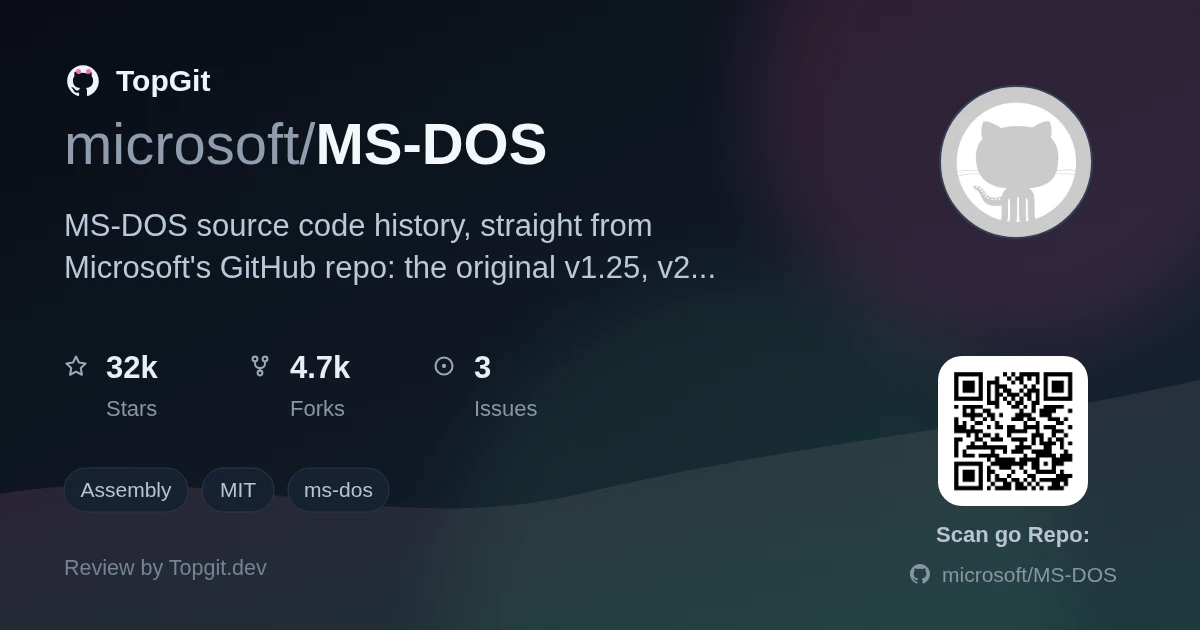
MS-DOS Source Code is worth exploring if you want to read real 16-bit assembly instead of a textbook description of one. Microsoft published the actual v1.25, v2.0, and v4.00 sources here, not a reconstruction, so the boot code, file-allocation-table logic, and command interpreter you're reading are what genuinely shipped on early IBM PCs.
What Is This Repository?
MS-DOS Source Code is Microsoft's own GitHub repository holding the original source and compiled binaries for MS-DOS v1.25 and v2.0, plus the source for MS-DOS v4.00, developed jointly with IBM. Microsoft first shared the v1.25 and v2.0 files with the Computer History Museum on March 25th, 2014, and republished them here under the MIT License for easier reference.
Why Did Microsoft Open-Source DOS?
Microsoft open-sourced MS-DOS Source Code to make files it had already shared with the Computer History Museum in 2014 easier to find and cite in external writing. The README frames this as a historical-reference release, not a new product: the code is meant for reading and forking, with pull requests changing the source explicitly discouraged.
What DOS Versions Are Included?
- ✓MS-DOS v1.25 source code plus its compiled binaries
- ✓MS-DOS v2.0 source code plus its compiled binaries
- ✓MS-DOS v4.00 source code, developed jointly by Microsoft and IBM
- ✓MIT License applied across the whole repository
- ✓Files originally surfaced through the Computer History Museum's 2014 publication
What You Can Learn From the Source
- •Reading boot-sector and low-level 16-bit assembly from a real, shipped OS
- •Comparing DOS internals across three versions, v1.25 through v4.00, to see how the codebase changed
- •Citing exact MS-DOS source in technical writing or research instead of paraphrasing secondhand descriptions
- •Forking the repo to experiment, which the README explicitly allows even though PRs to the source aren't accepted
Strengths
- ✓Comes straight from Microsoft, not a leaked or reconstructed copy, so it's an authoritative record of what actually shipped
- ✓Covers three real milestones — v1.25, v2.0, and the IBM-co-developed v4.00 — in one place
- ✓MIT License means you can read, fork, and quote the code without asking permission
- ✓Easy to find on GitHub instead of hunting down the original 2014 museum archive
What the Repo Does Not Provide
- △No inline documentation or guide walks you through the code; you're reading raw source with no annotation
- △The repo is explicitly frozen — the README says files 'will be kept static' and asks contributors not to send PRs modifying them
- △No build instructions or toolchain are provided, so assembling or running the code isn't documented here
- △Only three versions are present; the jump from v2.0 to v4.00 skips everything DOS shipped in between
Other Historical OS Source Code to Study
Who Is This For?
Retro-computing hobbyists, assembly programmers curious about early PC internals, and writers or researchers who need to cite exact DOS source will get the most out of this. Skip it if you want to actually run DOS today. FreeDOS is built for that. Also skip it if you're hoping for tutorials or inline comments explaining how the code works.
Frequently Asked Questions
MS-DOS Source Code does not include build or run instructions — the repo ships v1.25/v2.0 binaries alongside the source, but no assembler, toolchain, or setup steps, and the README states the files are kept static for reference rather than active use.
MS-DOS Source Code is written entirely in Assembly, the low-level 16-bit language used to program IBM PC-era operating systems directly against the hardware in the early 1980s, before higher-level systems languages became standard for OS kernels.
MS-DOS Source Code is released under the MIT License, which covers every file in the repository, so you can read, copy, and reference it freely. Microsoft's trademark guidelines still apply if you use the MS-DOS name or logo in anything built from it.
MS-DOS Source Code does not document the difference between MS-DOS and PC-DOS. The README only confirms that MS-DOS v4.00 was jointly developed by Microsoft and IBM, without explaining how it relates to IBM's separately branded PC-DOS release.
Microsoft republished MS-DOS Source Code to make files first shared with the Computer History Museum in 2014 easier to find, to support citation in external writing and research, and to let developers explore and experiment with early PC operating system code under the MIT License.
MS-DOS Source Code includes MS-DOS v1.25 and v2.0, with both source code and compiled binaries, plus the source code for MS-DOS v4.00, which Microsoft developed jointly with IBM.
Still deciding about MS-DOS?
One click hands the question to an AI along with this page — see what it says about MS-DOS.