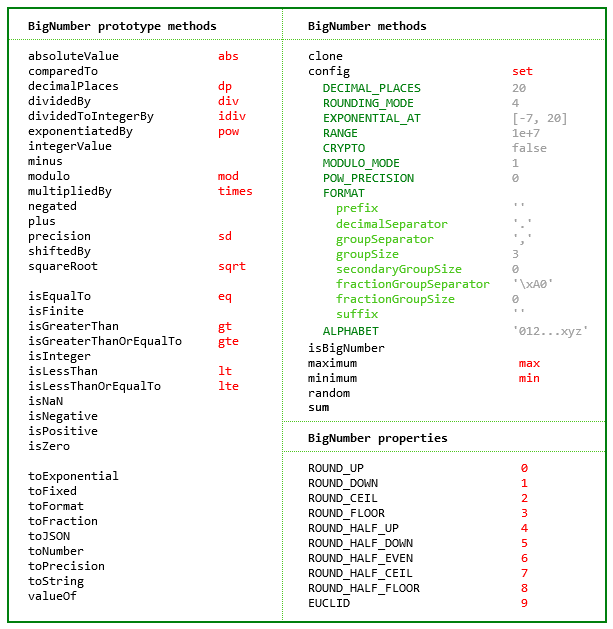
Indexed by TopGit from live GitHub metadata: MikeMcl/bignumber.js has 7.0k stars, written primarily in JavaScript. A JavaScript library for arbitrary-precision decimal and non-decimal arithmetic
Snapshot summary built from the project's own GitHub metadata — there's no written TopGit review yet. The page will update automatically when a full review is published.
WHY NO REVIEW YET
TopGit writes full reviews for the most-starred, most-requested repositories. This page is a snapshot until then — see the READ ME tab for the original README in full.
A JavaScript library for arbitrary-precision decimal and non-decimal arithmetic.
Features
Build
Load
Use
Test
Minify
Licence
Features
Integers and decimals
Simple API but full-featured
Faster, smaller, and perhaps easier to use than JavaScript versions of Java's BigDecimal
8 KB minified and gzipped
Replicates the toExponential, toFixed, toPrecision and toString methods of JavaScript's Number type
Includes a toFraction and a correctly-rounded squareRoot method
Supports cryptographically-secure pseudo-random number generation
No dependencies
Wide platform compatibility: uses JavaScript 1.5 (ECMAScript 3) features only
Comprehensive documentation and test set
If a smaller and simpler library is required see big.js.
It's less than half the size but only works with decimal numbers and only has half the methods.
It also has fewer configuration options than this library, and does not allow NaN or Infinity.
See also decimal.js, which among other things adds support for non-integer powers, and performs all operations to a specified number of significant digits.
Build
bignumber.js is the single source file, and bignumber.d.ts contains the type declarations for it. The build script, build.js, creates targeted builds in a dist directory for ES module, CommonJS, and browser usage.
To run the build script (requires Node.js ≥ 14.14.0):
npm install
npm run build
# or: node build.js
A dist directory will be created containing the following:
Module format
Distributable
Type declaration
ES module (ESM)
bignumber.mjs
bignumber.d.mts
CommonJS (CJS)
bignumber.cjs
bignumber.d.cts
Browser (global)
bignumber.js
bignumber.d.ts
Load
Browser
<script src='dist/bignumber.js'></script>
or, minified from a CDN (Content Delivery Network):
<script type="module">
import BigNumber from './dist/bignumber.mjs';
// ...
</script>
or, minified from a CDN:
<script type="module">
import BigNumber from 'https://cdn.jsdelivr.net/npm/bignumber.js@latest/+esm'
// ...
</script>
Node.js
npm install bignumber.js
CommonJS
const BigNumber = require('bignumber.js');

// or, testing from a local repo:
const BigNumber = require('./dist/bignumber.cjs');
ES module
import BigNumber from 'bignumber.js';

// or
import { BigNumber } from 'bignumber.js';

// or, testing from a local repo:
import { BigNumber } from './dist/bignumber.mjs';
Deno
// @deno-types="https://raw.githubusercontent.com/MikeMcl/bignumber.js/main/dist/bignumber.d.mts"
import BigNumber from 'https://raw.githubusercontent.com/MikeMcl/bignumber.js/main/dist/bignumber.mjs';

// or
// @deno-types="https://unpkg.com/bignumber.js@latest/dist/bignumber.d.mts"
import { BigNumber } from 'https://unpkg.com/bignumber.js@latest/dist/bignumber.mjs';
Use
The library exports a single constructor function, BigNumber, which accepts a value of type Number, String, BigInt or BigNumber,
let x = new BigNumber(123.4567);
let y = BigNumber('123456.7e-3');
let z = new BigNumber(x);
x.isEqualTo(y) && y.isEqualTo(z) && x.isEqualTo(z);      // true
To get the string value of a BigNumber use toString() or toFixed(). Using toFixed() prevents exponential notation being returned, no matter how large or small the value.
let x = new BigNumber('1_234_567_890_000_000_000_000');
x.toString();                       // "1.23456789e+21"
x.toFixed();                        // "1234567890000000000000"
If the limited precision of Number values is not well understood, it is recommended to create BigNumbers from String values rather than Number values to avoid a potential loss of precision.
In all further examples below, let, semicolons and toString calls are not shown. If a commented-out value is in quotes it means toString has been called on the preceding expression.
// Precision loss from using numeric literals with more than 15 significant digits.
new BigNumber(1.0000000000000001)         // '1'
new BigNumber(88259496234518.57)          // '88259496234518.56'
new BigNumber(99999999999999999999)       // '100000000000000000000'

// Precision loss from using numeric literals outside the range of Number values.
new BigNumber(2e+308)                     // 'Infinity'
new BigNumber(1e-324)                     // '0'

// Precision loss from the unexpected result of arithmetic with Number values.
new BigNumber(0.7 + 0.1)                  // '0.7999999999999999'
When creating a BigNumber from a Number, note that a BigNumber is created from a Number's decimal toString() value not from its underlying binary value. If the latter is required, then pass the Number's toString(2) value and specify base 2.
new BigNumber(Number.MAX_VALUE.toString(2), 2)
BigNumbers can be created from string values in bases from 2 to 36. See ALPHABET to extend this range.
a = new BigNumber('1011', 2)        // "11"
b = new BigNumber('zz.9', 36)       // "1295.25"
c = a.plus(b)                       // "1306.25"
Explicitly passing base 10 is not recommended as it will cause the slower base conversion path to be used, which is only necessary if an unconventional ALPHABET has been specified.
A BigNumber is immutable in the sense that it is not changed by its methods.
0.3 - 0.1                           // 0.19999999999999998
x = new BigNumber(0.3)
x.minus(0.1)                        // "0.2"
x                                   // "0.3"
The methods that return a BigNumber can be chained.
As with JavaScript's Number type, there are toExponential, toFixed and toPrecision methods.
x = new BigNumber(255.5)
x.toExponential(5)                  // "2.55500e+2"
x.toFixed(5)                        // "255.50000"
x.toPrecision(5)                    // "255.50"
x.toNumber()                        //  255.5
A base can be specified for toString.
x.toString(16) // "ff.8"
Again, explicitly passing base 10 is not recommended as it will cause the slower base conversion path to be used, which is only necessary if an unconventional ALPHABET has been specified.
There is a toFormat method which may be useful for internationalisation.
y = new BigNumber('1234567.898765')
y.toFormat({
  prefix: '€',
  decimalSeparator: ',',
  groupSeparator: '.',
  decimalPlaces: [0, 2]
})                                  // "€1.234.567,90"
The maximum number of decimal places of the result of an operation involving division (i.e. a division, square root, base conversion or negative power operation) is set using the set or config method of the BigNumber constructor.
The other arithmetic operations always give the exact result.
BigNumber.set({ DECIMAL_PLACES: 10, ROUNDING_MODE: 4 })

x = new BigNumber(2)
y = new BigNumber(3)
z = x.dividedBy(y)                        // "0.6666666667"
z.squareRoot()                            // "0.8164965809"
z.exponentiatedBy(-3)                     // "3.3749999995"
z.toString(2)                             // "0.1010101011"
z.multipliedBy(z)                         // "0.44444444448888888889"
z.multipliedBy(z).decimalPlaces(10)       // "0.4444444445"
There is a toFraction method with an optional maximum denominator argument
y = new BigNumber(355)
pi = y.dividedBy(113)               // "3.1415929204"
pi.toFraction()                     // [ "7853982301", "2500000000" ]
pi.toFraction(1000)                 // [ "355", "113" ]
and isNaN and isFinite methods, as NaN and Infinity are valid BigNumber values.
x = new BigNumber(NaN)                                           // "NaN"
y = new BigNumber(Infinity)                                      // "Infinity"
x.isNaN() && !y.isNaN() && !x.isFinite() && !y.isFinite()        // true

BigNumber.set({ STRICT: false })
z = new BigNumber('zzz')
z.isNaN()                                                        // true
The value of a BigNumber is stored in a decimal floating point format in terms of a coefficient, exponent and sign.
For advanced usage, multiple BigNumber constructors can be created, each with its own independent configuration.
// Set DECIMAL_PLACES for the original BigNumber constructor
BigNumber.set({ DECIMAL_PLACES: 10 })

// Create another BigNumber constructor, optionally passing in a configuration object
BN = BigNumber.clone({ DECIMAL_PLACES: 5 })

x = new BigNumber(1)
y = new BN(1)

x.div(3)                            // '0.3333333333'
y.div(3)                            // '0.33333'
To avoid having to call toString or valueOf on a BigNumber to get its value in the Node.js REPL or when using console.log use
For further information see the API reference in the doc directory.
Test
The test/methods directory contains the test scripts for each method.
The tests can be run with Node.js or a browser. The tests require the CommonJS distributable, so build before testing:
npm run build
npm test
# or: node test/test
To test a single method, use, for example
node test/methods/toFraction
For the browser, open test/test.html.
There are also some old programs in perf that still work and can be useful for testing and cross-checking results over large sets of random inputs.
TypeScript
The test/typescript directory contains TypeScript compilation tests that verify the type declarations and imports work correctly for each module format. Run them with:
How active is development on MikeMcl/bignumber.js?
The most recent commit recorded on MikeMcl/bignumber.js was 1 month ago, based on the GitHub push timestamp. The repository has 753 forks — one of the better signals of community interest.
Is MikeMcl/bignumber.js open source?
Yes — MikeMcl/bignumber.js ships under the MIT license, which makes its source code freely readable (and, depending on license terms, forkable and reusable). Source: github.com/MikeMcl/bignumber.js.
What license does MikeMcl/bignumber.js use?
MikeMcl/bignumber.js is released under the MIT license. Always verify the LICENSE file directly on GitHub for the authoritative terms — license strings can be edited out of sync with a project's actual stance.
What topics is MikeMcl/bignumber.js associated with?
GitHub's repository topics for MikeMcl/bignumber.js: "arbitrary-precision", "bigdecimal", "bignumber", "decimal-places", "javascript". TopGit's editorial category is Frontend.
Where can I see MikeMcl/bignumber.js in action?
The project maintains a homepage at http://mikemcl.github.io/bignumber.js. The README tab on this page also usually contains screenshots and a quickstart.
Where do I read more about MikeMcl/bignumber.js?
This TopGit page is a snapshot — the READ ME tab shows the project's own README content (links stripped, images preserved). The GitHub repository at github.com/MikeMcl/bignumber.js is the definitive source.
Read full README in the tab above.
Curious whether bignumber.js is right for you?
Let ChatGPT, Claude, or Perplexity look into it — click below and see what AI actually says about bignumber.js.
 /bignumber.js