naver/splade

Indexed by TopGit from live GitHub metadata: naver/splade has 1.0k stars, written primarily in Python. SPLADE: sparse neural search (SIGIR21, SIGIR22)
Snapshot summary built from the project's own GitHub metadata — there's no written TopGit review yet. The page will update automatically when a full review is published.
TopGit writes full reviews for the most-starred, most-requested repositories. This page is a snapshot until then — see the READ ME tab for the original README in full.
Snapshot
Top contributors
Show top contributors
SPLADE




What's New:
- November 2023: Better training code for SPLADE and rerankers training (e.g, cross encoders, RankT5) available; new models coming soon on github!
- July 2023: We add the code for static pruning SPLADE indexes in order to reproduce A Static Pruning Study on Sparse Neural Retrievers
- May 2023: We add a new branch (based on HF Trainer) allowing training with several negatives : https://github.com/naver/splade/tree/hf
- April 2023: We have removed the weights and pushed them to huggingface (https://huggingface.co/naver/splade_v2_max and https://huggingface.co/naver/splade_v2_distil)
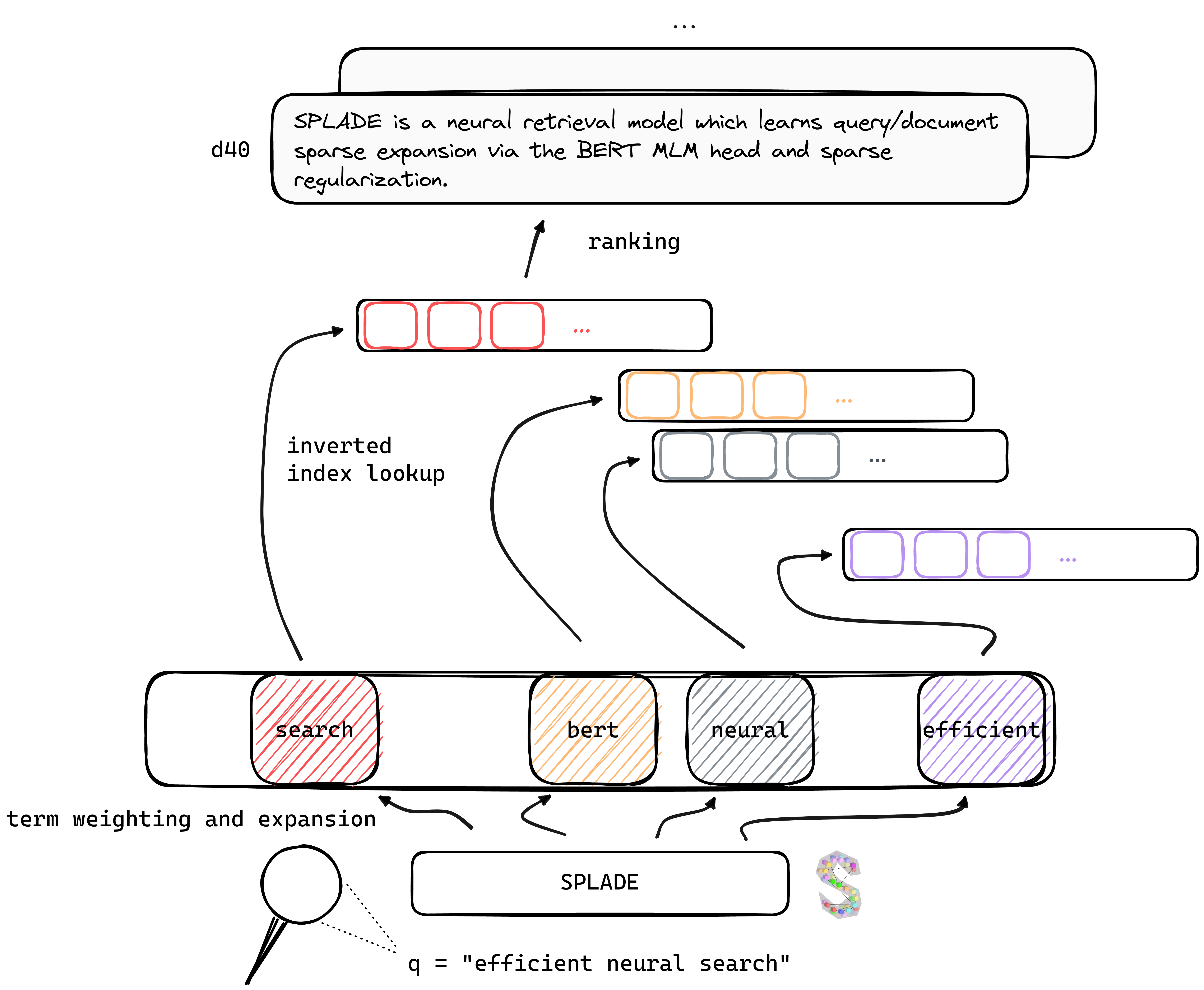
This repository contains the code to perform training, indexing and retrieval for SPLADE models. It also includes everything needed to launch evaluation on the BEIR benchmark.
TL; DR SPLADE is a neural retrieval model which learns query/document sparse expansion via the BERT MLM head and sparse regularization. Sparse representations benefit from several advantages compared to dense approaches: efficient use of inverted index, explicit lexical match, interpretability... They also seem to be better at generalizing on out-of-domain data (BEIR benchmark).
- (v1, SPLADE) SPLADE: Sparse Lexical and Expansion Model for First Stage Ranking, Thibault Formal, Benjamin Piwowarski and Stéphane Clinchant. SIGIR21 short paper.
By benefiting from recent advances in training neural retrievers, our v2 models rely on hard-negative mining, distillation and better Pre-trained Language Model initialization to further increase their effectiveness, on both in-domain (MS MARCO) and out-of-domain evaluation (BEIR benchmark).
- (v2, SPLADE v2) SPLADE v2: Sparse Lexical and Expansion Model for Information Retrieval, Thibault Formal, Benjamin Piwowarski, Carlos Lassance, and Stéphane Clinchant. arxiv.
- (v2bis, SPLADE++) From Distillation to Hard Negative Sampling: Making Sparse Neural IR Models More Effective, Thibault Formal, Carlos Lassance, Benjamin Piwowarski, and Stéphane Clinchant. SIGIR22 short paper (extension of SPLADE v2).
Finally, by introducing several modifications (query specific regularization, disjoint encoders etc.), we are able to improve efficiency, achieving latency on par with BM25 under the same computing constraints.
- (efficient SPLADE) An Efficiency Study for SPLADE Models, Carlos Lassance and Stéphane Clinchant. SIGIR22 short paper.
Weights for models trained under various settings can be found on Naver Labs Europe website, as well as Hugging Face. Please bear in mind that SPLADE is more a class of models rather than a model per se: depending on the regularization magnitude, we can obtain different models (from very sparse to models doing intense query/doc expansion) with different properties and performance.
splade: a spork that is sharp along one edge or both edges, enabling it to be used as a knife, a fork and a spoon.
Getting started :rocket:
Requirements
We recommend to start from a fresh environment, and install the packages from conda_splade_env.yml.
conda create -n splade_env python=3.9
conda activate splade_env
conda env create -f conda_splade_env.yml
Usage
Playing with the model
inference_splade.ipynb allows you to load and perform inference with a trained model, in order to inspect the
predicted "bag-of-expanded-words". We provide weights for six main models:
| model | MRR@10 (MS MARCO dev) |
|---|---|
naver/splade_v2_max (v2 HF) | 34.0 |
naver/splade_v2_distil (v2 HF) | 36.8 |
naver/splade-cocondenser-selfdistil (SPLADE++, HF) | 37.6 |
naver/splade-cocondenser-ensembledistil (SPLADE++, HF) | 38.3 |
naver/efficient-splade-V-large-doc (HF) + naver/efficient-splade-V-large-query (HF) (efficient SPLADE) | 38.8 |
naver/efficient-splade-VI-BT-large-doc (HF) + efficient-splade-VI-BT-large-query (HF) (efficient SPLADE) | 38.0 |
We also uploaded various models here. Feel free to try them out!
High level overview of the code structure
- This repository lets you either train (
train.py), index (index.py), retrieve (retrieve.py) (or perform every step withall.py) SPLADE models. - To manage experiments, we rely on hydra. Please refer to conf/README.md for a complete guide on how we configured experiments.
Data
- To train models, we rely on MS MARCO data.
- We also further rely on distillation and hard negative mining, from available datasets (Margin MSE Distillation , Sentence Transformers Hard Negatives) or datasets we built ourselves (e.g. negatives mined from SPLADE).
- Most of the data formats are pretty standard; for validation, we rely on an approximate validation set, following a setting similar to TAS-B.
To simplify setting up, we made available all our data folders, which can
be downloaded here. This link includes queries,
documents and hard negative data, allowing for training under the EnsembleDistil setting (see v2bis paper). For
other settings (Simple, DistilMSE, SelfDistil), you also have to download:
- (
Simple) standard BM25 Triplets - (
DistilMSE) "Vienna" triplets for MarginMSE distillation - (
SelfDistil) triplets mined from SPLADE
After downloading, you can just untar in the root directory, and it will be placed in the right folder.
tar -xzvf file.tar.gz
Quick start
In order to perform all steps (here on toy data, i.e. config_default.yaml), go on the root directory and run:
conda activate splade_env
export PYTHONPATH=$PYTHONPATH:$(pwd)
export SPLADE_CONFIG_NAME="config_default.yaml"
python3 -m splade.all \
  config.checkpoint_dir=experiments/debug/checkpoint \
  config.index_dir=experiments/debug/index \
  config.out_dir=experiments/debug/out
Additional examples
We provide additional examples that can be plugged in the above code. See conf/README.md for details on how to change experiment settings.
- you can similarly run training
python3 -m splade.train(same for indexing or retrieval) - to create Anserini readable files (after training),
run
SPLADE_CONFIG_FULLPATH=/path/to/checkpoint/dir/config.yaml python3 -m splade.create_anserini +quantization_factor_document=100 +quantization_factor_query=100 - config files for various settings (distillation etc.) are available in
/conf. For instance, to run theSelfDistilsetting:- change to
SPLADE_CONFIG_NAME=config_splade++_selfdistil.yaml - to further change parameters (e.g. lambdas) outside the config,
run:
python3 -m splade.all config.regularizer.FLOPS.lambda_q=0.06 config.regularizer.FLOPS.lambda_d=0.02
- change to
We provide several base configurations which correspond to the experiments in the v2bis and "efficiency" papers. Please note that these are
suited for our hardware setting, i.e. 4 GPUs Tesla V100 with 32GB memory. In order to train models with e.g. one GPU,
you need to decrease the batch size for training and evaluation. Also note that, as the range for the loss might change
with a different batch size, corresponding lambdas for regularization might need to be adapted. However, we provide a mono-gpu configuration
config_splade++_cocondenser_ensembledistil_monogpu.yaml for which we obtain 37.2 MRR@10, trained on a single 16GB GPU.
Evaluating a pre-trained model
Indexing (and retrieval) can be done either using our (numba-based) implementation of inverted index,
or Anserini. Let's perform these steps using an available model (naver/splade-cocondenser-ensembledistil).
conda activate splade_env
export PYTHONPATH=$PYTHONPATH:$(pwd)
export SPLADE_CONFIG_NAME="config_splade++_cocondenser_ensembledistil"
python3 -m splade.index \
  init_dict.model_type_or_dir=naver/splade-cocondenser-ensembledistil \
  config.pretrained_no_yamlconfig=true \
  config.index_dir=experiments/pre-trained/index
python3 -m splade.retrieve \
  init_dict.model_type_or_dir=naver/splade-cocondenser-ensembledistil \
  config.pretrained_no_yamlconfig=true \
  config.index_dir=experiments/pre-trained/index \
  config.out_dir=experiments/pre-trained/out
# pretrained_no_yamlconfig indicates that we solely rely on a HF-valid model path
- To change the data, simply override the hydra retrieve_evaluate package, e.g. add
retrieve_evaluate=msmarcoas argument ofsplade.retrieve.
You can similarly build the files that will be ingested by Anserini:
python3 -m splade.create_anserini \
  init_dict.model_type_or_dir=naver/splade-cocondenser-ensembledistil \
  config.pretrained_no_yamlconfig=true \
  config.index_dir=experiments/pre-trained/index \
  +quantization_factor_document=100 \
  +quantization_factor_query=100
It will create the json collection (docs_anserini.jsonl) as well as the queries (queries_anserini.tsv) that are
needed for Anserini. You then just need to follow the regression for
SPLADE here in order to index and retrieve.
BEIR eval
You can also run evaluation on BEIR, for instance:
conda activate splade_env
export PYTHONPATH=$PYTHONPATH:$(pwd)
export SPLADE_CONFIG_FULLPATH="/path/to/checkpoint/dir/config.yaml"
for dataset in arguana fiqa nfcorpus quora scidocs scifact trec-covid webis-touche2020 climate-fever dbpedia-entity fever hotpotqa nq
do
    python3 -m splade.beir_eval \
      +beir.dataset=$dataset \
      +beir.dataset_path=data/beir \
      config.index_retrieve_batch_size=100
done
PISA evaluation
We provide in efficient_splade_pisa/README.md the steps to evaluate efficient SPLADE models with PISA.
Cite :scroll:
Please cite our work as:
- (v1) SIGIR21 short paper
@inbook{10.1145/3404835.3463098,
author = {Formal, Thibault and Piwowarski, Benjamin and Clinchant, St\'{e}phane},
title = {SPLADE: Sparse Lexical and Expansion Model for First Stage Ranking},
year = {2021},
isbn = {9781450380379},
publisher = {Association for Computing Machinery},
address = {New York, NY, USA},
url = {https://doi.org/10.1145/3404835.3463098},
booktitle = {Proceedings of the 44th International ACM SIGIR Conference on Research and Development in Information Retrieval},
pages = {2288–2292},
numpages = {5}
}
- (v2) arxiv
@misc{https://doi.org/10.48550/arxiv.2109.10086,
  doi = {10.48550/ARXIV.2109.10086},
  url = {https://arxiv.org/abs/2109.10086},
  author = {Formal, Thibault and Lassance, Carlos and Piwowarski, Benjamin and Clinchant, Stéphane},
  keywords = {Information Retrieval (cs.IR), Artificial Intelligence (cs.AI), Computation and Language (cs.CL), FOS: Computer and information sciences, FOS: Computer and information sciences},
  title = {SPLADE v2: Sparse Lexical and Expansion Model for Information Retrieval},
  publisher = {arXiv},
  year = {2021},
  copyright = {Creative Commons Attribution Non Commercial Share Alike 4.0 International}
}
- (v2bis) SPLADE++, SIGIR22 short paper
@inproceedings{10.1145/3477495.3531857,
author = {Formal, Thibault and Lassance, Carlos and Piwowarski, Benjamin and Clinchant, St\'{e}phane},
title = {From Distillation to Hard Negative Sampling: Making Sparse Neural IR Models More Effective},
year = {2022},
isbn = {9781450387323},
publisher = {Association for Computing Machinery},
address = {New York, NY, USA},
url = {https://doi.org/10.1145/3477495.3531857},
doi = {10.1145/3477495.3531857},
abstract = {Neural retrievers based on dense representations combined with Approximate Nearest Neighbors search have recently received a lot of attention, owing their success to distillation and/or better sampling of examples for training -- while still relying on the same backbone architecture. In the meantime, sparse representation learning fueled by traditional inverted indexing techniques has seen a growing interest, inheriting from desirable IR priors such as explicit lexical matching. While some architectural variants have been proposed, a lesser effort has been put in the training of such models. In this work, we build on SPLADE -- a sparse expansion-based retriever -- and show to which extent it is able to benefit from the same training improvements as dense models, by studying the effect of distillation, hard-negative mining as well as the Pre-trained Language Model initialization. We furthermore study the link between effectiveness and efficiency, on in-domain and zero-shot settings, leading to state-of-the-art results in both scenarios for sufficiently expressive models.},
booktitle = {Proceedings of the 45th International ACM SIGIR Conference on Research and Development in Information Retrieval},
pages = {2353–2359},
numpages = {7},
keywords = {neural networks, indexing, sparse representations, regularization},
location = {Madrid, Spain},
series = {SIGIR '22}
}
- efficient SPLADE, SIGIR22 short paper
@inproceedings{10.1145/3477495.3531833,
author = {Lassance, Carlos and Clinchant, St\'{e}phane},
title = {An Efficiency Study for SPLADE Models},
year = {2022},
isbn = {9781450387323},
publisher = {Association for Computing Machinery},
address = {New York, NY, USA},
url = {https://doi.org/10.1145/3477495.3531833},
doi = {10.1145/3477495.3531833},
abstract = {Latency and efficiency issues are often overlooked when evaluating IR models based on Pretrained Language Models (PLMs) in reason of multiple hardware and software testing scenarios. Nevertheless, efficiency is an important part of such systems and should not be overlooked. In this paper, we focus on improving the efficiency of the SPLADE model since it has achieved state-of-the-art zero-shot performance and competitive results on TREC collections. SPLADE efficiency can be controlled via a regularization factor, but solely controlling this regularization has been shown to not be efficient enough. In order to reduce the latency gap between SPLADE and traditional retrieval systems, we propose several techniques including L1 regularization for queries, a separation of document/query encoders, a FLOPS-regularized middle-training, and the use of faster query encoders. Our benchmark demonstrates that we can drastically improve the efficiency of these models while increasing the performance metrics on in-domain data. To our knowledge, we propose the first neural models that, under the same computing constraints, achieve similar latency (less than 4ms difference) as traditional BM25, while having similar performance (less than 10% MRR@10 reduction) as the state-of-the-art single-stage neural rankers on in-domain data.},
booktitle = {Proceedings of the 45th International ACM SIGIR Conference on Research and Development in Information Retrieval},
pages = {2220–2226},
numpages = {7},
keywords = {splade, sparse representations, latency, information retrieval},
location = {Madrid, Spain},
series = {SIGIR '22}
}
Contact :mailbox_with_no_mail:
Feel free to contact us via Twitter or by mail @ [email protected] !
License
SPLADE Copyright (c) 2021-present NAVER Corp.
SPLADE is licensed under a Creative Commons Attribution-NonCommercial-ShareAlike 4.0 International License. (see license)
You should have received a copy of the license along with this work. If not, see http://creativecommons.org/licenses/by-nc-sa/4.0/ .
Related repositories
Hugging Face Transformers (huggingface/transformers) is a Python library that centralizes model definitions for text, computer vision, audio, video, and multimodal machine learning, covering both inference and training. The README describes it as a pivot point compatible with training frameworks such as Axolotl, DeepSpeed, and PyTorch-Lightning, and inference engines such as vLLM, SGLang, and TGI, with more than 1M+ model checkpoints listed on the Hugging Face Hub.
Superpowers is an open-source (MIT) skills library and bootstrap instruction set that turns a coding agent's ad-hoc habits into a fixed pipeline: brainstorm a spec, write a plan, build under TDD, review, then close out the branch. Skills trigger automatically once installed, and the same methodology works across eleven different agent harnesses, each requiring its own install step.
TensorFlow is Google's open-source, end-to-end platform for machine learning, hosted at tensorflow/tensorflow with 196,995 stars and 76,009 forks under the Apache-2.0 license. It was originally built within Google Brain's Machine Intelligence team for ML and neural network research, and today it ships stable Python and C++ APIs alongside GPU, CPU-only, and Docker install paths. The README positions it as covering both research work and shipping ML-powered applications.
DigitalPlat FreeDomain: Free Domain For Everyone
Quick answers
How active is development on naver/splade?
The most recent commit recorded on naver/splade was 2.3 years ago, based on the GitHub push timestamp. The repository has 96 forks — one of the better signals of community interest.
How does naver/splade compare to other AI Tools projects?
naver/splade is tracked by TopGit in the AI Tools category, with 1.0k GitHub stars and written in Python. Browse the AI Tools topic page on TopGit to compare it against similar projects by stars and activity.
How many stars does naver/splade have?
naver/splade has 1.0k GitHub stars — refresh the page for the live number, or check github.com/naver/splade. TopGit mirrors GitHub's count but does not claim minute-by-minute accuracy.
Is naver/splade open source?
TopGit's metadata for naver/splade does not record a license. Most public repositories on GitHub ARE open source, but the exact terms vary — verify by opening the LICENSE file directly.
What is naver/splade?
naver/splade (naver/splade) is a Python project on GitHub. From the project's own README: SPLADE: sparse neural search (SIGIR21, SIGIR22)
Where do I read more about naver/splade?
This TopGit page is a snapshot — the READ ME tab shows the project's own README content (links stripped, images preserved). The GitHub repository at github.com/naver/splade is the definitive source.
Read full README in the tab above.
Curious whether splade is right for you?
Let ChatGPT, Claude, or Perplexity look into it — click below and see what AI actually says about splade.