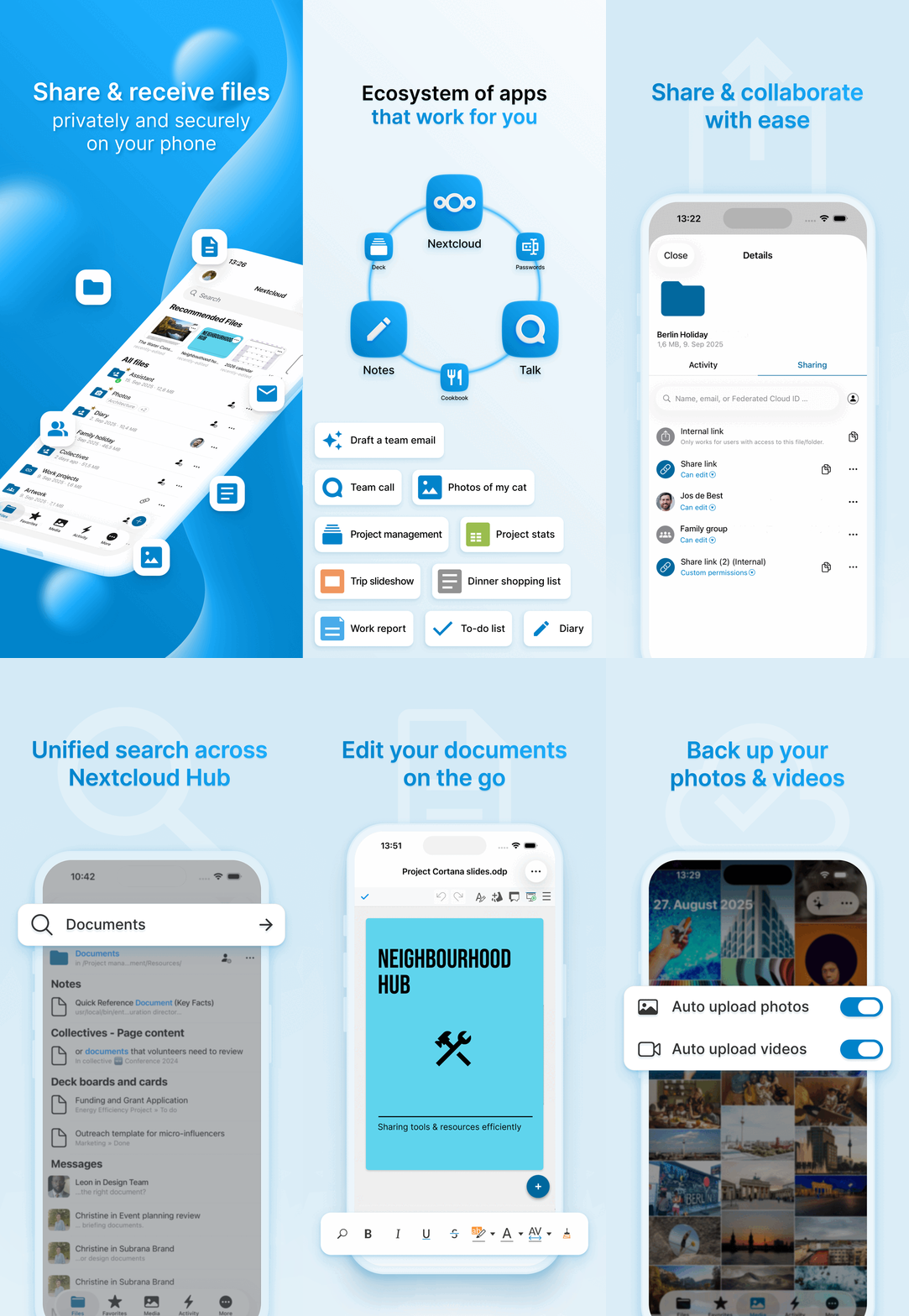
nextcloud/ios sits at 2.6k stars on GitHub, written primarily in Swift. 📱 Nextcloud iOS App
Snapshot summary built from the project's own GitHub metadata — there's no written TopGit review yet. The page will update automatically when a full review is published.
WHY NO REVIEW YET
TopGit writes full reviews for the most-starred, most-requested repositories. This page is a snapshot until then — see the READ ME tab for the original README in full.
Check out https://nextcloud.com and follow us on twitter.com/nextclouders
How to contribute
If you want to contribute to Nextcloud, you are very welcome:
our forum at https://help.nextcloud.com/c/clients/ios
for translations of the app on Transifex
opening issues and PRs (including a corresponding issue)
Contribution Guidelines & License
GPLv3 with Apple app store exception.
Nextcloud doesn't require a CLA (Contributor License Agreement). The copyright belongs to all the individual contributors. Use SPDX headers for source files, preserving existing contributor credits and adding your own when making substantial changes:
Please read the Code of Conduct. This document offers some guidance to ensure Nextcloud participants can cooperate effectively in a positive and inspiring atmosphere, and to explain how together we can strengthen and support each other.
More information how to contribute: https://nextcloud.com/contribute/
Start contributing
You can start by forking this repository and creating pull requests on the develop
branch. Maybe start working on starter issues.
Easy starting points are also reviewing pull requests
Xcode 27.2 Project Setup
Open Nextcloud.xcodeproj; package dependencies are managed by Swift Package Manager. The CI toolchain and simulator destination are defined in .github/workflows/xcode.yml (currently Xcode 27.1 and iPhone 17 with iOS 27.0).
Dependencies
In order to build the project in Xcode you will also need a file GoogleService-Info.plist at the root of the repository which contains the Firebase configuration. For development work you can use a mock version found here.
Creating Pull requests
DCO Signoff
Nextcloud enforces the Developer Certificate of Origin (DCO) on Pull Requests. It requires your commit messages to contain a Signed-off-by line with an email address that matches your GitHub account.
How to Sign off
The DCO is a way for contributors to certify that they wrote or otherwise have the right to submit the code they are contributing by adding a Signed-off-by line to commit messages.
My Commit message

Signed-off-by: Random Contributor <[email protected]>
Git even has a -s | --signoff command line option to append this to your commit messages automatically.
Support
If you need assistance or want to ask a question about the iOS app, you are welcome to ask for support in our Forums. If you have found a bug, feel free to open a new Issue on GitHub. Keep in mind, that this repository only manages the iOS app. If you find bugs or have problems with the server/backend, you should ask the Nextcloud server team for help!
TestFlight
Do you want to try the latest version in development of Nextcloud iOS ? Simple, follow this simple step
Apple TestFlight
Testing
Note: If a unit or integration test exclusively uses and tests NextcloudKit functions and components, then add that test to the NextcloudKit project instead. NextcloudKit is used in many other projects as an API, and it's better if such tests are located there.
Unit Tests
There are currently no prerequisites for unit testing.
Mock everything which is not needed.
Integration Tests
Configure the server URL and credentials in Tests/TestConstants.swift. The defaults are http://localhost:8080 and admin / admin, matching CI.
Local tests use the shallow CI server image through the Docker script below. GitHub Actions instead installs Nextcloud directly on the runner and serves it on port 8080 using PHP. Both currently use the stable30 server branch.
Currently, you still need to launch the server manually once before running any tests locally.
This project comes with a convenience script to do so, see or run Tests/Server.sh.
Please familiarize yourself with its content before running it to avoid unintended removal of a container named like in the script.
The same instance is reused for all tests.
A long term goal is to automatically create and discard container per test to ensure maximum test isolation and a clean test environment.
Note that plain HTTP is used in this case to circumvent certificate issues and simplify the sign-in flow in automation.
UI Tests
UI tests also require a Nextcloud server to test against just like integration tests.
Important: Additionally, UI tests assume your test device (regardless whether physical or Simulator) is set to US English.
This is required because in some parts of the user interface the automation has no other choice than to rely on localized texts for control.
The most recent commit recorded on nextcloud/ios was 3 months ago, based on the GitHub push timestamp. The repository has 1.0k forks — one of the better signals of community interest.
How does nextcloud/ios compare to other Mobile projects?
nextcloud/ios is tracked by TopGit in the Mobile category, with 2.6k GitHub stars and written in Swift. Browse the Mobile topic page on TopGit to compare it against similar projects by stars and activity.
How many stars does nextcloud/ios have?
nextcloud/ios has 2.6k GitHub stars — refresh the page for the live number, or check github.com/nextcloud/ios. TopGit mirrors GitHub's count but does not claim minute-by-minute accuracy.
What is nextcloud/ios?
nextcloud/ios (nextcloud/ios) is a Swift project on GitHub. From the project's own README: 📱 Nextcloud iOS App
What language is nextcloud/ios written in?
nextcloud/ios is written primarily in Swift. GitHub's language field is based on the largest share of bytes in the default branch.
What topics is nextcloud/ios associated with?
GitHub's repository topics for nextcloud/ios: "hacktoberfest", "ios", "nextcloud", "open-source". TopGit's editorial category is Mobile.
Why is nextcloud/ios categorized under Mobile?
TopGit places nextcloud/ios in the Mobile category based on its GitHub topics and description (tagged: "hacktoberfest", "ios", "nextcloud"). Categories are assigned from real repository metadata, not editorial guesswork.
Read full README in the tab above.
Want a second opinion on ios?
Ask an AI that can read this page — one click and you get its take on ios.

 /ios