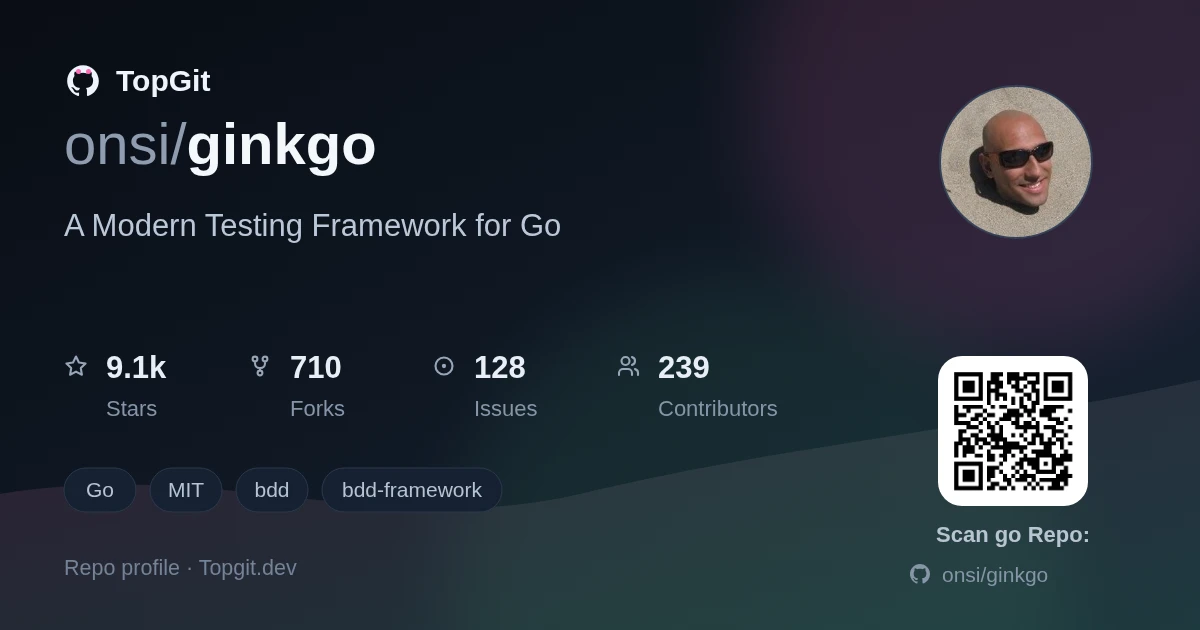
onsi/ginkgo — a backend project — sits at 9.1k GitHub stars in the Backend space. A Modern Testing Framework for Go
Snapshot summary built from the project's own GitHub metadata — there's no written TopGit review yet. The page will update automatically when a full review is published.
WHY NO REVIEW YET
TopGit writes full reviews for the most-starred, most-requested repositories. This page is a snapshot until then — see the READ ME tab for the original README in full.
Ginkgo is a mature testing framework for Go designed to help you write expressive specs. Ginkgo builds on top of Go's testing foundation and is complemented by the Gomega matcher library. Together, Ginkgo and Gomega let you express the intent behind your specs clearly:
import (
    . "github.com/onsi/ginkgo/v2"
    . "github.com/onsi/gomega"
    ...
)

var _ = Describe("Checking books out of the library", Label("library"), func() {
    var library *libraries.Library
    var book *books.Book
    var valjean *users.User
    BeforeEach(func() {
        library = libraries.NewClient()
        book = &books.Book{
            Title: "Les Miserables",
            Author: "Victor Hugo",
        }
        valjean = users.NewUser("Jean Valjean")
    })

    When("the library has the book in question", func() {
        BeforeEach(func(ctx SpecContext) {
            Expect(library.Store(ctx, book)).To(Succeed())
        })

        Context("and the book is available", func() {
            It("lends it to the reader", func(ctx SpecContext) {
                Expect(valjean.Checkout(ctx, library, "Les Miserables")).To(Succeed())
                Expect(valjean.Books()).To(ContainElement(book))
                Expect(library.UserWithBook(ctx, book)).To(Equal(valjean))
            }, SpecTimeout(time.Second * 5))
        })

        Context("but the book has already been checked out", func() {
            var javert *users.User
            BeforeEach(func(ctx SpecContext) {
                javert = users.NewUser("Javert")
                Expect(javert.Checkout(ctx, library, "Les Miserables")).To(Succeed())
            })

            It("tells the user", func(ctx SpecContext) {
                err := valjean.Checkout(ctx, library, "Les Miserables")
                Expect(err).To(MatchError("Les Miserables is currently checked out"))
            }, SpecTimeout(time.Second * 5))

            It("lets the user place a hold and get notified later", func(ctx SpecContext) {
                Expect(valjean.Hold(ctx, library, "Les Miserables")).To(Succeed())
                Expect(valjean.Holds(ctx)).To(ContainElement(book))

                By("when Javert returns the book")
                Expect(javert.Return(ctx, library, book)).To(Succeed())

                By("it eventually informs Valjean")
                notification := "Les Miserables is ready for pick up"
                Eventually(ctx, valjean.Notifications).Should(ContainElement(notification))

                Expect(valjean.Checkout(ctx, library, "Les Miserables")).To(Succeed())
                Expect(valjean.Books(ctx)).To(ContainElement(book))
                Expect(valjean.Holds(ctx)).To(BeEmpty())
            }, SpecTimeout(time.Second * 10))
        })
    })

    When("the library does not have the book in question", func() {
        It("tells the reader the book is unavailable", func(ctx SpecContext) {
            err := valjean.Checkout(ctx, library, "Les Miserables")
            Expect(err).To(MatchError("Les Miserables is not in the library catalog"))
        }, SpecTimeout(time.Second * 5))
    })
})
Jump to the docs to learn more. It's easy to bootstrap and start writing your first specs.
If you have a question, comment, bug report, feature request, etc. please open a GitHub issue, or visit the Ginkgo Slack channel.
Capabilities
Whether writing basic unit specs, complex integration specs, or even performance specs - Ginkgo gives you an expressive Domain-Specific Language (DSL) that will be familiar to users coming from frameworks such as Quick, RSpec, Jasmine, and Busted. This style of testing is sometimes referred to as "Behavior-Driven Development" (BDD) though Ginkgo's utility extends beyond acceptance-level testing.
With Ginkgo's DSL you can use nestable Describe, Context and When container nodes to help you organize your specs. BeforeEach and AfterEach setup nodes for setup and cleanup. It and Specify subject nodes that hold your assertions. BeforeSuite and AfterSuite nodes to prep for and cleanup after a suite... and much more!.
At runtime, Ginkgo can run your specs in reproducibly random order and has sophisticated support for spec parallelization. In fact, running specs in parallel is as easy as
ginkgo -p
By following established patterns for writing parallel specs you can build even large, complex integration suites that parallelize cleanly and run performantly. And you don't have to worry about your spec suite hanging or leaving a mess behind - Ginkgo provides a per-node context.Context and the capability to interrupt the spec after a set period of time - and then clean up.
As your suites grow Ginkgo helps you keep your specs organized with labels and lets you easily run subsets of specs, either programmatically or on the command line. And Ginkgo's reporting infrastructure generates machine-readable output in a variety of formats and allows you to build your own custom reporting infrastructure.
Ginkgo ships with ginkgo, a command line tool with support for generating, running, filtering, and profiling Ginkgo suites. You can even have Ginkgo automatically run your specs when it detects a change with ginkgo watch, enabling rapid feedback loops during test-driven development.
And that's just Ginkgo! Gomega brings a rich, mature, family of assertions and matchers to your suites. With Gomega you can easily mix synchronous and asynchronous assertions in your specs. You can even build your own set of expressive domain-specific matchers quickly and easily by composing Gomega's existing building blocks.
Happy Testing!
Using Ginkgo with Claude Code
Ginkgo ships a set of Claude Code skills as a plugin, with this repo doubling as the marketplace, so an agent writing specs in your project has Ginkgo's idioms, decorators, and gotchas on hand. From inside Claude Code:
(or non-interactively: claude plugin marketplace add onsi/ginkgo then claude plugin install ginkgo@ginkgo)
This installs a family of ginkgo:* skills that activate automatically while you write and run specs. Start with ginkgo:overview; see the plugin README for the full list.
License
Ginkgo is MIT-Licensed
Contributing
See CONTRIBUTING.md
Sponsors
Sponsors commit to a sponsorship for a year. If you're an organization that makes use of Ginkgo please consider becoming a sponsor!
The most recent commit recorded on onsi/ginkgo was 4 months ago, based on the GitHub push timestamp. The repository has 710 forks — one of the better signals of community interest.
How many stars does onsi/ginkgo have?
onsi/ginkgo has 9.1k GitHub stars — refresh the page for the live number, or check github.com/onsi/ginkgo. TopGit mirrors GitHub's count but does not claim minute-by-minute accuracy.
What language is onsi/ginkgo written in?
onsi/ginkgo is written primarily in Go. GitHub's language field is based on the largest share of bytes in the default branch.
What license does onsi/ginkgo use?
onsi/ginkgo is released under the MIT license. Always verify the LICENSE file directly on GitHub for the authoritative terms — license strings can be edited out of sync with a project's actual stance.
What topics is onsi/ginkgo associated with?
GitHub's repository topics for onsi/ginkgo: "bdd", "bdd-framework", "go", "golang", "test", "test-driven-development", "testing". TopGit's editorial category is Backend.
Where can I see onsi/ginkgo in action?
The project maintains a homepage at http://onsi.github.io/ginkgo/. The README tab on this page also usually contains screenshots and a quickstart.
Where do I read more about onsi/ginkgo?
This TopGit page is a snapshot — the READ ME tab shows the project's own README content (links stripped, images preserved). The GitHub repository at github.com/onsi/ginkgo is the definitive source.
Read full README in the tab above.
Still deciding about ginkgo?
One click hands the question to an AI along with this page — see what it says about ginkgo.

 /ginkgo