open-mmlab/OpenPCDet — 5.7k★ on GitHub (Python). OpenPCDet Toolbox for LiDAR-based 3D Object Detection.
Snapshot summary built from the project's own GitHub metadata — there's no written TopGit review yet. The page will update automatically when a full review is published.
WHY NO REVIEW YET
TopGit writes full reviews for the most-starred, most-requested repositories. This page is a snapshot until then — see the READ ME tab for the original README in full.
OpenPCDet is a clear, simple, self-contained open source project for LiDAR-based 3D object detection.
It is also the official code release of [PointRCNN], [Part-A2-Net], [PV-RCNN], [Voxel R-CNN], [PV-RCNN++] and [MPPNet].
Highlights:
OpenPCDet has been updated to v0.6.0 (Sep. 2022).
The codes of PV-RCNN++ has been supported.
The codes of MPPNet has been supported.
The multi-modal 3D detection approaches on Nuscenes have been supported.
Overview
Changelog
Design Pattern
Model Zoo
Installation
Quick Demo
Getting Started
Citation
Changelog
[2023-06-30] NEW: Added support for DSVT, which achieves state-of-the-art performance on large-scale Waymo Open Dataset with real-time inference speed (27HZ with TensorRT).
[2023-05-13] NEW: Added support for the multi-modal 3D object detection models on Nuscenes dataset.
Support multi-modal Nuscenes detection (See the GETTING_STARTED.md to process data).
Support TransFusion-Lidar head, which ahcieves 69.43% NDS on Nuscenes validation dataset.
Support BEVFusion, which fuses multi-modal information on BEV space and reaches 70.98% NDS on Nuscenes validation dataset. (see the guideline on how to train/test with BEVFusion).
[2023-04-02] Added support for VoxelNeXt on Nuscenes, Waymo, and Argoverse2 datasets. It is a fully sparse 3D object detection network, which is a clean sparse CNNs network and predicts 3D objects directly upon voxels.
[2022-09-02] NEW: Update OpenPCDet to v0.6.0:
Official code release of MPPNet for temporal 3D object detection, which supports long-term multi-frame 3D object detection and ranks 1st place on 3D detection learderboard of Waymo Open Dataset on Sept. 2th, 2022. For validation dataset, MPPNet achieves 74.96%, 75.06% and 74.52% for vehicle, pedestrian and cyclist classes in terms of mAPH@Level_2. (see the guideline on how to train/test with MPPNet).
Support multi-frame training/testing on Waymo Open Dataset (see the change log for more details on how to process data).
Support to save changing training details (e.g., loss, iter, epoch) to file (previous tqdm progress bar is still supported by using --use_tqdm_to_record). Please use pip install gpustat if you also want to log the GPU related information.
Support to save latest model every 5 mintues, so you can restore the model training from latest status instead of previous epoch.
[2022-08-22] Added support for custom dataset tutorial and template
[2022-07-05] Added support for the 3D object detection backbone network Focals Conv.
[2022-02-12] Added support for using docker. Please refer to the guidance in ./docker.
[2022-02-07] Added support for Centerpoint models on Nuscenes Dataset.
[2022-01-14] Added support for dynamic pillar voxelization, following the implementation proposed in H^23D R-CNN with unique operation and torch_scatter package.
[2022-01-05] NEW: Update OpenPCDet to v0.5.2:
The code of PV-RCNN++ has been released to this repo, with higher performance, faster training/inference speed and less memory consumption than PV-RCNN.
Add performance of several models trained with full training set of Waymo Open Dataset.
Support Lyft dataset, see the pull request here.
[2021-12-09] NEW: Update OpenPCDet to v0.5.1:
Add PointPillar related baseline configs/results on Waymo Open Dataset.
Support Pandaset dataloader, see the pull request here.
Support a set of new augmentations, see the pull request here.
[2021-12-01] NEW:OpenPCDet v0.5.0 is released with the following features:
Improve the performance of all models on Waymo Open Dataset. Note that you need to re-prepare the training/validation data and ground-truth database of Waymo Open Dataset (see GETTING_STARTED.md).
Support anchor-free CenterHead, add configs of CenterPoint and PV-RCNN with CenterHead.
Support lastest PyTorch 1.1~1.10 and spconv 1.0~2.x, where spconv 2.x should be easy to install with pip and faster than previous version (see the official update of spconv here).
Support config USE_SHARED_MEMORY to use shared memory to potentially speed up the training process in case you suffer from an IO problem.
Support better and faster visualization script, and you need to install Open3D firstly.
[2021-06-08] Added support for the voxel-based 3D object detection model Voxel R-CNN.
[2021-05-14] Added support for the monocular 3D object detection model CaDDN.
[2020-11-27] Bugfixed: Please re-prepare the validation infos of Waymo dataset (version 1.2) if you would like to
use our provided Waymo evaluation tool (see PR).
Note that you do not need to re-prepare the training data and ground-truth database.
[2020-11-10] The Waymo Open Dataset has been supported with state-of-the-art results. Currently we provide the
configs and results of SECOND, PartA2 and PV-RCNN on the Waymo Open Dataset, and more models could be easily supported by modifying their dataset configs.
[2020-08-10] Bugfixed: The provided NuScenes models have been updated to fix the loading bugs. Please redownload it if you need to use the pretrained NuScenes models.
[2020-07-30] OpenPCDet v0.3.0 is released with the following features:
The Point-based and Anchor-Free models (PointRCNN, PartA2-Free) are supported now.
The NuScenes dataset is supported with strong baseline results (SECOND-MultiHead (CBGS) and PointPillar-MultiHead).
High efficiency than last version, support PyTorch 1.1~1.7 and spconv 1.0~1.2 simultaneously.
[2020-07-17] Add simple visualization codes and a quick demo to test with custom data.
[2020-06-24] OpenPCDet v0.2.0 is released with pretty new structures to support more models and datasets.
[2020-03-16] OpenPCDet v0.1.0 is released.
Introduction
What does OpenPCDet toolbox do?
Note that we have upgrated PCDet from v0.1 to v0.2 with pretty new structures to support various datasets and models.
OpenPCDet is a general PyTorch-based codebase for 3D object detection from point cloud.
It currently supports multiple state-of-the-art 3D object detection methods with highly refactored codes for both one-stage and two-stage 3D detection frameworks.
Based on OpenPCDet toolbox, we win the Waymo Open Dataset challenge in 3D Detection,
3D Tracking, Domain Adaptation
three tracks among all LiDAR-only methods, and the Waymo related models will be released to OpenPCDet soon.
We are actively updating this repo currently, and more datasets and models will be supported soon.
Contributions are also welcomed.
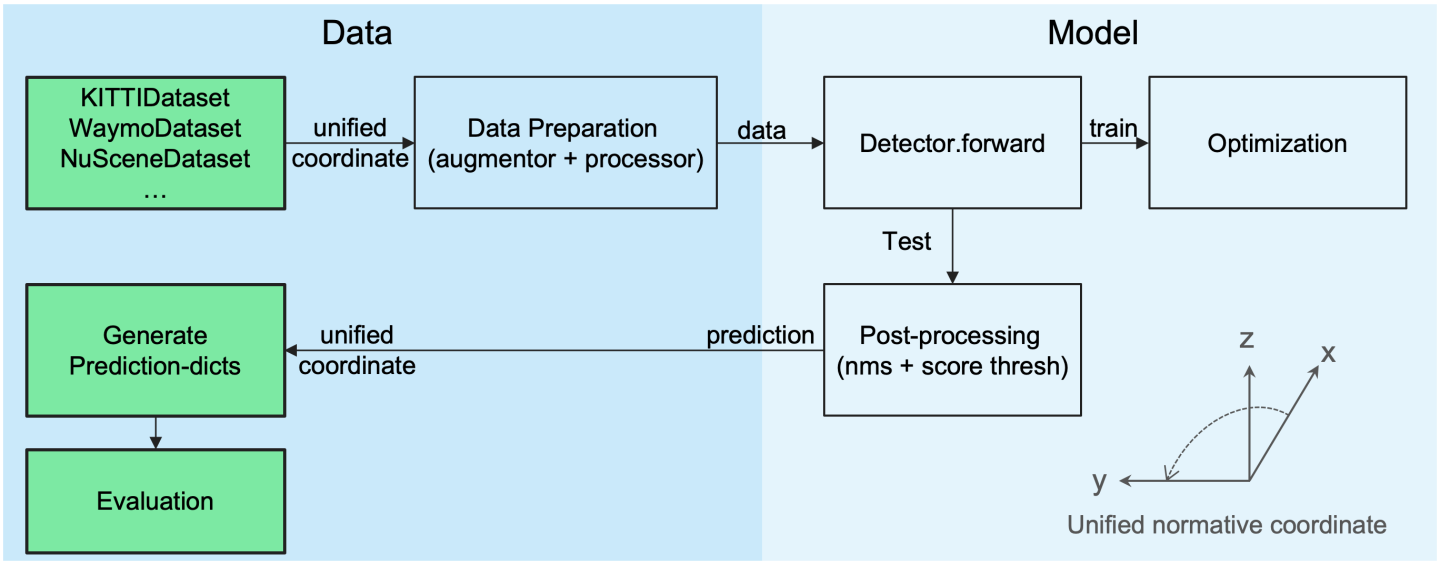
OpenPCDet design pattern
Data-Model separation with unified point cloud coordinate for easily extending to custom datasets:
Unified 3D box definition: (x, y, z, dx, dy, dz, heading).
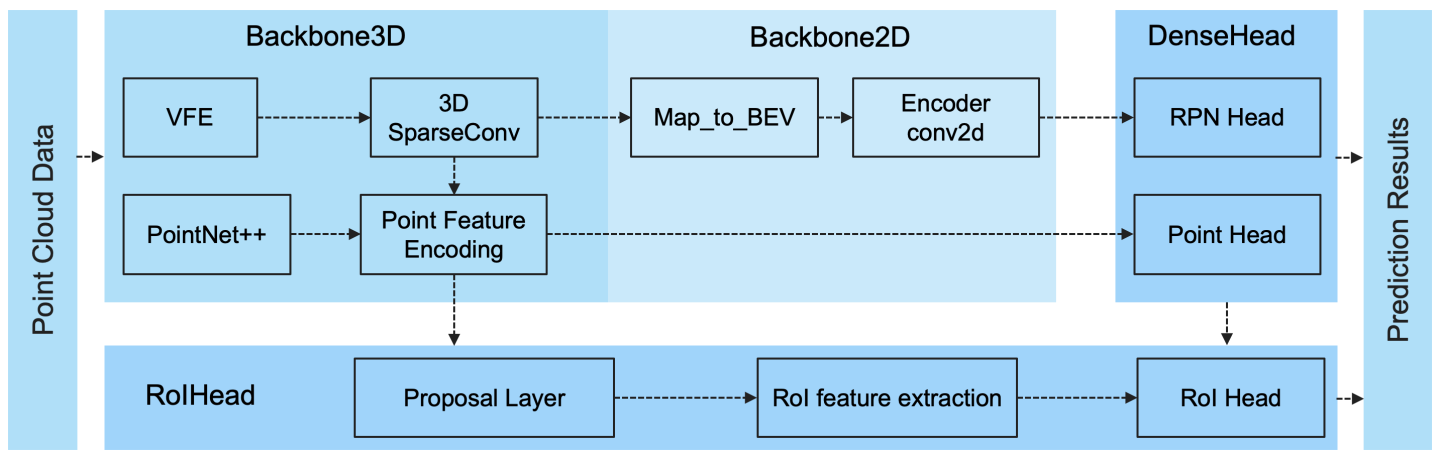
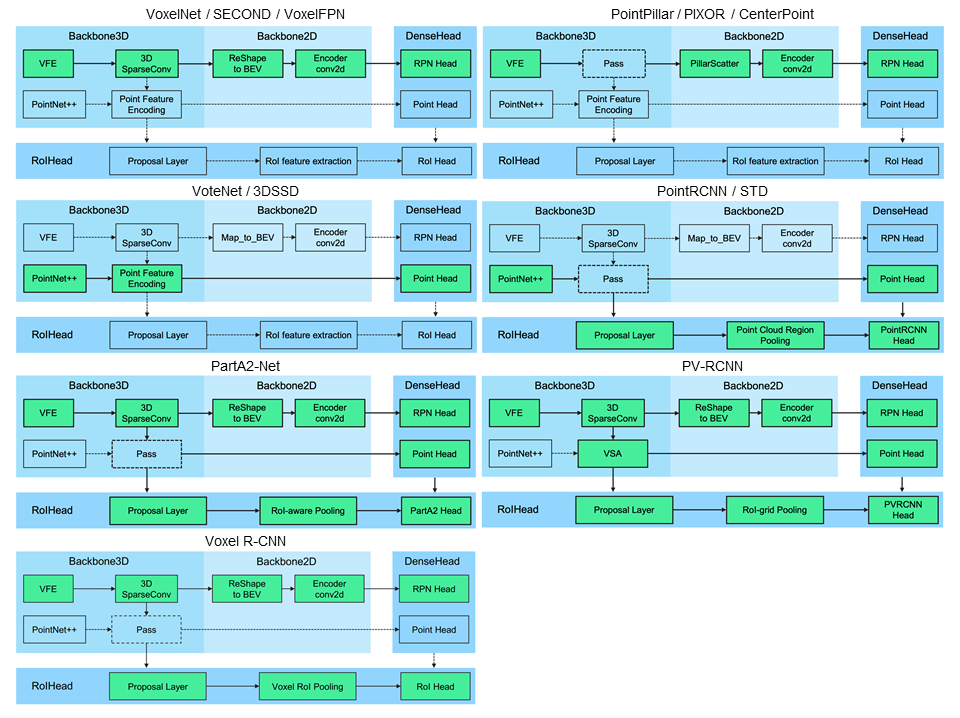
Flexible and clear model structure to easily support various 3D detection models:
Support various models within one framework as:
Currently Supported Features
Support both one-stage and two-stage 3D object detection frameworks
Support distributed training & testing with multiple GPUs and multiple machines
Support multiple heads on different scales to detect different classes
Support stacked version set abstraction to encode various number of points in different scenes
Support Adaptive Training Sample Selection (ATSS) for target assignment
Support RoI-aware point cloud pooling & RoI-grid point cloud pooling
Support GPU version 3D IoU calculation and rotated NMS
Model Zoo
KITTI 3D Object Detection Baselines
Selected supported methods are shown in the below table. The results are the 3D detection performance of moderate difficulty on the val set of KITTI dataset.
All LiDAR-based models are trained with 8 GTX 1080Ti GPUs and are available for download.
The training time is measured with 8 TITAN XP GPUs and PyTorch 1.5.
training time
Car@R11
Pedestrian@R11
Cyclist@R11
download
PointPillar
~1.2 hours
77.28
52.29
62.68
model-18M
SECOND
~1.7 hours
78.62
52.98
67.15
model-20M
SECOND-IoU
-
79.09
55.74
71.31
model-46M
PointRCNN
~3 hours
78.70
54.41
72.11
model-16M
PointRCNN-IoU
~3 hours
78.75
58.32
71.34
model-16M
Part-A2-Free
~3.8 hours
78.72
65.99
74.29
model-226M
Part-A2-Anchor
~4.3 hours
79.40
60.05
69.90
model-244M
PV-RCNN
~5 hours
83.61
57.90
70.47
model-50M
Voxel R-CNN (Car)
~2.2 hours
84.54
-
-
model-28M
Focals Conv - F
~4 hours
85.66
-
-
model-30M
CaDDN (Mono)
~15 hours
21.38
13.02
9.76
model-774M
Waymo Open Dataset Baselines
We provide the setting of DATA_CONFIG.SAMPLED_INTERVAL on the Waymo Open Dataset (WOD) to subsample partial samples for training and evaluation,
so you could also play with WOD by setting a smaller DATA_CONFIG.SAMPLED_INTERVAL even if you only have limited GPU resources.
By default, all models are trained with a single frame of 20% data (~32k frames) of all the training samples on 8 GTX 1080Ti GPUs, and the results of each cell here are mAP/mAPH calculated by the official Waymo evaluation metrics on the whole validation set (version 1.2).
Performance@(train with 20% Data)
Vec_L1
Vec_L2
Ped_L1
Ped_L2
Cyc_L1
Cyc_L2
SECOND
70.96/70.34
62.58/62.02
65.23/54.24
57.22/47.49
57.13/55.62
54.97/53.53
PointPillar
70.43/69.83
62.18/61.64
66.21/46.32
58.18/40.64
55.26/51.75
53.18/49.80
CenterPoint-Pillar
70.50/69.96
62.18/61.69
73.11/61.97
65.06/55.00
65.44/63.85
62.98/61.46
CenterPoint-Dynamic-Pillar
70.46/69.93
62.06/61.58
73.92/63.35
65.91/56.33
66.24/64.69
63.73/62.24
CenterPoint
71.33/70.76
63.16/62.65
72.09/65.49
64.27/58.23
68.68/67.39
66.11/64.87
CenterPoint (ResNet)
72.76/72.23
64.91/64.42
74.19/67.96
66.03/60.34
71.04/69.79
68.49/67.28
Part-A2-Anchor
74.66/74.12
65.82/65.32
71.71/62.24
62.46/54.06
66.53/65.18
64.05/62.75
PV-RCNN (AnchorHead)
75.41/74.74
67.44/66.80
71.98/61.24
63.70/53.95
65.88/64.25
63.39/61.82
PV-RCNN (CenterHead)
75.95/75.43
68.02/67.54
75.94/69.40
67.66/61.62
70.18/68.98
67.73/66.57
Voxel R-CNN (CenterHead)-Dynamic-Voxel
76.13/75.66
68.18/67.74
78.20/71.98
69.29/63.59
70.75/69.68
68.25/67.21
PV-RCNN++
77.82/77.32
69.07/68.62
77.99/71.36
69.92/63.74
71.80/70.71
69.31/68.26
PV-RCNN++ (ResNet)
77.61/77.14
69.18/68.75
79.42/73.31
70.88/65.21
72.50/71.39
69.84/68.77
Here we also provide the performance of several models trained on the full training set (refer to the paper of PV-RCNN++):
Performance@(train with 100% Data)
Vec_L1
Vec_L2
Ped_L1
Ped_L2
Cyc_L1
Cyc_L2
SECOND
72.27/71.69
63.85/63.33
68.70/58.18
60.72/51.31
60.62/59.28
58.34/57.05
CenterPoint-Pillar
73.37/72.86
65.09/64.62
75.35/65.11
67.61/58.25
67.76/66.22
65.25/63.77
Part-A2-Anchor
77.05/76.51
68.47/67.97
75.24/66.87
66.18/58.62
68.60/67.36
66.13/64.93
VoxelNeXt-2D
77.94/77.47
69.68/69.25
80.24/73.47
72.23/65.88
73.33/72.20
70.66/69.56
VoxelNeXt
78.16/77.70
69.86/69.42
81.47/76.30
73.48/68.63
76.06/74.90
73.29/72.18
PV-RCNN (CenterHead)
78.00/77.50
69.43/68.98
79.21/73.03
70.42/64.72
71.46/70.27
68.95/67.79
PV-RCNN++
79.10/78.63
70.34/69.91
80.62/74.62
71.86/66.30
73.49/72.38
70.70/69.62
PV-RCNN++ (ResNet)
79.25/78.78
70.61/70.18
81.83/76.28
73.17/68.00
73.72/72.66
71.21/70.19
DSVT-Pillar
79.44/78.97
71.24/70.81
83.00/77.22
75.45/69.95
76.70/75.70
73.83/72.86
DSVT-Voxel
79.77/79.31
71.67/71.25
83.75/78.92
76.21/71.57
77.57/76.58
74.70/73.73
PV-RCNN++ (ResNet, 2 frames)
80.17/79.70
72.14/71.70
83.48/80.42
75.54/72.61
74.63/73.75
72.35/71.50
MPPNet (4 frames)
81.54/81.06
74.07/73.61
84.56/81.94
77.20/74.67
77.15/76.50
75.01/74.38
MPPNet (16 frames)
82.74/82.28
75.41/74.96
84.69/82.25
77.43/75.06
77.28/76.66
75.13/74.52
We could not provide the above pretrained models due to Waymo Dataset License Agreement,
but you could easily achieve similar performance by training with the default configs.
NuScenes 3D Object Detection Baselines
All models are trained with 8 GPUs and are available for download. For training BEVFusion, please refer to the guideline.
mATE
mASE
mAOE
mAVE
mAAE
mAP
NDS
download
PointPillar-MultiHead
33.87
26.00
32.07
28.74
20.15
44.63
58.23
model-23M
SECOND-MultiHead (CBGS)
31.15
25.51
26.64
26.26
20.46
50.59
62.29
model-35M
CenterPoint-PointPillar
31.13
26.04
42.92
23.90
19.14
50.03
60.70
model-23M
CenterPoint (voxel_size=0.1)
30.11
25.55
38.28
21.94
18.87
56.03
64.54
model-34M
CenterPoint (voxel_size=0.075)
28.80
25.43
37.27
21.55
18.24
59.22
66.48
model-34M
VoxelNeXt (voxel_size=0.075)
30.11
25.23
40.57
21.69
18.56
60.53
66.65
model-31M
TransFusion-L*
27.96
25.37
29.35
27.31
18.55
64.58
69.43
model-32M
BEVFusion
28.03
25.43
30.19
26.76
18.48
67.75
70.98
model-157M
*: Use the fade strategy, which disables data augmentations in the last several epochs during training.
ONCE 3D Object Detection Baselines
All models are trained with 8 GPUs.
Vehicle
Pedestrian
Cyclist
mAP
PointRCNN
52.09
4.28
29.84
28.74
PointPillar
68.57
17.63
46.81
44.34
SECOND
71.19
26.44
58.04
51.89
PV-RCNN
77.77
23.50
59.37
53.55
CenterPoint
78.02
49.74
67.22
64.99
Argoverse2 3D Object Detection Baselines
All models are trained with 4 GPUs.
mAP
download
VoxelNeXt
30.5
model-32M
Other datasets
Welcome to support other datasets by submitting pull request.
Installation
Please refer to INSTALL.md for the installation of OpenPCDet.
Quick Demo
Please refer to DEMO.md for a quick demo to test with a pretrained model and
visualize the predicted results on your custom data or the original KITTI data.
Getting Started
Please refer to GETTING_STARTED.md to learn more usage about this project.
License
OpenPCDet is released under the Apache 2.0 license.
Acknowledgement
OpenPCDet is an open source project for LiDAR-based 3D scene perception that supports multiple
LiDAR-based perception models as shown above. Some parts of PCDet are learned from the official released codes of the above supported methods.
We would like to thank for their proposed methods and the official implementation.
We hope that this repo could serve as a strong and flexible codebase to benefit the research community by speeding up the process of reimplementing previous works and/or developing new methods.
Citation
If you find this project useful in your research, please consider cite:
@misc{openpcdet2020,
    title={OpenPCDet: An Open-source Toolbox for 3D Object Detection from Point Clouds},
    author={OpenPCDet Development Team},
    howpublished = {\url{https://github.com/open-mmlab/OpenPCDet}},
    year={2020}
}
Contribution
Welcome to be a member of the OpenPCDet development team by contributing to this repo, and feel free to contact us for any potential contributions.
How active is development on open-mmlab/OpenPCDet?
The most recent commit recorded on open-mmlab/OpenPCDet was 10 months ago, based on the GitHub push timestamp. The repository has 1.5k forks — one of the better signals of community interest.
How many stars does open-mmlab/OpenPCDet have?
open-mmlab/OpenPCDet has 5.7k GitHub stars — refresh the page for the live number, or check github.com/open-mmlab/OpenPCDet. TopGit mirrors GitHub's count but does not claim minute-by-minute accuracy.
What else is in the AI Tools space?
open-mmlab/OpenPCDet is tracked by TopGit under the AI Tools category, alongside 6 GitHub-tagged topics. Trending and Topics pages list peer repositories of comparable stars and language.
What language is open-mmlab/OpenPCDet written in?
open-mmlab/OpenPCDet is written primarily in Python. GitHub's language field is based on the largest share of bytes in the default branch.
What topics is open-mmlab/OpenPCDet associated with?
GitHub's repository topics for open-mmlab/OpenPCDet: "3d-detection", "autonomous-driving", "object-detection", "point-cloud", "pv-rcnn", "pytorch". TopGit's editorial category is AI Tools.
Where do I read more about open-mmlab/OpenPCDet?
This TopGit page is a snapshot — the READ ME tab shows the project's own README content (links stripped, images preserved). The GitHub repository at github.com/open-mmlab/OpenPCDet is the definitive source.
Why is open-mmlab/OpenPCDet categorized under AI Tools?
TopGit places open-mmlab/OpenPCDet in the AI Tools category based on its GitHub topics and description (tagged: "3d-detection", "autonomous-driving", "object-detection"). Categories are assigned from real repository metadata, not editorial guesswork.
Read full README in the tab above.
Is OpenPCDet worth your time?
ChatGPT, Claude and Perplexity can all read this page. Ask one of them what it makes of OpenPCDet.
 /OpenPCDet