Indexed by TopGit from live GitHub metadata: openfaas/faas has 26.3k stars, written primarily in Go. OpenFaaS - Serverless Functions Made Simple
Snapshot summary built from the project's own GitHub metadata — there's no written TopGit review yet. The page will update automatically when a full review is published.
WHY NO REVIEW YET
TopGit writes full reviews for the most-starred, most-requested repositories. This page is a snapshot until then — see the READ ME tab for the original README in full.
OpenFaaS® makes it easy for developers to deploy event-driven functions and microservices to Kubernetes without repetitive, boiler-plate coding. Package your code or an existing binary in an OCI-compatible image to get a highly scalable endpoint with auto-scaling and metrics.
"OpenFaaS Community Edition (CE) is licensed for individual exploration and hobbyist use. A 60 day limit applies for commercial PoCs. Commercial and production workloads require OpenFaaS Standard or OpenFaaS for Enterprises."
Highlights
Ease of use through UI portal and one-click install
Write services and functions in any language with Template Store or a Dockerfile
Build and ship your code in an OCI-compatible/Docker image
Portable: runs on existing hardware or public/private cloud by leveraging Kubernetes
CLI available with YAML format for templating and defining functions
Auto-scales as demand increases including to zero
Commercially supported Pro distribution by the team behind OpenFaaS
Want to dig deeper into OpenFaaS?
Trigger endpoints with either HTTP or events sources such as Apache Kafka and AWS SQS
Offload tasks to the built-in queuing and background processing
Quick-start your Kubernetes journey with GitOps from OpenFaaS Cloud
Go secure or go home with 5 must-know security tips
Learn everything you need to know to go to production
Integrate with Istio or Linkerd with Featured Tutorials
Deploy to Kubernetes or OpenShift
OpenFaaS Tiers and Pricing
This repository is part of OpenFaaS Community Edition (CE), which is licensed for non-commercial use by individuals, and a time-limited trial for commercial Proof Of Concepts (PoC). Internal use within a company or business requires a license.
OpenFaaS CE:
has usage restrictions, which you can learn about in the OpenFaaS CE EULA
has basic or primitive features and capabilities compared to the commercial versions
is not licensed for commercial use of any kind beyond an initial trial period
OpenFaaS Standard and OpenFaaS for Enterprises are full and distinct commercial products.
They are maintained and developed independently, by a full-time team, with commercial support, and active maintenance for CVEs, and updates in the Kubernetes and Cloud Native ecosystem.
Learn more about the tiers at https://www.openfaas.com/pricing/
Overview of OpenFaaS (Serverless Functions Made Simple)
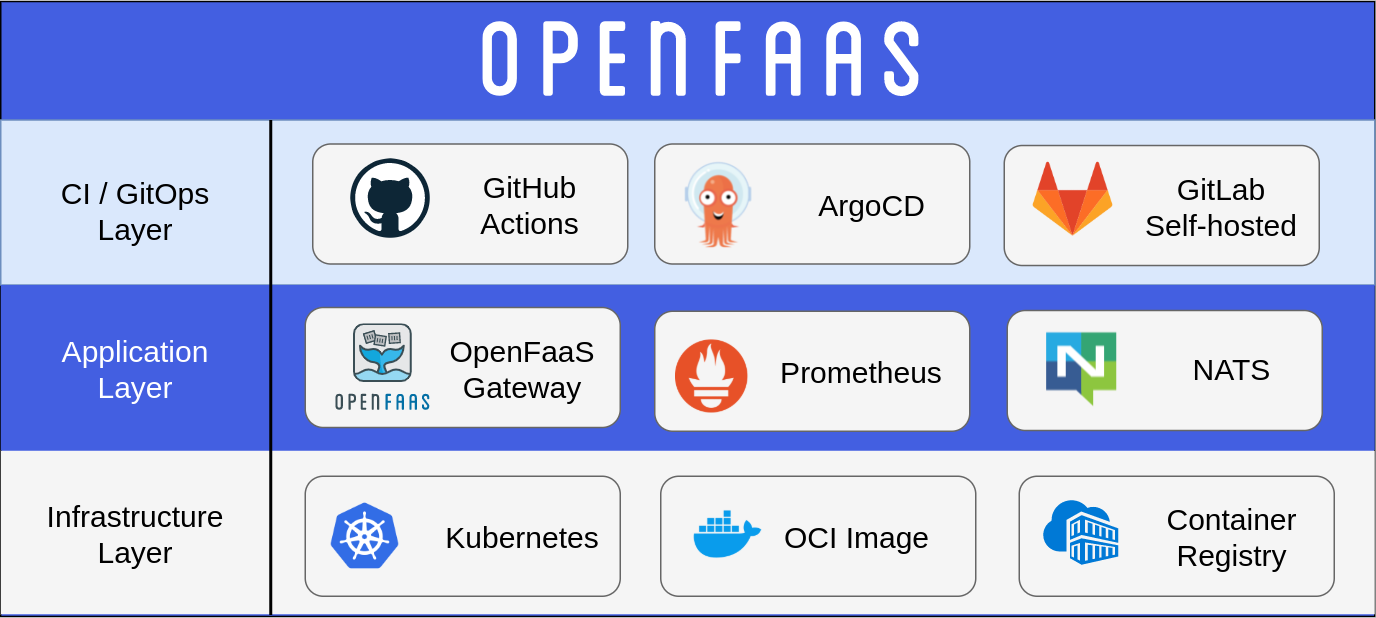
Conceptual architecture and stack, more detail available in the docs
Code samples
You can scaffold a new function using the faas-cli new command passing in the name of the function and the language template you want to use i.e. faas-cli new --lang node20 stripe-webhooks.
Official templates exist for many popular languages and are easily extensible with Dockerfiles.
package function

import (
 	"fmt"
 	"io"
 	"net/http"
)

func Handle(w http.ResponseWriter, r *http.Request) {
    var input []byte

   	if r.Body != nil {
    		defer r.Body.Close()
    		body, _ := io.ReadAll(r.Body)
    		input = body
   	}

   	w.WriteHeader(http.StatusOK)
   	w.Write([]byte(fmt.Sprintf("Body: %s", string(input))))
}
Get started with OpenFaaS
Official training resources
View our official training materials
Official eBook and video workshop
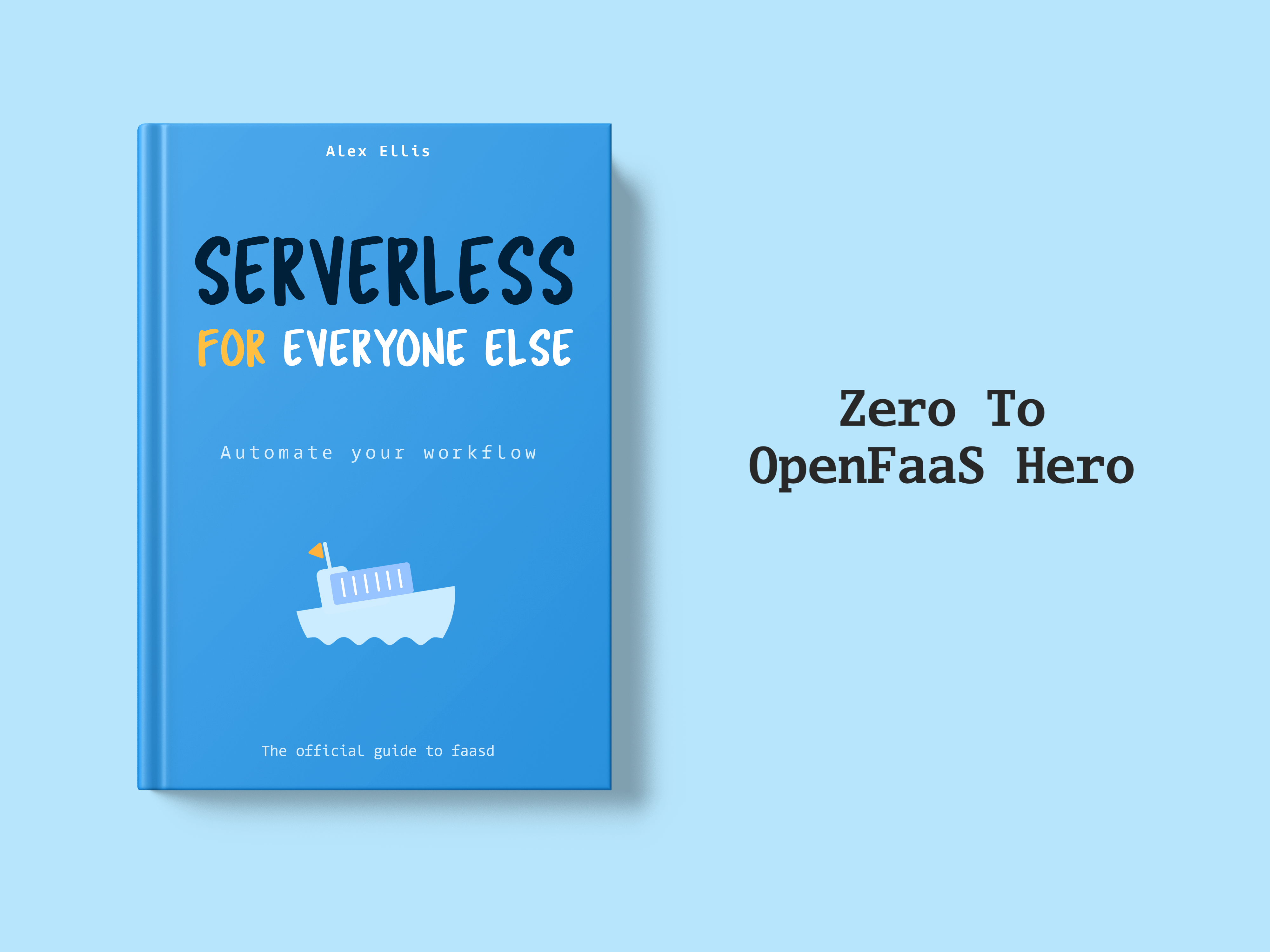
The founder of OpenFaaS wrote Serverless For Everyone Else to help developers understand the use-case for functions through practical hands-on exercises using JavaScript and Node.js. No programming experience is required to try the exercises.
The examples use the faasd project, which is an easy to use and lightweight way to start learning about OpenFaaS and functions.
Check out Serverless For Everyone Else on Gumroad
OpenFaaS and Golang
Everyday Go is a practical, hands-on guide to writing CLIs, web pages, and microservices in Go. It also features a chapter dedicated to development and testing of functions using OpenFaaS and Go.
Everyday Golang
Community blog and documentation
Read the documentation: docs.openfaas.com
Read latest news and tutorials on the Official Blog
Quickstart
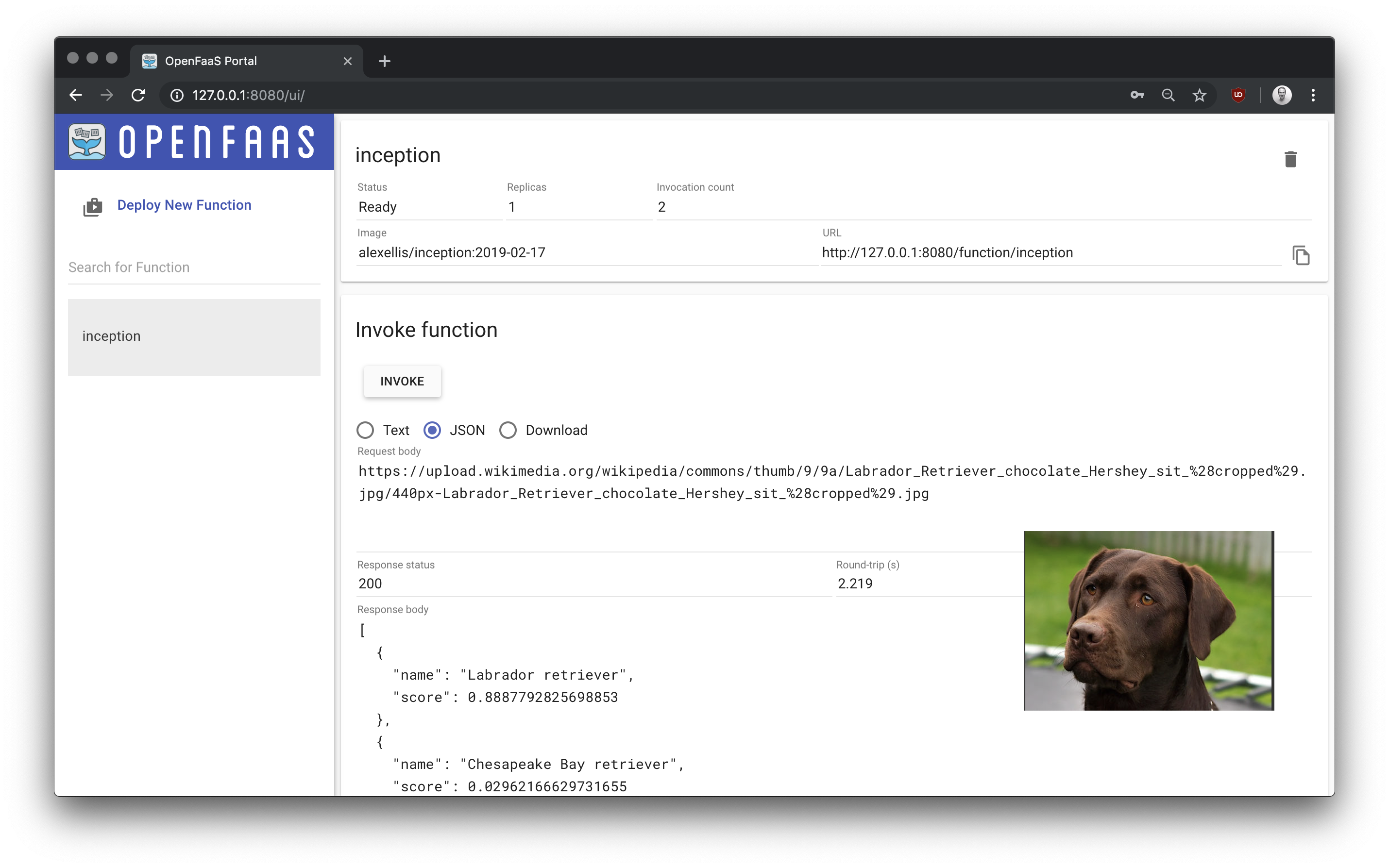
Here is a screenshot of the OpenFaaS Community Edition UI which was designed for ease of use. The inception function is being run which is available on the in the store.
Deploy OpenFaaS to Kubernetes, OpenShift, or faasd now with a deployment guide
OpenFaaS Standard and OpenFaaS for Enterprises have their own, brand new dashboard with multi-tenancy support, learn more about the OpenFaaS Dashboard.
Video presentations
Meet faasd. Look Ma’ No Kubernetes! 2020
Getting Beyond FaaS: The PLONK Stack for Kubernetes Developers 2019
Serverless Beyond the Hype - Alex Ellis - GOTO 2018
How LivePerson is Tailoring its Conversational Platform Using OpenFaaS - Simon Pelczer 2019
Digital Transformation of Vision Banco Paraguay with Serverless Functions @ KubeCon 2018
Introducing "faas" - Cool Hacks Keynote at Dockercon 2017
Community events and blog posts
Have you written a blog about OpenFaaS? Do you have a speaking event? Send a Pull Request to the community page below.
Read blogs/articles and find events about OpenFaaS
Contributing
OpenFaaS Community Edition is written in Golang. All third-party contributions to the source code are made under the MIT license, additional restrictions apply to OpenFaaS CE as a whole, where contributions from OpenFaaS Ltd are licensed under the OpenFaaS CE EULA. Various types of contributions are welcomed whether that means providing feedback, testing existing and new feature or hacking on the source code.
How do I become a contributor?
Please see the guide on community & contributing
Dashboards
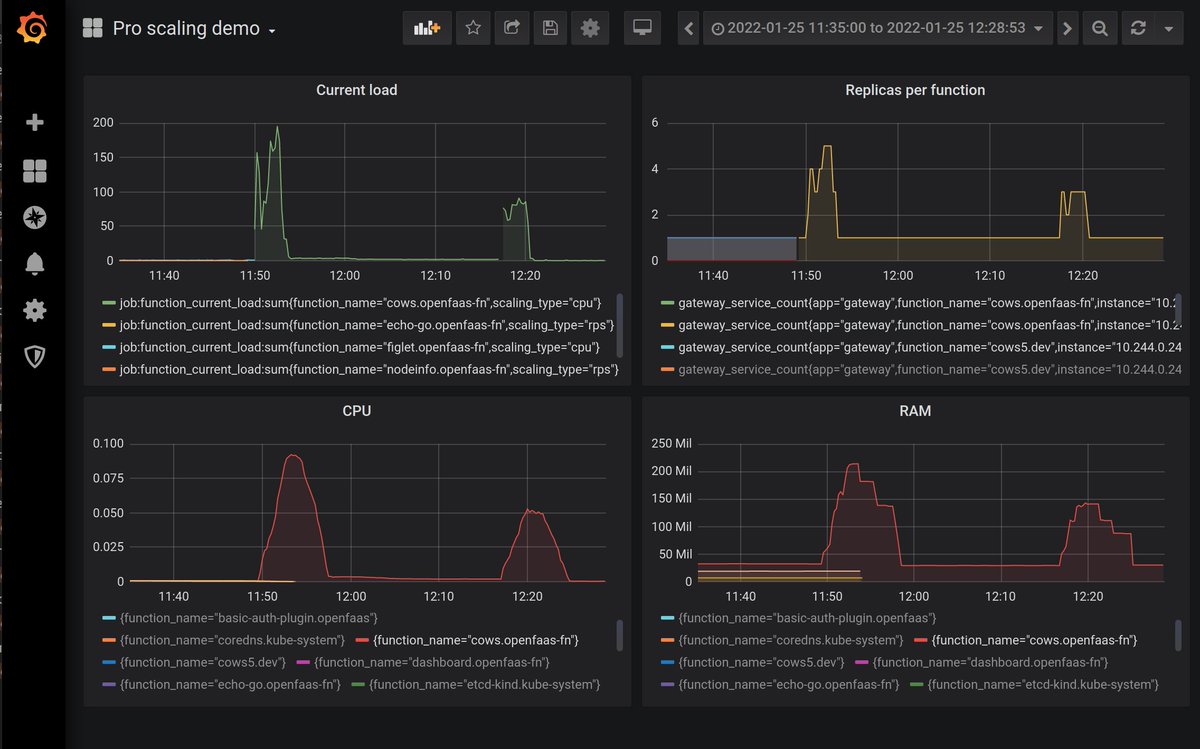
Example of a Grafana dashboard linked to OpenFaaS showing auto-scaling live in action: here
OpenFaaS Pro auto-scaling dashboard with Grafana
An alternative community dashboard is available here
Press / Branding / Website Sponsorship
OpenFaaS for commercial and internal use
OpenFaaS Pro (Standard and For Enterprises) is fully featured, supported, and built for production. The Community Edition (CE) is licensed for a 60-day Proof of Concept (PoC) and limited experimentation.
Learn more about OpenFaaS editions
Website Sponsorship 🌎
If you'd like to gain visibility by displaying your logon on the openfaas.com homepage, feel free to reach out via email or browse the tiers via GitHub Sponsors.
Press / Analysts
Looking at these repositories for commit counts and activity? All public repositories are part of OpenFaaS CE, a limited version of OpenFaaS aimed at giving people a low-barrier trial experience without having to sign up with a credit card. OpenFaaS CE is maintained on a best effort basis, but is not "OpenFaaS" itself. All OpenFaaS product development is done in private repositories, and cannot be tracked by third parties or by simply browsing GitHub.
How are GitHub Stars and Forks counted? OpenFaaS CE is not a mono-repo, you cannot simply look at one repository and say "ah that's the count" - statistics are gathered from the whole GitHub organisation.
Governance
OpenFaaS ® is an independent open-source project created by Alex Ellis, which is being built and shaped by a growing community of contributors.
OpenFaaS is hosted by OpenFaaS Ltd (registration: 11076587), a company which also offers commercial services, homepage sponsorships, and support. OpenFaaS ® is a registered trademark in England and Wales.
Users
View a selection of end-user companies who have given permission to have their logo listed at openfaas.com.
The most recent commit recorded on openfaas/faas was 4 months ago, based on the GitHub push timestamp. The repository has 2.0k forks — one of the better signals of community interest.
Is openfaas/faas open source?
TopGit's metadata for openfaas/faas does not record a license. Most public repositories on GitHub ARE open source, but the exact terms vary — verify by opening the LICENSE file directly.
The project maintains a homepage at https://www.openfaas.com. The README tab on this page also usually contains screenshots and a quickstart.
Where do I read more about openfaas/faas?
This TopGit page is a snapshot — the READ ME tab shows the project's own README content (links stripped, images preserved). The GitHub repository at github.com/openfaas/faas is the definitive source.
Read full README in the tab above.
Still deciding about faas?
One click hands the question to an AI along with this page — see what it says about faas.

 /faas