
Public APIs: A Curated Directory of Free APIs
 /public-apis
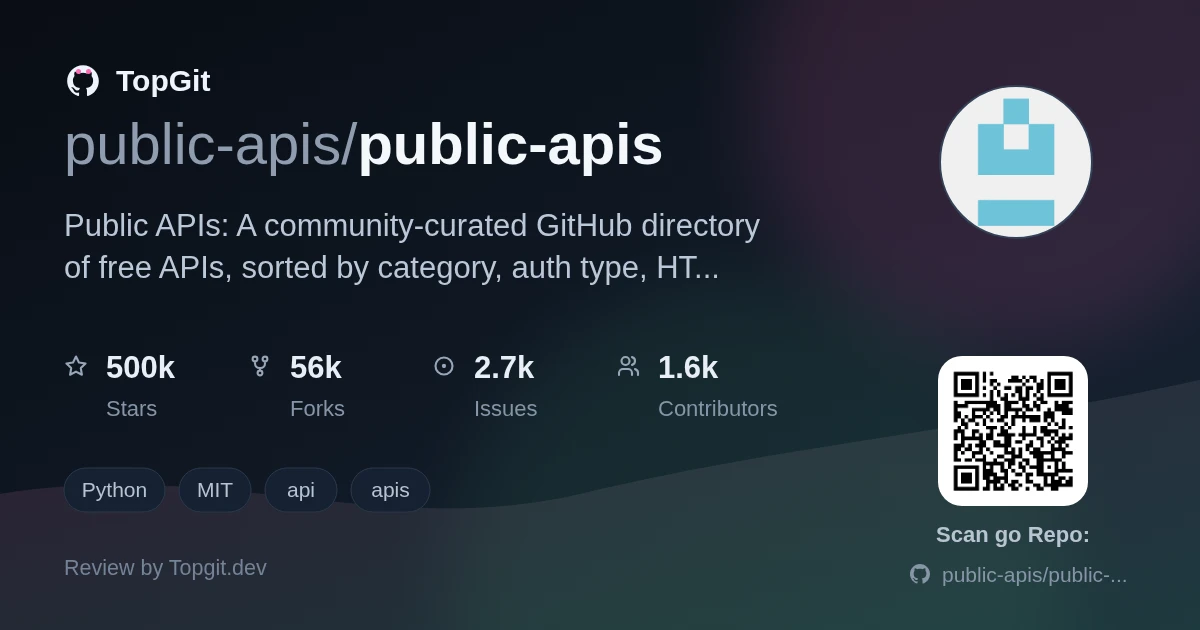
Public APIs is a GitHub-hosted directory of free, publicly accessible APIs sorted by category, auth type, HTTPS support, and CORS availability. Reach for it when you're prototyping and need a free API fast, and don't mind digging through duplicate entries and the occasional dead link. Skip it if you want uptime guarantees or a single well-documented SDK instead of a raw links list.
What is Public APIs?
Public APIs is a GitHub repository that indexes free, publicly available APIs into a browsable list, manually curated by community contributors and people from APILayer. Each entry lists the API's name, a short description, its authentication method, whether it supports HTTPS, and whether CORS is enabled. It spans everything from Animals and Anime to Blockchain and Authentication tooling. There's no code to install; you read the table, click through, and integrate the API yourself.
Exploring the API Categories
- ✓Every entry carries four data points: API name, description, auth type (apiKey, OAuth, or none), and whether HTTPS and CORS are supported, so you can rule out APIs that won't work from a browser before you click through.
- ✓Categories span a wide range, from Animals, Anime, and Art & Design to Blockchain, Authentication & Authorization, and Anti-Malware. The README organizes entries into topic sections rather than one long table.
- ✓A companion project, public-api, maintained separately by a different developer, exposes this list as a queryable API instead of a markdown table.
- ✓Entries are plain markdown links. No ratings or usage stats attached.
- ✓The top of the README promotes APILayer's own paid API suite ahead of the free community list.
How to Use This API Collection
- •Prototyping a side project? Search the category table for something close, like cat facts, weather, or exchange rates, and wire it in without signing up for a vendor evaluation call.
- •Comparing auth models before you commit: scan the Auth column to see which APIs need a key, which use OAuth, and which are open, so you don't discover a paywall after you've already written the integration code.
- •Teaching or learning HTTP basics.
- •Building a demo app that touches multiple domains, since categories are split cleanly enough to grab three or four unrelated APIs, like weather, animals, and art, for one project.
Who Benefits from Public APIs?
Public APIs suits developers who need a free API right now and can tolerate some manual verification: students building class projects, indie hackers prototyping without a budget, and anyone testing an integration pattern before committing to a paid vendor. It's a weaker fit for teams that need contractual uptime guarantees or a single well-supported SDK, since this is a links list, not a managed platform.
Strengths
- ✓Every entry states its auth requirement, HTTPS support, and CORS availability up front, so you can rule out APIs that won't work for a browser-based project before you open their docs.
- ✓Categories cover niche territory that you would not find grouped together in a single vendor's catalog, including Anti-Malware, Blockchain, and Anime.
- ✓MIT licensed, free to browse, and requires no signup to start reading.
- ✓Contribution is a straightforward pull request against a markdown file, not a locked-down submission process.
Considerations for Using Public APIs
- △The list is community-maintained via pull request, so entries can go stale. Dead links, deprecated endpoints, or services that added a paywall after being listed happen, and nothing in the repo flags this automatically.
- △No uptime, rate-limit, or reliability data is attached to any entry; the CORS and HTTPS columns are the only structured metadata you get.
- △The README opens with a sponsor pitch for APILayer's paid API suite before you reach the community list, which is easy to mistake for the main content on first scroll.
- △It's a markdown table, not a search or filter UI. Finding the right entry means reading through a category section or using GitHub's in-page search.
Other API Discovery Resources
Common Questions
Public APIs is free to browse, and the listed APIs are free public APIs. Some individual APIs still require their own signup or key to call, which is documented per entry in the Auth column.
Contributors submit a pull request against the repository's markdown file, following the format documented in the Contributing Guide, and a maintainer reviews it before merging.
Public APIs spans categories including Animals, Anime, Art & Design, Blockchain, Authentication & Authorization, and Anti-Malware, among many others, covering data, media, security, and developer-tooling APIs.
The Public APIs repository itself is released under the MIT license; the APIs it links to each carry their own separate licensing and usage terms.
Open a pull request following the repository's Contributing Guide, or file an issue if you spot a broken link or an API that no longer matches its listed description.
Public APIs does not host any of the listed APIs itself; it only links out to third-party services that are hosted and maintained elsewhere.
Related repositories
Want a second opinion on public-apis?
Ask an AI that can read this page — one click and you get its take on public-apis.