On GitHub, Qihoo360/Quicksql has picked up 2.0k stars, Data, Java. A Flexible, Fast, Federated(3F) SQL Analysis Middleware for Multiple Data Sources
Snapshot summary built from the project's own GitHub metadata — there's no written TopGit review yet. The page will update automatically when a full review is published.
WHY NO REVIEW YET
TopGit writes full reviews for the most-starred, most-requested repositories. This page is a snapshot until then — see the READ ME tab for the original README in full.
Quicksql is a SQL query product which can be used for specific datastore queries or multiple datastores correlated queries. It supports relational databases, non-relational databases and even datastore which does not support SQL (such as Elasticsearch, Druid) . In addition, a SQL query can join or union data from multiple datastores in Quicksql. For example, you can perform unified SQL query on one situation that a part of data stored on Elasticsearch, but the other part of data stored on Hive. The most important is that QSQL is not dependent on any intermediate compute engine, users only need to focus on data and unified SQL grammar to finished statistics and analysis.
Architecture
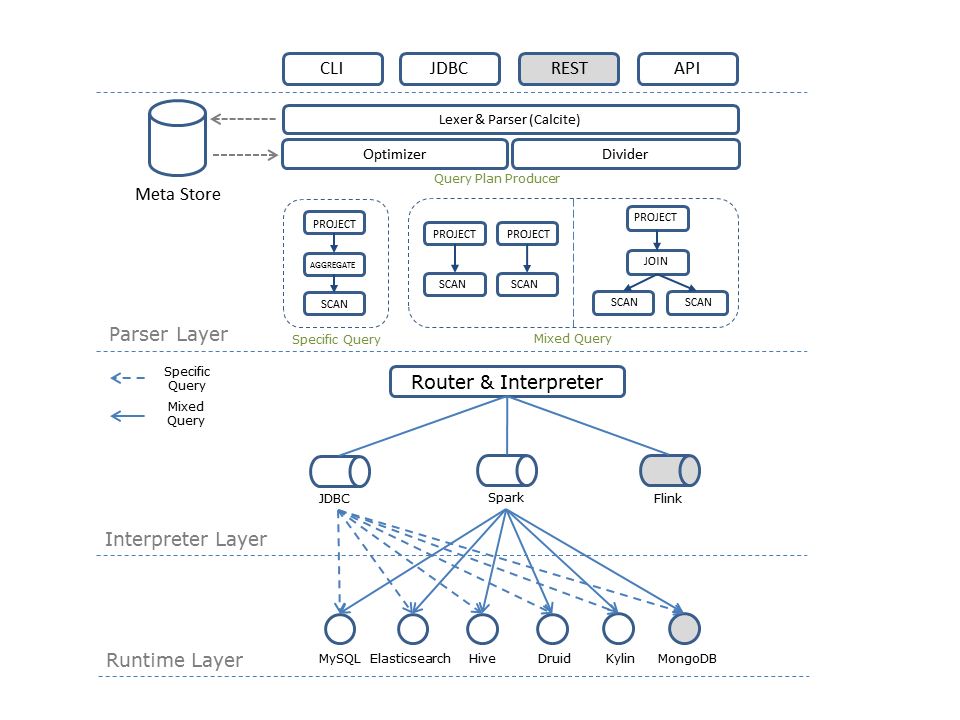
An architecture diagram helps you access Quicksql more easily.
QSQL architecture consists of three layers:
Parsing Layer: Used for parsing, validation, optimization of SQL statements, splitting of mixed SQL and finally generating Query Plan;
Computing Layer: For routing query plan to a specific execution plan, then interpreted to executable code for given storage or engine(such as Elasticsearch JSON query or Hive HQL);
Storage Layer: For data prepared extraction and storage;
Basic Features
In the vast majority of cases, we expect to use a language for data analysis and don't want to consider things that are not related to data analysis, Quicksql is born for this.
The goal of Quicksql is to provide three functions:
1. Unify all structured data queries into a SQL grammar
Only Use SQL
In Quicksql, you can query Elasticsearch like this:
SELECT state, pop FROM geo_mapping WHERE state = 'CA' ORDER BY state
Even an aggregation query:
SELECT approx_count_distinct(city), state FROM geo_mapping GROUP BY state LIMIT 10
You won't be annoyed again because the brackets in the JSON query can't match ;)
Eliminate Dialects
In the past, the same semantic statement needs to be converted to a dialect for different engines, such as:
SELECT * FROM geo_mapping                       -- MySQL Dialect
LIMIT 10 OFFSET 10
SELECT * FROM geo_mapping                       -- Oracle Dialect
OFFSET 10 ROWS FETCH NEXT 10 ROWS ONLY
In Quicksql, relational databases no longer have the concept of dialects. You can use the grammar of Quicksql to query any engine, just like this:
SELECT * FROM geo_mapping LIMIT 10 OFFSET 10 -- Run Anywhere
2. Shield the isolation between different data sources
Consider a situation where you want to join tables that are in different engines or are not in the same cluster, you may be in trouble.
However, in Quicksql, you can query like this:
SELECT * FROM
    (SELECT * FROM es_raw.profile AS profile    //index.tpye on Elasticsearch
        WHERE note IS NOT NULL )AS es_profile
INNER JOIN
    (SELECT * FROM hive_db.employee AS emp  //database.table on Hive
    INNER JOIN hive_db.action AS act    //database.table on Hive
    ON emp.name = act.name) AS tmp
ON es_profile.prefer = tmp.prefer
3. Choose the most appropriate way to execute the query
A query involving multiple engines can be executed in a variety of ways. Quicksql wants to combine the advantages of each engine to find the most appropriate one.
Getting Started
For instructions on building Quicksql from source, see Getting Started.
Reporting Issues
If you find any bugs or have any better suggestions, please file a GitHub issue.
And if the issue is approved, a label [QSQL-ID] will be added before the issue description by committer so that it can correspond to commit. Such as:
[QSQL-1002]: Views generated after splitting logical plan are redundant.
Contributing
We welcome contributions.
If you are interested in Quicksql, you can download the source code from GitHub and execute the following maven command at the project root directory:
mvn -DskipTests clean package
If you are planning to make a large contribution, talk to us first! It helps to agree on the general approach. Log a Issures on GitHub for your proposed feature.
Fork the GitHub repository, and create a branch for your feature.
Develop your feature and test cases, and make sure that mvn install succeeds. (Run extra tests if your change warrants it.)
Commit your change to your branch.
If your change had multiple commits, use git rebase -i master to squash them into a single commit, and to bring your code up to date with the latest on the main line.
Then push your commit(s) to GitHub, and create a pull request from your branch to the QSQL master branch. Update the JIRA case to reference your pull request, and a committer will review your changes.
The pull request may need to be updated (after its submission) for two main reasons:
you identified a problem after the submission of the pull request;
the reviewer requested further changes;
In order to update the pull request, you need to commit the changes in your branch and then push the commit(s) to GitHub. You are encouraged to use regular (non-rebased) commits on top of previously existing ones.
The most recent commit recorded on Qihoo360/Quicksql was 4.1 years ago, based on the GitHub push timestamp. The repository has 565 forks — one of the better signals of community interest.
How many stars does Qihoo360/Quicksql have?
Qihoo360/Quicksql has 2.0k GitHub stars — refresh the page for the live number, or check github.com/Qihoo360/Quicksql. TopGit mirrors GitHub's count but does not claim minute-by-minute accuracy.
Is Qihoo360/Quicksql open source?
Yes — Qihoo360/Quicksql ships under the MIT license, which makes its source code freely readable (and, depending on license terms, forkable and reusable). Source: github.com/Qihoo360/Quicksql.
What else is in the Data space?
Qihoo360/Quicksql is tracked by TopGit under the Data category, alongside 4 GitHub-tagged topics. Trending and Topics pages list peer repositories of comparable stars and language.
What topics is Qihoo360/Quicksql associated with?
GitHub's repository topics for Qihoo360/Quicksql: "flink", "hive", "spark", "sql". TopGit's editorial category is Data.
Where can I see Qihoo360/Quicksql in action?
The project maintains a homepage at https://quicksql.readthedocs.io. The README tab on this page also usually contains screenshots and a quickstart.
Where do I read more about Qihoo360/Quicksql?
This TopGit page is a snapshot — the READ ME tab shows the project's own README content (links stripped, images preserved). The GitHub repository at github.com/Qihoo360/Quicksql is the definitive source.
Read full README in the tab above.
Curious whether Quicksql is right for you?
Let ChatGPT, Claude, or Perplexity look into it — click below and see what AI actually says about Quicksql.

 /Quicksql