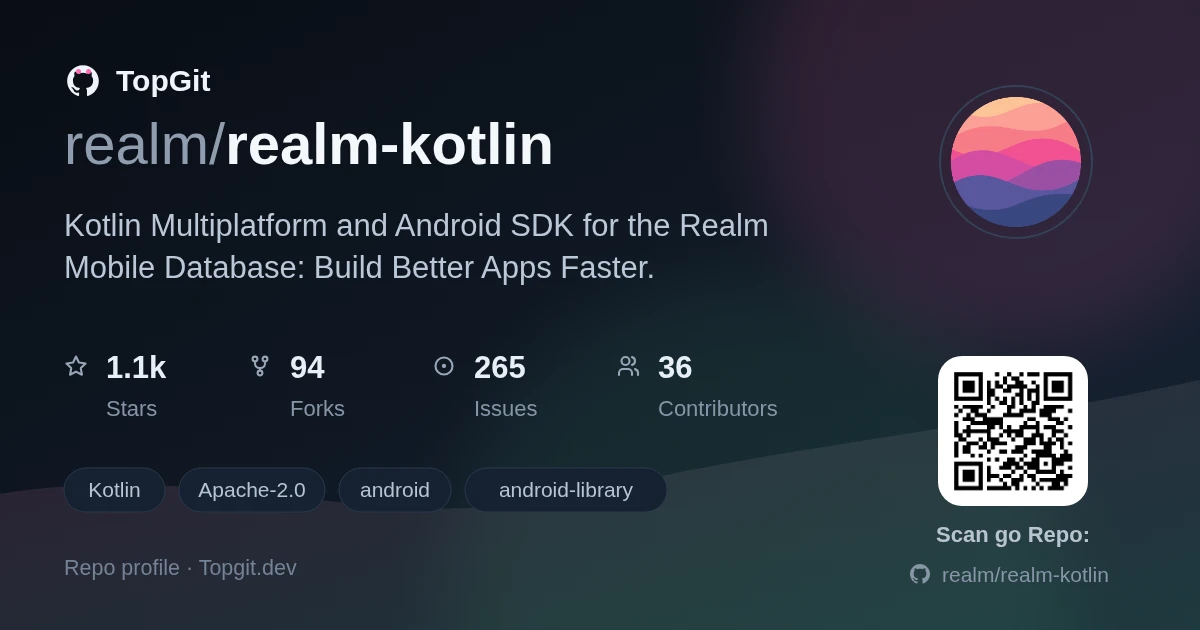
realm/realm-kotlin is a Kotlin project with 1.1k stars in the Mobile space. Kotlin Multiplatform and Android SDK for the Realm Mobile Database: Build Better Apps Faster.
Snapshot summary built from the project's own GitHub metadata — there's no written TopGit review yet. The page will update automatically when a full review is published.
WHY NO REVIEW YET
TopGit writes full reviews for the most-starred, most-requested repositories. This page is a snapshot until then — see the READ ME tab for the original README in full.
[!WARNING]
We announced the deprecation of Atlas Device Sync + Realm SDKs in September 2024. For more information please see:
SDK Deprecation
Device Sync Deprecation
For a version of Realm Kotlin without sync features, install version 3.0.0+ or see the community git branch.
Realm is a mobile database that runs directly inside phones, tablets or wearables.
This repository holds the source code for the Kotlin SDK for Realm, which runs on Kotlin Multiplatform and Android.
Why Use Realm
Intuitive to Developers: Realm’s object-oriented data model is simple to learn, doesn’t need an ORM, and lets you write less code.
Built for Mobile: Realm is fully-featured, lightweight, and efficiently uses memory, disk space, and battery life.
Designed for Offline Use: Realm’s local database persists data on-disk, so apps work as well offline as they do online.
Atlas Device Sync: Makes it simple to keep data in sync across users, devices, and your backend in real-time. Get started for free with a template application and create the cloud backend.
General Availability
The Realm Kotlin SDK is GA.
Documentation can be found here.
Sample projects can be found here.
If you are upgrading from a previous beta release of Realm Kotlin, please see the CHANGELOG for the full list of changes.
If you are migrating from Realm Java, please see the Migration Guide.
Usage
Installation
Installation differs slightly depending on the type of project and whether or not you are using Device Sync. See the details in the documentation:
Android
Kotlin Multiplatform
Also pay attention to restrictions on which versions of Kotlin and other dependencies that are supported. You can read
more in the version compatibility matrix.
Define model
Start writing your database logic by first defining your model.
class Person : RealmObject {
    var name: String = "Foo"
    var dog: Dog? = null
}

class Dog : RealmObject {
    var name: String = ""
    var age: Int = 0
}
Open Database
Define a RealmConfiguration with the database schema, then open the Realm using it.
// use the RealmConfiguration.Builder() for more options
val configuration = RealmConfiguration.create(schema = setOf(Person::class, Dog::class))
val realm = Realm.open(configuration)
Write
Persist some data by instantiating the model object and copying it into the open Realm instance.
// plain old kotlin object
val person = Person().apply {
    name = "Carlo"
    dog = Dog().apply { name = "Fido"; age = 16 }
}

// Persist it in a transaction
realm.writeBlocking { // this : MutableRealm
    val managedPerson = copyToRealm(person)
}

// Asynchronous updates with Kotlin coroutines
CoroutineScope(context).async {
    realm.write { // this : MutableRealm
        val managedPerson = copyToRealm(person)
    }
}
Query
The query language supported by Realm is inspired by Apple’s NSPredicate, see more examples here
// All persons
import io.realm.kotlin.ext.query

val all = realm.query<Person>().find()

// Persons named 'Carlo'
val personsByNameQuery: RealmQuery<Person> = realm.query<Person>("name = $0", "Carlo")
val filteredByName: RealmResults<Person> = personsByNameQuery.find()

// Person having a dog aged more than 7 with a name starting with 'Fi'
val filteredByDog = realm.query<Person>("dog.age > $0 AND dog.name BEGINSWITH $1", 7, "Fi").find()

// Observing changes with Coroutine Flows
CoroutineScope(context).async {
    personsByNameQuery.asFlow().collect { result: ResultsChange<Person> ->
        println("Realm updated: Number of persons is ${result.list.size}")
    }
}
Update
// Find the first Person without a dog
realm.query<Person>("dog == NULL LIMIT(1)")
    .first()
    .find()
    ?.also { personWithoutDog ->
        // Add a dog in a transaction
        realm.writeBlocking {
            findLatest(personWithoutDog)?.dog = Dog().apply { name = "Laika"; age = 3 }
        }
    }
Delete
Use the result of a query to delete from the database.
// delete all Dogs
realm.writeBlocking {
    // Selected by a query
    val query = this.query<Dog>()
    delete(query)

    // From a query result
    val results = query.find()
    delete(results)

    // From individual objects
    results.forEach { delete(it) }
}
Observing data changes
Realm support asynchronous observers on all its data structures.
Realm
A Realm can be observed globally for changes on its data.
realm.asFlow()
    .collect { realmChange: RealmChange<Realm> ->
        when (realmChange) {
            is InitialRealm<*> -> println("Initial Realm")
            is UpdatedRealm<*> -> println("Realm updated")
        }
    }
RealmObject
Realm objects can be observed individually. A list of the changed field names is provided on each update.
person.asFlow().collect { objectChange: ObjectChange<Person> ->
        when (objectChange) {
            is InitialObject -> println("Initial object: ${objectChange.obj.name}")
            is UpdatedObject ->
                println("Updated object: ${objectChange.obj.name}, changed fields: ${objectChange.changedFields.size}")
            is DeletedObject -> println("Deleted object")
        }
    }
RealmLists
Realm data structures can be observed too. On RealmList on each update you receive what positions were inserted, changed or deleted.
person.addresses.asFlow()
        .collect { listChange: ListChange<String> ->
            when (listChange) {
                is InitialList -> println("Initial list size: ${listChange.list.size}")
                is UpdatedList ->
                    println("Updated list size: ${listChange.list.size} insertions ${listChange.insertions.size}")
                is DeletedList -> println("Deleted list")
            }
        }
RealmQuery
Query results are also observable, and like RealmList on each update, the inserted, changed and deleted indices are also provided.
realm.query<Person>().asFlow()
    .collect { resultsChange: ResultsChange<Person> ->
        when (resultsChange) {
            is InitialResults -> println("Initial results size: ${resultsChange.list.size}")
            is UpdatedResults ->
                println("Updated results size: ${resultsChange.list.size} insertions ${resultsChange.insertions.size}")
        }
    }
RealmSingleQuery
Single element queries allow observing a RealmObject that might not be in the realm.
realm.query<Person>("name = $0", "Carlo").first().asFlow()
    .collect { objectChange: SingleQueryChange<Person> ->
        when (objectChange) {
            is PendingObject -> println("Pending object")
            is InitialObject -> println("Initial object: ${objectChange.obj.name}")
            is UpdatedObject ->
                println("Updated object: ${objectChange.obj.name}, changed fields: ${objectChange.changedFields.size}")
            is DeletedObject -> println("Deleted object")
        }
    }
Next: head to the full KMM example.
Using Snapshots
If you want to test recent bugfixes or features that have not been packaged in an official release yet, you can use a -SNAPSHOT release of the current development version of Realm via Gradle, available on Maven Central
With Kotlin Multiplatform still in Beta
and the Compiler Plugin APIs being experimental, there might be restrictions on what versions of Kotlin the Realm Kotlin
SDK supports. In the matrix below, you will find the minimum supported version for the dependencies of each Realm release.
Realm Version
Requirements
2.3.0
Kotlin 2.0.20+
AtomicFu 0.18.3+.
Ktor 2.1.2+.
Coroutines 1.7.0+.
Gradle 7.2 - 8.5
The new memory model only.
2.0.0
Kotlin 2.0.0+
AtomicFu 0.18.3+.
Ktor 2.1.2+.
Coroutines 1.7.0+.
Gradle 7.2 - 8.5
The new memory model only.
1.16.0
Kotlin 1.9.0+
AtomicFu 0.18.3+.
Ktor 2.1.2+.
Coroutines 1.7.0+.
Gradle 6.8.3 - 8.5
The new memory model only.
1.15.0
Kotlin 1.9.0+
AtomicFu 0.18.3+.
Ktor 2.1.2+.
Coroutines 1.7.0+.
Gradle 6.8.3 - 8.5
The new memory model only.
1.14.0
Kotlin 1.9.0+
AtomicFu 0.18.3+.
Ktor 2.1.2+.
Coroutines 1.7.0+.
Gradle 6.8.3 - 8.5
The new memory model only.
1.13.0
Kotlin 1.9.0+
AtomicFu 0.18.3+.
Ktor 2.1.2+.
Coroutines 1.7.0+.
Gradle 6.8.3 - 8.5
The new memory model only.
1.12.0
Kotlin 1.8.20+
AtomicFu 0.18.3+.
Ktor 2.1.2+.
Coroutines 1.7.0+.
Gradle 6.8.3 - 7.6.1.
The new memory model only.
1.11.0
Kotlin 1.8.0+
AtomicFu 0.18.3+.
Ktor 2.1.2+.
Coroutines 1.7.0+.
Gradle 6.8.3 - 7.6.1.
The new memory model only.
1.10.0
Kotlin 1.8.0+
AtomicFu 0.18.3+.
Ktor 2.1.2+.
Coroutines 1.7.0+.
Gradle 6.8.3 - 7.6.1.
The new memory model only.
1.9.0
Kotlin 1.8.0+
AtomicFu 0.18.3+.
Ktor 2.1.2+.
Coroutines 1.6.4+.
Gradle 6.8.3 - 7.6.1.
The new memory model only.
1.8.0
Kotlin 1.7.20+
AtomicFu 0.18.3+.
Ktor 2.1.2+.
Coroutines 1.6.4+.
Gradle 6.7.1 - 7.6.1.
The new memory model only.
1.7.1
Kotlin 1.7.20+
AtomicFu 0.18.3+.
Ktor 2.1.2+.
Coroutines 1.6.4+.
Gradle 6.7.1 - 7.6.1.
The new memory model only.
1.7.0
Kotlin 1.7.20 - 1.8.10
AtomicFu 0.18.3+.
Ktor 2.1.2+.
Coroutines 1.6.4+.
Gradle 6.7.1 - 7.6.1.
The new memory model only.
1.6.1
Kotlin 1.7.20+.
AtomicFu 0.18.3+.
Ktor 2.1.2+.
Coroutines 1.6.4+.
Gradle 6.7.1 - 7.6.1.
The new memory model only.
1.6.0
Kotlin 1.7.20 - 1.7.21.
AtomicFu 0.18.3+.
Ktor 2.1.2+.
Coroutines 1.6.4+.
Gradle 6.7.1 - 7.6.1.
The new memory model only.
1.5.2
Kotlin 1.7.20 - 1.7.21.
AtomicFu 0.18.3+.
Ktor 2.1.2+.
Coroutines 1.6.4+.
Gradle 6.7.1 - 7.6.1.
The new memory model only.
1.5.1
Kotlin 1.7.20 - 1.7.21.
AtomicFu 0.18.3+.
Ktor 2.1.2+.
Coroutines 1.6.4+.
Gradle 6.7.1 - 7.6.1.
The new memory model only.
1.5.0
Kotlin 1.7.20 - 1.7.21.
AtomicFu 0.18.3+.
Ktor 2.1.2+.
Coroutines 1.6.4+.
Gradle 6.7.1 - 7.6.1.
The new memory model only.
1.4.0
Kotlin 1.7.20 - 1.7.21.
AtomicFu 0.18.3+.
Ktor 2.1.2+.
Coroutines 1.6.4+.
Gradle 6.7.1 - 7.6.1.
The new memory model only.
1.3.0
Kotlin 1.6.10 - 1.7.10.
AtomicFu 0.17.0+.
Ktor 1.6.8.
Coroutines 1.6.0-native-mt.
Gradle 6.1.1 - 7.6.1.
1.2.0
Kotlin 1.6.10 - 1.7.10.
AtomicFu 0.17.0+.
Ktor 1.6.8.
Coroutines 1.6.0-native-mt.
Gradle 6.1.1 - 7.6.1.
1.1.0
Kotlin 1.6.10 - 1.7.10.
AtomicFu 0.17.0+.
Ktor 1.6.8.
Coroutines 1.6.0-native-mt.
Gradle 6.1.1 - 7.6.1.
1.0.2
Kotlin 1.6.10 - 1.7.10.
AtomicFu 0.17.0+.
Ktor 1.6.8.
Coroutines 1.6.0-native-mt.
Gradle 6.1.1 - 7.6.1.
1.0.1
Kotlin 1.6.10 - 1.7.10.
AtomicFu 0.17.0+.
Ktor 1.6.8.
Coroutines 1.6.0-native-mt.
Gradle 6.1.1 - 7.6.1.
1.0.0
Kotlin 1.6.10 - 1.7.10.
AtomicFu 0.17.0+.
Ktor 1.6.8.
Coroutines 1.6.0-native-mt.
Gradle 6.1.1 - 7.6.1.
While we strive to be compatible with other plugins and libraries like Android Gradle Plugin, Jetpack Compose
and Compose Multiplatform, these plugins (and others) have their own version restrictions, so if you are running into
build errors this would be the first thing to check:
You can find Kotlin version requirements for these libraries and plugins here:
Android Gradle Plugin
Jetpack Compose
Compose Multiplatform
Kotlin Memory Model and Coroutine compatibility
Realm Kotlin 1.3.0 and above only works with the new Kotlin Native memory model. This is also the default memory model from Kotlin 1.7.20 and onwards. This mean that you need the default Kotlin Coroutine library 1.6.0 and above and not the -mt variant, which have also been deprecated.
See the ## Compatibility section of the CHANGELOG for information about exactly which versions are compatible with a given version of Realm Kotlin.
When upgrading older projects, it is important to be aware that certain Gradle properties will control the memory model being used. So, if you have the Gradle properties below defined in your project. Make sure they are set to the values shown:
See https://kotlinlang.org/docs/native-memory-manager.html for more details about the new memory model.
Contributing
See CONTRIBUTING.md for more details!
Code of Conduct
This project adheres to the MongoDB Code of Conduct.
By participating, you are expected to uphold this code. Please report
unacceptable behavior to [email protected].
License
Realm Kotlin is published under the Apache 2.0 license.
This product is not being made available to any person located in Cuba, Iran, North Korea, Sudan, Syria or the Crimea region, or to any other person that is not eligible to receive the product under U.S. law.
No homepage URL was recorded for realm/realm-kotlin in TopGit's last sync. The README tab above frequently contains screenshots and demo links, or check the repository description on GitHub.
How active is development on realm/realm-kotlin?
The most recent commit recorded on realm/realm-kotlin was 9 months ago, based on the GitHub push timestamp. The repository has 94 forks — one of the better signals of community interest.
How many stars does realm/realm-kotlin have?
realm/realm-kotlin has 1.1k GitHub stars — refresh the page for the live number, or check github.com/realm/realm-kotlin. TopGit mirrors GitHub's count but does not claim minute-by-minute accuracy.
Is realm/realm-kotlin open source?
Yes — realm/realm-kotlin ships under the Apache-2.0 license, which makes its source code freely readable (and, depending on license terms, forkable and reusable). Source: github.com/realm/realm-kotlin.
What else is in the Mobile space?
realm/realm-kotlin is tracked by TopGit under the Mobile category, alongside 10 GitHub-tagged topics. Trending and Topics pages list peer repositories of comparable stars and language.
What topics is realm/realm-kotlin associated with?
GitHub's repository topics for realm/realm-kotlin: "android", "android-library", "database", "kotlin", "kotlin-multiplatform", "kotlin-multiplatform-library", "kotlin-multiplatform-mobile", "kotlin-native", "nosql-database", "realtime-database". TopGit's editorial category is Mobile.
Where do I read more about realm/realm-kotlin?
This TopGit page is a snapshot — the READ ME tab shows the project's own README content (links stripped, images preserved). The GitHub repository at github.com/realm/realm-kotlin is the definitive source.
Read full README in the tab above.
Still deciding about realm-kotlin?
One click hands the question to an AI along with this page — see what it says about realm-kotlin.