richzhang/PerceptualSimilarity is tracked by TopGit as an AI tool, with 4.3k stars on GitHub, written primarily in Python. LPIPS metric. pip install lpips
Snapshot summary built from the project's own GitHub metadata — there's no written TopGit review yet. The page will update automatically when a full review is published.
WHY NO REVIEW YET
TopGit writes full reviews for the most-starred, most-requested repositories. This page is a snapshot until then — see the READ ME tab for the original README in full.
Perceptual Similarity Metric and Dataset [Project Page]
The Unreasonable Effectiveness of Deep Features as a Perceptual Metric
Richard Zhang, Phillip Isola, Alexei A. Efros, Eli Shechtman, Oliver Wang. In CVPR, 2018.
Quick start
Run pip install lpips. The following Python code is all you need.
import lpips
loss_fn_alex = lpips.LPIPS(net='alex') # best forward scores
loss_fn_vgg = lpips.LPIPS(net='vgg') # closer to "traditional" perceptual loss, when used for optimization

import torch
img0 = torch.zeros(1,3,64,64) # image should be RGB, IMPORTANT: normalized to [-1,1]
img1 = torch.zeros(1,3,64,64)
d = loss_fn_alex(img0, img1)
More thorough information about variants is below. This repository contains our perceptual metric (LPIPS) and dataset (BAPPS). It can also be used as a "perceptual loss". This uses PyTorch; a Tensorflow alternative is here.
Table of Contents
Learned Perceptual Image Patch Similarity (LPIPS) metric
a. Basic Usage If you just want to run the metric through command line, this is all you need.
b. "Perceptual Loss" usage
c. About the metric
Berkeley-Adobe Perceptual Patch Similarity (BAPPS) dataset
a. Download
b. Evaluation
c. About the dataset
d. Train the metric using the dataset
(0) Dependencies/Setup
Installation
Install PyTorch 1.0+ and torchvision fom http://pytorch.org
pip install -r requirements.txt
Clone this repo:
git clone https://github.com/richzhang/PerceptualSimilarity
cd PerceptualSimilarity
Evaluate the distance between image patches. Higher means further/more different. Lower means more similar.
(A) Basic Usage
(A.I) Line commands
Example scripts to take the distance between 2 specific images, all corresponding pairs of images in 2 directories, or all pairs of images within a directory:
File test_network.py shows example usage. This snippet is all you really need.
import lpips
loss_fn = lpips.LPIPS(net='alex')
d = loss_fn.forward(im0,im1)
Variables im0, im1 is a PyTorch Tensor/Variable with shape Nx3xHxW (N patches of size HxW, RGB images scaled in [-1,+1]). This returns d, a length N Tensor/Variable.
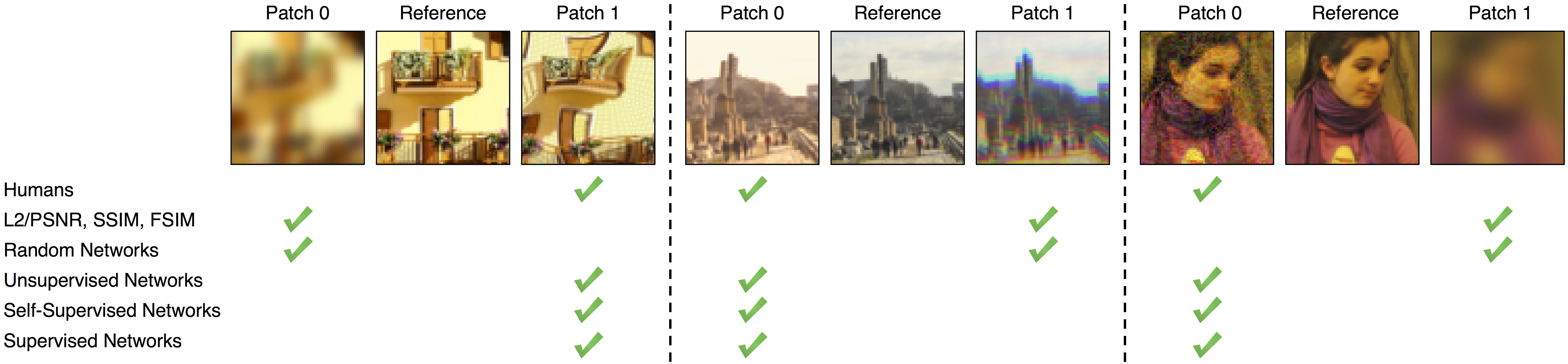
Run python test_network.py to take the distance between example reference image ex_ref.png to distorted images ex_p0.png and ex_p1.png. Before running it - which do you think should be closer?
Some Options By default in model.initialize:
By default, net='alex'. Network alex is fastest, performs the best (as a forward metric), and is the default. For backpropping, net='vgg' loss is closer to the traditional "perceptual loss".
By default, lpips=True. This adds a linear calibration on top of intermediate features in the net. Set this to lpips=False to equally weight all the features.
(B) Backpropping through the metric
File lpips_loss.py shows how to iteratively optimize using the metric. Run python lpips_loss.py for a demo. The code can also be used to implement vanilla VGG loss, without our learned weights.
(C) About the metric
Higher means further/more different. Lower means more similar.
We found that deep network activations work surprisingly well as a perceptual similarity metric. This was true across network architectures (SqueezeNet [2.8 MB], AlexNet [9.1 MB], and VGG [58.9 MB] provided similar scores) and supervisory signals (unsupervised, self-supervised, and supervised all perform strongly). We slightly improved scores by linearly "calibrating" networks - adding a linear layer on top of off-the-shelf classification networks. We provide 3 variants, using linear layers on top of the SqueezeNet, AlexNet (default), and VGG networks.
If you use LPIPS in your publication, please specify which version you are using. The current version is 0.1. You can set version='0.0' for the initial release.
Run bash ./scripts/download_dataset.sh to download and unzip the dataset into directory ./dataset. It takes [6.6 GB] total. Alternatively, run bash ./scripts/download_dataset_valonly.sh to only download the validation set [1.3 GB].
2AFC train [5.3 GB]
2AFC val [1.1 GB]
JND val [0.2 GB]
(B) Evaluating a perceptual similarity metric on a dataset
Script test_dataset_model.py evaluates a perceptual model on a subset of the dataset.
Dataset flags
--dataset_mode: 2afc or jnd, which type of perceptual judgment to evaluate
--datasets: list the datasets to evaluate
if --dataset_mode 2afc: choices are [train/traditional, train/cnn, val/traditional, val/cnn, val/superres, val/deblur, val/color, val/frameinterp]
if --dataset_mode jnd: choices are [val/traditional, val/cnn]
Perceptual similarity model flags
--model: perceptual similarity model to use
lpips for our LPIPS learned similarity model (linear network on top of internal activations of pretrained network)
baseline for a classification network (uncalibrated with all layers averaged)
l2 for Euclidean distance
ssim for Structured Similarity Image Metric
--net: [squeeze,alex,vgg] for the net-lin and net models; ignored for l2 and ssim models
--colorspace: choices are [Lab,RGB], used for the l2 and ssim models; ignored for net-lin and net models
Misc flags
--batch_size: evaluation batch size (will default to 1)
--use_gpu: turn on this flag for GPU usage
An example usage is as follows: python ./test_dataset_model.py --dataset_mode 2afc --datasets val/traditional val/cnn --model lpips --net alex --use_gpu --batch_size 50. This would evaluate our model on the "traditional" and "cnn" validation datasets.
(C) About the dataset
The dataset contains two types of perceptual judgements: Two Alternative Forced Choice (2AFC) and Just Noticeable Differences (JND).
(1) 2AFC Evaluators were given a patch triplet (1 reference + 2 distorted). They were asked to select which of the distorted was "closer" to the reference.
Training sets contain 2 judgments/triplet.
train/traditional [56.6k triplets]
train/cnn [38.1k triplets]
train/mix [56.6k triplets]
Validation sets contain 5 judgments/triplet.
val/traditional [4.7k triplets]
val/cnn [4.7k triplets]
val/superres [10.9k triplets]
val/deblur [9.4k triplets]
val/color [4.7k triplets]
val/frameinterp [1.9k triplets]
Each 2AFC subdirectory contains the following folders:
ref: original reference patches
p0,p1: two distorted patches
judge: human judgments - 0 if all preferred p0, 1 if all humans preferred p1
(2) JND Evaluators were presented with two patches - a reference and a distorted - for a limited time. They were asked if the patches were the same (identically) or different.
Each set contains 3 human evaluations/example.
val/traditional [4.8k pairs]
val/cnn [4.8k pairs]
Each JND subdirectory contains the following folders:
p0,p1: two patches
same: human judgments: 0 if all humans thought patches were different, 1 if all humans thought patches were same
(D) Using the dataset to train the metric
See script train_test_metric.sh for an example of training and testing the metric. The script will train a model on the full training set for 10 epochs, and then test the learned metric on all of the validation sets. The numbers should roughly match the Alex - lin row in Table 5 in the paper. The code supports training a linear layer on top of an existing representation. Training will add a subdirectory in the checkpoints directory.
You can also train "scratch" and "tune" versions by running train_test_metric_scratch.sh and train_test_metric_tune.sh, respectively.
Citation
If you find this repository useful for your research, please use the following.
@inproceedings{zhang2018perceptual,
  title={The Unreasonable Effectiveness of Deep Features as a Perceptual Metric},
  author={Zhang, Richard and Isola, Phillip and Efros, Alexei A and Shechtman, Eli and Wang, Oliver},
  booktitle={CVPR},
  year={2018}
}
Acknowledgements
This repository borrows partially from the pytorch-CycleGAN-and-pix2pix repository. The average precision (AP) code is borrowed from the py-faster-rcnn repository. Angjoo Kanazawa, Connelly Barnes, Gaurav Mittal, wilhelmhb, Filippo Mameli, SuperShinyEyes, Minyoung Huh helped to improve the codebase.
How active is development on richzhang/PerceptualSimilarity?
The most recent commit recorded on richzhang/PerceptualSimilarity was 2.4 years ago, based on the GitHub push timestamp. The repository has 521 forks — one of the better signals of community interest.
Is richzhang/PerceptualSimilarity open source?
Yes — richzhang/PerceptualSimilarity ships under the BSD-2-Clause license, which makes its source code freely readable (and, depending on license terms, forkable and reusable). Source: github.com/richzhang/PerceptualSimilarity.
What license does richzhang/PerceptualSimilarity use?
richzhang/PerceptualSimilarity is released under the BSD-2-Clause license. Always verify the LICENSE file directly on GitHub for the authoritative terms — license strings can be edited out of sync with a project's actual stance.
What topics is richzhang/PerceptualSimilarity associated with?
GitHub's repository topics for richzhang/PerceptualSimilarity: "deep-learning", "deep-neural-networks", "perceptual", "perceptual-losses", "perceptual-metric", "perceptual-similarity", "pytorch". TopGit's editorial category is AI Tools.
Where can I see richzhang/PerceptualSimilarity in action?
The project maintains a homepage at https://richzhang.github.io/PerceptualSimilarity. The README tab on this page also usually contains screenshots and a quickstart.
Where do I read more about richzhang/PerceptualSimilarity?
This TopGit page is a snapshot — the READ ME tab shows the project's own README content (links stripped, images preserved). The GitHub repository at github.com/richzhang/PerceptualSimilarity is the definitive source.
Read full README in the tab above.
Still deciding about PerceptualSimilarity?
One click hands the question to an AI along with this page — see what it says about PerceptualSimilarity.

 /PerceptualSimilarity