
ruvnet/open-claude-code

ruvnet/open-claude-code sits at 574 stars on GitHub, written primarily in JavaScript. Nightly Claude Code CLI Decompile — Reverse Engineered & Rebuilt
Snapshot summary built from the project's own GitHub metadata — there's no written TopGit review yet. The page will update automatically when a full review is published.
TopGit writes full reviews for the most-starred, most-requested repositories. This page is a snapshot until then — see the READ ME tab for the original README in full.
Snapshot
Top contributors
Show top contributors
Open Claude Code
Open Source Claude Code CLI — Reverse Engineered & Rebuilt
An open source implementation of Anthropic's Claude Code CLI,
built from decompiled source intelligence using ruDevolution.




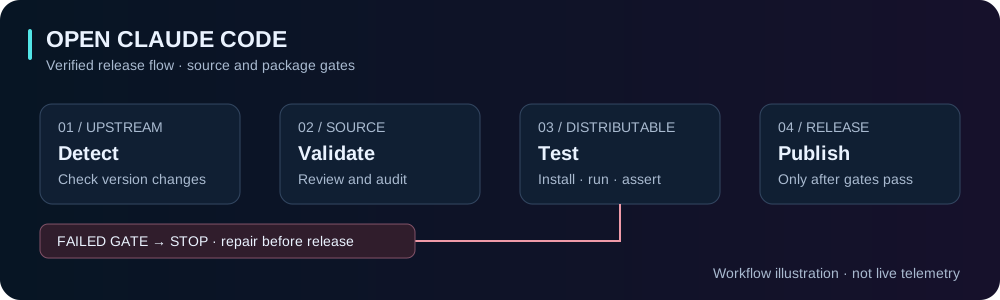
Release automation: The nightly workflow gates publication on source validation, tests, AI analysis, and registry checks. A successful run is the evidence of completion; failed runs do not advance checkpoints. Capability proposals require review before implementation. See the release workflow and ADR-004.
⚡ Quick Start
# Run instantly (no install)
npx @ruvnet/open-claude-code "explain this codebase"

# Or install globally
npm install -g @ruvnet/open-claude-code
occ "hello"

# Interactive mode
occ
Requires: ANTHROPIC_API_KEY environment variable set.
export ANTHROPIC_API_KEY=sk-ant-...
npx @ruvnet/open-claude-code "what files are in this directory?"
Skills and Claude Code plugin
Three shared skills cover CLI usage, diagnosis, and release verification. Choose one installation method to avoid duplicate skills.
Install with npx skills
The tested skills installer requires Node 22.20 or newer (Node 24 recommended). OCC itself requires Node 20 or newer.
npx [email protected] add ruvnet/open-claude-code --agent claude-code --skill occ-use occ-diagnose occ-verify-release
OCC 2.1.2 also loads these project skills from .claude/skills, including the installer's symlinks. Project skills override user skills. Invoke them with OCC's Skill tool or slash commands.
Install the native Claude Code plugin
In Claude Code:
/plugin marketplace add ruvnet/open-claude-code
/plugin install occ@ruvnet-occ
/occ:occ-use
/occ:occ-diagnose
/occ:occ-verify-release
Restart Claude Code after installation if the current session has not loaded the new skills.
claude plugin update occ@ruvnet-occ
claude plugin uninstall occ@ruvnet-occ
The occ plugin uses the same skills/ sources. It installs no hooks, MCP servers, credentials, or background processes. It guides use of the separately published CLI. This native Claude Code package does not imply compatibility between OCC's custom PluginLoader and all third party Claude plugins.
Reproduce installation tests
# From a repository checkout, with Node 24 and Claude Code installed:
node scripts/plugin-e2e.mjs
# Test public GitHub distribution after publishing:
node scripts/plugin-e2e.mjs ruvnet/open-claude-code
The suite installs and removes real skills and plugins in disposable profiles, checks all three Claude skill expansions with a local model fixture, and verifies OCC discovery. Live provider behavior is tested separately by scripts/live-package-e2e.mjs. Tested installer: skills 1.7.2; Claude Code: 2.1.283.
Upstream behavior fixes in 2.1.3
Implemented and tested against the public Claude Code 2.1.295 and 2.1.296 changelog:
| Behavior | OCC support |
|---|---|
| Hook failure policy | Command and HTTP hooks honor onFailure: "block"; exit 2 vetoes execution |
| PreToolUse veto | continue: false and structured deny block the call and return an error result to the next model turn |
| PostToolUse MCP output | updatedMCPToolOutput replaces results for MCP tool names |
| Large text reads | Read.allow_large: true bypasses the implicit 2,000 line limit; explicit offset/limit remain active |
| Encoding safety | Edit, MultiEdit and NotebookEdit reject invalid UTF8 before any write |
| Delegation safety | Child tools intersect parent tools and inherit permission checks and hooks |
| Model call budget | --max-turns limits model requests, including tool continuations |
Large text reads have hard ceilings of 16 MiB and 100,000 lines. HTTP hook responses have a 1 MiB limit. Typed hook timeouts use seconds; legacy flat hook timeouts retain milliseconds. Plain command stdout remains supported.
Subagents default to at most 10 model calls, delegation depth 2 (hard maximum 3), and at most 4 running background agents. An explicit empty child tool list grants no tools. Worktree isolation requests are rejected until isolation is implemented.
Prompt and agent hook evaluators, asynchronous hooks, complete session/checkpoint lifecycle wiring, and full provider parity remain outside this release. See ADR-006. The lifecycle issue remains open for those gaps.
🧠 What Is This?
Open Claude Code is a ground-up open source rebuild of Anthropic's Claude Code CLI, informed by ruDevolution's AI-powered decompilation of the published npm package.
It's not a copy — it's a clean-room implementation that mirrors the actual Claude Code architecture: async generator agent loop, 25 tools, 4 MCP transports, 6 permission modes, hooks, settings chain, sessions, and more.
1,008 unit tests plus installed-package behavioral checks. Full upstream parity is not established.
📦 Installation
npx (no install needed)
npx @ruvnet/open-claude-code "your prompt here"
Global install
npm install -g @ruvnet/open-claude-code
occ "your prompt here"
From source
git clone https://github.com/ruvnet/open-claude-code.git
cd open-claude-code/v2
export ANTHROPIC_API_KEY=sk-ant-...
node src/index.mjs "hello"
🖥️ Usage
One-shot mode
occ "explain the auth module"
occ "fix the bug in server.js"
occ "create a REST API for user management"
occ "find all TODO comments in this project"
Interactive REPL
occ
# > explain this codebase
# > /help
# > /tools
# > /model claude-opus-4-6
# > refactor the database layer
# > /cost
# > /exit
CLI Options
occ [options] [prompt]

Options:
  -m, --model <model>          Model to use (default: claude-sonnet-4-6)
  -p, --print                  Print mode (non-interactive, output only)
  --permission-mode <mode>     Permission mode: default, auto, plan, acceptEdits,
                               bypassPermissions, dontAsk
  --system-prompt <text>       Override system prompt
  --add-dir <path>             Additional CLAUDE.md directory
  --max-turns <n>              Maximum conversation turns
  --allowedTools <tools>       Comma-separated allowed tools
  --disallowedTools <tools>    Comma-separated denied tools
  --output-format <fmt>        Output: text, json, stream-json
  -v, --verbose                Verbose output
  -d, --debug                  Debug mode
  --version                    Show version
  -h, --help                   Show help
Examples
# Use a different model
occ -m claude-opus-4-6 "design a database schema for a blog"

# Print mode (for piping)
occ -p "list all functions in src/" > functions.txt

# Plan mode (read-only, no edits)
occ --permission-mode plan "review the security of auth.js"

# Restrict tools
occ --allowedTools "Read,Glob,Grep" "find all API endpoints"

# With custom system prompt
occ --system-prompt "You are a senior Go developer" "review main.go"
🔧 Interactive Commands
40 slash commands available in REPL mode:
| Command | Description |
|---|---|
/help | Show all commands |
/model <name> | Switch model mid-conversation |
/tools | List available tools |
/tokens | Show current token usage |
/cost | Show session cost estimate |
/compact | Compact context window |
/undo | Undo last file edit |
/clear | Clear conversation history |
/doctor | Check API connectivity + health |
/fast | Toggle fast mode (Haiku) |
/effort <level> | Set effort: low, medium, high, max |
/resume [id] | Resume a previous session |
/sessions | List saved sessions |
/agents | List custom agents |
/skills | List available skills |
/hooks | Show active hooks |
/config | Show current settings |
/permissions | Show permission mode |
/mcp | Show MCP server status |
/memory | Show memory usage |
/exit | Exit |
🔨 Tools
25 built-in tools matching Claude Code's tool system:
| Tool | Description |
|---|---|
| Bash | Execute shell commands (sandboxed) |
| Read | Read files with line numbers |
| Edit | Replace strings in files |
| Write | Create/overwrite files |
| Glob | Find files by pattern |
| Grep | Search file contents (regex) |
| LS | List directory contents |
| Agent | Spawn sub-agents |
| WebFetch | Fetch URL content |
| WebSearch | Web search |
| TodoWrite | Task management |
| NotebookEdit | Edit Jupyter notebooks |
| MultiEdit | Atomic multi-file edits |
| ToolSearch | Discover deferred tools |
| AskUser | Prompt user for input |
| Skill | Invoke a skill |
| SendMessage | Agent team messaging |
| CronCreate/Delete/List | Scheduled tasks |
| EnterWorktree/ExitWorktree | Git worktree isolation |
| RemoteTrigger | Remote execution |
| LSP | Language server protocol |
| ReadMcpResource | Read MCP resources |
⚙️ Configuration
Settings
Create .claude/settings.json in your project or ~/.claude/settings.json globally:
{
  "model": "claude-sonnet-4-6",
  "permissions": {
    "defaultMode": "auto"
  },
  "hooks": {
    "PreToolUse": [{
      "matcher": "Bash",
      "hooks": [{ "type": "command", "command": "echo 'Running bash...'" }]
    }]
  },
  "autoCompactEnabled": true,
  "alwaysThinkingEnabled": true
}
Settings are loaded from 4 sources (in priority order):
.claude/settings.local.json(local, gitignored).claude/settings.json(project, shared)~/.claude/settings.json(user global)- Managed policy (enterprise)
CLAUDE.md
Create a CLAUDE.md in your project root to customize behavior:
# Project Rules
- Always use TypeScript
- Follow TDD
- Keep files under 500 lines
CLAUDE.md files are loaded from: ~/.claude/CLAUDE.md → parent directories → project root → .claude/CLAUDE.md.
Custom Agents
Create .claude/agents/reviewer.md:
---
name: reviewer
description: Code review specialist
model: claude-sonnet-4-6
tools: [Read, Glob, Grep]
---

You are a thorough code reviewer. Check for bugs, security issues, and style.
Skills
Create .claude/skills/deploy/SKILL.md:
---
name: deploy
description: Deploy to production
---

1. Run tests: npm test
2. Build: npm run build
3. Deploy: ./scripts/deploy.sh
Invoke with /deploy in the REPL.
🔐 Multi-Provider Support
Adapters exist for Anthropic, OpenAI-compatible endpoints and Google. Installed-package E2E covers Anthropic and OpenAI-compatible tool roundtrips; Google is not covered by that gate. Bedrock and Vertex remain stubs.
# Anthropic (default)
ANTHROPIC_API_KEY=... occ "hello"

# OpenAI
OPENAI_API_KEY=... occ -m gpt-4o "hello"

# Google
GOOGLE_API_KEY=... occ -m gemini-2.5-flash "hello"
🔗 MCP Integration
Connect to MCP servers for additional tools:
// .mcp.json
{
  "mcpServers": {
    "my-server": {
      "command": "npx",
      "args": ["-y", "my-mcp-server"],
      "env": { "API_KEY": "..." }
    }
  }
}
Supports 4 transports: stdio, SSE, Streamable HTTP, WebSocket.
🔍 Background: The Claude Code Source Leak
On March 31, 2026, Anthropic accidentally shipped source maps in the Claude Code npm package, exposing the full TypeScript source. This project takes a different approach — we use ruDevolution to analyze the published npm package legally and rebuild from that intelligence.
What ruDevolution Found
| Discovery | Evidence |
|---|---|
| 🤖 Agent Teams | CLAUDE_CODE_EXPERIMENTAL_AGENT_TEAMS |
| 🌙 Auto Dream Mode | tengu_auto_dream_completed |
| 🔮 claude-opus-4-6 | Unreleased model ID |
| 🔐 6 "amber" codenames | Internal feature gates |
| ☁️ Cloud Code Runner | BYOC compute |
| 📡 MCP Streamable HTTP | New transport |
Download decompiled releases →
⚖️ Legal
This is a clean-room implementation — no leaked source used. Architecture informed by analysis of the published npm package, legal under US DMCA §1201(f), EU Software Directive Art. 6, UK CDPA §50B.
📚 Related
- ruDevolution — AI-Powered JavaScript Decompiler
- Decompiled Releases — Every Claude Code version
- v2 Architecture (ADR-001)
- Path to 100% (ADR-002)
Verified release automation
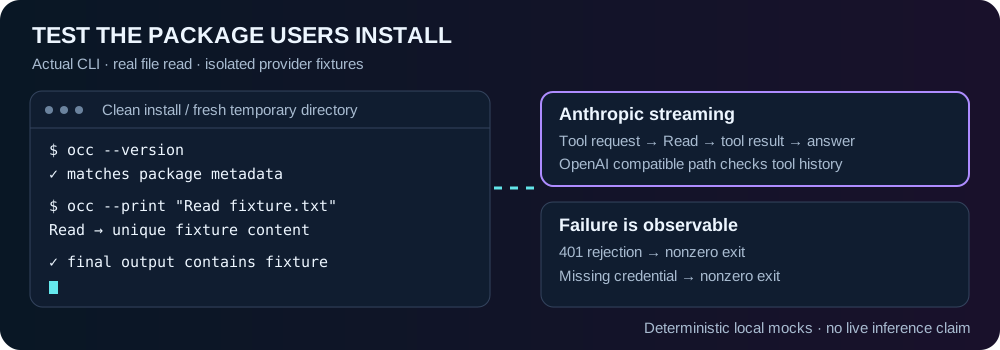
Runs daily at 03:00 UTC. Unchanged upstream versions are explicitly reported as no-op runs.
Publication requires unit and regression tests, a dependency audit, validated source recovery, successful AI analysis, clean package installation tests, and a live provider Read tool roundtrip against a fresh random fixture. The exact tested tarball is published to npm, its SHA-512 integrity verified, and the registry version installed and exercised again.
Only then does the upstream checkpoint advance. Failed gates stop publication and create an investigation issue. GitHub releases attach the package, source commit receipt and analysis. Nightly versions use the npm nightly tag. Stable releases require the manually selected latest channel.
Required repository secrets: AI_API_KEY (OpenRouter) and NPM_TOKEN with publishing permission. GITHUB_TOKEN is supplied by GitHub Actions. ruOS bindings provision credentials without printing their values.
gh workflow run nightly.yml -f force_release=true -f channel=nightly
npm install @ruvnet/open-claude-code@nightly
Structural changes produce review proposals, not implemented features. Concrete behavioral specifications and new tests are required before implementing them. Full upstream parity is not established.
See release integrity ADR.
📄 License
MIT
Related repositories
REA is an MCP server and CLI that gives AI coding agents the ability to reverse engineer binaries, JavaScript apps, .NET assemblies, and websites. It hooks into Hopper, Ghidra, or IDA Pro for native binary work, or runs static JavaScript analysis with just Node.js. Every investigation returns an Evidence bundle that includes what was found, what was not, and the reasoning path. Setup registers REA with supported agents and walks you through connecting an analysis engine. The CLI also works standalone for terminal-first workflows.
Hermes Agent (NousResearch/hermes-agent) is an open-source, self-improving AI agent from Nous Research, written in Python and released under the MIT license. The README describes a closed learning loop, a terminal UI, and a messaging gateway spanning Telegram, Discord, Slack, WhatsApp, and Signal, plus support for running the agent on a VPS, a GPU cluster, or serverless infrastructure.
ECC is an MIT-licensed system from affaan-m/ECC that installs into AI coding agent harnesses such as Claude Code, Codex, and several others, adding skills, specialized agents, persistent memory, and AgentShield security scanning around whatever large language model the harness already runs. The README positions it as developer productivity tooling for LLM agent development and agent performance tuning rather than a code generation tool itself, composing around whichever model the harness already calls.
The agent harness performance optimization system. Skills, instincts, memory, security, and research-first development for Claude Code, Codex, Opencode, Cursor and beyond.
Quick answers
How active is development on ruvnet/open-claude-code?
The most recent commit recorded on ruvnet/open-claude-code was today, based on the GitHub push timestamp. The repository has 176 forks — one of the better signals of community interest.
How many stars does ruvnet/open-claude-code have?
ruvnet/open-claude-code has 574 GitHub stars — refresh the page for the live number, or check github.com/ruvnet/open-claude-code. TopGit mirrors GitHub's count but does not claim minute-by-minute accuracy.
Is ruvnet/open-claude-code open source?
Yes — ruvnet/open-claude-code ships under the MIT license, which makes its source code freely readable (and, depending on license terms, forkable and reusable). Source: github.com/ruvnet/open-claude-code.
What is ruvnet/open-claude-code?
ruvnet/open-claude-code (ruvnet/open-claude-code) is a JavaScript project on GitHub. From the project's own README: Nightly Claude Code CLI Decompile — Reverse Engineered & Rebuilt
Where do I read more about ruvnet/open-claude-code?
This TopGit page is a snapshot — the READ ME tab shows the project's own README content (links stripped, images preserved). The GitHub repository at github.com/ruvnet/open-claude-code is the definitive source.
Read full README in the tab above.
Is open-claude-code worth your time?
ChatGPT, Claude and Perplexity can all read this page. Ask one of them what it makes of open-claude-code.