
Best of Agent Harnesses: Curated List of LLM Agent Runtimes
 /best-of-Agent-Harnesses
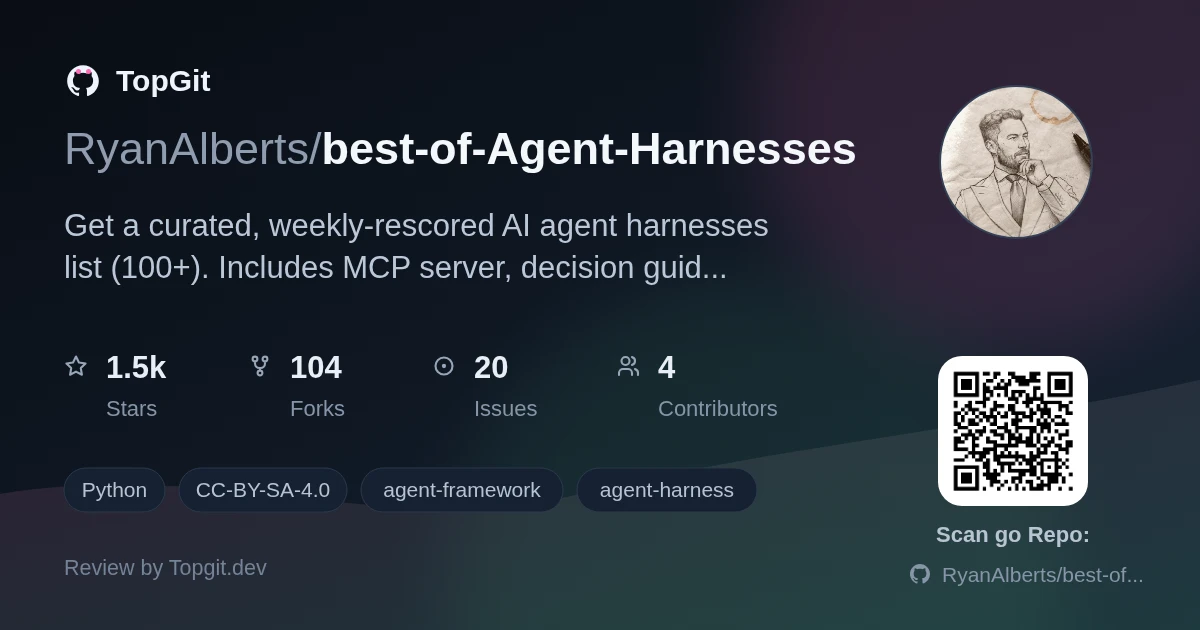
Best of Agent Harnesses is a resource for navigating the LLM agent harness landscape. It covers 100+ tools, ships an MCP server your agents can actually query, and backs every ranking with evidence that the harness changes scores more than the model does. The weekly refresh and agent-readable outputs set it apart from static bookmarks. The catch is that it's a wide-angle lens — useful once you know what problem you're solving, not as a tutorial for beginners. If you're building or evaluating agentic systems, it's worth bookmarking.
What is Best of Agent Harnesses?
Best of Agent Harnesses is a curated list of over 100 AI agent harnesses, organized by use case and ranked by relevance to harness engineering concerns. It publishes the full list in machine-readable formats and as an MCP server, so both humans browsing GitHub and agents running in your pipeline can query the same data. Decision guides, example links, and three ready-to-run agent skeletons ship alongside the list.
Why Agent Harnesses Matter
Current benchmark information indicates that modifying the agent harness impacts pass@1 to a greater extent than numerous model improvements. The SWE-agent paper introduced the concept of the agent-computer interface, explaining how the presentation of tools and feedback can influence a model's capabilities, separate from the model's own architecture. When teams deploy more agentic systems into production environments, the quality of the harness — encompassing retry logic, fallbacks, persistence, and permissions — directly dictates if those systems can withstand interaction with actual users. This compilation was created because such an issue is both genuine and expanding.
Key Features of the Harness List
- ✓100+ projects across 12 categories: coding agents, multi-agent orchestration, memory layers, evaluation harnesses, frameworks, and more
- ✓Machine-readable formats (harnesses.json, llms.txt) so agents can recommend harnesses programmatically
- ✓MCP server with search, compare, recommend, and pick_harness tools — installable via uvx in one command
- ✓Decision guides covering head-to-head comparisons: terminal coding agents, multi-agent orchestration, agent memory layers, sandboxed code execution, and more
- ✓Editorial ranking by relevance to harness engineering (environment, orchestration, lifecycle, guardrails) and adoption signals
- ✓Weekly rescoring keeps rankings current against a frozen GitHub star snapshot
- ✓One concrete example link per project, so you see it in action rather than reading docs
- ✓Three agent skeletons (harness-scout, stack-auditor, harness-radar) for teams that want agents working from the list automatically
Picking an Agent Harness by Use Case
- •Turnkey coding agents for immediate use: opencode, Cline, Codex, Gemini CLI, OpenHands
- •Always-on personal agents: OpenClaw, Hermes, Khoj, Agent Zero
- •Building a custom coding harness from scratch: Claude Agent SDK, Google ADK, AutoHarness, SWE-agent
- •Adding a memory or state layer to existing agents: Mem0, Graphiti, claude-mem, Letta
- •Scaling to hundreds or thousands of tools without context bloat: MCP-Zero, ToolGen, langgraph-bigtool
- •Multi-agent orchestration: OpenAI Agents SDK, CrewAI, AutoGen, LangGraph
Strengths
- ✓Covers 100+ tools across 12 categories with enough context to actually compare them
- ✓Machine-readable formats and an MCP server make it machine-consumable, not just human-readable
- ✓Weekly rescoring prevents stale rankings from misleading teams
- ✓Decision guides and the agent-computer interface framing give the list a point of view, not just data
- ✓Agent skeletons ship with the repo so teams can automate harness discovery and audit workflows
- ✓CC-BY-SA-4.0 license is standard and attribution-friendly for open-source projects
Considerations for Using the List
- △Star counts are frozen at capture time.
- △Rankings are editorial, not automatic — corrections via issues and PRs, while fast, mean the list reflects maintainer judgment
- △The breadth is a feature and a tax: without a specific use case in mind, the list can feel like a maze
- △Many listed projects are actively developed, so a project's current state may diverge from what the list records
- △CC-BY-SA-4.0 means derivative works must attribute and share under the same license — not suitable for embedding into proprietary products without review
Exploring Other Agent Resources
Frequently Asked Questions
A harness is the runtime that surrounds the model-thinks-plus-tools loop — it controls which tools exist, what the model sees each turn, what needs approval, and what survives a crash. The model answers; the harness decides what the answer is allowed to touch.
The list is rescored weekly. Rankings reflect relevance to harness engineering concerns and adoption signals, not just raw star counts which are captured once.
Yes. Best of Agent Harnesses publishes harnesses.json and llms.txt for direct consumption, plus an MCP server with recommend, compare, pick_harness, and search_harnesses tools that agents can call directly in their loop.
CC-BY-SA-4.0, a Creative Commons license that requires attribution and share-alike for derivative works. It is not a software license — it applies to the curated content, not the code shipped alongside it.
Rankings are editorial, weighted toward relevance to harness engineering (environment, orchestration, lifecycle, guardrails) and adoption signals. The README explicitly notes that harness rankings barely transfer across models, so the ranking is not a universal leaderboard.
Yes. The agents/ directory ships three ready-to-run agent skeletons: harness-scout (picks a harness from a task description), stack-auditor (flags dead harnesses in your codebase), and harness-radar (weekly movement briefing). All three run against the current week's list data.
Who should try it — and who should skip
Best of Agent Harnesses is built for engineers and teams building, evaluating, or choosing agentic systems. If you're picking a coding harness for your team, comparing multi-agent orchestration frameworks, or building a pipeline that needs to recommend harnesses programmatically, this list gives you the raw material to make that decision rigorously. Researchers and framework authors will find the taxonomy and decision guides useful for understanding how the field categorizes harness concerns. If you just want a single turnkey agent without caring about the runtime, the simpler dedicated products (opencode, Cline, Roo Code) are faster to install — this list shines when you need to understand the runtime, not just use it.
Related repositories
Is best-of-Agent-Harnesses worth your time?
ChatGPT, Claude and Perplexity can all read this page. Ask one of them what it makes of best-of-Agent-Harnesses.