Awesome Lists by sindresorhus
 /awesome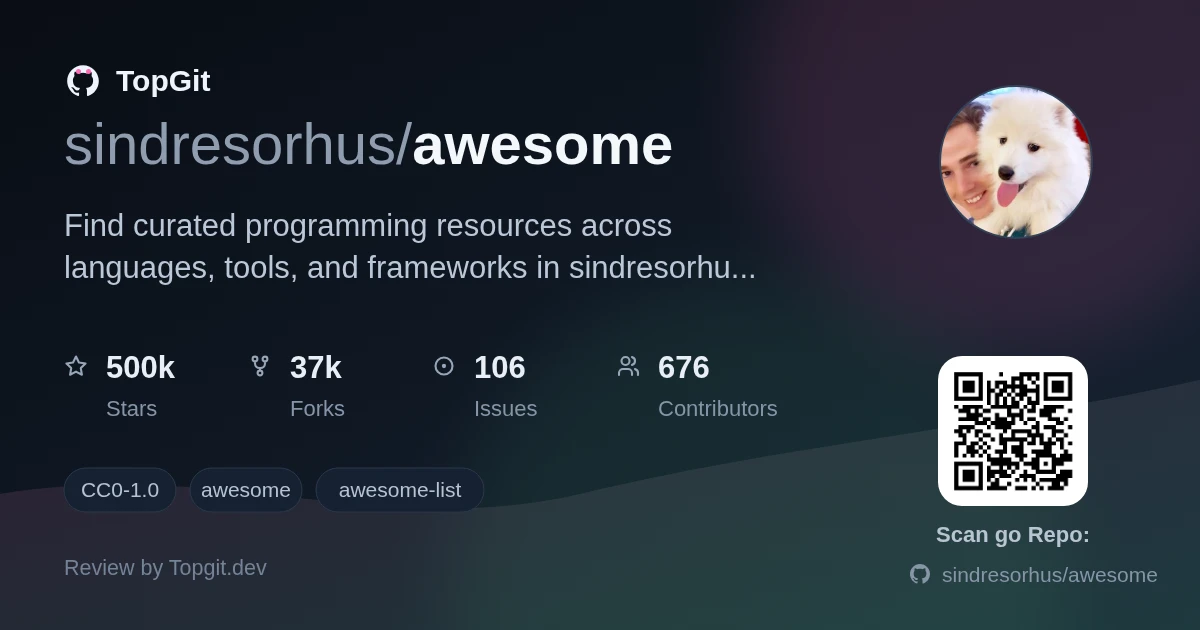
Awesome Lists are a GitHub-hosted meta-directory of curated programming resources. They work well for discovering tools and learning paths across dozens of technology areas — but the quality and freshness of each individual list depends entirely on its maintainer. Reach for this when exploring an unfamiliar domain; skip it if you need guaranteed-up-to-date recommendations or official documentation.
What Are Awesome Lists?
Awesome Lists are community-curated collections of resources organized by topic. The sindresorhus/awesome repository serves as a meta-index, pointing to hundreds of specialized lists covering programming languages, platforms, frameworks, and developer tooling — all contributed via pull requests and maintained in GitHub repositories.
Exploring the Curated Topics
- ✓Broad platform coverage spanning Node.js, iOS, Android, Linux, macOS, Flutter, React Native, and cloud platforms like AWS, GCP, and Firebase
- ✓Deep programming language sections for JavaScript, Python, Go, Rust, Ruby, Swift, Kotlin, and dozens more — each with sub-topics for specialized domains like data science, async programming, or type systems
- ✓Front-end development resources including React, Vue, Angular, CSS frameworks, Web Components, D3, and accessibility tooling
- ✓Specialized topics such as Home Assistant automation, IoT, eBPF tracing, quantum computing with Q#, and smart TV development
- ✓A contribution guide and community governance that keeps the meta-list itself organized through GitHub's existing PR and review workflows
- ✓Full-text search available via the GitHub repository interface, plus the short URL awesome.re for quick access
Benefits for Developers and Learners
- •Discovering tools and libraries when starting work in a new language or framework
- •Finding learning resources, tutorials, and community spaces for a technology you're evaluating
- •Exploring what's available in an ecosystem — for instance, seeing all the major Rust crates organized by use case
- •Quickly getting oriented with the tooling landscape around a platform like Android or iOS
- •Identifying lesser-known open source projects that solve specific problems, surfaced by maintainers who actually use them
- •Following curated lists for specialized roles like DevOps, data engineering, or security research
Strengths
- ✓Massive breadth: dozens of programming languages, platforms, and specialized domains covered in one place
- ✓All lists are freely accessible on GitHub — no signup, paywall, or account required
- ✓CC0 public domain dedication means no legal restrictions on using, modifying, or building on these resources
- ✓Community-maintained lists often include maintainer notes and annotations beyond just raw links
- ✓The meta-list itself is actively maintained by a dedicated team, with clear contribution guidelines
- ✓Hundreds of related awesome lists exist beyond the main repository, covering niche topics from Elixir
Challenges of Curated Lists
- △Quality and freshness vary wildly between lists — some are meticulously maintained, others haven't been updated in years
- △No formal review or peer-validation process ensures entries remain accurate over time
- △The GitHub interface offers basic search but limited filtering by recency, popularity, or license type
- △Navigation through hundreds of linked repositories can feel overwhelming without guidance on where to start
- △Duplication occurs across lists — the same project may appear in multiple places with different annotations or no annotation at all
- △Lists depend entirely on volunteer maintainers; abandoned lists remain visible with no indication of their status
Other Resource Aggregators
Common Questions
An awesome list is a GitHub repository containing curated links to resources — tools, libraries, tutorials, articles — on a specific topic. The sindresorhus/awesome repository is a meta-list that indexes hundreds of these individual awesome lists.
Find the relevant awesome list repository on GitHub, read its contribution guidelines, then submit a pull request adding your resource with a brief description of why it belongs.
Yes. Create a new GitHub repository prefixed with "awesome-", add a README with curated resources, and submit it to the main sindresorhus/awesome list for potential inclusion.
The sindresorhus/awesome repository uses the CC0-1.0 public domain dedication, placing all content in the public domain with no restrictions on use.
There is no fixed schedule. Individual lists are updated whenever contributors submit pull requests and maintainers merge them — some lists are actively maintained while others become stale.
Yes. The CC0 license explicitly releases all content into the public domain, meaning you can use resources from awesome lists in commercial projects without attribution requirements.
Who should try it — and who should skip
Developers new to a technology who need a starting point for tools and learning paths. Engineers evaluating whether to adopt a language or framework. Contributors interested in maintaining a specialized list in their area of expertise. Skip this if you need authoritative documentation, guaranteed-up-to-date recommendations, or vendor-backed tooling reviews — none of that is what awesome lists provide.
Related repositories
Still deciding about awesome?
One click hands the question to an AI along with this page — see what it says about awesome.