On GitHub, src-d/enry has picked up 455 stars, Backend, Go. A faster file programming language detector
Snapshot summary built from the project's own GitHub metadata — there's no written TopGit review yet. The page will update automatically when a full review is published.
WHY NO REVIEW YET
TopGit writes full reviews for the most-starred, most-requested repositories. This page is a snapshot until then — see the READ ME tab for the original README in full.
WE CONTINUE THE DEVELOPMENT AT go-enry/go-enry. This repository is abandoned, and no further updates will be done on the code base, nor issue/prs will be answered or attended.
enry
Programming language detector and toolbox to ignore binary or vendored files. enry, started as a port to Go of the original linguist Ruby library, that has an improved 2x performance.
CLI
Library
Go
Java bindings
Python bindings
Divergences from linguist
Benchmarks
Why Enry?
Development
Sync with github/linguist upstream
Misc
License
CLI
The recommended way to install the enry command-line tool is to either
download a release or run:
(cd "$(mktemp -d)" && go mod init enry && go get github.com/src-d/enry/v2/cmd/enry)
enry CLI accepts similar flags (--breakdown/--json) and produce an output, similar to linguist:
$ enry
97.71%	Go
1.60%	C
0.31%	Shell
0.22%	Java
0.07%	Ruby
0.05%	Makefile
0.04%	Scala
0.01%	Gnuplot
Note that enry's CLI does not need an actual git repository to work, which is an intentional difference from linguist.
Library
enry is also available as a native Go library with FFI bindings for multiple programming languages.
Go
In a Go module,
import enry to the module by running:
go get github.com/src-d/enry/v2
The rest of the examples will assume you have either done this or fetched the
library into your GOPATH.
// The examples here and below assume you have imported the library.
import "github.com/src-d/enry/v2"

lang, safe := enry.GetLanguageByExtension("foo.go")
fmt.Println(lang, safe)
// result: Go true

lang, safe := enry.GetLanguageByContent("foo.m", []byte("<matlab-code>"))
fmt.Println(lang, safe)
// result: Matlab true

lang, safe := enry.GetLanguageByContent("bar.m", []byte("<objective-c-code>"))
fmt.Println(lang, safe)
// result: Objective-C true

// all strategies together
lang := enry.GetLanguage("foo.cpp", []byte("<cpp-code>"))
// result: C++ true
Note that the returned boolean value safe is true if there is only one possible language detected.
To get a list of all possible languages for a given file, there is a plural version of the same API.
langs := enry.GetLanguages("foo.h",  []byte("<cpp-code>"))
// result: []string{"C", "C++", "Objective-C}

langs := enry.GetLanguagesByExtension("foo.asc", []byte("<content>"), nil)
// result: []string{"AGS Script", "AsciiDoc", "Public Key"}

langs := enry.GetLanguagesByFilename("Gemfile", []byte("<content>"), []string{})
// result: []string{"Ruby"}
Java bindings
Generated Java bindings using a C shared library and JNI are available under java.
A library is published on Maven as tech.sourced:enry-java for macOS and linux platforms. Windows support is planned under src-d/enry#150.
Python bindings
Generated Python bindings using a C shared library and cffi are WIP under src-d/enry#154.
A library is going to be published on pypi as enry for
macOS and linux platforms. Windows support is planned under src-d/enry#150.
Divergences from linguist
The enry library is based on the data from github/linguist version v7.5.1.
As opposed to linguist, enry CLI tool does not require a full Git repository in the filesystem in order to report languages.
Parsing linguist/samples the following enry results are different from linguist:
Heuristics for ".es" extension in JavaScript could not be parsed, due to unsupported backreference in RE2 regexp engine.
Heuristics for ".rno" extension in RUNOFF could not be parsed, due to unsupported lookahead in RE2 regexp engine.
As of Linguist v5.3.2 it is using flex-based scanner in C for tokenization. Enry still uses extract_token regex-based algorithm. See #193.
Bayesian classifier can't distinguish "SQL" from "PLpgSQL. See #194.
Detection of generated files is not supported yet.
(Thus they are not excluded from CLI output). See #213.
XML detection strategy is not implemented. See #192.
Overriding languages and types though .gitattributes is not yet supported. See #18.
enry CLI output does NOT exclude .gitignoreed files and git submodules, as linguist does
In all the cases above that have an issue number - we plan to update enry to match Linguist behavior.
Benchmarks
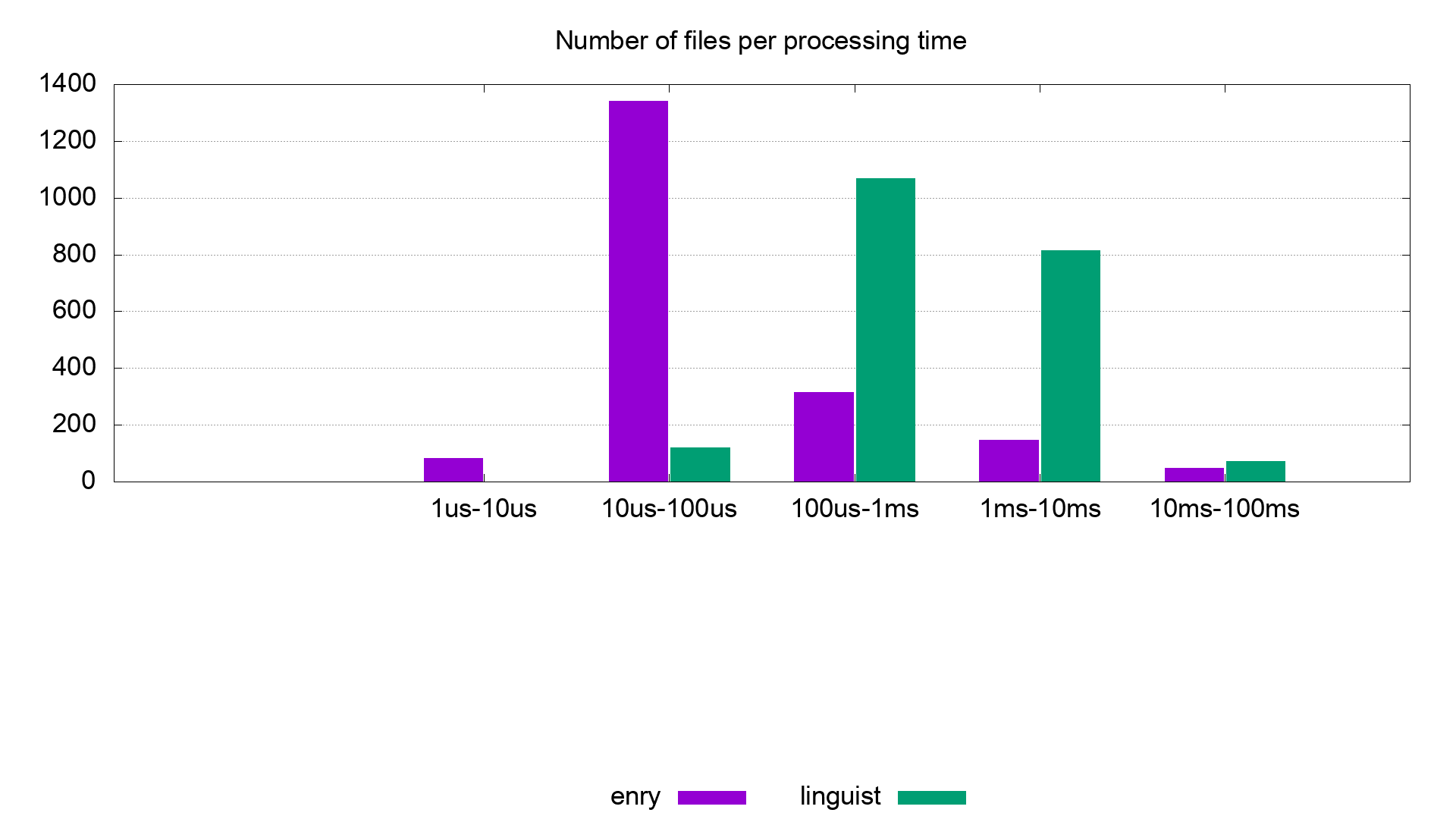
Enry's language detection has been compared with Linguist's on linguist/samples.
We got these results:
The histogram shows the number of files (y-axis) per time interval bucket (x-axis).
Most of the files were detected faster by enry.
There are several cases where enry is slower than linguist due to
Go regexp engine being slower than Ruby's on, wich is based on oniguruma library, written in C.
See instructions for running enry with oniguruma.
Why Enry?
In the movie My Fair Lady, Professor Henry Higgins is a linguist who at the very beginning of the movie enjoys guessing the origin of people based on their accent.
"Enry Iggins" is how Eliza Doolittle, pronounces the name of the Professor.
Development
To build enry's CLI run:
make build
this will generate a binary in the project's root directory called enry.
To run the tests use:
make test
Sync with github/linguist upstream
enry re-uses parts of the original github/linguist to generate internal data structures.
In order to update to the latest release of linguist do:
$ git clone https://github.com/github/linguist.git .linguist
$ cd .linguist; git checkout <release-tag>; cd ..

# put the new release's commit sha in the generator_test.go (to re-generate .gold test fixtures)
# https://github.com/src-d/enry/blob/13d3d66d37a87f23a013246a1b0678c9ee3d524b/internal/code-generator/generator/generator_test.go#L18

$ make code-generate
To stay in sync, enry needs to be updated when a new release of the linguist includes changes to any of the following files:
languages.yml
heuristics.yml
vendor.yml
documentation.yml
There is no automation for detecting the changes in the linguist project, so this process above has to be done manually from time to time.
When submitting a pull request syncing up to a new release, please make sure it only contains the changes in
the generated files (in data subdirectory).
Separating all the necessary "manual" code changes to a different PR that includes some background description and an update to the documentation on "divergences from linguist" is very much appreciated as it simplifies the maintenance (review/release notes/etc).
Misc
Running a benchmark & faster regexp engine
Benchmark
All benchmark scripts are in benchmarks directory.
Dependencies
As benchmarks depend on Ruby and Github-Linguist gem make sure you have:
Ruby (e.g using rbenv), bundler installed
Docker
native dependencies installed
Build the gem cd .linguist && bundle install && rake build_gem && cd -
Install it gem install --no-rdoc --no-ri --local .linguist/github-linguist-*.gem
Quick benchmark
To run quicker benchmarks you can either:
make benchmarks
to get average times for the main detection function and strategies for the whole samples set or:
make benchmarks-samples
if you want to see measures per sample file.
Full benchmark
If you want to reproduce the same benchmarks as reported above:
Make sure all dependencies are installed
Install gnuplot (in order to plot the histogram)
Run ENRY_TEST_REPO="$PWD/.linguist" benchmarks/run.sh (takes ~15h)
It will run the benchmarks for enry and linguist, parse the output, create csv files and plot the histogram.
Faster regexp engine (optional)
Oniguruma is CRuby's regular expression engine.
It is very fast and performs better than the one built into Go runtime. enry supports swapping
between those two engines thanks to rubex project.
The typical overall speedup from using Oniguruma is 1.5-2x. However, it requires CGo and the external shared library.
On macOS with Homebrew, it is:
brew install oniguruma
On Ubuntu, it is
sudo apt install libonig-dev
To build enry with Oniguruma regexps use the oniguruma build tag
Yes — src-d/enry ships under the Apache-2.0 license, which makes its source code freely readable (and, depending on license terms, forkable and reusable). Source: github.com/src-d/enry.
What else is in the Backend space?
src-d/enry is tracked by TopGit under the Backend category, alongside 5 GitHub-tagged topics. Trending and Topics pages list peer repositories of comparable stars and language.
What is src-d/enry?
src-d/enry (src-d/enry) is a Go project on GitHub. From the project's own README: A faster file programming language detector
What license does src-d/enry use?
src-d/enry is released under the Apache-2.0 license. Always verify the LICENSE file directly on GitHub for the authoritative terms — license strings can be edited out of sync with a project's actual stance.
Where can I see src-d/enry in action?
The project maintains a homepage at https://blog.sourced.tech/post/enry/. The README tab on this page also usually contains screenshots and a quickstart.
Where do I read more about src-d/enry?
This TopGit page is a snapshot — the READ ME tab shows the project's own README content (links stripped, images preserved). The GitHub repository at github.com/src-d/enry is the definitive source.
Why is src-d/enry categorized under Backend?
TopGit places src-d/enry in the Backend category based on its GitHub topics and description (tagged: "cli", "golang", "java"). Categories are assigned from real repository metadata, not editorial guesswork.
Read full README in the tab above.
Want a second opinion on enry?
Ask an AI that can read this page — one click and you get its take on enry.

 /enry