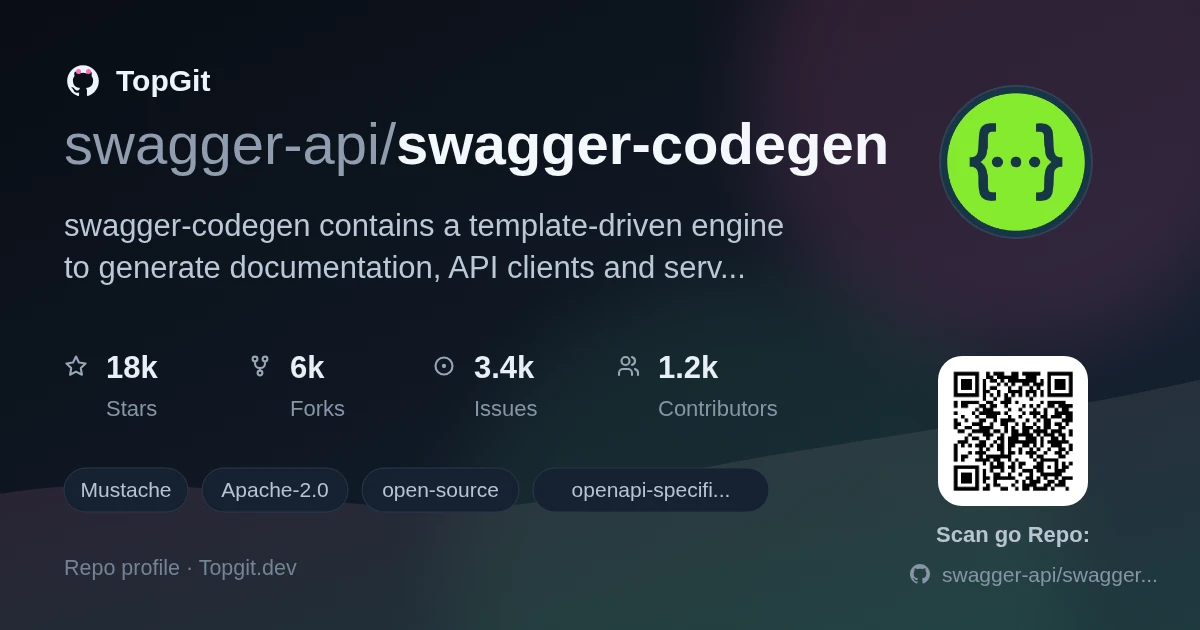
swagger-api/swagger-codegen sits at 17.8k stars on GitHub, written primarily in Mustache. swagger-codegen contains a template-driven engine to generate documentation, API clients and server stubs in different languages by parsing your OpenAPI / Swagger definition.
Snapshot summary built from the project's own GitHub metadata — there's no written TopGit review yet. The page will update automatically when a full review is published.
WHY NO REVIEW YET
TopGit writes full reviews for the most-starred, most-requested repositories. This page is a snapshot until then — see the READ ME tab for the original README in full.
This is the Swagger Codegen project, which allows generation of API client libraries (SDK generation), server stubs and documentation automatically given an OpenAPI Spec.
💚 If you would like to contribute, please refer to guidelines and a list of open tasks.💚
📔 For more information, please refer to the Wiki page and FAQ 📔
⚠️ If the OpenAPI Description or Swagger file is obtained from an untrusted source, please make sure you've reviewed the artefact before using Swagger Codegen to generate the API client, server stub or documentation as code injection may occur. ⚠️
Versioning
⚠️ this document refers to version 2.X, check here for 3.X.
Both 2.X and 3.X version lines of Swagger Codegen are available and are independently maintained.
NOTES:
Versions 2.X (io.swagger) and 3.X (io.swagger.codegen.v3) have different group ids.
OpenAPI 3.0.X is supported from the 3.X version only.
For full versioning information, please refer to the versioning documentation.
Supported Languages and Frameworks
Currently, the following languages/frameworks are supported:
API clients: ActionScript, Ada, Apex, Bash, C# (.net 2.0, 3.5 or later), C++ (cpprest, Qt5, Tizen), Clojure, Dart, Elixir, Elm, Eiffel, Erlang, Go, Groovy, Haskell (http-client, Servant), Java (Jersey1.x, Jersey2.x, OkHttp, Retrofit1.x, Retrofit2.x, Feign, RestTemplate, RESTEasy, Vertx, Google API Client Library for Java, Rest-assured), Kotlin, Lua, Node.js (ES5, ES6, AngularJS with Google Closure Compiler annotations) Objective-C, Perl, PHP, PowerShell, Python, R, Ruby, Rust (rust, rust-server), Scala (akka, http4s, swagger-async-httpclient), Swift (2.x, 3.x, 4.x, 5.x), Typescript (Angular1.x, Angular2.x, Fetch, jQuery, Node)
API documentation generators: HTML, Confluence Wiki
Configuration files: Apache2
Others: JMeter
Check out OpenAPI-Spec for additional information about the OpenAPI project.
Table of contents
Versioning
Compatibility
Getting Started
Generators
To generate a sample client library
Generating libraries from your server
Validating your OpenAPI Spec
Generating dynamic html api documentation
Generating static html api documentation
Workflow Integration
Online Generators
Contribution
Swagger Codegen Core Team
Compatibility
The OpenAPI Specification has undergone 3 revisions since initial creation in 2010. The current stable versions of Swagger Codegen project have the following compatibilities with the OpenAPI Specification:
Swagger Codegen Version
Release Date
Swagger / OpenAPI Spec compatibility
Notes
3.0.71 (current stable)
2025-07-03
1.0, 1.1, 1.2, 2.0, 3.0
tag v3.0.71
2.4.46 (current stable)
2025-06-30
1.0, 1.1, 1.2, 2.0
tag v2.4.46
💁 Here's also an overview of what's coming around the corner:
Swagger Codegen Version
Release Date
Swagger / OpenAPI Spec compatibility
Notes
3.0.72-SNAPSHOT (current 3.0.0, upcoming minor release) SNAPSHOT
TBD
1.0, 1.1, 1.2, 2.0, 3.0
Minor release
2.4.47-SNAPSHOT (current master, upcoming minor release) SNAPSHOT
TBD
1.0, 1.1, 1.2, 2.0
Minor release
For detailed breakdown of all versions, please see the full compatibility listing.
Getting Started
To get up and running with Swagger Codegen, check out the following guides and instructions:
Prerequisites
Building
Using Docker
Once you've your environment setup, you're ready to start generating clients and/or servers.
As a quick example, to generate a PHP client for https://petstore.swagger.io/v2/swagger.json, you can run the following:
It's just as easy--just use the -i flag to point to either a server or file.
🔧 Swagger Codegen comes with a tonne of flexibility to support your code generation preferences. Checkout the generators documentation which takes you through some of the possibilities as well as showcasing how to generate from local files and ignore file formats.
Selective generation
You may not want to generate all models in your project. Likewise you may want just one or two apis to be written. If that's the case check the selective generation instructions.
Advanced Generator Customization
There are different aspects of customizing the code generator beyond just creating or modifying templates. Each language has a supporting configuration file to handle different type mappings, or bring your own models. For more information check out the advanced configuration docs.
Validating your OpenAPI Spec
You have options. The easiest is to use our online validator which not only will let you validate your spec, but with the debug flag, you can see what's wrong with your spec. For example check out Swagger Validator.
If you want to have validation directly on your own machine, then Spectral is an excellent option.
Generating dynamic html api documentation
To do so, just use the -l dynamic-html flag when reading a spec file. This creates HTML documentation that is available as a single-page application with AJAX. To view the documentation:
cd samples/dynamic-html/
npm install
node .
Which launches a node.js server so the AJAX calls have a place to go.
Generating static html api documentation
To do so, just use the -l html flag when reading a spec file. This creates a single, simple HTML file with embedded css so you can ship it as an email attachment, or load it from your filesystem:
cd samples/html/
open index.html
Workflow Integration
It's possible to leverage Swagger Codegen directly within your preferred CI/CD workflows to streamline your auto-generation requirements. Check out the workflows integration guide to see information on our Maven, Gradle, and GitHub integration options. 🚀
Online Generators
If you don't want to run and host your own code generation instance, check our our online generators information.
Contributing
Please refer to this page
Swagger Codegen Core Team
Swagger Codegen core team members are contributors who have been making significant contributions (review issues, fix bugs, make enhancements, etc) to the project on a regular basis.
Members of the core team shoulder the following responsibilities:
Provides guidance and direction to other users
Reviews pull requests and issues
Improves the generator by making enhancements, fixing bugs or updating documentations
Sets the technical direction of the generator
Security contact
Please disclose any security-related issues or vulnerabilities by emailing [email protected], instead of using the public issue tracker.
License information on Generated Code
The Swagger Codegen project is intended as a benefit for users of the Swagger / Open API Specification. The project itself has the License as specified. In addition, please understand the following points:
The templates included with this project are subject to the License.
Generated code is intentionally not subject to the parent project license
When code is generated from this project, it shall be considered AS IS and owned by the user of the software. There are no warranties--expressed or implied--for generated code. You can do what you wish with it, and once generated, the code is your responsibility and subject to the licensing terms that you deem appropriate.
Thank You
💚💚💚 We'd like to give a big shout out to all those who've contributed to Swagger Codegen, be that in raising issues, fixing bugs, authoring templates, or crafting useful content for others to benefit from. 💚💚💚
How does swagger-api/swagger-codegen compare to other API projects?
swagger-api/swagger-codegen is tracked by TopGit in the API category, with 17.8k GitHub stars and written in Mustache. Browse the API topic page on TopGit to compare it against similar projects by stars and activity.
Is swagger-api/swagger-codegen open source?
Yes — swagger-api/swagger-codegen ships under the Apache-2.0 license, which makes its source code freely readable (and, depending on license terms, forkable and reusable). Source: github.com/swagger-api/swagger-codegen.
What else is in the API space?
swagger-api/swagger-codegen is tracked by TopGit under the API category, alongside 8 GitHub-tagged topics. Trending and Topics pages list peer repositories of comparable stars and language.
What is swagger-api/swagger-codegen?
swagger-api/swagger-codegen (swagger-api/swagger-codegen) is a Mustache project on GitHub. From the project's own README: swagger-codegen contains a template-driven engine to generate documentation, API clients and server stubs in different languages by parsing your OpenAPI / Swagger definition.
Where do I read more about swagger-api/swagger-codegen?
This TopGit page is a snapshot — the READ ME tab shows the project's own README content (links stripped, images preserved). The GitHub repository at github.com/swagger-api/swagger-codegen is the definitive source.
Why is swagger-api/swagger-codegen categorized under API?
TopGit places swagger-api/swagger-codegen in the API category based on its GitHub topics and description (tagged: "open-source", "openapi-specification", "openapi3"). Categories are assigned from real repository metadata, not editorial guesswork.
Read full README in the tab above.
Is swagger-codegen worth your time?
ChatGPT, Claude and Perplexity can all read this page. Ask one of them what it makes of swagger-codegen.
 /swagger-codegen