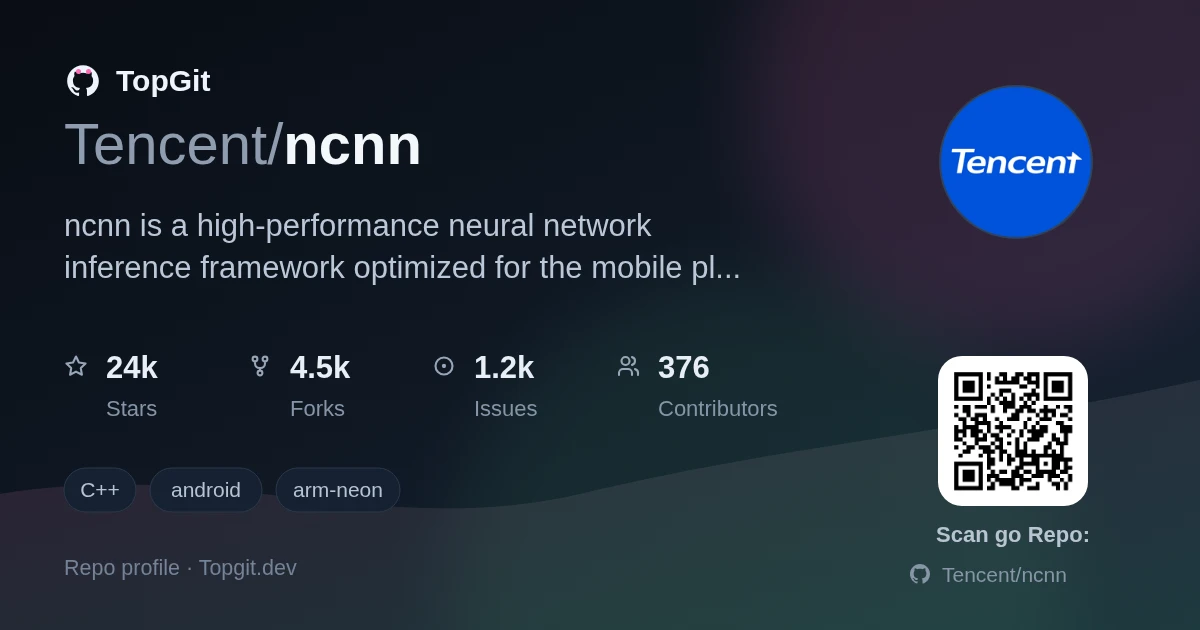
Tencent/ncnn — 24.0k★ on GitHub (C++). ncnn is a high-performance neural network inference framework optimized for the mobile platform
Snapshot summary built from the project's own GitHub metadata — there's no written TopGit review yet. The page will update automatically when a full review is published.
WHY NO REVIEW YET
TopGit writes full reviews for the most-starred, most-requested repositories. This page is a snapshot until then — see the READ ME tab for the original README in full.
ncnn is a high-performance neural network inference framework optimized for mobile, embedded, and desktop deployment.
It has no third-party runtime dependencies, runs across CPU and Vulkan GPU backends, and provides tools such as pnnx for converting PyTorch and ONNX models to ncnn.
Developers can deploy deep learning models efficiently on phones, PCs, browsers, and edge devices.
ncnn is currently being used in many Tencent applications, such as QQ, Qzone, WeChat, Pitu, and so on.
The recommended beginner path is PyTorch -> pnnx -> ncnn.
Install pnnx in a PyTorch environment
pip3 install pnnx
Export a PyTorch model to ncnn
import torch
import torch.nn as nn
import pnnx

class Model(nn.Module):
    def __init__(self):
        super().__init__()
        self.conv = nn.Conv2d(3, 8, 1)
        self.relu = nn.ReLU()
        self.fc = nn.Linear(8, 4)

    def forward(self, x):
        x = self.conv(x)
        x = self.relu(x)
        x = x.mean((2, 3))
        return self.fc(x)

model = Model().eval()

x = torch.rand(1, 3, 224, 224)
pnnx.export(model, "model.pt", (x,))
This generates model.ncnn.param and model.ncnn.bin.
Run with ncnn C++ API
#include "net.h"

ncnn::Net net;
net.load_param("model.ncnn.param");
net.load_model("model.ncnn.bin");

ncnn::Mat in(224, 224, 3);

auto ex = net.create_extractor();
ex.input("in0", in);

ncnn::Mat out;
ex.extract("out0", out);
Or use Python
import numpy as np
import ncnn

net = ncnn.Net()
net.load_param("model.ncnn.param")
net.load_model("model.ncnn.bin")

x = np.zeros((3, 224, 224), np.float32)
mat = ncnn.Mat(x)

ex = net.create_extractor()
ex.input("in0", mat)

ret, out = ex.extract("out0")
print(np.array(out).shape)
See pnnx, use ncnn with PyTorch or ONNX, Python API, and examples for complete workflows.
how to build ncnn library on Linux / Windows / macOS / Raspberry Pi3, Pi4 / POWER / Android / NVIDIA Jetson / iOS / WebAssembly / AllWinner D1 / Loongson 2K1000
Source
Build for Android
Build for Termux on Android
Android
Android shared
Build for HarmonyOS with cross-compiling
HarmonyOS
HarmonyOS shared
Build for iOS on macOS with xcode
iOS
iOS-Simulator
Build for macOS
macOS
Mac-Catalyst
watchOS
watchOS-Simulator
tvOS
tvOS-Simulator
visionOS
visionOS-Simulator
Apple xcframework
Build for Linux / NVIDIA Jetson / Raspberry Pi3, Pi4 / POWER
Ubuntu 22.04
Ubuntu 24.04
Ubuntu 26.04
Build for Windows x64 using VS2017
Build for Windows x64 using MinGW-w64
VS2015
VS2017
VS2019
VS2022
VS2026
Build for WebAssembly
WebAssembly
WebAssembly64
Build for ARM Cortex-A family with cross-compiling
Build for Hisilicon platform with cross-compiling
Build for AllWinner D1
Build for Loongson 2K1000
Build for QNX
Linux (arm)
Linux (aarch64)
Linux (mips)
Linux (mips64)
Linux (ppc64)
Linux (riscv64)
Linux (loongarch64)
Build
Use the prebuilt packages above when possible. To build from source, see the full how to build ncnn library guide for Linux, Windows, macOS, Android, iOS, WebAssembly, HarmonyOS, Raspberry Pi, Jetson, and embedded targets.
Common Linux build:
git clone --recursive https://github.com/Tencent/ncnn.git
cd ncnn
mkdir build && cd build
cmake -DCMAKE_BUILD_TYPE=Release -DNCNN_VULKAN=ON -DNCNN_BUILD_EXAMPLES=ON ..
cmake --build . -j$(nproc)
Model Conversion
Source model
Recommended path
Docs
PyTorch
pnnx.export(model, "model.pt", (input_tensor,)) or pnnx model.pt inputshape=[...]
pnnx, PyTorch / ONNX guide
ONNX
pnnx model.onnx
pnnx, onnx tools
ncnn model optimization
ncnnoptimize model.param model.bin new.param new.bin flag
quantization, model file spec
Legacy Caffe / MXNet / Darknet
Use compatibility converters when maintaining older models
caffe, mxnet, darknet, AlexNet legacy tutorial
Use Netron to inspect .param, .onnx, and .pnnx.param graphs.
Features
No third-party runtime dependencies and no BLAS / NNPACK requirement.
Pure C++ implementation with C API and Python binding.
Optimized CPU inference for mobile and embedded processors, including ARM NEON and multi-core scheduling.
Vulkan GPU acceleration for supported platforms.
Low memory footprint with explicit blob/workspace allocator design.
Supports multi-input, multi-output, and multi-branch graphs.
PyTorch and ONNX conversion through pnnx, plus legacy converter support for older model formats.
Supports fp16 storage/arithmetic paths, int8 quantized inference, model optimization, and custom layers.
Direct memory reference loading for .param and .bin models.
Model and Workload Coverage
ncnn is still strong for classic and mobile CNN workloads, but current usage is broader than CNN-only deployment.
The most recent commit recorded on Tencent/ncnn was 3 months ago, based on the GitHub push timestamp. The repository has 4.5k forks — one of the better signals of community interest.
How many stars does Tencent/ncnn have?
Tencent/ncnn has 24.0k GitHub stars — refresh the page for the live number, or check github.com/Tencent/ncnn. TopGit mirrors GitHub's count but does not claim minute-by-minute accuracy.
What else is in the AI Tools space?
Tencent/ncnn is tracked by TopGit under the AI Tools category, alongside 20 GitHub-tagged topics. Trending and Topics pages list peer repositories of comparable stars and language.
What language is Tencent/ncnn written in?
Tencent/ncnn is written primarily in C++. GitHub's language field is based on the largest share of bytes in the default branch.
This TopGit page is a snapshot — the READ ME tab shows the project's own README content (links stripped, images preserved). The GitHub repository at github.com/Tencent/ncnn is the definitive source.
Why is Tencent/ncnn categorized under AI Tools?
TopGit places Tencent/ncnn in the AI Tools category based on its GitHub topics and description (tagged: "android", "arm-neon", "artificial-intelligence"). Categories are assigned from real repository metadata, not editorial guesswork.
Read full README in the tab above.
Curious whether ncnn is right for you?
Let ChatGPT, Claude, or Perplexity look into it — click below and see what AI actually says about ncnn.

 /ncnn