VuePress: a Vue-powered static site generator
 /vuepress
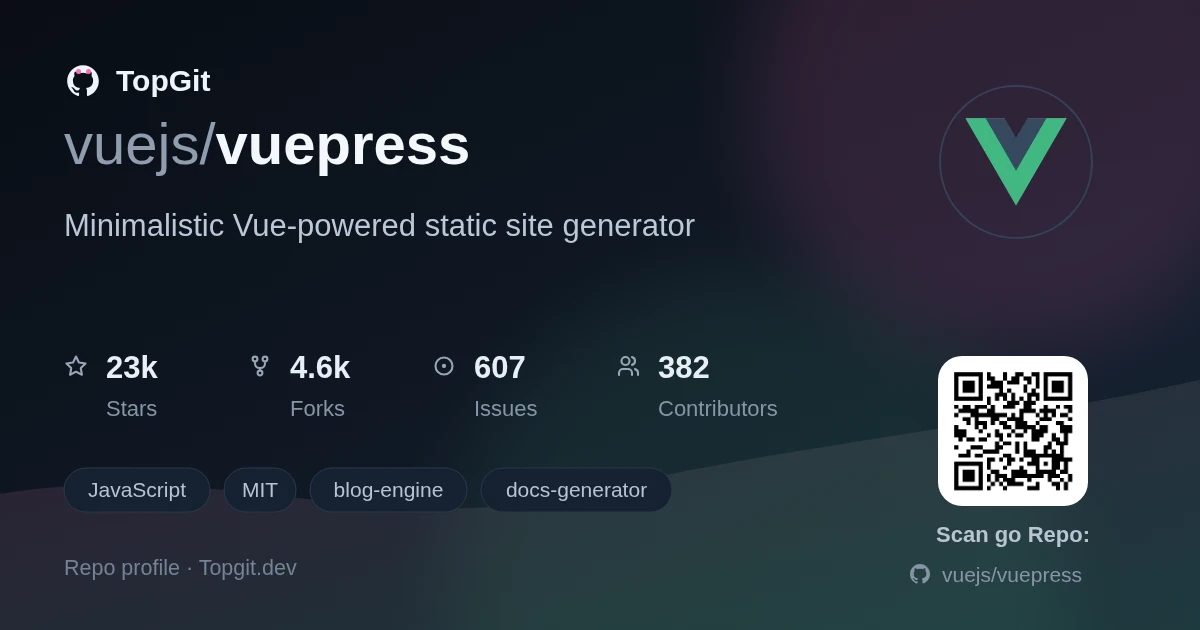
VuePress v1 is in maintenance mode, a fact the project states in the first line of its own README. For an existing site, that's not a crisis — the generator still turns Markdown into a working static build. For a new project, it's a clear signal to start on VitePress instead and treat v1 as something you inherit, not something you choose.
What is VuePress?
VuePress is a static site generator that compiles Markdown files into a Vue-powered site, built and originally led by Evan You, the creator of Vue.js. GitHub tags the repo as both a docs-generator and a blog-engine, which matches how teams actually used v1: project documentation on one end, personal or team blogs on the other.
Core features of VuePress
- ✓Vue-powered output — GitHub's own description calls it a 'minimalistic Vue-powered static site generator,' so pages compile through Vue rather than a generic templating layer.
- ✓Two GitHub topic tags, docs-generator and blog-engine, cover the two content modes the project is built for.
- ✓SEO is listed as one of the six topics attached to the repo, alongside static-site-generator, vue, and vuepress itself.
- ✓MIT-licensed, so forking or vendoring the source carries no licensing friction.
- ✓A working example ships with the repo — the contribution guide's `yarn dev` serves VuePress's own documentation site, built with VuePress.
- ✓A community showcase exists: the Awesome VuePress list and the vuepress.tools directory, built by Ahmad Mostafa, both catalog real sites and plugins.
What you can build with VuePress
- •Documentation sites — the repo is tagged docs-generator on GitHub, and VuePress's own docs are built with VuePress itself (the contribution guide's `yarn dev` command literally serves the project's own docs).
- •Blogs — separately tagged blog-engine, for teams that want Markdown posts rendered through the same Vue-based pipeline as their docs.
- •Whatever the community showcase proves out — the Awesome VuePress list and the community-run vuepress.tools directory catalog real sites built with it, beyond the docs/blog split GitHub's tags imply.
Strengths
- ✓MIT license. No restrictions on forking, vendoring, or modifying the source.
- ✓A real community showcase (Awesome VuePress, vuepress.tools) exists, so you can see actual sites built with it instead of taking marketing copy on faith.
- ✓The maintenance-mode status is disclosed upfront in the README rather than buried — you're not going to be surprised by it after adopting v1.
- ✓Built and originally led by Evan You, the creator of Vue.js himself, which is listed directly in the repo's contributor credits.
Known limitations of VuePress v1
- △VuePress v1 is officially in maintenance mode. The README says so in its first line, and points new users to VitePress or VuePress v2 instead of v1.
- △The README provided here doesn't document a feature list, install steps, or CLI usage directly — anyone starting fresh has to leave GitHub and read the separate docs site to learn how the tool actually works.
- △No migration-guide content is included in this README — the project links out to VitePress and VuePress v2 but doesn't walk through what breaks when you move.
Alternatives to VuePress
Who should still consider VuePress v1
Best suited to teams already running a VuePress v1 site who need it to keep building, not break — not teams starting something new. If you maintain a project whose docs live in VuePress v1 today, sticking with it a while longer is reasonable since the generator still works and the upgrade path (VitePress or VuePress v2) is a real migration project, not a drop-in swap. If you're picking a docs tool for a brand-new Vue project in 2024, the README's own maintenance notice is your answer: start on VitePress instead.
Frequently asked questions
VuePress v1 is in maintenance mode, according to the project's own README — it isn't being actively developed further. The team's attention has moved to VitePress (official) and VuePress v2 (community-supported), both listed as the recommended next steps for new projects.
VuePress v1 is the original Vue-powered static site generator, now in maintenance mode. VitePress is its successor, built on Vue 3 and Vite, and it carries official Vue.js team support — the README names VitePress as the recommended replacement for new projects.
VuePress v1 can still build and serve a production docs site — the generator itself hasn't stopped working. But because the project's README describes v1 as maintenance-only and points elsewhere, starting a brand-new production site on it in 2024 means building on a version the maintainers are actively steering people away from.
The VuePress README doesn't include migration steps — it links out to VitePress's own site and to the VuePress v2 (vuepress/core) repository rather than documenting the migration path itself, so check those projects' docs directly for conversion guidance.
VuePress is free to use — it's released under the MIT license, which permits free use, modification, and redistribution, including in commercial projects, without royalties or usage fees.
After v1, the Vue.js team's active development effort shifted to VitePress, an official successor built on Vue 3 and Vite. VuePress itself continued as VuePress v2, hosted at vuepress/core, a community-supported project rather than one led directly by the core Vue.js team, per the same README notice.
The problem it solves
Vue.js teams that wanted a docs or blog site built from inside their own stack — instead of pulling in a React-based generator like Gatsby or Docusaurus — needed a Vue-powered option, and VuePress was that option, created and originally led by Evan You. The same repo now says plainly that v1's approach has been superseded: the README's first section is a maintenance notice pointing at VitePress and VuePress v2, so the problem VuePress v1 solves today is narrower than the one it solved when Evan You built it — mostly keeping older Vue-ecosystem doc sites running rather than starting new ones.
How to install / try
The install steps for adding VuePress to your own project aren't in this README — it only documents how to set up the VuePress repo itself for contributing (`yarn install`, then `yarn dev` to serve VuePress's own docs with itself, and `yarn test` to run the test suite). For actual usage as a dependency, the README points to the separate docs site at vuepress.vuejs.org rather than listing npm or yarn commands here. If you don't want a local checkout, the README also offers a one-click Gitpod environment for browsing the source in-browser.
How to use
Day-to-day usage — writing Markdown, configuring a theme, running a build — isn't documented in this README either; that content lives on the separate docs site linked from the repo. What the README does cover is the contribution workflow: run the test suite with `yarn test` before submitting a change, and if you're proposing something 'substantial' to VuePress itself or its docs, the project asks you to file an RFC first rather than just opening a pull request.
Related repositories
Is vuepress worth your time?
ChatGPT, Claude and Perplexity can all read this page. Ask one of them what it makes of vuepress.