wagtail/wagtail is tracked by TopGit as a backend project, with 20.4k stars on GitHub, written primarily in Python. A Django content management system focused on flexibility and user experience
Snapshot summary built from the project's own GitHub metadata — there's no written TopGit review yet. The page will update automatically when a full review is published.
WHY NO REVIEW YET
TopGit writes full reviews for the most-starred, most-requested repositories. This page is a snapshot until then — see the READ ME tab for the original README in full.
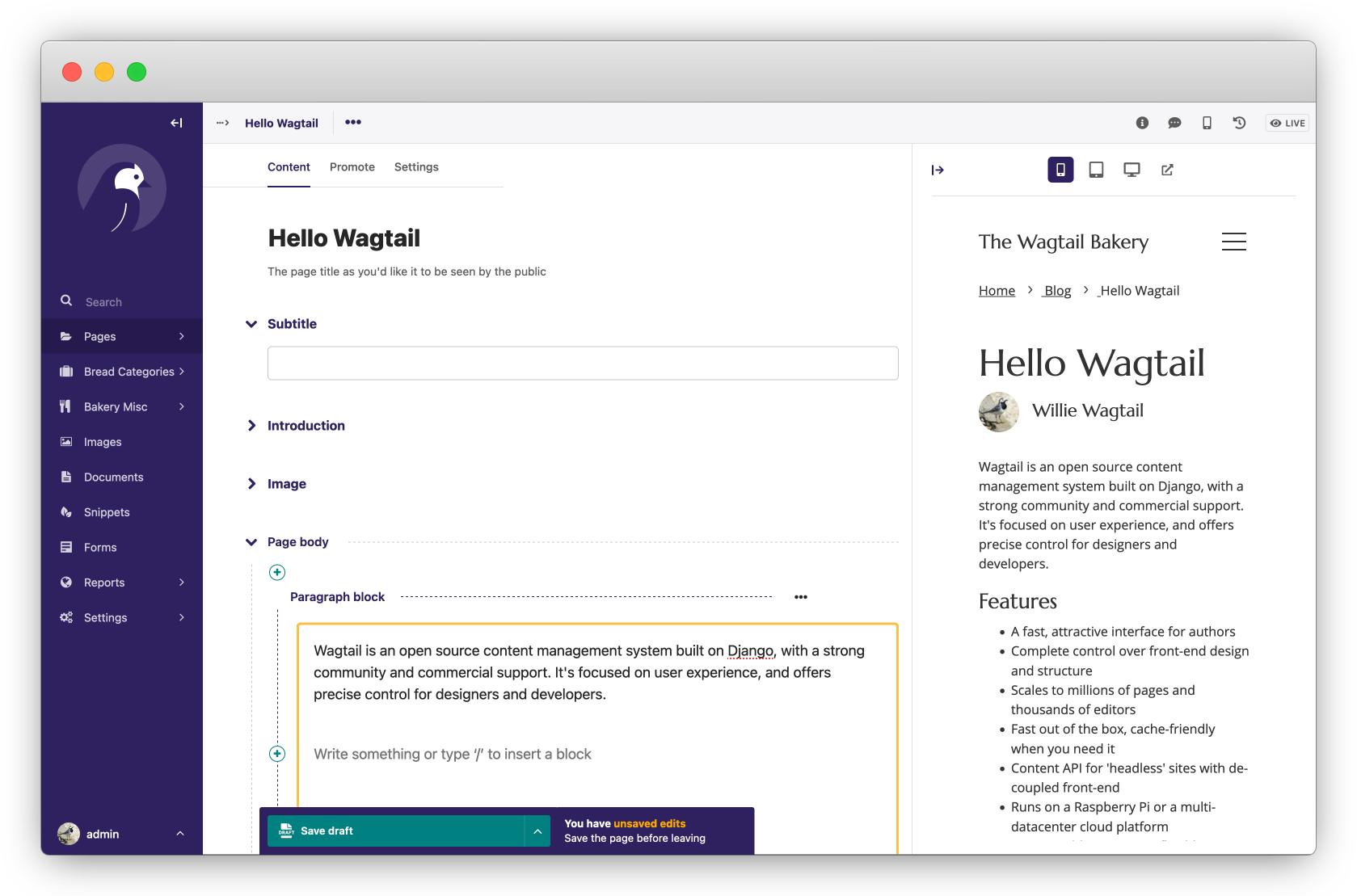
Wagtail is an open source content management system built on Django, with a strong community and commercial support. It's focused on user experience, and offers precise control for designers and developers.
🔥 Features
A fast, attractive interface for authors
Complete control over front-end design and structure
Scales to millions of pages and thousands of editors
Fast out of the box, cache-friendly when you need it
Content API for 'headless' sites with decoupled front-end
Runs on a Raspberry Pi or a multi-datacenter cloud platform
StreamField encourages flexible content without compromising structure
Powerful, integrated search, using Elasticsearch or PostgreSQL
Excellent support for images and embedded content
Multi-site and multi-language ready
Embraces and extends Django
Find out more at wagtail.org.
👉 Getting started
Wagtail works with Python 3, on any platform.
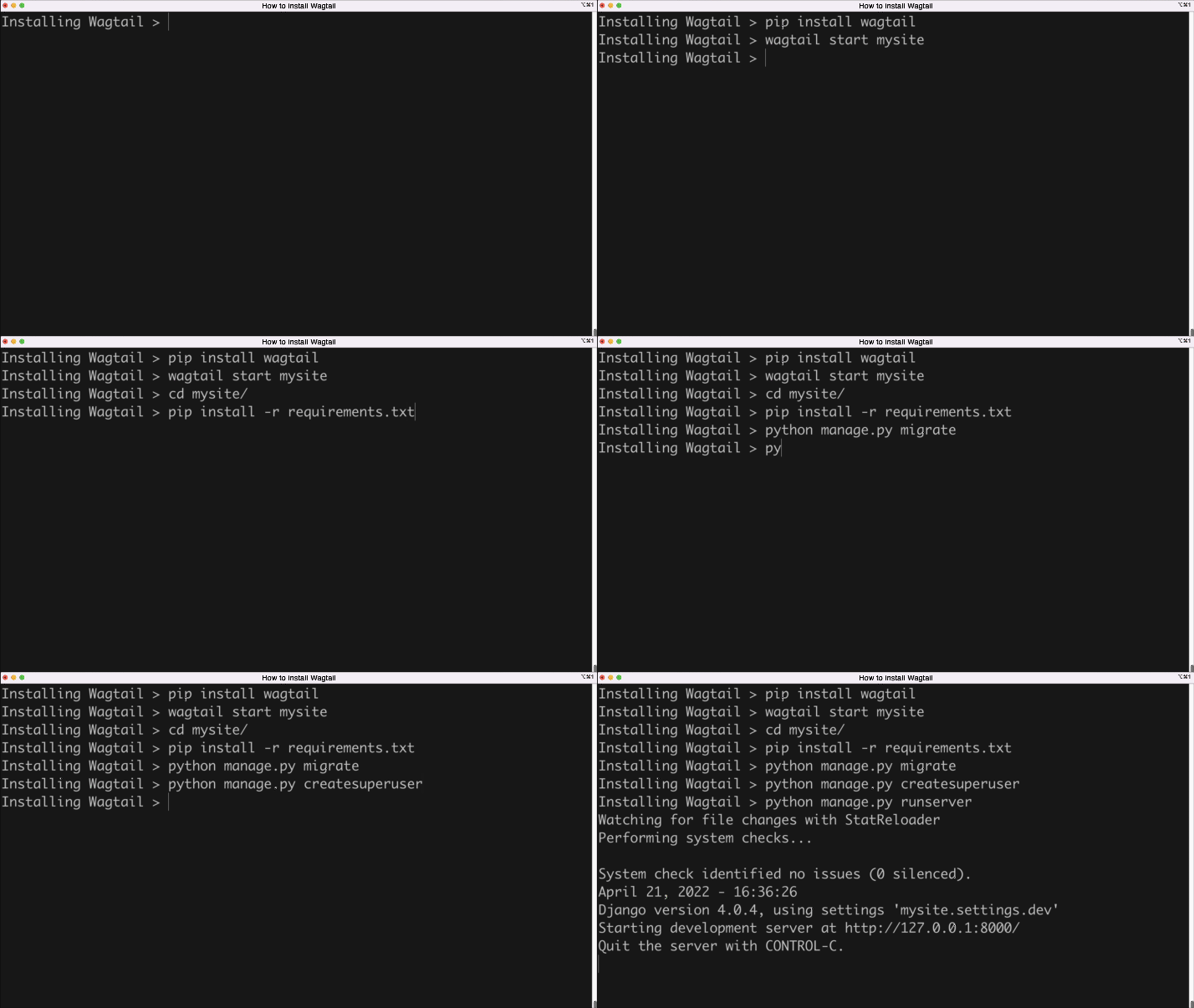
To get started with using Wagtail, run the following in a virtual environment:
For detailed installation and setup docs, see the getting started tutorial.
👨👩👧👦 Who’s using it?
Wagtail is used by NASA, Google, Oxfam, the NHS, Mozilla, MIT, the Red Cross, Salesforce, NBC, BMW, and the US and UK governments. Add your own Wagtail site to madewithwagtail.org.
📖 Documentation
docs.wagtail.org is the full reference for Wagtail, and includes guides for developers, designers and editors, alongside release notes and our roadmap.
For those who are new to Wagtail, the Zen of Wagtail will help you understand what Wagtail is, and what Wagtail is not.
For developers who are ready to jump in to their first Wagtail website the Getting Started Tutorial will guide you through creating and editing your first page.
Do you have an existing Django project? The Wagtail Integration documentation is the best place to start.
📌 Compatibility
(If you are reading this on GitHub, the details here may not be indicative of the current released version - please see Compatible Django / Python versions in the Wagtail documentation.)
Wagtail supports:
Django 5.2.x and 6.0.x
Python 3.10, 3.11, 3.12, 3.13, and 3.14
PostgreSQL, MySQL, MariaDB and SQLite (with JSON1) as database backends
Previous versions of Wagtail additionally supported Python 2.7, 3.8 and earlier Django versions.
📢 Community Support
There is an active community of Wagtail users and developers responding to questions on Stack Overflow. When posting questions, please read Stack Overflow's advice on how to ask questions and remember to tag your question "wagtail".
For topics and discussions that do not fit Stack Overflow's question and answer format we have a Slack workspace. Please respect the time and effort of volunteers by not asking the same question in multiple places.
Our GitHub discussion boards are open for sharing ideas and plans for the Wagtail project.
We maintain a curated list of third party packages, articles and other resources at Awesome Wagtail.
🧑💼 Commercial Support
Wagtail is sponsored by Torchbox. If you need help implementing or hosting Wagtail, please contact us: [email protected]. See also madewithwagtail.org/developers/ for expert Wagtail developers around the world.
🔐 Security
We take the security of Wagtail, and related packages we maintain, seriously. If you have found a security issue with any of our projects please email us at [email protected] so we can work together to find and patch the issue. We appreciate responsible disclosure with any security related issues, so please contact us first before creating a GitHub issue.
🕒 Release schedule
Feature releases of Wagtail are released every three months. Selected releases are designated as Long Term Support (LTS) releases, and will receive maintenance updates for an extended period to address any security and data-loss related issues. For dates of past and upcoming releases and support periods, see Release Schedule.
🕛 Nightly releases
To try out the latest features before a release, we also create builds from main every night. You can find instructions on how to install the latest nightly release at https://releases.wagtail.org/nightly/index.html
🙋🏽 Contributing
If you're a Python or Django developer, fork the repo and get stuck in! We have several developer focused channels on the Slack workspace.
You might like to start by reviewing the contributing guidelines and checking issues with the good first issue label.
We also welcome translations for Wagtail's interface. Translation work should be submitted through Transifex.
🔓 License
BSD - Free to use and modify for any purpose, including both open and closed-source code.
👏 Thanks
We thank the following organisations for their services used in Wagtail's development:
BrowserStack provides the project with free access to their live web-based browser testing tool, and automated Selenium cloud testing.
Assistiv Labs provides the project with unlimited access to their remote testing with assistive technologies.
The most recent commit recorded on wagtail/wagtail was 13 days ago, based on the GitHub push timestamp. The repository has 4.6k forks — one of the better signals of community interest.
How many stars does wagtail/wagtail have?
wagtail/wagtail has 20.4k GitHub stars — refresh the page for the live number, or check github.com/wagtail/wagtail. TopGit mirrors GitHub's count but does not claim minute-by-minute accuracy.
What language is wagtail/wagtail written in?
wagtail/wagtail is written primarily in Python. GitHub's language field is based on the largest share of bytes in the default branch.
What license does wagtail/wagtail use?
wagtail/wagtail is released under the BSD-3-Clause license. Always verify the LICENSE file directly on GitHub for the authoritative terms — license strings can be edited out of sync with a project's actual stance.
What topics is wagtail/wagtail associated with?
GitHub's repository topics for wagtail/wagtail: "cms", "django", "hacktoberfest", "python", "wagtail". TopGit's editorial category is Backend.
Where can I see wagtail/wagtail in action?
The project maintains a homepage at https://wagtail.org. The README tab on this page also usually contains screenshots and a quickstart.
Where do I read more about wagtail/wagtail?
This TopGit page is a snapshot — the READ ME tab shows the project's own README content (links stripped, images preserved). The GitHub repository at github.com/wagtail/wagtail is the definitive source.