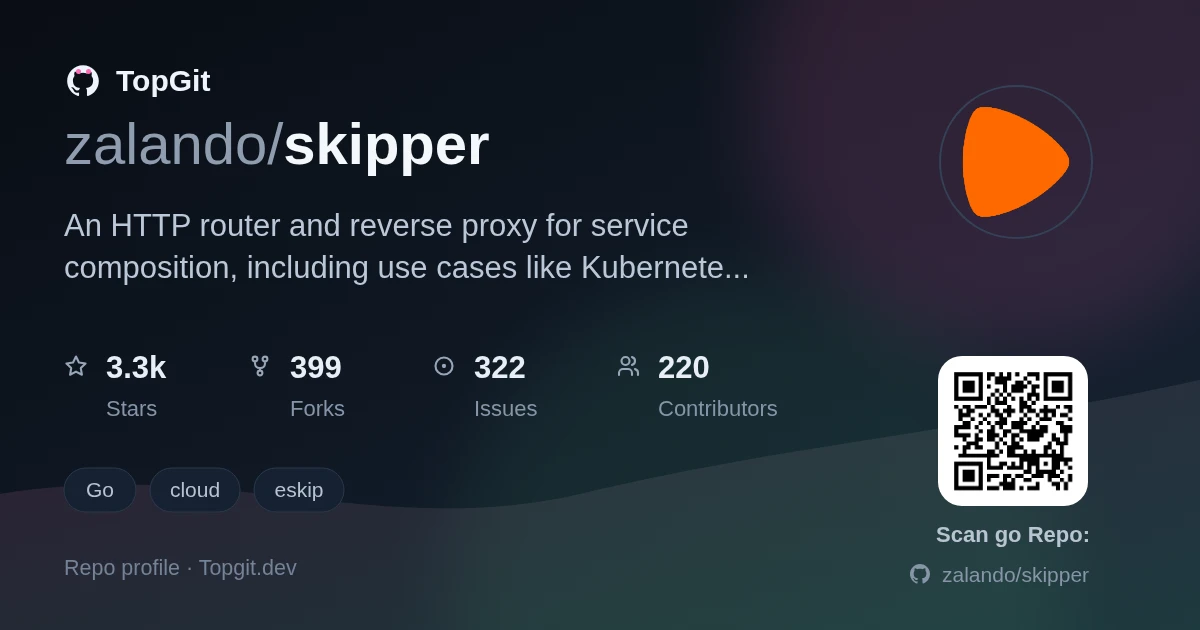
zalando/skipper is one of the server-side repositories TopGit tracks, currently at 3.3k stars, written primarily in Go. An HTTP router and reverse proxy for service composition, including use cases like Kubernetes Ingress
Snapshot summary built from the project's own GitHub metadata — there's no written TopGit review yet. The page will update automatically when a full review is published.
WHY NO REVIEW YET
TopGit writes full reviews for the most-starred, most-requested repositories. This page is a snapshot until then — see the READ ME tab for the original README in full.
Skipper is an HTTP router and reverse proxy for service composition. It's designed to handle >300k HTTP route
definitions with detailed lookup conditions, and flexible augmentation of the request flow with filters. It can be
used out of the box or extended with custom lookup, filter logic and configuration sources.
Main features:
An overview of deployments and data-clients
shows some use cases to run skipper.
Skipper
identifies routes based on the requests' properties, such as path, method, host and headers
allows modification of the requests and responses with filters that are independently configured for each route
simultaneously streams incoming requests and backend responses
optionally acts as a final endpoint (shunt), e.g. as a static file server or a mock backend for diagnostics
updates routing rules without downtime, while supporting multiple types of data sources — including
etcd, Kubernetes Ingress, static files, route string and
custom configuration sources
can serve as a
Kubernetes Ingress controller
without reloads. You can use it in combination with a controller that will route public traffic to
your skipper fleet; see AWS example
shipped with
eskip: a descriptive configuration language designed for routing
rules
routesrv: proxy to omit kube-apiserver overload leveraging Etag
header to reduce amount of CPU used in your skipper data plane
webhook: Kubernetes validation webhook to make sure your
manifests are deployed safely
Skipper provides a default executable command with a few built-in filters. However, its primary use case is to
be extended with custom filters, predicates or data sources. Go here for additional documentation.
A few examples for extending Skipper:
Example proxy with custom filter https://github.com/szuecs/skipper-example-proxy
Image server https://github.com/zalando-stups/skrop
In order to build and run Skipper, only the latest version of Go needs to be installed. Skipper can use
Innkeeper or Etcd as data sources for routes, or for the simplest cases, a local configuration file. See more
details in the documentation: https://pkg.go.dev/github.com/zalando/skipper
Installation
From Binary
Download binary tgz from https://github.com/zalando/skipper/releases/latest
Example, assumes that you have $GOBIN set to a directory that exists
and is in your $PATH:
Skipper will then be available on http://localhost:9090
Authentication Proxy
Skipper can be used as an authentication proxy, to check incoming
requests with Basic auth or an OAuth2 provider or an OpenID Connect
provider including audit logging. See the documentation at:
https://pkg.go.dev/github.com/zalando/skipper/filters/auth.
Working with the code
Getting the code with the test dependencies (-t switch):
git clone https://github.com/zalando/skipper.git
cd skipper
Build and test all packages:
make deps
make install
make lint
make shortcheck
On Mac the tests may fail because of low max open file limit. Please make sure you have correct limits setup
by following these instructions.
Working from IntelliJ / GoLand
To run or debug skipper from IntelliJ IDEA or GoLand, you need to create this configuration:
Parameter
Value
Template
Go Build
Run kind
Directory
Directory
skipper source dir + /cmd/skipper
Working directory
skipper source dir (usually the default)
Kubernetes Ingress
Skipper can be used to run as an Kubernetes Ingress controller.
Details with examples
of Skipper's capabilities and an
overview
you will can be found in our ingress-controller deployment docs.
For AWS integration, we provide an ingress controller
https://github.com/zalando-incubator/kube-ingress-aws-controller, that
manage ALBs or NLBs in front of your skipper deployment.
A production example for skipper
and a production example for kube-ingress-aws-controller,
can be found in our Kubernetes configuration https://github.com/zalando-incubator/kubernetes-on-aws.
Comparison with other Ingress controllers
Comparison with service-mesh
Documentation
Skipper's Documentation and
Godoc developer documentation,
includes information about deployment use cases
and detailed information on these topics:
The Routing Mechanism
Matching Requests
Filters - Augmenting Requests and Responses
Predicates - additional predicates to match a route
Service Backends
Route Definitions fetched by dataclients:
route string
eskip file
remote eskip
etcd
kubernetes
Circuit Breakers
Extending It with Custom Predicates, Filters, can be done by building your own proxy, Plugins or Lua Scripts
Proxy Package
Logging and Metrics
Operations guide
Authentication and Authorization
Load Shedders
Rate Limiters
Opentracing tracers or extend create your own
1 Minute Skipper introduction
The following example shows a skipper routes file in eskip format, that has 3 named routes: baidu, google and yandex.
baidu is using Path() matching to differentiate the HTTP requests to select the route.
google is the default matching with wildcard *
yandex is the default matching with wildcard * if you have a cookie yandex=true
Request Filters:
If baidu is selected, skipper sets the Host header, changes the path and sets a query string to the http request to the backend "http://www.baidu.com".
If google is selected, skipper changes the path and sets a query string to the http request to the backend "https://www.google.com".
If yandex is selected, skipper changes the path and sets a query string to the http request to the backend "https://yandex.ru". The modified request will be copied to "http://127.0.0.1:12345/"
Run skipper with the routes file doc-1min-intro.eskip shown above
This introduction was moved to ingress controller documentation.
For More details, please check out our Kubernetes ingress controller docs, our ingress usage and how to handle common backend problems in Kubernetes.
Packaging support
See https://github.com/zalando/skipper/blob/master/packaging/readme.md
In case you want to implement and link your own modules into your
skipper, there is https://github.com/skipper-plugins organization to
enable you to do so. In order to explain you the build process with
custom Go modules there is
https://github.com/skipper-plugins/skipper-tracing-build, that was
used to build skipper's opentracing package.
We moved the opentracing plugin source into the tracing package, so
there is no need to use plugins for this case.
Because Go plugins are not very well supported by Go itself we do not
recommend to use plugins, but you can extend skipper and
build your own proxy.
Community
User or developer questions can be asked in our public Google Group
We have a slack channel #skipper in gophers.slack.com. Get an invite.
If for some reason this link doesn't work, you can read the information about the gophers communities.
The preferred communication channel is the slack channel, because the google group is a manual process to add members.
Feel also free to create an issue, if you dislike chat and post your questions there.
Proposals
We do our proposals open in Skipper's Google drive.
If you want to make a proposal feel free to create an
issue and if it is a
bigger change we will invite you to a document, such that we can work together.
Users
Zalando used this project as shop frontend http router with 350000 routes.
We use it as Kubernetes ingress controller in more than 100 production clusters. With every day traffic between 500k and 7M RPS serving 15000 ingress and 3750 RouteGroups at less than ¢5/1M requests.
We also run several custom skipper instances that use skipper as library.
Sergio Ballesteros from spotahome said 2018:
We also ran tests with several ingress controllers and skipper gave us the more reliable results. Currently we are running skipper since almost 2 years with like 20K Ingress rules.
The fact that skipper is written in go let us understand the code, add features and fix bugs since all of our infra stack is golang.
In the media
Blog posts:
opensource.com - Try this Kubernetes HTTP router and reverse proxy
opensource.com - An open source HTTP router to increase your network visibility
Building our own open source http routing
solution:
Giving some context about why Skipper was created in the first place.
Kubernetes in production @ ShopGun
Hacker News Skipper – An HTTP router and reverse proxy for service composition
Conference/Meetups talks
LISA 2018 - modern HTTP routing
Version promise
Skipper will update the minor version in case we have either:
a significant change
a Go version requirement change (go directive in go.mod change)
a dependency change that adds or removes a replace directive in
go.mod file (requires library users to add or remove the same
directive in their go.mod file)
a change that require attention to users, for example Kubernetes
RBAC changes required to deploy
https://github.com/zalando/skipper/releases/tag/v0.18.0
a feature removal like Kubernetes ingress v1beta1
https://github.com/zalando/skipper/releases/tag/v0.15.0
an API change of a function that is marked experimental example
We expect that skipper library users will use
skipper.Run(skipper.Options{}) as main interface that we do not want
to break. Besides the Kubernetes v1beta1 removal there was never a
change that removed an option. We also do not want to break generic
useful packages like net. Sometimes we mark library functions, that
we expect to be useful as experimental, because we want to try and
learn over time if this is a good API decision or if this limits us.
This promise we hold considering the main, filter, predicate,
dataclient, eskip interfaces and generic packages. For other packages,
we have more weak promise with backwards compatibility as these are
more internal packages. We try to omit breaking changes also in
internal packages. If this would mean too much work or impossible
to build new functionality as we would like, we will do a breaking
change considering strictly semantic versioning rules.
How to update
Every update that changes the minor version (the m in v0.m.p),
should be done by +1 only. So v0.N.x to v0.N+1.y and you should
read v0.N+1.0 release page to see what can break and what you have
to do in order to have no issues while updating.
The most recent commit recorded on zalando/skipper was 20 days ago, based on the GitHub push timestamp. The repository has 401 forks — one of the better signals of community interest.
How does zalando/skipper compare to other Backend projects?
zalando/skipper is tracked by TopGit in the Backend category, with 3.3k GitHub stars and written in Go. Browse the Backend topic page on TopGit to compare it against similar projects by stars and activity.
How many stars does zalando/skipper have?
zalando/skipper has 3.3k GitHub stars — refresh the page for the live number, or check github.com/zalando/skipper. TopGit mirrors GitHub's count but does not claim minute-by-minute accuracy.
Is zalando/skipper open source?
TopGit's metadata for zalando/skipper does not record a license. Most public repositories on GitHub ARE open source, but the exact terms vary — verify by opening the LICENSE file directly.
What is zalando/skipper?
zalando/skipper (zalando/skipper) is a Go project on GitHub. From the project's own README: An HTTP router and reverse proxy for service composition, including use cases like Kubernetes Ingress
Where do I read more about zalando/skipper?
This TopGit page is a snapshot — the READ ME tab shows the project's own README content (links stripped, images preserved). The GitHub repository at github.com/zalando/skipper is the definitive source.
Read full README in the tab above.
Want a second opinion on skipper?
Ask an AI that can read this page — one click and you get its take on skipper.
 /skipper