
zloirock/core-js

25.5k GitHub stars and counting — zloirock/core-js is a JavaScript project TopGit is tracking across repositories on the platform. Standard Library
Snapshot summary built from the project's own GitHub metadata — there's no written TopGit review yet. The page will update automatically when a full review is published.
TopGit writes full reviews for the most-starred, most-requested repositories. This page is a snapshot until then — see the READ ME tab for the original README in full.
Snapshot
Top contributors
Show top contributors



Welcome to our new website, core-js.io, where our documentation is moving!
I highly recommend reading this: So, what's next?
Modular standard library for JavaScript. Includes polyfills for ECMAScript up to 2026: promises, symbols, collections, iterators, typed arrays, many other features, ECMAScript proposals, some cross-platform WHATWG / W3C features and proposals like
URL. You can load only required features or use it without global namespace pollution.
core-js@3, babel and a look into the future
Raising funds
core-js isn't backed by a company, so the future of this project depends on you. Become a sponsor or a backer if you are interested in core-js: Open Collective, Patreon, Boosty, Bitcoin ( bc1qlea7544qtsmj2rayg0lthvza9fau63ux0fstcz ), Alipay.


Example of usage:
import 'core-js/actual';

Promise.try(() => 42).then(it => console.log(it)); // -> 42

Array.from(new Set([1, 2, 3]).union(new Set([3, 4, 5]))); // => [1, 2, 3, 4, 5]

[1, 2].flatMap(it => [it, it]); // => [1, 1, 2, 2]

Iterator.concat([1, 2], function * (i) { while (true) yield i++; }(3))
  .drop(1).take(5)
  .filter(it => it % 2)
  .map(it => it ** 2)
  .toArray(); // => [9, 25]

structuredClone(new Set([1, 2, 3])); // => Set { 1, 2, 3 }
You can load only required features:
import 'core-js/actual/promise';
import 'core-js/actual/set';
import 'core-js/actual/iterator';
import 'core-js/actual/array/from';
import 'core-js/actual/array/flat-map';
import 'core-js/actual/structured-clone';

Promise.try(() => 42).then(it => console.log(it)); // -> 42

Array.from(new Set([1, 2, 3]).union(new Set([3, 4, 5]))); // => [1, 2, 3, 4, 5]

[1, 2].flatMap(it => [it, it]); // => [1, 1, 2, 2]

Iterator.concat([1, 2], function * (i) { while (true) yield i++; }(3))
  .drop(1).take(5)
  .filter(it => it % 2)
  .map(it => it ** 2)
  .toArray(); // => [9, 25]

structuredClone(new Set([1, 2, 3])); // => Set { 1, 2, 3 }
Or use it without global namespace pollution:
import Promise from 'core-js-pure/actual/promise';
import Set from 'core-js-pure/actual/set';
import Iterator from 'core-js-pure/actual/iterator';
import from from 'core-js-pure/actual/array/from';
import flatMap from 'core-js-pure/actual/array/flat-map';
import structuredClone from 'core-js-pure/actual/structured-clone';

Promise.try(() => 42).then(it => console.log(it)); // -> 42

from(new Set([1, 2, 3]).union(new Set([3, 4, 5]))); // => [1, 2, 3, 4, 5]

flatMap([1, 2], it => [it, it]); // => [1, 1, 2, 2]

Iterator.concat([1, 2], function * (i) { while (true) yield i++; }(3))
  .drop(1).take(5)
  .filter(it => it % 2)
  .map(it => it ** 2)
  .toArray(); // => [9, 25]

structuredClone(new Set([1, 2, 3])); // => Set { 1, 2, 3 }
Index
- Usage
- Installation
postinstallmessage- CommonJS API
- Babel
@babel/polyfill@babel/preset-env@babel/runtimebabel-plugin-polyfill-corejs3
- swc
- Configurable level of aggressiveness
- Custom build
- Supported engines and compatibility data
- Features
- ECMAScript
- ECMAScript: Object
- ECMAScript: Function
- ECMAScript: Error
- ECMAScript: Array
- ECMAScript: Iterator
- ECMAScript: String and RegExp
- ECMAScript: Number
- ECMAScript: Math
- ECMAScript: Date
- ECMAScript: Promise
- ECMAScript: Symbol
- ECMAScript: Collections
- ECMAScript: Explicit resource management
- ECMAScript: Typed arrays
- ECMAScript: Reflect
- ECMAScript: JSON
- ECMAScript: globalThis
- ECMAScript proposals
- Finished proposals
globalThis- Relative indexing method
Array.prototype.includesArray.prototype.flat/Array.prototype.flatMap- Array find from last
- Change
Arrayby copy ArraygroupingArray.fromAsyncArrayBuffer.prototype.transferand friendsUint8Arrayto / from base64 and hexErrorcauseError.isError- Explicit resource management
Float16methodsIteratorhelpersIteratorsequencingIteratorchunkingIteratorincludesIteratorjoin- Joint iteration
Object.values/Object.entriesObject.fromEntriesObject.getOwnPropertyDescriptors- Accessible
Object.prototype.hasOwnProperty StringpaddingString.prototype.matchAllString.prototype.replaceAllString.prototype.trimStart/String.prototype.trimEndRegExps(dotAll) flagRegExpnamed capture groupsRegExpescapingPromise.allSettledPromise.anyPromise.prototype.finallyPromise.tryPromise.withResolversSymbol.asyncIteratorfor asynchronous iterationSymbol.prototype.descriptionJSON.parsesource text access- Well-formed
JSON.stringify - Well-formed Unicode strings
- New
Setmethods MapupsertMath.sumPrecise
- Stage 3 proposals
- Await dictionary
- Stage 2.7 proposals
Symbol.metadatafor the decorator metadata proposal
- Stage 2 proposals
AsyncIteratorhelpersIterator.rangeNumber.prototype.clampString.dedentSymbolpredicatesSymbol.customMatcherfor extractors
- Stage 1 proposals
Observable- New collections methods
.ofand.frommethods on collection constructorscompositeKeyandcompositeSymbol- Array filtering
- Array deduplication
DataViewget / setUint8ClampedmethodsNumber.fromStringString.cookedString.prototype.codePointsSymbol.customMatcherfor pattern matching
- Stage 0 proposals
Function.prototype.demethodizeFunction.{ isCallable, isConstructor }
- Pre-stage 0 proposals
Reflectmetadata
- Finished proposals
- Web standards
selfstructuredClone- Base64 utility methods
setTimeoutandsetIntervalsetImmediatequeueMicrotaskURLandURLSearchParamsDOMException- Iterable DOM collections
- Iteration helpers
- ECMAScript
- Missing polyfills
- Contributing
- Security policy
- Changelog
Usage⬆
Installation:⬆
# global version
npm install --save [email protected]
# version without global namespace pollution
npm install --save [email protected]
# bundled global version
npm install --save [email protected]
postinstall message⬆
The core-js project needs your help, so the package shows a message about it after installation. If it causes problems for you, you can disable it:
ADBLOCK=true npm install
# or
DISABLE_OPENCOLLECTIVE=true npm install
# or
npm install --loglevel silent
CommonJS API⬆
You can import only the polyfills you need, like in the examples at the top of README.md. CommonJS entry points are available for all polyfilled methods / constructors and namespaces. Just some examples:
// polyfill all `core-js` features, including early-stage proposals:
import 'core-js';
// or:
import 'core-js/full';
// polyfill all actual features - stable ES, web standards and stage 3 ES proposals:
import 'core-js/actual';
// polyfill only stable features - ES and web standards:
import 'core-js/stable';
// polyfill only stable ES features:
import 'core-js/es';

// if you want to polyfill `Set`:
// all `Set`-related features, with early-stage ES proposals:
import 'core-js/full/set';
// stable required for `Set` ES features, features from web standards and stage 3 ES proposals:
import 'core-js/actual/set';
// stable required for `Set` ES features and features from web standards
// (DOM collections iterator in this case):
import 'core-js/stable/set';
// only stable ES features required for `Set`:
import 'core-js/es/set';
// the same without global namespace pollution:
import Set from "core-js-pure/full/set";
import Set from "core-js-pure/actual/set";
import Set from "core-js-pure/stable/set";
import Set from "core-js-pure/es/set";

// if you want to polyfill just the required methods:
import 'core-js/full/set/intersection';
import 'core-js/actual/array/find-last';
import 'core-js/stable/queue-microtask';
import 'core-js/es/array/from';

// polyfill async iterator helpers proposal:
import 'core-js/proposals/async-iterator-helpers';
// polyfill all stage 2+ proposals:
import 'core-js/stage/2';
[!TIP] The usage of the
/actual/namespace is recommended since it includes all actual JavaScript features and does not include unstable early-stage proposals that are available mainly for experiments.
[!WARNING]
- The
modulespath is an internal API, does not inject all required dependencies and can be changed in minor or patch releases. Use it only for a custom build and/or if you know what you are doing.- If you use
core-jswith the extension of native objects, recommended to load allcore-jsmodules at the top of the entry point of your application, otherwise, you can have conflicts.
- For example, Google Maps uses its own
Symbol.iterator, conflicting withArray.from,URLSearchParamsand / or something else fromcore-js, see related issues.- Such conflicts are also resolvable by discovering and manually adding each conflicting entry from
core-js.core-jsis extremely modular and uses a lot of very tiny modules, because of that, for usage in browsers, bundle upcore-jsinstead of using a loader for each file; otherwise, you will have hundreds of requests.
CommonJS and prototype methods without global namespace pollution⬆
In the pure version, we can't pollute prototypes of native constructors. Because of that, prototype methods are transformed into static methods, like in the examples above. But with transpilers, we can use one more trick - bind operator and virtual methods. For this case, there are /virtual/ entry points. Example:
import fill from 'core-js-pure/actual/array/virtual/fill';
import findIndex from 'core-js-pure/actual/array/virtual/find-index';

Array(10)::fill(0).map((a, b) => b * b)::findIndex(it => it && !(it % 8)); // => 4
[!WARNING] The bind operator is an early-stage ECMAScript proposal and usage of this syntax can be dangerous.
Babel⬆
core-js is integrated with babel and is the base for polyfilling-related babel features:
[!NOTE]
useBuiltInsandcorejsoptions described below are available only in Babel 7; in Babel 8, they were replaced withbabel-plugin-polyfill-corejs3.
@babel/polyfill⬆
@babel/polyfill IS just the import of stable core-js features and regenerator-runtime for generators and async functions, so loading @babel/polyfill means loading the global version of core-js without ES proposals.
Now it's deprecated in favor of separate inclusion of required parts of core-js and regenerator-runtime and, for backward compatibility, @babel/polyfill is still based on core-js@2.
As a full equivalent of @babel/polyfill, you can use the following:
import 'core-js/stable';
import 'regenerator-runtime/runtime';
@babel/preset-env⬆
@babel/preset-env has useBuiltIns option, which optimizes the use of the global version of core-js. With useBuiltIns option, you should also set corejs option to the used version of core-js, like corejs: '3.51'.
[!IMPORTANT] It is recommended to specify the used minor
core-jsversion, likecorejs: '3.51', instead ofcorejs: 3, since withcorejs: 3, modules added in minorcore-jsreleases will not be injected.
useBuiltIns: 'entry'replaces imports ofcore-jswith imports of only the modules required for a target environment. So, for example,
import 'core-js/stable';
with chrome 71 target will be replaced just to:
import 'core-js/modules/es.array.unscopables.flat';
import 'core-js/modules/es.array.unscopables.flat-map';
import 'core-js/modules/es.object.from-entries';
import 'core-js/modules/web.immediate';
// ...and the rest of the modules not yet supported by Chrome 71
It works for all entry points of global version of core-js and their combinations, for example for
import 'core-js/es';
import 'core-js/proposals/set-methods';
import 'core-js/full/set/map';
with chrome 71 target you will have as the result:
import 'core-js/modules/es.array.unscopables.flat';
import 'core-js/modules/es.array.unscopables.flat-map';
import 'core-js/modules/es.object.from-entries';
import 'core-js/modules/esnext.set.difference';
import 'core-js/modules/esnext.set.intersection';
import 'core-js/modules/esnext.set.is-disjoint-from';
import 'core-js/modules/esnext.set.is-subset-of';
import 'core-js/modules/esnext.set.is-superset-of';
import 'core-js/modules/esnext.set.map';
import 'core-js/modules/esnext.set.symmetric-difference';
import 'core-js/modules/esnext.set.union';
// ...and the rest of the modules not yet supported by Chrome 71
useBuiltIns: 'usage'adds to the top of each file imports of polyfills for features used in this file and not supported by target environments, so for:
// first file:
let set = new Set([1, 2, 3]);
// second file:
let array = Array.of(1, 2, 3);
if the target contains an old environment like IE 11 we will have something like:
// first file:
import 'core-js/modules/es.array.iterator';
import 'core-js/modules/es.object.to-string';
import 'core-js/modules/es.set';

var set = new Set([1, 2, 3]);
// second file:
import 'core-js/modules/es.array.of';

var array = Array.of(1, 2, 3);
By default, @babel/preset-env with useBuiltIns: 'usage' option only polyfills stable features, but you can enable polyfilling of proposals by the proposals option, as corejs: { version: '3.51', proposals: true }.
[!IMPORTANT] In the case of
useBuiltIns: 'usage', you should not addcore-jsimports by yourself, they will be added automatically.
@babel/runtime⬆
@babel/plugin-transform-runtime with corejs: 3 option simplifies work with the core-js-pure. It automatically replaces the usage of modern features from the JS standard library to imports from the version of core-js without global namespace pollution, so instead of:
import from from 'core-js-pure/stable/array/from';
import flat from 'core-js-pure/stable/array/flat';
import Set from 'core-js-pure/stable/set';
import Promise from 'core-js-pure/stable/promise';

from(new Set([1, 2, 3, 2, 1]));
flat([1, [2, 3], [4, [5]]], 2);
Promise.resolve(32).then(x => console.log(x));
you can write just:
Array.from(new Set([1, 2, 3, 2, 1]));
[1, [2, 3], [4, [5]]].flat(2);
Promise.resolve(32).then(x => console.log(x));
By default, @babel/plugin-transform-runtime only polyfills stable features, but like in @babel/preset-env, you can enable polyfilling of proposals by proposals option, as corejs: { version: 3, proposals: true }.
[!WARNING] If you use
@babel/preset-envand@babel/plugin-transform-runtimetogether, usecorejsoption only in one place since it's duplicate functionality and will cause conflicts.
babel-plugin-polyfill-corejs3⬆
babel-plugin-polyfill-corejs3 is a babel plugin for injection of core-js polyfills. In Babel 8, useBuiltIns and corejs options were removed from @babel/preset-env and @babel/plugin-transform-runtime in favor of this plugin; it also works with Babel 7. It has 3 methods: entry-global (like useBuiltIns: 'entry'), usage-global (like useBuiltIns: 'usage') and usage-pure (like @babel/plugin-transform-runtime with corejs: 3 option). Like with corejs option, it's recommended to specify the used minor core-js version by version option, and polyfilling of proposals can be enabled by proposals: true option. Example of configuration in babel.config.json:
{
  "plugins": [["polyfill-corejs3", { "method": "usage-global", "version": "3.51" }]]
}
swc⬆
Fast JavaScript transpiler swc contains integration with core-js, that optimizes work with the global version of core-js. Like @babel/preset-env, it has 2 modes: usage and entry, but usage mode still works not so well as in babel. Example of configuration in .swcrc:
{
  "env": {
    "targets": "> 0.25%, not dead",
    "mode": "entry",
    "coreJs": "3.51"
  }
}
Configurable level of aggressiveness⬆
By default, core-js sets polyfills only when they are required. That means that core-js checks if a feature is available and works correctly or not and if it has no problems, core-js uses native implementation.
But sometimes core-js feature detection could be too strict for your case. For example, Promise constructor requires support for unhandled rejection tracking and @@species.
Sometimes we could have an inverse problem - a knowingly broken environment with problems not covered by core-js feature detection.
For those cases, we could redefine this behavior for certain polyfills:
const configurator = require('core-js/configurator');

configurator({
  useNative: ['Promise'],                                 // polyfills will be used only if natives are completely unavailable
  usePolyfill: ['Array.from', 'String.prototype.padEnd'], // polyfills will be used anyway
  useFeatureDetection: ['Map', 'Set'],                    // default behavior
});

require('core-js/actual');
It does not work with some features. Also, if you change the default behavior, even core-js internals may not work correctly.
Custom build⬆
In some cases, it could be useful to exclude some core-js features or to generate a polyfill for target engines. You can use the core-js-builder package for that.
Supported engines and compatibility data⬆
core-js tries to support all possible JS engines and environments with ES3 support. Some features have a higher lower bar - for example, some accessors can properly work only from ES5, promises require a way to set a microtask or a task, etc.
However, I have no possibility to test core-js absolutely everywhere - for example, testing in IE7- and some other ancient engines was stopped. You can see the list of definitely supported engines in the compatibility table at the link below. Write if you have issues or questions with the support of any engine.
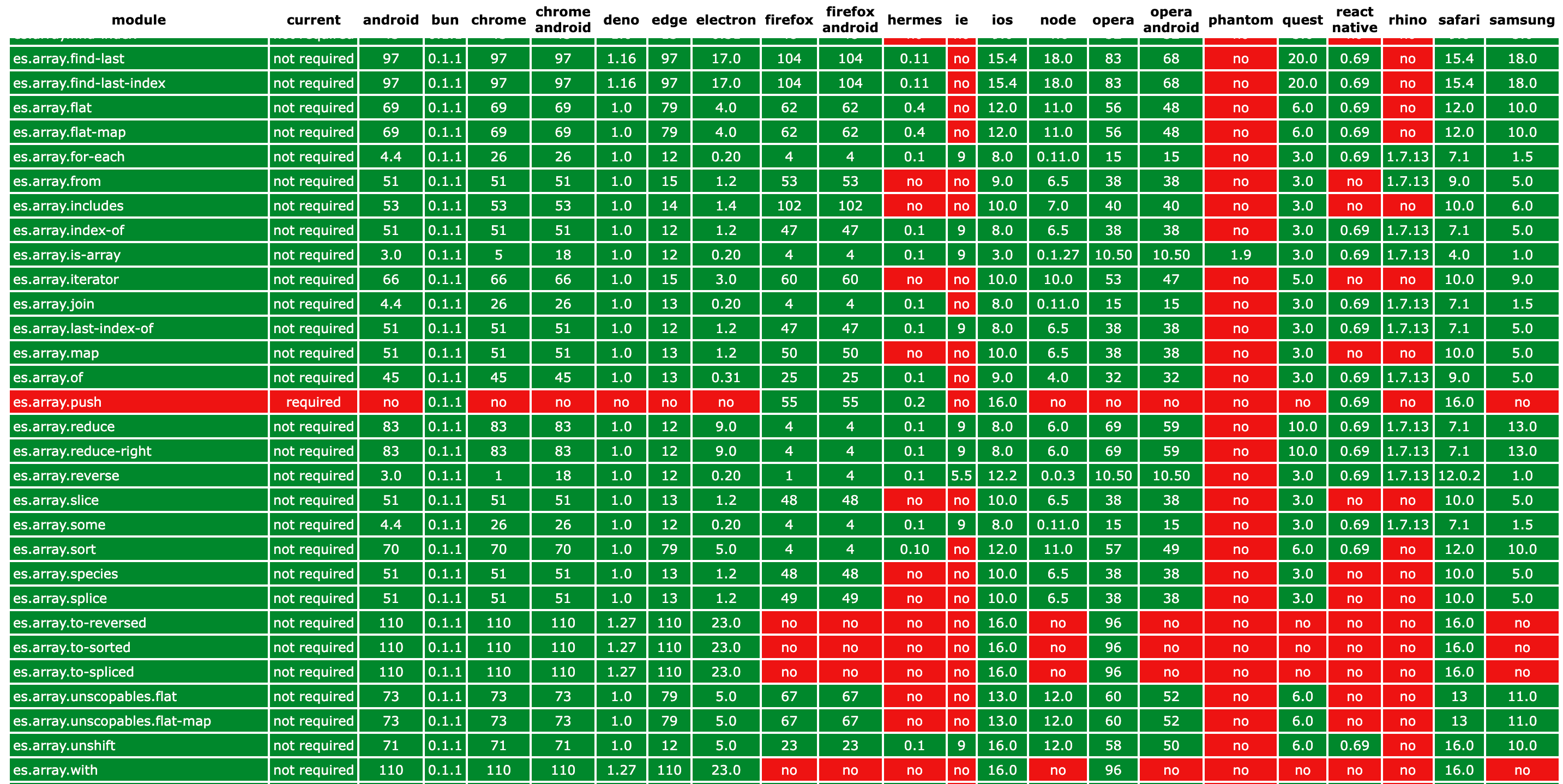
The core-js project provides (as the core-js-compat package) all required data about the necessity of core-js modules, entry points, and tools to work with it - it's useful for integration with tools like babel or swc. If you want to help, you could take a look at the related section of CONTRIBUTING.md. The visualization of compatibility data and the browser tests runner is available here, the example:
Features:⬆
CommonJS entry points:
core-js(-pure)
ECMAScript⬆
CommonJS entry points:
core-js(-pure)/es
ECMAScript: Object⬆
Modules es.object.assign, es.object.create, es.object.define-getter, es.object.define-property, es.object.define-properties, es.object.define-setter, es.object.entries, es.object.freeze, es.object.from-entries, es.object.get-own-property-descriptor, es.object.get-own-property-descriptors, es.object.get-own-property-names, es.object.get-prototype-of, es.object.group-by, es.object.has-own, es.object.is, es.object.is-extensible, es.object.is-frozen, es.object.is-sealed, es.object.keys, es.object.lookup-setter, es.object.lookup-getter, es.object.prevent-extensions, es.object.proto, es.object.to-string, es.object.seal, es.object.set-prototype-of, es.object.values.
class Object {
  toString(): string; // ES2015+ fix: @@toStringTag support
  __defineGetter__(property: PropertyKey, getter: Function): void;
  __defineSetter__(property: PropertyKey, setter: Function): void;
  __lookupGetter__(property: PropertyKey): Function | void;
  __lookupSetter__(property: PropertyKey): Function | void;
  __proto__: Object | null; // requires a way to set the prototype - does not work in IE10-, it's for modern engines like Deno
  static assign(target: Object, ...sources: Array<Object>): Object;
  static create(prototype: Object | null, properties?: { [property: PropertyKey]: PropertyDescriptor }): Object;
  static defineProperties(object: Object, properties: { [property: PropertyKey]: PropertyDescriptor }): Object;
  static defineProperty(object: Object, property: PropertyKey, attributes: PropertyDescriptor): Object;
  static entries(object: Object): Array<[string, mixed]>;
  static freeze(object: any): any;
  static fromEntries(iterable: Iterable<[key, value]>): Object;
  static getOwnPropertyDescriptor(object: any, property: PropertyKey): PropertyDescriptor | void;
  static getOwnPropertyDescriptors(object: any): { [property: PropertyKey]: PropertyDescriptor };
  static getOwnPropertyNames(object: any): Array<string>;
  static getPrototypeOf(object: any): Object | null;
  static groupBy(items: Iterable, callbackfn: (value: any, index: number) => key): { [key]: Array<mixed> };
  static hasOwn(object: object, key: PropertyKey): boolean;
  static is(value1: any, value2: any): boolean;
  static isExtensible(object: any): boolean;
  static isFrozen(object: any): boolean;
  static isSealed(object: any): boolean;
  static keys(object: any): Array<string>;
  static preventExtensions(object: any): any;
  static seal(object: any): any;
  static setPrototypeOf(target: any, prototype: Object | null): any; // requires __proto__ - IE11+
  static values(object: any): Array<mixed>;
}
CommonJS entry points:
core-js(-pure)/es|stable|actual|full/object
core-js(-pure)/es|stable|actual|full/object/assign
core-js(-pure)/es|stable|actual|full/object/is
core-js(-pure)/es|stable|actual|full/object/set-prototype-of
core-js(-pure)/es|stable|actual|full/object/get-prototype-of
core-js(-pure)/es|stable|actual|full/object/create
core-js(-pure)/es|stable|actual|full/object/define-property
core-js(-pure)/es|stable|actual|full/object/define-properties
core-js(-pure)/es|stable|actual|full/object/get-own-property-descriptor
core-js(-pure)/es|stable|actual|full/object/get-own-property-descriptors
core-js(-pure)/es|stable|actual|full/object/group-by
core-js(-pure)/es|stable|actual|full/object/has-own
core-js(-pure)/es|stable|actual|full/object/keys
core-js(-pure)/es|stable|actual|full/object/values
core-js(-pure)/es|stable|actual|full/object/entries
core-js(-pure)/es|stable|actual|full/object/get-own-property-names
core-js(-pure)/es|stable|actual|full/object/freeze
core-js(-pure)/es|stable|actual|full/object/from-entries
core-js(-pure)/es|stable|actual|full/object/seal
core-js(-pure)/es|stable|actual|full/object/prevent-extensions
core-js/es|stable|actual|full/object/proto
core-js(-pure)/es|stable|actual|full/object/is-frozen
core-js(-pure)/es|stable|actual|full/object/is-sealed
core-js(-pure)/es|stable|actual|full/object/is-extensible
core-js/es|stable|actual|full/object/to-string
core-js(-pure)/es|stable|actual|full/object/define-getter
core-js(-pure)/es|stable|actual|full/object/define-setter
core-js(-pure)/es|stable|actual|full/object/lookup-getter
core-js(-pure)/es|stable|actual|full/object/lookup-setter
Examples:
let foo = { q: 1, w: 2 };
let bar = { e: 3, r: 4 };
let baz = { t: 5, y: 6 };
Object.assign(foo, bar, baz); // => foo = { q: 1, w: 2, e: 3, r: 4, t: 5, y: 6 }

Object.is(NaN, NaN); // => true
Object.is(0, -0);    // => false
Object.is(42, 42);   // => true
Object.is(42, '42'); // => false

function Parent() { /* empty */ }
function Child() { /* empty */ }
Object.setPrototypeOf(Child.prototype, Parent.prototype);
new Child() instanceof Child;  // => true
new Child() instanceof Parent; // => true

({
  [Symbol.toStringTag]: 'Foo',
}).toString(); // => '[object Foo]'

Object.keys('qwe'); // => ['0', '1', '2']
Object.getPrototypeOf('qwe') === String.prototype; // => true

Object.values({ a: 1, b: 2, c: 3 });  // => [1, 2, 3]
Object.entries({ a: 1, b: 2, c: 3 }); // => [['a', 1], ['b', 2], ['c', 3]]

for (let [key, value] of Object.entries({ a: 1, b: 2, c: 3 })) {
  console.log(key);   // -> 'a', 'b', 'c'
  console.log(value); // -> 1, 2, 3
}

// Shallow object cloning with prototype and descriptors:
let copy = Object.create(Object.getPrototypeOf(object), Object.getOwnPropertyDescriptors(object));
// Mixin:
Object.defineProperties(target, Object.getOwnPropertyDescriptors(source));

const map = new Map([['a', 1], ['b', 2]]);
Object.fromEntries(map); // => { a: 1, b: 2 }

class Unit {
  constructor(id) {
    this.id = id;
  }
  toString() {
    return `unit${ this.id }`;
  }
}

const units = new Set([new Unit(101), new Unit(102)]);

Object.fromEntries(units.entries()); // => { unit101: Unit { id: 101 }, unit102: Unit { id: 102 } }

Object.hasOwn({ foo: 42 }, 'foo'); // => true
Object.hasOwn({ foo: 42 }, 'bar'); // => false
Object.hasOwn({}, 'toString');     // => false

Object.groupBy([1, 2, 3, 4, 5], it => it % 2); // => { 1: [1, 3, 5], 0: [2, 4] }
ECMAScript: Function⬆
Modules es.function.name, es.function.has-instance. Just ES5: es.function.bind.
class Function {
  name: string;
  bind(thisArg: any, ...args: Array<mixed>): Function;
  @@hasInstance(value: any): boolean;
}
CommonJS entry points:
core-js/es|stable|actual|full/function
core-js(-pure)/es|stable|actual|full/function/virtual
core-js/es|stable|actual|full/function/name
core-js/es|stable|actual|full/function/has-instance
core-js(-pure)/es|stable|actual|full/function/bind
core-js(-pure)/es|stable|actual|full/function/virtual/bind
Examples:
(function foo() { /* empty */ }).name; // => 'foo'

console.log.bind(console, 42)(43); // -> 42 43
ECMAScript: Error⬆
Modules es.aggregate-error, es.aggregate-error.cause, es.error.cause, es.error.is-error, es.suppressed-error.constructor, es.error.to-string.
class Error {
  static isError(value: any): boolean;
  constructor(message?: string, { cause: any }?): %Error%;
  toString(): string; // different fixes
}

class [
  EvalError,
  RangeError,
  ReferenceError,
  SyntaxError,
  TypeError,
  URIError,
  WebAssembly.CompileError,
  WebAssembly.LinkError,
  WebAssembly.RuntimeError,
] extends Error {
  constructor(message?: string, { cause: any }?): %Error%;
}

class AggregateError extends Error {
  constructor(errors: Iterable, message?: string, { cause: any }?): AggregateError;
  errors: Array<any>;
  message: string;
  cause: any;
}

class SuppressedError extends Error {
  constructor(error: any, suppressed: any, message?: string): SuppressedError;
  error: any;
  suppressed: any;
  message: string;
}
CommonJS entry points:
core-js/es|stable|actual|full/error
core-js/es|stable|actual|full/error/constructor
core-js(-pure)/es|stable|actual|full/error/is-error
core-js/es|stable|actual|full/error/to-string
core-js(-pure)/es|stable|actual|full/aggregate-error
core-js(-pure)/es|stable|actual|full/suppressed-error
Examples:
const error1 = new TypeError('Error 1');
const error2 = new TypeError('Error 2');
const aggregate = new AggregateError([error1, error2], 'Collected errors');
aggregate.errors[0] === error1; // => true
aggregate.errors[1] === error2; // => true

const cause = new TypeError('Something wrong');
const error = new TypeError('Here is what went wrong', { cause });
error.cause === cause; // => true

Error.prototype.toString.call({ message: 1, name: 2 }) === '2: 1'; // => true
Examples:
Error.isError(new Error('error')); // => true
Error.isError(new TypeError('error')); // => true
Error.isError(new DOMException('error')); // => true

Error.isError(null); // => false
Error.isError({}); // => false
Error.isError(Object.create(Error.prototype)); // => false
[!WARNING] We have no bulletproof way to polyfill this
Error.isError/ check if the object is an error, so it's a rather naive implementation.
ECMAScript: Array⬆
Modules es.array.from, es.array.from-async, es.array.is-array, es.array.of, es.array.species, es.array.concat, es.array.copy-within, es.array.fill, es.array.find, es.array.find-index, es.array.find-last, es.array.find-last-index, es.array.iterator, es.array.includes, es.array.push, es.array.slice, es.array.splice, es.array.join, es.array.unshift, es.array.index-of, es.array.last-index-of, es.array.every, es.array.some, es.array.for-each, es.array.map, es.array.filter, es.array.reduce, es.array.reduce-right, es.array.reverse, es.array.sort, es.array.flat, es.array.flat-map, es.array.unscopables.flat, es.array.unscopables.flat-map, es.array.at, es.array.to-reversed, es.array.to-sorted, es.array.to-spliced, es.array.with.
class Array {
  at(index: int): any;
  concat(...args: Array<mixed>): Array<mixed>; // with added support for @@isConcatSpreadable and @@species
  copyWithin(target: number, start: number, end?: number): this;
  entries(): Iterator<[index, value]>;
  every(callbackfn: (value: any, index: number, target: any) => boolean, thisArg?: any): boolean;
  fill(value: any, start?: number, end?: number): this;
  filter(callbackfn: (value: any, index: number, target: any) => boolean, thisArg?: any): Array<mixed>; // with added support for @@species
  find(callbackfn: (value: any, index: number, target: any) => boolean, thisArg?: any): any;
  findIndex(callbackfn: (value: any, index: number, target: any) => boolean, thisArg?: any): number;
  findLast(callbackfn: (value: any, index: number, target: any) => boolean, thisArg?: any): any;
  findLastIndex(callbackfn: (value: any, index: number, target: any) => boolean, thisArg?: any): number;
  flat(depthArg?: number = 1): Array<mixed>;
  flatMap(mapFn: (value: any, index: number, target: any) => any, thisArg?: any): Array<mixed>;
  forEach(callbackfn: (value: any, index: number, target: any) => void, thisArg?: any): void;
  includes(searchElement: any, from?: number): boolean;
  indexOf(searchElement: any, from?: number): number;
  join(separator: string = ','): string;
  keys(): Iterator<index>;
  lastIndexOf(searchElement: any, from?: number): number;
  map(mapFn: (value: any, index: number, target: any) => any, thisArg?: any): Array<mixed>; // with added support for @@species
  push(...args: Array<mixed>): uint;
  reduce(callbackfn: (memo: any, value: any, index: number, target: any) => any, initialValue?: any): any;
  reduceRight(callbackfn: (memo: any, value: any, index: number, target: any) => any, initialValue?: any): any;
  reverse(): this; // Safari 12.0 bug fix
  slice(start?: number, end?: number): Array<mixed>; // with added support for @@species
  splice(start?: number, deleteCount?: number, ...items: Array<mixed>): Array<mixed>; // with added support for @@species
  some(callbackfn: (value: any, index: number, target: any) => boolean, thisArg?: any): boolean;
  sort(comparefn?: (a: any, b: any) => number): this; // with modern behavior like stable sort
  toReversed(): Array<mixed>;
  toSpliced(start?: number, deleteCount?: number, ...items: Array<mixed>): Array<mixed>;
  toSorted(comparefn?: (a: any, b: any) => number): Array<mixed>;
  unshift(...args: Array<mixed>): uint;
  values(): Iterator<value>;
  with(index: int, value: any): Array<mixed>;
  @@iterator(): Iterator<value>;
  @@unscopables: { [newMethodNames: string]: true };
  static from(items: Iterable | ArrayLike, mapFn?: (value: any, index: number) => any, thisArg?: any): Array<mixed>;
  static fromAsync(asyncItems: AsyncIterable | Iterable | ArrayLike, mapFn?: (value: any, index: number) => any, thisArg?: any): Promise<Array<mixed>>;
  static isArray(value: any): boolean;
  static of(...args: Array<mixed>): Array<mixed>;
  static readonly attribute @@species: this;
}

class Arguments {
  @@iterator(): Iterator<value>; // available only in core-js methods
}
CommonJS entry points:
core-js(-pure)/es|stable|actual|full/array
core-js(-pure)/es|stable|actual|full/array/virtual
core-js(-pure)/es|stable|actual|full/array/from
core-js(-pure)/es|stable|actual|full/array/from-async
core-js(-pure)/es|stable|actual|full/array/of
core-js(-pure)/es|stable|actual|full/array/is-array
core-js(-pure)/es|stable|actual|full/array(/virtual)/at
core-js(-pure)/es|stable|actual|full/array(/virtual)/concat
core-js(-pure)/es|stable|actual|full/array(/virtual)/copy-within
core-js(-pure)/es|stable|actual|full/array(/virtual)/entries
core-js(-pure)/es|stable|actual|full/array(/virtual)/every
core-js(-pure)/es|stable|actual|full/array(/virtual)/fill
core-js(-pure)/es|stable|actual|full/array(/virtual)/filter
core-js(-pure)/es|stable|actual|full/array(/virtual)/find
core-js(-pure)/es|stable|actual|full/array(/virtual)/find-index
core-js(-pure)/es|stable|actual|full/array(/virtual)/find-last
core-js(-pure)/es|stable|actual|full/array(/virtual)/find-last-index
core-js(-pure)/es|stable|actual|full/array(/virtual)/flat
core-js(-pure)/es|stable|actual|full/array(/virtual)/flat-map
core-js(-pure)/es|stable|actual|full/array(/virtual)/for-each
core-js(-pure)/es|stable|actual|full/array(/virtual)/includes
core-js(-pure)/es|stable|actual|full/array(/virtual)/index-of
core-js(-pure)/es|stable|actual|full/array(/virtual)/iterator
core-js(-pure)/es|stable|actual|full/array(/virtual)/join
core-js(-pure)/es|stable|actual|full/array(/virtual)/keys
core-js(-pure)/es|stable|actual|full/array(/virtual)/last-index-of
core-js(-pure)/es|stable|actual|full/array(/virtual)/map
core-js(-pure)/es|stable|actual|full/array(/virtual)/push
core-js(-pure)/es|stable|actual|full/array(/virtual)/reduce
core-js(-pure)/es|stable|actual|full/array(/virtual)/reduce-right
core-js(-pure)/es|stable|actual|full/array(/virtual)/reverse
core-js(-pure)/es|stable|actual|full/array(/virtual)/slice
core-js(-pure)/es|stable|actual|full/array(/virtual)/some
core-js(-pure)/es|stable|actual|full/array(/virtual)/sort
core-js(-pure)/es|stable|actual|full/array(/virtual)/splice
core-js(-pure)/es|stable|actual|full/array(/virtual)/to-reversed
core-js(-pure)/es|stable|actual|full/array(/virtual)/to-sorted
core-js(-pure)/es|stable|actual|full/array(/virtual)/to-spliced
core-js(-pure)/es|stable|actual|full/array(/virtual)/unshift
core-js(-pure)/es|stable|actual|full/array(/virtual)/values
core-js(-pure)/es|stable|actual|full/array(/virtual)/with
Examples:
Array.from(new Set([1, 2, 3, 2, 1]));        // => [1, 2, 3]
Array.from({ 0: 1, 1: 2, 2: 3, length: 3 }); // => [1, 2, 3]
Array.from('123', Number);                   // => [1, 2, 3]
Array.from('123', it => it ** 2);            // => [1, 4, 9]

Array.of(1);       // => [1]
Array.of(1, 2, 3); // => [1, 2, 3]

let array = ['a', 'b', 'c'];

for (let value of array) console.log(value);          // -> 'a', 'b', 'c'
for (let value of array.values()) console.log(value); // -> 'a', 'b', 'c'
for (let key of array.keys()) console.log(key);       // -> 0, 1, 2
for (let [key, value] of array.entries()) {
  console.log(key);                                   // -> 0, 1, 2
  console.log(value);                                 // -> 'a', 'b', 'c'
}

function isOdd(value) {
  return value % 2;
}
[4, 8, 15, 16, 23, 42].find(isOdd);      // => 15
[4, 8, 15, 16, 23, 42].findIndex(isOdd); // => 2
[1, 2, 3, 4].findLast(isOdd);            // => 3
[1, 2, 3, 4].findLastIndex(isOdd);       // => 2

Array(5).fill(42); // => [42, 42, 42, 42, 42]

[1, 2, 3, 4, 5].copyWithin(0, 3); // => [4, 5, 3, 4, 5]

[1, 2, 3].includes(2);        // => true
[1, 2, 3].includes(4);        // => false
[1, 2, 3].includes(2, 2);     // => false

[NaN].indexOf(NaN);           // => -1
[NaN].includes(NaN);          // => true
Array(1).indexOf(undefined);  // => -1
Array(1).includes(undefined); // => true

[1, [2, 3], [4, 5]].flat();    // => [1, 2, 3, 4, 5]
[1, [2, [3, [4]]], 5].flat();  // => [1, 2, [3, [4]], 5]
[1, [2, [3, [4]]], 5].flat(3); // => [1, 2, 3, 4, 5]

[{ a: 1, b: 2 }, { a: 3, b: 4 }, { a: 5, b: 6 }].flatMap(it => [it.a, it.b]); // => [1, 2, 3, 4, 5, 6]

[1, 2, 3].at(1);  // => 2
[1, 2, 3].at(-1); // => 3

const sequence = [1, 2, 3];
sequence.toReversed(); // => [3, 2, 1]
sequence; // => [1, 2, 3]

const initialArray = [1, 2, 3, 4];
initialArray.toSpliced(1, 2, 5, 6, 7); // => [1, 5, 6, 7, 4]
initialArray; // => [1, 2, 3, 4]

const outOfOrder = [3, 1, 2];
outOfOrder.toSorted(); // => [1, 2, 3]
outOfOrder; // => [3, 1, 2]

const correctionNeeded = [1, 1, 3];
correctionNeeded.with(1, 2); // => [1, 2, 3]
correctionNeeded; // => [1, 1, 3]
Array.fromAsync example:
await Array.fromAsync((async function * () { yield * [1, 2, 3]; })(), i => i ** 2); // => [1, 4, 9]
ECMAScript: Iterator⬆
Modules es.iterator.constructor, es.iterator.chunks, es.iterator.concat, es.iterator.dispose, es.iterator.drop, es.iterator.every, es.iterator.filter, es.iterator.find, es.iterator.flat-map, es.iterator.for-each, es.iterator.from, es.iterator.includes, es.iterator.join, es.iterator.map, es.iterator.reduce, es.iterator.some, es.iterator.take, es.iterator.to-array, es.iterator.windows, es.iterator.zip, es.iterator.zip-keyed.
class Iterator {
  static concat(...items: Array<IterableObject>): Iterator<any>;
  static from(iterable: Iterable<any> | Iterator<any>): Iterator<any>;
  static zip<T extends readonly Iterable<unknown>[]>(
    iterables: T,
    options?: {
      mode?: 'shortest' | 'longest' | 'strict';
      padding?: { [K in keyof T]?: T[K] extends Iterable<infer U> ? U : never };
    }
  ): Iterator<{ [K in keyof T]: T[K] extends Iterable<infer U> ? U : never }>;
  static zipKeyed<K extends PropertyKey, V extends Record<K, Iterable<unknown>>>(
    iterables: V,
    options?: {
      mode?: 'shortest' | 'longest' | 'strict';
      padding?: { [P in keyof V]?: V[P] extends Iterable<infer U> ? U : never };
    }
  ): Iterator<{ [P in keyof V]: V[P] extends Iterable<infer U> ? U : never }>;
  chunks(chunkSize: number): Iterator<any>;
  drop(limit: uint): Iterator<any>;
  every(callbackfn: (value: any, counter: uint) => boolean): boolean;
  filter(callbackfn: (value: any, counter: uint) => boolean): Iterator<any>;
  find(callbackfn: (value: any, counter: uint) => boolean): any;
  flatMap(callbackfn: (value: any, counter: uint) => Iterable<any> | Iterator<any>): Iterator<any>;
  forEach(callbackfn: (value: any, counter: uint) => void): void;
  includes(searchElement: any, skippedElements?: number): boolean;
  join(separator?: string): string;
  map(callbackfn: (value: any, counter: uint) => any): Iterator<any>;
  reduce(callbackfn: (memo: any, value: any, counter: uint) => any, initialValue?: any): any;
  some(callbackfn: (value: any, counter: uint) => boolean): boolean;
  take(limit: uint): Iterator<any>;
  toArray(): Array<any>;
  windows(windowSize: number, undersized?: 'only-full' | 'allow-partial' | undefined): Iterator<any>;
  @@dispose(): undefined;
  @@toStringTag: 'Iterator';
}
CommonJS entry points:
core-js(-pure)/es|stable|actual|full/iterator
core-js(-pure)/es|stable|actual|full/iterator/chunks
core-js(-pure)/es|stable|actual|full/iterator/concat
core-js(-pure)/es|stable|actual|full/iterator/dispose
core-js(-pure)/es|stable|actual|full/iterator/drop
core-js(-pure)/es|stable|actual|full/iterator/every
core-js(-pure)/es|stable|actual|full/iterator/filter
core-js(-pure)/es|stable|actual|full/iterator/find
core-js(-pure)/es|stable|actual|full/iterator/flat-map
core-js(-pure)/es|stable|actual|full/iterator/for-each
core-js(-pure)/es|stable|actual|full/iterator/from
core-js(-pure)/es|stable|actual|full/iterator/includes
core-js(-pure)/es|stable|actual|full/iterator/join
core-js(-pure)/es|stable|actual|full/iterator/map
core-js(-pure)/es|stable|actual|full/iterator/reduce
core-js(-pure)/es|stable|actual|full/iterator/some
core-js(-pure)/es|stable|actual|full/iterator/take
core-js(-pure)/es|stable|actual|full/iterator/to-array
core-js(-pure)/es|stable|actual|full/iterator/windows
core-js(-pure)/es|stable|actual|full/iterator/zip
core-js(-pure)/es|stable|actual|full/iterator/zip-keyed
Examples:
[1, 2, 3, 4, 5, 6, 7].values()
  .drop(1)
  .take(5)
  .filter(it => it % 2)
  .map(it => it ** 2)
  .toArray(); // => [9, 25]

Iterator.from({
  next: () => ({ done: Math.random() > 0.9, value: Math.random() * 10 | 0 }),
}).toArray(); // => [7, 6, 3, 0, 2, 8]

Iterator.concat([0, 1].values(), [2, 3], function * () {
  yield 4;
  yield 5;
}()).toArray(); // => [0, 1, 2, 3, 4, 5]

Iterator.zip([
  [0, 1, 2],
  [3, 4, 5],
]).toArray();  // => [[0, 3], [1, 4], [2, 5]]

Iterator.zipKeyed({
  a: [0, 1, 2],
  b: [3, 4, 5, 6],
  c: [7, 8, 9],
}, {
  mode: 'longest',
  padding: { c: 10 },
}).toArray(); // =>
/*
[
  { a: 0,         b: 3, c: 7  },
  { a: 1,         b: 4, c: 8  },
  { a: 2,         b: 5, c: 9  },
  { a: undefined, b: 6, c: 10 },
];
 */

const digits = () => [0, 1, 2, 3, 4, 5, 6, 7, 8, 9].values();

Array.from(digits().chunks(2));  // => [[0, 1], [2, 3], [4, 5], [6, 7], [8, 9]]

Array.from(digits().windows(2));  // => [[0, 1], [1, 2], [2, 3], [3, 4], [4, 5], [5, 6], [6, 7], [7, 8], [8, 9]]

Array.from([0, 1].values().windows(3, 'allow-partial'));  // => [[0, 1]]

Array.from([0, 1].values().windows(3));  // => []

[1, 2, 3].values().includes(2);     // => true
[1, 2, 3].values().includes(4);     // => false
[NaN].values().includes(NaN);       // => true
[1, 2, 3].values().includes(3, 2);  // => true
[1, 2, 3].values().includes(1, 1);  // => false

[1, 2, 3].values().join();     // => '1,2,3'
[1, 2, 3].values().join('-');  // => '1-2-3'
[1, null, 3].values().join();  // => '1,,3'
[!WARNING]
- To prevent prototype pollution, in the
pureversion, new%IteratorPrototype%methods are not added to the real%IteratorPrototype%, they are available only on wrappers - instead of[].values().map(fn)useIterator.from([]).map(fn).
ECMAScript: String and RegExp⬆
The main part of String features: modules es.string.from-code-point, es.string.raw, es.string.iterator, es.string.split, es.string.code-point-at, es.string.ends-with, es.string.includes, es.string.repeat, es.string.pad-start, es.string.pad-end, es.string.starts-with, es.string.trim, es.string.trim-start, es.string.trim-end, es.string.match-all, es.string.replace-all, es.string.at-alternative, es.string.is-well-formed, es.string.to-well-formed.
Added support for well-known symbols @@match, @@replace, @@search and @@split and direct .exec calls to the related String methods, modules es.string.match, es.string.replace, es.string.search and es.string.split.
Annex B methods. Modules es.string.anchor, es.string.big, es.string.blink, es.string.bold, es.string.fixed, es.string.fontcolor, es.string.fontsize, es.string.italics, es.string.link, es.string.small, es.string.strike, es.string.sub, es.string.sup, es.string.substr, es.escape and es.unescape.
RegExp features: modules es.regexp.constructor, es.regexp.escape, es.regexp.exec, es.regexp.dot-all, es.regexp.flags, es.regexp.sticky, es.regexp.test and es.regexp.to-string.
class String {
  static fromCodePoint(...codePoints: Array<number>): string;
  static raw({ raw: Array<string> }, ...substitutions: Array<string>): string;
  at(index: int): string | void;
  includes(searchString: string, position?: number): boolean;
  startsWith(searchString: string, position?: number): boolean;
  endsWith(searchString: string, position?: number): boolean;
  repeat(count: number): string;
  padStart(length: number, fillStr?: string = ' '): string;
  padEnd(length: number, fillStr?: string = ' '): string;
  codePointAt(pos: number): number | void;
  match(template: any): any; // ES2015+ fix for @@match support
  matchAll(regexp: RegExp): Iterator;
  replace(template: any, replacer: any): any; // ES2015+ fix for @@replace support
  replaceAll(searchValue: string | RegExp, replaceString: string | (searchValue, index, this) => string): string;
  search(template: any): any; // ES2015+ fix for @@search support
  split(template: any, limit?: int): Array<string>; // ES2015+ fix for @@split support, some fixes for old engines
  trim(): string;
  trimLeft(): string;
  trimRight(): string;
  trimStart(): string;
  trimEnd(): string;
  isWellFormed(): boolean;
  toWellFormed(): string;
  anchor(name: string): string;
  big(): string;
  blink(): string;
  bold(): string;
  fixed(): string;
  fontcolor(color: string): string;
  fontsize(size: any): string;
  italics(): string;
  link(url: string): string;
  small(): string;
  strike(): string;
  sub(): string;
  substr(start: int, length?: int): string;
  sup(): string;
  @@iterator(): Iterator<characters>;
}

class RegExp {
  // support for sticky (`y`) flag, dotAll (`s`) flag, named capture groups, can alter flags
  constructor(pattern: RegExp | string, flags?: string): RegExp;
  static escape(value: string): string;
  exec(string: string): Array<string | undefined> | null; // IE8 fixes
  test(string: string): boolean; // delegation to `.exec`
  toString(): string; // ES2015+ fix - generic
  @@match(string: string): Array | null;
  @@matchAll(string: string): Iterator;
  @@replace(string: string, replaceValue: Function | string): string;
  @@search(string: string): number;
  @@split(string: string, limit?: number): Array<string>;
  readonly attribute dotAll: boolean; // IE9+
  readonly attribute flags: string;   // IE9+
  readonly attribute sticky: boolean; // IE9+
}

function escape(string: string): string;
function unescape(string: string): string;
CommonJS entry points:
core-js(-pure)/es|stable|actual|full/string
core-js(-pure)/es|stable|actual|full/string/virtual
core-js(-pure)/es|stable|actual|full/string/from-code-point
core-js(-pure)/es|stable|actual|full/string/raw
core-js/es|stable|actual|full/string/match
core-js/es|stable|actual|full/string/replace
core-js/es|stable|actual|full/string/search
core-js/es|stable|actual|full/string/split
core-js(-pure)/es|stable|actual/string(/virtual)/at
core-js(-pure)/es|stable|actual|full/string(/virtual)/code-point-at
core-js(-pure)/es|stable|actual|full/string(/virtual)/ends-with
core-js(-pure)/es|stable|actual|full/string(/virtual)/includes
core-js(-pure)/es|stable|actual|full/string(/virtual)/starts-with
core-js(-pure)/es|stable|actual|full/string(/virtual)/match-all
core-js(-pure)/es|stable|actual|full/string(/virtual)/pad-start
core-js(-pure)/es|stable|actual|full/string(/virtual)/pad-end
core-js(-pure)/es|stable|actual|full/string(/virtual)/repeat
core-js(-pure)/es|stable|actual|full/string(/virtual)/replace-all
core-js(-pure)/es|stable|actual|full/string(/virtual)/trim
core-js(-pure)/es|stable|actual|full/string(/virtual)/trim-start
core-js(-pure)/es|stable|actual|full/string(/virtual)/trim-end
core-js(-pure)/es|stable|actual|full/string(/virtual)/trim-left
core-js(-pure)/es|stable|actual|full/string(/virtual)/trim-right
core-js(-pure)/es|stable|actual|full/string(/virtual)/is-well-formed
core-js(-pure)/es|stable|actual|full/string(/virtual)/to-well-formed
core-js(-pure)/es|stable|actual|full/string(/virtual)/anchor
core-js(-pure)/es|stable|actual|full/string(/virtual)/big
core-js(-pure)/es|stable|actual|full/string(/virtual)/blink
core-js(-pure)/es|stable|actual|full/string(/virtual)/bold
core-js(-pure)/es|stable|actual|full/string(/virtual)/fixed
core-js(-pure)/es|stable|actual|full/string(/virtual)/fontcolor
core-js(-pure)/es|stable|actual|full/string(/virtual)/fontsize
core-js(-pure)/es|stable|actual|full/string(/virtual)/italics
core-js(-pure)/es|stable|actual|full/string(/virtual)/link
core-js(-pure)/es|stable|actual|full/string(/virtual)/small
core-js(-pure)/es|stable|actual|full/string(/virtual)/strike
core-js(-pure)/es|stable|actual|full/string(/virtual)/sub
core-js(-pure)/es|stable|actual|full/string(/virtual)/substr
core-js(-pure)/es|stable|actual|full/string(/virtual)/sup
core-js(-pure)/es|stable|actual|full/string(/virtual)/iterator
core-js/es|stable|actual|full/regexp
core-js/es|stable|actual|full/regexp/constructor
core-js(-pure)/es|stable|actual|full/regexp/escape
core-js/es|stable|actual|full/regexp/dot-all
core-js(-pure)/es|stable|actual|full/regexp/flags
core-js/es|stable|actual|full/regexp/match
core-js/es|stable|actual|full/regexp/replace
core-js/es|stable|actual|full/regexp/search
core-js/es|stable|actual|full/regexp/split
core-js/es|stable|actual|full/regexp/sticky
core-js/es|stable|actual|full/regexp/test
core-js/es|stable|actual|full/regexp/to-string
core-js/es|stable|actual|full/escape
core-js/es|stable|actual|full/unescape
Examples:
for (let value of 'a𠮷b') {
console.log(value); // -> 'a', '𠮷', 'b'
}
'foobarbaz'.includes('bar'); // => true
'foobarbaz'.includes('bar', 4); // => false
'foobarbaz'.startsWith('foo'); // => true
'foobarbaz'.startsWith('bar', 3); // => true
'foobarbaz'.endsWith('baz'); // => true
'foobarbaz'.endsWith('bar', 6); // => true
'string'.repeat(3); // => 'stringstringstring'
'hello'.padStart(10); // => ' hello'
'hello'.padStart(10, '1234'); // => '12341hello'
'hello'.padEnd(10); // => 'hello '
'hello'.padEnd(10, '1234'); // => 'hello12341'
'𠮷'.codePointAt(0); // => 134071
String.fromCodePoint(97, 134071, 98); // => 'a𠮷b'
let name = 'Bob';
String.raw`Hi\n${ name }!`; // => 'Hi\\nBob!' (ES2015 template string syntax)
String.raw({ raw: 'test' }, 0, 1, 2); // => 't0e1s2t'
'foo'.bold(); // => '<b>foo</b>'
'bar'.anchor('a"b'); // => '<a name="a"b">bar</a>'
'baz'.link('https://example.com'); // => '<a href="https://example.com">baz</a>'
RegExp('.', 's').test('\n'); // => true
RegExp('.', 's').dotAll; // => true
RegExp('foo:(?<foo>\\w+),bar:(?<bar>\\w+)').exec('foo:abc,bar:def').groups; // => { foo: 'abc', bar: 'def' }
'foo:abc,bar:def'.replace(RegExp('foo:(?<foo>\\w+),bar:(?<bar>\\w+)'), '$<bar>,$<foo>'); // => 'def,abc'
RegExp(/./g, 'm'); // => /./m
/foo/.flags; // => ''
/foo/gi.flags; // => 'gi'
RegExp('foo', 'y').sticky; // => true
const text = 'First line\nSecond line';
const regex = RegExp('(?<index>\\S+) line\\n?', 'y');
regex.exec(text).groups.index; // => 'First'
regex.exec(text).groups.index; // => 'Second'
regex.exec(text); // => null
'foo'.match({ [Symbol.match]: () => 1 }); // => 1
'foo'.replace({ [Symbol.replace]: () => 2 }); // => 2
'foo'.search({ [Symbol.search]: () => 3 }); // => 3
'foo'.split({ [Symbol.split]: () => 4 }); // => 4
RegExp.prototype.toString.call({ source: 'foo', flags: 'bar' }); // => '/foo/bar'
' hello '.trimLeft(); // => 'hello '
' hello '.trimRight(); // => ' hello'
' hello '.trimStart(); // => 'hello '
' hello '.trimEnd(); // => ' hello'
for (let { groups: { number, letter } } of '1111a2b3cccc'.matchAll(RegExp('(?<number>\\d)(?<letter>\\D)', 'g'))) {
console.log(number, letter); // -> 1 a, 2 b, 3 c
}
'Test abc test test abc test.'.replaceAll('abc', 'foo'); // => 'Test foo test test foo test.'
'abc'.at(1); // => 'b'
'abc'.at(-1); // => 'c'
'a💩b'.isWellFormed(); // => true
'a\uD83Db'.isWellFormed(); // => false
'a💩b'.toWellFormed(); // => 'a💩b'
'a\uD83Db'.toWellFormed(); // => 'a�b'
Examples:
RegExp.escape('10$'); // => '\\x310\\$'
RegExp.escape('abcdefg_123456'); // => '\\x61bcdefg_123456'
RegExp.escape('Привет'); // => 'Привет'
RegExp.escape('(){}[]|,.?*+-^$=<>\\/#&!%:;@~\'"`');
// => '\\(\\)\\{\\}\\[\\]\\|\\x2c\\.\\?\\*\\+\\x2d\\^\\$\\x3d\\x3c\\x3e\\\\\\/\\x23\\x26\\x21\\x25\\x3a\\x3b\\x40\\x7e\\x27\\x22\\x60'
RegExp.escape('\u0009\u000A\u000B\u000C\u000D\u0020\u00A0\u1680\u2000\u2001\u2002\u2003\u2004\u2005\u2006\u2007\u2008\u2009\u200A\u202F\u205F\u3000\u2028\u2029\uFEFF');
// => '\\t\\n\\v\\f\\r\\x20\\xa0\\u1680\\u2000\\u2001\\u2002\\u2003\\u2004\\u2005\\u2006\\u2007\\u2008\\u2009\\u200a\\u202f\\u205f\\u3000\\u2028\\u2029\\ufeff'
RegExp.escape('💩'); // => '💩'
RegExp.escape('\uD83D'); // => '\\ud83d'
ECMAScript: Number⬆
Modules es.number.constructor. The Number constructor supports binary and octal literals, examples:
Number('0b1010101'); // => 85
Number('0o7654321'); // => 2054353
Modules es.number.epsilon, es.number.is-finite, es.number.is-integer, es.number.is-nan, es.number.is-safe-integer, es.number.max-safe-integer, es.number.min-safe-integer, es.number.parse-float, es.number.parse-int, es.number.to-exponential, es.number.to-fixed, es.number.to-precision, es.parse-int, es.parse-float.
class Number {
  constructor(value: any): number;
  toExponential(digits?: number): string;
  toFixed(digits?: number): string;
  toPrecision(precision?: number): string;
  static isFinite(number: any): boolean;
  static isNaN(number: any): boolean;
  static isInteger(number: any): boolean;
  static isSafeInteger(number: any): boolean;
  static parseFloat(string: string): number;
  static parseInt(string: string, radix?: number): number;
  static EPSILON: number;
  static MAX_SAFE_INTEGER: number;
  static MIN_SAFE_INTEGER: number;
}

function parseFloat(string: string): number;
function parseInt(string: string, radix?: number): number;
CommonJS entry points:
core-js(-pure)/es|stable|actual|full/number
core-js(-pure)/es|stable|actual|full/number/virtual
core-js(-pure)/es|stable|actual|full/number/constructor
core-js(-pure)/es|stable|actual|full/number/is-finite
core-js(-pure)/es|stable|actual|full/number/is-nan
core-js(-pure)/es|stable|actual|full/number/is-integer
core-js(-pure)/es|stable|actual|full/number/is-safe-integer
core-js(-pure)/es|stable|actual|full/number/parse-float
core-js(-pure)/es|stable|actual|full/number/parse-int
core-js(-pure)/es|stable|actual|full/number/epsilon
core-js(-pure)/es|stable|actual|full/number/max-safe-integer
core-js(-pure)/es|stable|actual|full/number/min-safe-integer
core-js(-pure)/es|stable|actual|full/number(/virtual)/to-exponential
core-js(-pure)/es|stable|actual|full/number(/virtual)/to-fixed
core-js(-pure)/es|stable|actual|full/number(/virtual)/to-precision
core-js(-pure)/es|stable|actual|full/parse-float
core-js(-pure)/es|stable|actual|full/parse-int
ECMAScript: Math⬆
Modules es.math.acosh, es.math.asinh, es.math.atanh, es.math.cbrt, es.math.clz32, es.math.cosh, es.math.expm1, es.math.fround, es.math.f16round, es.math.hypot, es.math.imul, es.math.log10, es.math.log1p, es.math.log2, es.math.sign, es.math.sinh, es.math.sum-precise, es.math.tanh, es.math.trunc, es.math.to-string-tag.
namespace Math {
  acosh(number: number): number;
  asinh(number: number): number;
  atanh(number: number): number;
  cbrt(number: number): number;
  clz32(number: number): number;
  cosh(number: number): number;
  expm1(number: number): number;
  fround(number: number): number;
  f16round(number: any): number;
  hypot(...args: Array<number>): number;
  imul(number1: number, number2: number): number;
  log1p(number: number): number;
  log10(number: number): number;
  log2(number: number): number;
  sign(number: number): 1 | -1 | 0 | -0 | NaN;
  sinh(number: number): number;
  sumPrecise(items: Iterable<number>): number;
  tanh(number: number): number;
  trunc(number: number): number;
  @@toStringTag: 'Math';
}
CommonJS entry points:
core-js(-pure)/es|stable|actual|full/math
core-js(-pure)/es|stable|actual|full/math/acosh
core-js(-pure)/es|stable|actual|full/math/asinh
core-js(-pure)/es|stable|actual|full/math/atanh
core-js(-pure)/es|stable|actual|full/math/cbrt
core-js(-pure)/es|stable|actual|full/math/clz32
core-js(-pure)/es|stable|actual|full/math/cosh
core-js(-pure)/es|stable|actual|full/math/expm1
core-js(-pure)/es|stable|actual|full/math/fround
core-js(-pure)/es|stable|actual|full/math/f16round
core-js(-pure)/es|stable|actual|full/math/hypot
core-js(-pure)/es|stable|actual|full/math/imul
core-js(-pure)/es|stable|actual|full/math/log1p
core-js(-pure)/es|stable|actual|full/math/log10
core-js(-pure)/es|stable|actual|full/math/log2
core-js(-pure)/es|stable|actual|full/math/sign
core-js(-pure)/es|stable|actual|full/math/sinh
core-js(-pure)/es|stable|actual|full/math/sum-precise
core-js(-pure)/es|stable|actual|full/math/tanh
core-js(-pure)/es|stable|actual|full/math/trunc
core-js(-pure)/es|stable|actual|full/math/to-string-tag
Examples:
1e20 + 0.1 + -1e20; // => 0
Math.sumPrecise([1e20, 0.1, -1e20]); // => 0.1
ECMAScript: Date⬆
Modules es.date.to-string and es.date.to-primitive, ES5 features with fixes: es.date.now, es.date.to-iso-string and es.date.to-json.
Annex B methods. Modules es.date.get-year, es.date.set-year and es.date.to-gmt-string.
class Date {
  getYear(): int;
  setYear(year: int): number;
  toGMTString(): string;
  toISOString(): string;
  toJSON(): string | null;
  toString(): string;
  @@toPrimitive(hint: 'default' | 'number' | 'string'): string | number;
  static now(): number;
}
CommonJS entry points:
core-js/es|stable|actual|full/date
core-js/es|stable|actual|full/date/to-string
core-js(-pure)/es|stable|actual|full/date/now
core-js(-pure)/es|stable|actual|full/date/get-year
core-js(-pure)/es|stable|actual|full/date/set-year
core-js(-pure)/es|stable|actual|full/date/to-gmt-string
core-js(-pure)/es|stable|actual|full/date/to-iso-string
core-js(-pure)/es|stable|actual|full/date/to-json
core-js(-pure)/es|stable|actual|full/date/to-primitive
Examples:
new Date(NaN).toString(); // => 'Invalid Date'
ECMAScript: Promise⬆
Modules es.promise, es.promise.all-settled, es.promise.any, es.promise.finally, es.promise.try and es.promise.with-resolvers.
class Promise {
  constructor(executor: (resolve: Function, reject: Function) => void): Promise;
  then(onFulfilled?: Function, onRejected?: Function): Promise;
  catch(onRejected: Function): Promise;
  finally(onFinally: Function): Promise;
  static all(iterable: Iterable): Promise;
  static allSettled(iterable: Iterable): Promise;
  static any(promises: Iterable): Promise;
  static race(iterable: Iterable): Promise;
  static reject(r: any): Promise;
  static resolve(x: any): Promise;
  static try(callbackfn: Function, ...args: Array<mixed>): Promise;
  static withResolvers(): { promise: Promise, resolve: Function, reject: Function };
}
CommonJS entry points:
core-js(-pure)/es|stable|actual|full/promise
core-js(-pure)/es|stable|actual|full/promise/all-settled
core-js(-pure)/es|stable|actual|full/promise/any
core-js(-pure)/es|stable|actual|full/promise/finally
core-js(-pure)/es|stable|actual|full/promise/try
core-js(-pure)/es|stable|actual|full/promise/with-resolvers
Basic examples:
function sleepRandom(time) {
  return new Promise((resolve, reject) => {
    setTimeout(resolve, time * 1e3, 0 | Math.random() * 1e3);
  });
}

console.log('Run');                    // -> Run
sleepRandom(5).then(result => {
  console.log(result);                 // -> 869, after 5 sec.
  return sleepRandom(10);
}).then(result => {
  console.log(result);                 // -> 202, after 10 sec.
}).then(() => {
  console.log('immediately after');    // -> immediately after
  throw new Error('Irror!');
}).then(() => {
  console.log('will not be displayed');
}).catch(error => console.log(error)); // -> Error: Irror!
Promise.resolve and Promise.reject examples:
Promise.resolve(42).then(x => console.log(x));         // -> 42
Promise.reject(42).catch(error => console.log(error)); // -> 42

Promise.resolve($.getJSON('/data.json')); // => ES promise
Promise#finally examples:
Promise.resolve(42).finally(() => console.log('You will see it anyway'));

Promise.reject(42).finally(() => console.log('You will see it anyway'));
Promise.all examples:
Promise.all([
  'foo',
  sleepRandom(5),
  sleepRandom(15),
  sleepRandom(10),            // after 15 sec:
]).then(x => console.log(x)); // -> ['foo', 956, 85, 382]
Promise.race examples:
function timeLimit(promise, time) {
  return Promise.race([promise, new Promise((resolve, reject) => {
    setTimeout(reject, time * 1e3, new Error(`Await > ${ time } sec`));
  })]);
}

timeLimit(sleepRandom(5), 10).then(x => console.log(x));           // -> 853, after 5 sec.
timeLimit(sleepRandom(15), 10).catch(error => console.log(error)); // -> Error: Await > 10 sec
Promise.allSettled examples:
Promise.allSettled([
  Promise.resolve(1),
  Promise.reject(2),
  Promise.resolve(3),
]).then(console.log); // -> [{ value: 1, status: 'fulfilled' }, { reason: 2, status: 'rejected' }, { value: 3, status: 'fulfilled' }]
Promise.any examples:
Promise.any([
  Promise.resolve(1),
  Promise.reject(2),
  Promise.resolve(3),
]).then(console.log); // -> 1

Promise.any([
  Promise.reject(1),
  Promise.reject(2),
  Promise.reject(3),
]).catch(({ errors }) => console.log(errors)); // -> [1, 2, 3]
Promise.try examples:
Promise.try(() => 42).then(it => console.log(`Promise, resolved as ${ it }`));

Promise.try(() => { throw new Error('42'); }).catch(error => console.log(`Promise, rejected as ${ error }`));

Promise.try(async () => 42).then(it => console.log(`Promise, resolved as ${ it }`));

Promise.try(async () => { throw new Error('42'); }).catch(error => console.log(`Promise, rejected as ${ error }`));

Promise.try(it => it, 42).then(it => console.log(`Promise, resolved as ${ it }`));
Promise.withResolvers examples:
const d = Promise.withResolvers();
d.resolve(42);
d.promise.then(console.log); // -> 42
Examples with async functions:
let delay = time => new Promise(resolve => setTimeout(resolve, time));

async function sleepRandom(time) {
  await delay(time * 1e3);
  return 0 | Math.random() * 1e3;
}

async function sleepError(time, msg) {
  await delay(time * 1e3);
  throw new Error(msg);
}

(async () => {
  try {
    console.log('Run');                // -> Run
    console.log(await sleepRandom(5)); // -> 936, after 5 sec.
    let [a, b, c] = await Promise.all([
      sleepRandom(5),
      sleepRandom(15),
      sleepRandom(10),
    ]);
    console.log(a, b, c);              // -> 210 445 71, after 15 sec.
    await sleepError(5, 'Error!');
    console.log('Will not be displayed');
  } catch (error) {
    console.log(error);                // -> Error: Error!, after 5 sec.
  }
})();
Unhandled rejection tracking⬆
In Node.js, as with the native implementation, the unhandledRejection and rejectionHandled events are available:
process.on('unhandledRejection', (reason, promise) => console.log('unhandled', reason, promise));
process.on('rejectionHandled', promise => console.log('handled', promise));

let promise = Promise.reject(42);
// -> unhandled 42 [object Promise]

setTimeout(() => promise.catch(() => { /* empty */ }), 1e3);
// -> handled [object Promise]
In a browser, an unhandled rejection is reported to the console by default; you can also add handlers for unhandled and later handled rejections, examples:
globalThis.addEventListener('unhandledrejection', e => console.log('unhandled', e.reason, e.promise));
globalThis.addEventListener('rejectionhandled', e => console.log('handled', e.reason, e.promise));
// or
globalThis.onunhandledrejection = e => console.log('unhandled', e.reason, e.promise);
globalThis.onrejectionhandled = e => console.log('handled', e.reason, e.promise);

let promise = Promise.reject(42);
// -> unhandled 42 [object Promise]

setTimeout(() => promise.catch(() => { /* empty */ }), 1e3);
// -> handled 42 [object Promise]
ECMAScript: Symbol⬆
Modules es.symbol, es.symbol.async-dispose, es.symbol.async-iterator, es.symbol.description, es.symbol.dispose, es.symbol.has-instance, es.symbol.is-concat-spreadable, es.symbol.iterator, es.symbol.match, es.symbol.match-all, es.symbol.replace, es.symbol.search, es.symbol.species, es.symbol.split, es.symbol.to-primitive, es.symbol.to-string-tag, es.symbol.unscopables.
class Symbol {
  constructor(description?): symbol;
  readonly attribute description: string | void;
  static asyncDispose: @@asyncDispose;
  static asyncIterator: @@asyncIterator;
  static dispose: @@dispose;
  static hasInstance: @@hasInstance;
  static isConcatSpreadable: @@isConcatSpreadable;
  static iterator: @@iterator;
  static match: @@match;
  static matchAll: @@matchAll;
  static replace: @@replace;
  static search: @@search;
  static species: @@species;
  static split: @@split;
  static toPrimitive: @@toPrimitive;
  static toStringTag: @@toStringTag;
  static unscopables: @@unscopables;
  static for(key: string): symbol;
  static keyFor(sym: symbol): string | void;
  static useSimple(): void;
  static useSetter(): void;
}

class Object {
  static getOwnPropertySymbols(object: any): Array<symbol>;
}
Some methods are also wrapped to work correctly with the Symbol polyfill.
class Object {
  static create(prototype: Object | null, properties?: { [property: PropertyKey]: PropertyDescriptor }): Object;
  static defineProperties(object: Object, properties: { [property: PropertyKey]: PropertyDescriptor }): Object;
  static defineProperty(object: Object, property: PropertyKey, attributes: PropertyDescriptor): Object;
  static getOwnPropertyDescriptor(object: any, property: PropertyKey): PropertyDescriptor | void;
  static getOwnPropertyNames(object: any): Array<string>;
  propertyIsEnumerable(key: PropertyKey): boolean;
}
CommonJS entry points:
core-js(-pure)/es|stable|actual|full/symbol
core-js(-pure)/es|stable|actual|full/symbol/async-dispose
core-js(-pure)/es|stable|actual|full/symbol/async-iterator
core-js/es|stable|actual|full/symbol/description
core-js(-pure)/es|stable|actual|full/symbol/dispose
core-js(-pure)/es|stable|actual|full/symbol/has-instance
core-js(-pure)/es|stable|actual|full/symbol/is-concat-spreadable
core-js(-pure)/es|stable|actual|full/symbol/iterator
core-js(-pure)/es|stable|actual|full/symbol/match
core-js(-pure)/es|stable|actual|full/symbol/match-all
core-js(-pure)/es|stable|actual|full/symbol/replace
core-js(-pure)/es|stable|actual|full/symbol/search
core-js(-pure)/es|stable|actual|full/symbol/species
core-js(-pure)/es|stable|actual|full/symbol/split
core-js(-pure)/es|stable|actual|full/symbol/to-primitive
core-js(-pure)/es|stable|actual|full/symbol/to-string-tag
core-js(-pure)/es|stable|actual|full/symbol/unscopables
core-js(-pure)/es|stable|actual|full/symbol/for
core-js(-pure)/es|stable|actual|full/symbol/key-for
core-js(-pure)/es|stable|actual|full/object/get-own-property-symbols
Basic example:
let Person = (() => {
  let NAME = Symbol('name');
  return class {
    constructor(name) {
      this[NAME] = name;
    }
    getName() {
      return this[NAME];
    }
  };
})();

let person = new Person('Vasya');
person.getName();                         // => 'Vasya'
person.name;                              // => undefined
person[Symbol('name')];                   // => undefined, symbols are unique
for (let key in person) console.log(key); // -> nothing, for-in skips symbol keys
Symbol.for & Symbol.keyFor examples:
let symbol = Symbol.for('key');
symbol === Symbol.for('key'); // => true
Symbol.keyFor(symbol);        // => 'key'
Examples with methods for getting own object keys:
let object = { a: 1 };
Object.defineProperty(object, 'b', { value: 2 });
object[Symbol('c')] = 3;
Object.keys(object);                  // => ['a']
Object.getOwnPropertyNames(object);   // => ['a', 'b']
Object.getOwnPropertySymbols(object); // => [Symbol(c)]
Reflect.ownKeys(object);              // => ['a', 'b', Symbol(c)]
Symbol#description getter:
Symbol('foo').description; // => 'foo'
Symbol().description;      // => undefined
Caveats when using Symbol polyfill:⬆
- We can't add a new primitive type,
Symbolreturns an object. Symbol.forandSymbol.keyForcan't be polyfilled cross-realm.- By default, to hide the keys,
Symbolpolyfill defines a setter inObject.prototype. For this reason, an uncontrolled creation of symbols can cause a memory leak and theinoperator does not work correctly with theSymbolpolyfill:Symbol() in {} // => true.
You can disable defining setters in Object.prototype. Examples:
Symbol.useSimple();
let object1 = { [Symbol('symbol1')]: true };
for (let key in object1) console.log(key); // -> 'Symbol(symbol1)_t.qamkg9f3q', without native `Symbol`

Symbol.useSetter();
let object2 = { [Symbol('symbol2')]: true };
for (let key in object2) console.log(key); // -> nothing
- Currently,
core-jsdoes not add setters toObject.prototypefor well-known symbols, so that something likeSymbol.iterator in fooworks correctly. It can cause problems with their enumerability. - Some problems are possible with environment exotic objects (for example, IE
localStorage).
ECMAScript: Collections⬆
core-js uses native collections in most cases and only fixes methods / constructors where required; in old environments, it uses a fast polyfill (O(1) lookup).
Map⬆
Modules es.map, es.map.group-by, es.map.get-or-insert and es.map.get-or-insert-computed.
class Map {
  constructor(iterable?: Iterable<[key, value]>): Map;
  clear(): void;
  delete(key: any): boolean;
  forEach(callbackfn: (value: any, key: any, target: any) => void, thisArg?: any): void;
  get(key: any): any;
  getOrInsert(key: any, value: any): any;
  getOrInsertComputed(key: any, callbackfn: (key: any) => any): any;
  has(key: any): boolean;
  set(key: any, val: any): this;
  values(): Iterator<value>;
  keys(): Iterator<key>;
  entries(): Iterator<[key, value]>;
  @@iterator(): Iterator<[key, value]>;
  readonly attribute size: number;
  static groupBy(items: Iterable, callbackfn: (value: any, index: number) => key): Map<key, Array<mixed>>;
}
CommonJS entry points:
core-js(-pure)/es|stable|actual|full/map
core-js(-pure)/es|stable|actual|full/map/group-by
core-js(-pure)/es|stable|actual|full/map/get-or-insert
core-js(-pure)/es|stable|actual|full/map/get-or-insert-computed
Examples:
let array = [1];

let map = new Map([['a', 1], [42, 2]]);
map.set(array, 3).set(true, 4);

map.size;        // => 4
map.has(array);  // => true
map.has([1]);    // => false
map.get(array);  // => 3
map.forEach((val, key) => {
  console.log(val);           // -> 1, 2, 3, 4
  console.log(key);           // -> 'a', 42, [1], true
});
map.delete(array);
map.size;        // => 3
map.get(array);  // => undefined
Array.from(map); // => [['a', 1], [42, 2], [true, 4]]

map = new Map([['a', 1], ['b', 2], ['c', 3]]);

for (let [key, value] of map) {
  console.log(key);                                 // -> 'a', 'b', 'c'
  console.log(value);                               // -> 1, 2, 3
}
for (let value of map.values()) console.log(value); // -> 1, 2, 3
for (let key of map.keys()) console.log(key);       // -> 'a', 'b', 'c'
for (let [key, value] of map.entries()) {
  console.log(key);                                 // -> 'a', 'b', 'c'
  console.log(value);                               // -> 1, 2, 3
}

map = Map.groupBy([1, 2, 3, 4, 5], it => it % 2);
map.get(1); // => [1, 3, 5]
map.get(0); // => [2, 4]

map = new Map([['a', 1]]);

map.getOrInsert('a', 2); // => 1

map.getOrInsert('b', 3); // => 3

map.getOrInsertComputed('a', key => key); // => 1

map.getOrInsertComputed('c', key => key); // => 'c'

map; // => Map { 'a' => 1, 'b' => 3, 'c' => 'c' }
Set⬆
Modules es.set, es.set.difference.v2, es.set.intersection.v2, es.set.is-disjoint-from.v2, es.set.is-subset-of.v2, es.set.is-superset-of.v2, es.set.symmetric-difference.v2, es.set.union.v2.
class Set {
  constructor(iterable?: Iterable<value>): Set;
  add(key: any): this;
  clear(): void;
  delete(key: any): boolean;
  forEach(callbackfn: (value: any, key: any, target: any) => void, thisArg?: any): void;
  has(key: any): boolean;
  values(): Iterator<value>;
  keys(): Iterator<value>;
  entries(): Iterator<[value, value]>;
  difference(other: SetLike<mixed>): Set;
  intersection(other: SetLike<mixed>): Set;
  isDisjointFrom(other: SetLike<mixed>): boolean;
  isSubsetOf(other: SetLike<mixed>): boolean;
  isSupersetOf(other: SetLike<mixed>): boolean;
  symmetricDifference(other: SetLike<mixed>): Set;
  union(other: SetLike<mixed>): Set;
  @@iterator(): Iterator<value>;
  readonly attribute size: number;
}
CommonJS entry points:
core-js(-pure)/es|stable|actual|full/set
core-js(-pure)/es|stable|actual|full/set/difference
core-js(-pure)/es|stable|actual|full/set/intersection
core-js(-pure)/es|stable|actual|full/set/is-disjoint-from
core-js(-pure)/es|stable|actual|full/set/is-subset-of
core-js(-pure)/es|stable|actual|full/set/is-superset-of
core-js(-pure)/es|stable|actual|full/set/symmetric-difference
core-js(-pure)/es|stable|actual|full/set/union
Examples:
let set = new Set(['a', 'b', 'a', 'c']);
set.add('d').add('b').add('e');
set.size;        // => 5
set.has('b');    // => true
set.forEach(it => {
  console.log(it);            // -> 'a', 'b', 'c', 'd', 'e'
});
set.delete('b');
set.size;        // => 4
set.has('b');    // => false
Array.from(set); // => ['a', 'c', 'd', 'e']

set = new Set([1, 2, 3, 2, 1]);

for (let value of set) console.log(value);          // -> 1, 2, 3
for (let value of set.values()) console.log(value); // -> 1, 2, 3
for (let key of set.keys()) console.log(key);       // -> 1, 2, 3
for (let [key, value] of set.entries()) {
  console.log(key);                                 // -> 1, 2, 3
  console.log(value);                               // -> 1, 2, 3
}

new Set([1, 2, 3]).union(new Set([3, 4, 5]));               // => Set { 1, 2, 3, 4, 5 }
new Set([1, 2, 3]).intersection(new Set([3, 4, 5]));        // => Set { 3 }
new Set([1, 2, 3]).difference(new Set([3, 4, 5]));          // => Set { 1, 2 }
new Set([1, 2, 3]).symmetricDifference(new Set([3, 4, 5])); // => Set { 1, 2, 4, 5 }
new Set([1, 2, 3]).isDisjointFrom(new Set([4, 5, 6]));      // => true
new Set([1, 2, 3]).isSubsetOf(new Set([5, 4, 3, 2, 1]));    // => true
new Set([5, 4, 3, 2, 1]).isSupersetOf(new Set([1, 2, 3]));  // => true
WeakMap⬆
Modules es.weak-map, es.weak-map.get-or-insert and es.weak-map.get-or-insert-computed.
class WeakMap {
  constructor(iterable?: Iterable<[key, value]>): WeakMap;
  delete(key: object | symbol): boolean;
  get(key: object | symbol): any;
  getOrInsert(key: object | symbol, value: any): any;
  getOrInsertComputed(key: object | symbol, callbackfn: (key: any) => any): any;
  has(key: object | symbol): boolean;
  set(key: object | symbol, val: any): this;
}
CommonJS entry points:
core-js(-pure)/es|stable|actual|full/weak-map
core-js(-pure)/es|stable|actual|full/weak-map/get-or-insert
core-js(-pure)/es|stable|actual|full/weak-map/get-or-insert-computed
Examples:
let a = [1];
let b = [2];
let c = [3];

let weakmap = new WeakMap([[a, 1], [b, 2]]);
weakmap.set(c, 3).set(b, 4);
weakmap.has(a);   // => true
weakmap.has([1]); // => false
weakmap.get(a);   // => 1
weakmap.delete(a);
weakmap.get(a);   // => undefined

// Private properties store:
let Person = (() => {
  let names = new WeakMap();
  return class {
    constructor(name) {
      names.set(this, name);
    }
    getName() {
      return names.get(this);
    }
  };
})();

let person = new Person('Vasya');
person.getName();            // => 'Vasya'
WeakSet⬆
Modules es.weak-set.
class WeakSet {
  constructor(iterable?: Iterable<value>): WeakSet;
  add(key: object | symbol): this;
  delete(key: object | symbol): boolean;
  has(key: object | symbol): boolean;
}
CommonJS entry points:
core-js(-pure)/es|stable|actual|full/weak-set
Examples:
let a = [1];
let b = [2];
let c = [3];

let weakset = new WeakSet([a, b, a]);
weakset.add(c).add(b).add(c);
weakset.has(b);   // => true
weakset.has([2]); // => false
weakset.delete(b);
weakset.has(b);   // => false
[!WARNING]
- Weak-collections polyfill stores values as hidden properties of keys. It works correctly and does not leak in most cases. However, it is desirable to store a collection longer than its keys.
- Native symbols as
WeakMapkeys can't be properly polyfilled without memory leaks.
ECMAScript: Explicit resource management⬆
[!NOTE] These are only built-ins for Explicit Resource Management; the
usingsyntax requires transpiler support.
[!WARNING] By default,
core-jshas no access to the real%AsyncIteratorPrototype%, so in engines without native support, async generator objects do not get@@asyncDispose. To fix it, set theUSE_FUNCTION_CONSTRUCTORoption ofcore-js/configuratortotrueor pass%AsyncIteratorPrototype%to it as theAsyncIteratorPrototypeoption, seeAsyncIteratorhelpers caveats.
Modules es.disposable-stack.constructor, es.iterator.dispose, es.async-disposable-stack.constructor, es.async-iterator.async-dispose, es.suppressed-error.constructor, es.symbol.async-dispose, es.symbol.dispose.
class Symbol {
  static asyncDispose: @@asyncDispose;
  static dispose: @@dispose;
}

class DisposableStack {
  constructor(): DisposableStack;
  readonly attribute disposed: boolean;
  dispose(): undefined;
  use(value: Disposable | null | undefined): value;
  adopt(value: any, onDispose: Function): value;
  defer(onDispose: Function): undefined;
  move(): DisposableStack;
  @@dispose(): undefined;
  @@toStringTag: 'DisposableStack';
}

class AsyncDisposableStack {
  constructor(): AsyncDisposableStack;
  readonly attribute disposed: boolean;
  disposeAsync(): Promise<undefined>;
  use(value: AsyncDisposable | Disposable | null | undefined): value;
  adopt(value: any, onDispose: Function): value;
  defer(onDispose: Function): undefined;
  move(): AsyncDisposableStack;
  @@asyncDispose(): Promise<undefined>;
  @@toStringTag: 'AsyncDisposableStack';
}

class SuppressedError extends Error {
  constructor(error: any, suppressed: any, message?: string): SuppressedError;
  error: any;
  suppressed: any;
  message: string;
}

class Iterator {
  @@dispose(): undefined;
}

class AsyncIterator {
  @@asyncDispose(): Promise<undefined>;
}
CommonJS entry points:
core-js(-pure)/es|stable|actual|full/disposable-stack
core-js(-pure)/es|stable|actual|full/disposable-stack/constructor
core-js(-pure)/es|stable|actual|full/async-disposable-stack
core-js(-pure)/es|stable|actual|full/async-disposable-stack/constructor
core-js(-pure)/es|stable|actual|full/iterator/dispose
core-js(-pure)/es|stable|actual|full/async-iterator
core-js(-pure)/es|stable|actual|full/async-iterator/async-dispose
core-js(-pure)/es|stable|actual|full/suppressed-error
core-js(-pure)/es|stable|actual|full/symbol/async-dispose
core-js(-pure)/es|stable|actual|full/symbol/dispose
Examples:
const stack = new DisposableStack();
stack.use({
  [Symbol.dispose]() {
    console.log('resource disposed');
  },
});
stack.defer(() => console.log('deferred cleanup'));
stack.adopt(42, value => console.log(`${ value } released`));

stack.disposed; // => false
stack.dispose(); // -> '42 released', 'deferred cleanup', 'resource disposed'
stack.disposed; // => true

const failing = new DisposableStack();
failing.defer(() => {
  throw new Error('first');
});
failing.defer(() => {
  throw new Error('second');
});
try {
  failing.dispose();
} catch (error) {
  error instanceof SuppressedError; // => true
  error.error.message;              // => 'first'
  error.suppressed.message;         // => 'second'
}

const asyncStack = new AsyncDisposableStack();
asyncStack.defer(async () => console.log('async cleanup'));
await asyncStack.disposeAsync(); // -> 'async cleanup'

function * gen() {
  try {
    yield 1;
  } finally {
    console.log('iterator closed');
  }
}
const iterator = gen();
iterator.next();
iterator[Symbol.dispose](); // -> 'iterator closed'
ECMAScript: Typed arrays⬆
Implementations and fixes for ArrayBuffer, DataView, Typed Arrays constructors, static and prototype methods. Typed arrays work only in environments with support for descriptors (IE9+), ArrayBuffer and DataView should work anywhere.
Modules es.array-buffer.constructor, es.array-buffer.is-view, es.array-buffer.detached, es.array-buffer.slice, es.array-buffer.transfer, es.array-buffer.transfer-to-fixed-length, es.data-view, es.data-view.get-float16, es.data-view.set-float16, es.typed-array.int8-array, es.typed-array.uint8-array, es.typed-array.uint8-clamped-array, es.typed-array.int16-array, es.typed-array.uint16-array, es.typed-array.int32-array, es.typed-array.uint32-array, es.typed-array.float32-array, es.typed-array.float64-array, es.typed-array.copy-within, es.typed-array.every, es.typed-array.fill, es.typed-array.filter, es.typed-array.find, es.typed-array.find-index, es.typed-array.find-last, es.typed-array.find-last-index, es.typed-array.for-each, es.typed-array.from, es.typed-array.includes, es.typed-array.index-of, es.typed-array.iterator, es.typed-array.join, es.typed-array.last-index-of, es.typed-array.map, es.typed-array.of, es.typed-array.reduce, es.typed-array.reduce-right, es.typed-array.reverse, es.typed-array.set, es.typed-array.slice, es.typed-array.some, es.typed-array.sort, es.typed-array.subarray, es.typed-array.to-locale-string, es.typed-array.to-string, es.typed-array.at, es.typed-array.to-reversed, es.typed-array.to-sorted, es.typed-array.with, es.uint8-array.from-base64, es.uint8-array.from-hex, es.uint8-array.set-from-base64, es.uint8-array.set-from-hex, es.uint8-array.to-base64, es.uint8-array.to-hex.
class ArrayBuffer {
  constructor(length: any): ArrayBuffer;
  readonly attribute byteLength: number;
  readonly attribute detached: boolean;
  slice(start?: any, end?: any): ArrayBuffer;
  transfer(newLength?: number): ArrayBuffer;
  transferToFixedLength(newLength?: number): ArrayBuffer;
  static isView(arg: any): boolean;
}

class DataView {
  constructor(buffer: ArrayBuffer, byteOffset?: number, byteLength?: number): DataView;
  getInt8(offset: any): int8;
  getUint8(offset: any): uint8;
  getInt16(offset: any, littleEndian?: boolean = false): int16;
  getUint16(offset: any, littleEndian?: boolean = false): uint16;
  getInt32(offset: any, littleEndian?: boolean = false): int32;
  getUint32(offset: any, littleEndian?: boolean = false): uint32;
  getFloat16(offset: any, littleEndian?: boolean = false): float16;
  getFloat32(offset: any, littleEndian?: boolean = false): float32;
  getFloat64(offset: any, littleEndian?: boolean = false): float64;
  setInt8(offset: any, value: any): void;
  setUint8(offset: any, value: any): void;
  setInt16(offset: any, value: any, littleEndian?: boolean = false): void;
  setUint16(offset: any, value: any, littleEndian?: boolean = false): void;
  setInt32(offset: any, value: any, littleEndian?: boolean = false): void;
  setUint32(offset: any, value: any, littleEndian?: boolean = false): void;
  setFloat16(offset: any, value: any, littleEndian?: boolean = false): void;
  setFloat32(offset: any, value: any, littleEndian?: boolean = false): void;
  setFloat64(offset: any, value: any, littleEndian?: boolean = false): void;
  readonly attribute buffer: ArrayBuffer;
  readonly attribute byteLength: number;
  readonly attribute byteOffset: number;
}

class [
  Int8Array,
  Uint8Array,
  Uint8ClampedArray,
  Int16Array,
  Uint16Array,
  Int32Array,
  Uint32Array,
  Float32Array,
  Float64Array,
] extends %TypedArray% {
  constructor(length: number): %TypedArray%;
  constructor(object: %TypedArray% | Iterable | ArrayLike): %TypedArray%;
  constructor(buffer: ArrayBuffer, byteOffset?: number, length?: number): %TypedArray%;
  BYTES_PER_ELEMENT: number;
  static BYTES_PER_ELEMENT: number;
}

class %TypedArray% {
  at(index: int): number | void;
  copyWithin(target: number, start: number, end?: number): this;
  entries(): Iterator<[index, value]>;
  every(callbackfn: (value: number, index: number, target: %TypedArray%) => boolean, thisArg?: any): boolean;
  fill(value: number, start?: number, end?: number): this;
  filter(callbackfn: (value: number, index: number, target: %TypedArray%) => boolean, thisArg?: any): %TypedArray%;
  find(callbackfn: (value: number, index: number, target: %TypedArray%) => boolean, thisArg?: any): any;
  findIndex(callbackfn: (value: number, index: number, target: %TypedArray%) => boolean, thisArg?: any): number;
  findLast(callbackfn: (value: any, index: number, target: %TypedArray%) => boolean, thisArg?: any): any;
  findLastIndex(callbackfn: (value: any, index: number, target: %TypedArray%) => boolean, thisArg?: any): number;
  forEach(callbackfn: (value: number, index: number, target: %TypedArray%) => void, thisArg?: any): void;
  includes(searchElement: any, from?: number): boolean;
  indexOf(searchElement: any, from?: number): number;
  join(separator: string = ','): string;
  keys(): Iterator<index>;
  lastIndexOf(searchElement: any, from?: number): number;
  map(mapFn: (value: number, index: number, target: %TypedArray%) => number, thisArg?: any): %TypedArray%;
  reduce(callbackfn: (memo: any, value: number, index: number, target: %TypedArray%) => any, initialValue?: any): any;
  reduceRight(callbackfn: (memo: any, value: number, index: number, target: %TypedArray%) => any, initialValue?: any): any;
  reverse(): this;
  set(array: ArrayLike, offset?: number): void;
  slice(start?: number, end?: number): %TypedArray%;
  some(callbackfn: (value: number, index: number, target: %TypedArray%) => boolean, thisArg?: any): boolean;
  sort(comparefn?: (a: number, b: number) => number): this; // with modern behavior like stable sort
  subarray(begin?: number, end?: number): %TypedArray%;
  toReversed(): %TypedArray%;
  toSorted(comparefn?: (a: any, b: any) => number): %TypedArray%;
  toString(): string;
  toLocaleString(): string;
  values(): Iterator<value>;
  with(index: int, value: any): %TypedArray%;
  @@iterator(): Iterator<value>;
  readonly attribute buffer: ArrayBuffer;
  readonly attribute byteLength: number;
  readonly attribute byteOffset: number;
  readonly attribute length: number;
  static from(items: Iterable | ArrayLike, mapFn?: (value: any, index: number) => any, thisArg?: any): %TypedArray%;
  static of(...args: Array<mixed>): %TypedArray%;
}

class Uint8Array {
  static fromBase64(string: string, options?: { alphabet?: 'base64' | 'base64url', lastChunkHandling?: 'loose' | 'strict' | 'stop-before-partial' }): Uint8Array;
  static fromHex(string: string): Uint8Array;
  setFromBase64(string: string, options?: { alphabet?: 'base64' | 'base64url', lastChunkHandling?: 'loose' | 'strict' | 'stop-before-partial' }): { read: uint, written: uint };
  setFromHex(string: string): { read: uint, written: uint };
  toBase64(options?: { alphabet?: 'base64' | 'base64url', omitPadding?: boolean }): string;
  toHex(): string;
}
CommonJS entry points:
core-js/es|stable|actual|full/array-buffer
core-js/es|stable|actual|full/array-buffer/constructor
core-js/es|stable|actual|full/array-buffer/is-view
core-js/es|stable|actual|full/array-buffer/detached
core-js/es|stable|actual|full/array-buffer/slice
core-js/es|stable|actual|full/array-buffer/transfer
core-js/es|stable|actual|full/array-buffer/transfer-to-fixed-length
core-js/es|stable|actual|full/data-view
core-js/es|stable|actual|full/data-view/get-float16
core-js/es|stable|actual|full/data-view/set-float16
core-js/es|stable|actual|full/typed-array
core-js/es|stable|actual|full/typed-array/int8-array
core-js/es|stable|actual|full/typed-array/uint8-array
core-js/es|stable|actual|full/typed-array/uint8-clamped-array
core-js/es|stable|actual|full/typed-array/int16-array
core-js/es|stable|actual|full/typed-array/uint16-array
core-js/es|stable|actual|full/typed-array/int32-array
core-js/es|stable|actual|full/typed-array/uint32-array
core-js/es|stable|actual|full/typed-array/float32-array
core-js/es|stable|actual|full/typed-array/float64-array
core-js/es|stable|actual|full/typed-array/methods
core-js/es|stable|actual|full/typed-array/at
core-js/es|stable|actual|full/typed-array/copy-within
core-js/es|stable|actual|full/typed-array/entries
core-js/es|stable|actual|full/typed-array/every
core-js/es|stable|actual|full/typed-array/fill
core-js/es|stable|actual|full/typed-array/filter
core-js/es|stable|actual|full/typed-array/find
core-js/es|stable|actual|full/typed-array/find-index
core-js/es|stable|actual|full/typed-array/find-last
core-js/es|stable|actual|full/typed-array/find-last-index
core-js/es|stable|actual|full/typed-array/for-each
core-js/es|stable|actual|full/typed-array/from
core-js/es|stable|actual|full/typed-array/from-base64
core-js/es|stable|actual|full/typed-array/from-hex
core-js/es|stable|actual|full/typed-array/includes
core-js/es|stable|actual|full/typed-array/index-of
core-js/es|stable|actual|full/typed-array/iterator
core-js/es|stable|actual|full/typed-array/join
core-js/es|stable|actual|full/typed-array/keys
core-js/es|stable|actual|full/typed-array/last-index-of
core-js/es|stable|actual|full/typed-array/map
core-js/es|stable|actual|full/typed-array/of
core-js/es|stable|actual|full/typed-array/reduce
core-js/es|stable|actual|full/typed-array/reduce-right
core-js/es|stable|actual|full/typed-array/reverse
core-js/es|stable|actual|full/typed-array/set
core-js/es|stable|actual|full/typed-array/set-from-base64
core-js/es|stable|actual|full/typed-array/set-from-hex
core-js/es|stable|actual|full/typed-array/slice
core-js/es|stable|actual|full/typed-array/some
core-js/es|stable|actual|full/typed-array/sort
core-js/es|stable|actual|full/typed-array/subarray
core-js/es|stable|actual|full/typed-array/to-base64
core-js/es|stable|actual|full/typed-array/to-hex
core-js/es|stable|actual|full/typed-array/to-locale-string
core-js/es|stable|actual|full/typed-array/to-reversed
core-js/es|stable|actual|full/typed-array/to-sorted
core-js/es|stable|actual|full/typed-array/to-string
core-js/es|stable|actual|full/typed-array/values
core-js/es|stable|actual|full/typed-array/with
Examples:
new Int32Array(4);                          // => [0, 0, 0, 0]
new Uint8ClampedArray([1, 2, 3, 666]);      // => [1, 2, 3, 255]
new Float32Array(new Set([1, 2, 3, 2, 1])); // => [1, 2, 3]

let buffer = new ArrayBuffer(8);
let view = new DataView(buffer);
view.setFloat64(0, 123.456, true);
new Uint8Array(buffer.slice(4)); // => [47, 221, 94, 64]

Int8Array.of(1, 1.5, 5.7, 745);      // => [1, 1, 5, -23]
Uint8Array.from([1, 1.5, 5.7, 745]); // => [1, 1, 5, 233]

let typed = new Uint8Array([1, 2, 3]);

let a = typed.slice(1);    // => [2, 3]
typed.buffer === a.buffer; // => false
let b = typed.subarray(1); // => [2, 3]
typed.buffer === b.buffer; // => true

typed.filter(it => it % 2); // => [1, 3]
typed.map(it => it * 1.5);  // => [1, 3, 4]

for (let value of typed) console.log(value);          // -> 1, 2, 3
for (let value of typed.values()) console.log(value); // -> 1, 2, 3
for (let key of typed.keys()) console.log(key);       // -> 0, 1, 2
for (let [key, value] of typed.entries()) {
  console.log(key);                                   // -> 0, 1, 2
  console.log(value);                                 // -> 1, 2, 3
}

new Int32Array([1, 2, 3]).at(1);  // => 2
new Int32Array([1, 2, 3]).at(-1); // => 3

buffer = Int8Array.of(1, 2, 3, 4, 5, 6, 7, 8).buffer;
buffer.byteLength; // => 8
buffer.detached; // => false
const newBuffer = buffer.transfer(4);
buffer.byteLength; // => 0
buffer.detached; // => true
newBuffer.byteLength; // => 4
newBuffer.detached; // => false
[...new Int8Array(newBuffer)]; // => [1, 2, 3, 4]
Base64 / hex examples:
let arr = new Uint8Array([72, 101, 108, 108, 111, 32, 87, 111, 114, 108, 100]);
arr.toBase64(); // => 'SGVsbG8gV29ybGQ='
arr.toBase64({ omitPadding: true }); // => 'SGVsbG8gV29ybGQ'
arr.toHex(); // => '48656c6c6f20576f726c64'
Uint8Array.fromBase64('SGVsbG8gV29ybGQ='); // => Uint8Array([72, 101, 108, 108, 111, 32, 87, 111, 114, 108, 100])
Uint8Array.fromHex('48656c6c6f20576f726c64'); // => Uint8Array([72, 101, 108, 108, 111, 32, 87, 111, 114, 108, 100])
[!WARNING]
- Polyfills of Typed Arrays constructors work as close to the spec as possible without
Proxy- integer-indexed exotic behavior, like ignoring out-of-range numeric keys, can't be emulated. Still, because of the internal usage of getters / setters on each instance, they are slow and consume significant memory. However, polyfills of Typed Arrays constructors are required mainly for old IE, all modern engines have native Typed Arrays constructors and require only fixes of constructors and polyfills of methods.ArrayBuffer.prototype.{ transfer, transferToFixedLength }are polyfilled only in runtimes with nativestructuredClonewithArrayBuffertransfer orMessageChannelsupport.
ECMAScript: Reflect⬆
Modules es.reflect.apply, es.reflect.construct, es.reflect.define-property, es.reflect.delete-property, es.reflect.get, es.reflect.get-own-property-descriptor, es.reflect.get-prototype-of, es.reflect.has, es.reflect.is-extensible, es.reflect.own-keys, es.reflect.prevent-extensions, es.reflect.set, es.reflect.set-prototype-of, es.reflect.to-string-tag.
namespace Reflect {
  apply(target: Function, thisArgument: any, argumentsList: Array<mixed>): any;
  construct(target: Function, argumentsList: Array<mixed>, newTarget?: Function): Object;
  defineProperty(target: Object, propertyKey: PropertyKey, attributes: PropertyDescriptor): boolean;
  deleteProperty(target: Object, propertyKey: PropertyKey): boolean;
  get(target: Object, propertyKey: PropertyKey, receiver?: any): any;
  getOwnPropertyDescriptor(target: Object, propertyKey: PropertyKey): PropertyDescriptor | void;
  getPrototypeOf(target: Object): Object | null;
  has(target: Object, propertyKey: PropertyKey): boolean;
  isExtensible(target: Object): boolean;
  ownKeys(target: Object): Array<string | symbol>;
  preventExtensions(target: Object): boolean;
  set(target: Object, propertyKey: PropertyKey, V: any, receiver?: any): boolean;
  setPrototypeOf(target: Object, proto: Object | null): boolean; // requires __proto__ - IE11+
  @@toStringTag: 'Reflect';
}
CommonJS entry points:
core-js(-pure)/es|stable|actual|full/reflect
core-js(-pure)/es|stable|actual|full/reflect/apply
core-js(-pure)/es|stable|actual|full/reflect/construct
core-js(-pure)/es|stable|actual|full/reflect/define-property
core-js(-pure)/es|stable|actual|full/reflect/delete-property
core-js(-pure)/es|stable|actual|full/reflect/get
core-js(-pure)/es|stable|actual|full/reflect/get-own-property-descriptor
core-js(-pure)/es|stable|actual|full/reflect/get-prototype-of
core-js(-pure)/es|stable|actual|full/reflect/has
core-js(-pure)/es|stable|actual|full/reflect/is-extensible
core-js(-pure)/es|stable|actual|full/reflect/own-keys
core-js(-pure)/es|stable|actual|full/reflect/prevent-extensions
core-js(-pure)/es|stable|actual|full/reflect/set
core-js(-pure)/es|stable|actual|full/reflect/set-prototype-of
core-js(-pure)/es|stable|actual|full/reflect/to-string-tag
Examples:
let object = { a: 1 };
Object.defineProperty(object, 'b', { value: 2 });
object[Symbol('c')] = 3;
Reflect.ownKeys(object); // => ['a', 'b', Symbol(c)]

function C(a, b) {
  this.c = a + b;
}

let instance = Reflect.construct(C, [20, 22]);
instance.c; // => 42
ECMAScript: JSON⬆
Since the JSON object is missing only in very old engines like IE7-, core-js does not provide a full JSON.stringify polyfill; however, it fixes existing implementations according to the current standard. JSON.parse is fully polyfilled.
Modules es.json.is-raw-json, es.json.parse, es.json.raw-json, es.json.stringify and es.json.to-string-tag.
namespace JSON {
  isRawJSON(O: any): boolean;
  parse(text: string, reviver?: (this: any, key: string, value: any, context: { source?: string }) => any): any;
  rawJSON(text: any): RawJSON;
  stringify(value: any, replacer?: Array<string | number> | (this: any, key: string, value: any) => any, space?: string | number): string | void;
  @@toStringTag: 'JSON';
}
CommonJS entry points:
core-js(-pure)/es|stable|actual|full/json
core-js(-pure)/es|stable|actual|full/json/is-raw-json
core-js(-pure)/es|stable|actual|full/json/parse
core-js(-pure)/es|stable|actual|full/json/raw-json
core-js(-pure)/es|stable|actual|full/json/stringify
core-js(-pure)/es|stable|actual|full/json/to-string-tag
Examples:
JSON.stringify({ '𠮷': ['\uDF06\uD834'] }); // => '{"𠮷":["\\udf06\\ud834"]}'

function digitsToBigInt(key, val, { source }) {
  return /^\d+$/.test(source) ? BigInt(source) : val;
}

function bigIntToRawJSON(key, val) {
  return typeof val === 'bigint' ? JSON.rawJSON(String(val)) : val;
}

const tooBigForNumber = BigInt(Number.MAX_SAFE_INTEGER) + 2n;
JSON.parse(String(tooBigForNumber), digitsToBigInt) === tooBigForNumber; // => true

const wayTooBig = BigInt(`1${ '0'.repeat(1000) }`);
JSON.parse(String(wayTooBig), digitsToBigInt) === wayTooBig; // => true

const embedded = JSON.stringify({ tooBigForNumber }, bigIntToRawJSON);
embedded === '{"tooBigForNumber":9007199254740993}'; // => true
ECMAScript: globalThis⬆
Modules es.global-this.
let globalThis: GlobalThisValue;
CommonJS entry points:
core-js(-pure)/es|stable|actual|full/global-this
Examples:
globalThis.Array === Array; // => true
ECMAScript proposals⬆
The TC39 process.
core-js/stage/3 entry point contains stage 3 and all higher-stage proposals (including finished ones and obsolete versions kept for compatibility), core-js/stage/2.7 - stage 2.7 and higher, etc.
Finished proposals⬆
Finished (stage 4) proposals are already marked in core-js as stable ECMAScript and available in the core-js/stable and core-js/es namespaces; you can find them in the related sections of the README. However, even for finished proposals, core-js provides a way to include only features for a specific proposal like core-js/proposals/proposal-name.
globalThis⬆
let globalThis: GlobalThisValue;
CommonJS entry points:
core-js/proposals/global-this
Relative indexing method⬆
class Array {
  at(index: int): any;
}

class String {
  at(index: int): string | void;
}

class %TypedArray% {
  at(index: int): number | void;
}
CommonJS entry points:
core-js/proposals/relative-indexing-method
Array.prototype.includes⬆
class Array {
  includes(searchElement: any, from?: number): boolean;
}

class %TypedArray% {
  includes(searchElement: any, from?: number): boolean;
}
CommonJS entry points:
core-js/proposals/array-includes
Array.prototype.flat / Array.prototype.flatMap⬆
class Array {
  flat(depthArg?: number = 1): Array<mixed>;
  flatMap(mapFn: (value: any, index: number, target: any) => any, thisArg?: any): Array<mixed>;
}
CommonJS entry points:
core-js/proposals/array-flat-map
Array find from last⬆
class Array {
  findLast(callbackfn: (value: any, index: number, target: any) => boolean, thisArg?: any): any;
  findLastIndex(callbackfn: (value: any, index: number, target: any) => boolean, thisArg?: any): number;
}

class %TypedArray% {
  findLast(callbackfn: (value: any, index: number, target: %TypedArray%) => boolean, thisArg?: any): any;
  findLastIndex(callbackfn: (value: any, index: number, target: %TypedArray%) => boolean, thisArg?: any): number;
}
CommonJS entry points:
core-js/proposals/array-find-from-last
Change Array by copy⬆
class Array {
  toReversed(): Array<mixed>;
  toSpliced(start?: number, deleteCount?: number, ...items: Array<mixed>): Array<mixed>;
  toSorted(comparefn?: (a: any, b: any) => number): Array<mixed>;
  with(index: int, value: any): Array<mixed>;
}

class %TypedArray% {
  toReversed(): %TypedArray%;
  toSorted(comparefn?: (a: any, b: any) => number): %TypedArray%;
  with(index: int, value: any): %TypedArray%;
}
CommonJS entry points:
core-js/proposals/change-array-by-copy-stage-4
core-js(-pure)/es|stable|actual|full/array(/virtual)/to-reversed
core-js(-pure)/es|stable|actual|full/array(/virtual)/to-sorted
core-js(-pure)/es|stable|actual|full/array(/virtual)/to-spliced
core-js(-pure)/es|stable|actual|full/array(/virtual)/with
core-js/es|stable|actual|full/typed-array/to-reversed
core-js/es|stable|actual|full/typed-array/to-sorted
core-js/es|stable|actual|full/typed-array/with
Array grouping⬆
class Object {
  static groupBy(items: Iterable, callbackfn: (value: any, index: number) => key): { [key]: Array<mixed> };
}

class Map {
  static groupBy(items: Iterable, callbackfn: (value: any, index: number) => key): Map<key, Array<mixed>>;
}
CommonJS entry points:
core-js/proposals/array-grouping-v2
Array.fromAsync⬆
class Array {
  static fromAsync(asyncItems: AsyncIterable | Iterable | ArrayLike, mapFn?: (value: any, index: number) => any, thisArg?: any): Promise<Array<mixed>>;
}
CommonJS entry points:
core-js/proposals/array-from-async-stage-2
ArrayBuffer.prototype.transfer and friends⬆
class ArrayBuffer {
  readonly attribute detached: boolean;
  transfer(newLength?: number): ArrayBuffer;
  transferToFixedLength(newLength?: number): ArrayBuffer;
}
CommonJS entry points:
core-js/proposals/array-buffer-transfer
Uint8Array to / from base64 and hex⬆
class Uint8Array {
  static fromBase64(string: string, options?: { alphabet?: 'base64' | 'base64url', lastChunkHandling?: 'loose' | 'strict' | 'stop-before-partial' }): Uint8Array;
  static fromHex(string: string): Uint8Array;
  setFromBase64(string: string, options?: { alphabet?: 'base64' | 'base64url', lastChunkHandling?: 'loose' | 'strict' | 'stop-before-partial' }): { read: uint, written: uint };
  setFromHex(string: string): { read: uint, written: uint };
  toBase64(options?: { alphabet?: 'base64' | 'base64url', omitPadding?: boolean }): string;
  toHex(): string;
}
CommonJS entry points:
core-js/proposals/array-buffer-base64
Error cause⬆
class Error {
  constructor(message?: string, { cause: any }?): %Error%;
}

class [
  EvalError,
  RangeError,
  ReferenceError,
  SyntaxError,
  TypeError,
  URIError,
  WebAssembly.CompileError,
  WebAssembly.LinkError,
  WebAssembly.RuntimeError,
] extends Error {
  constructor(message?: string, { cause: any }?): %Error%;
}

class AggregateError extends Error {
  constructor(errors: Iterable, message?: string, { cause: any }?): AggregateError;
  cause: any;
}
CommonJS entry points:
core-js/proposals/error-cause
core-js/es|stable|actual|full/error
core-js/es|stable|actual|full/error/constructor
core-js(-pure)/es|stable|actual|full/aggregate-error
Error.isError⬆
class Error {
  static isError(value: any): boolean;
}
CommonJS entry points:
core-js/proposals/is-error
[!WARNING] We have no bulletproof way to polyfill this
Error.isError/ check if the object is an error, so it's a rather naive implementation.
Explicit resource management⬆
[!NOTE] These are only built-ins for Explicit Resource Management; the
usingsyntax requires transpiler support.
[!WARNING] By default,
core-jshas no access to the real%AsyncIteratorPrototype%, so in engines without native support, async generator objects do not get@@asyncDispose. To fix it, set theUSE_FUNCTION_CONSTRUCTORoption ofcore-js/configuratortotrueor pass%AsyncIteratorPrototype%to it as theAsyncIteratorPrototypeoption, seeAsyncIteratorhelpers caveats.
class Symbol {
  static asyncDispose: @@asyncDispose;
  static dispose: @@dispose;
}

class DisposableStack {
  constructor(): DisposableStack;
  readonly attribute disposed: boolean;
  dispose(): undefined;
  use(value: Disposable | null | undefined): value;
  adopt(value: any, onDispose: Function): value;
  defer(onDispose: Function): undefined;
  move(): DisposableStack;
  @@dispose(): undefined;
  @@toStringTag: 'DisposableStack';
}

class AsyncDisposableStack {
  constructor(): AsyncDisposableStack;
  readonly attribute disposed: boolean;
  disposeAsync(): Promise<undefined>;
  use(value: AsyncDisposable | Disposable | null | undefined): value;
  adopt(value: any, onDispose: Function): value;
  defer(onDispose: Function): undefined;
  move(): AsyncDisposableStack;
  @@asyncDispose(): Promise<undefined>;
  @@toStringTag: 'AsyncDisposableStack';
}

class SuppressedError extends Error {
  constructor(error: any, suppressed: any, message?: string): SuppressedError;
  error: any;
  suppressed: any;
  message: string;
}

class Iterator {
  @@dispose(): undefined;
}

class AsyncIterator {
  @@asyncDispose(): Promise<undefined>;
}
CommonJS entry points:
core-js/proposals/explicit-resource-management
Float16 methods⬆
class DataView {
  getFloat16(offset: any, littleEndian?: boolean = false): float16;
  setFloat16(offset: any, value: any, littleEndian?: boolean = false): void;
}

namespace Math {
  f16round(number: any): number;
}
CommonJS entry points:
core-js/proposals/float16
Iterator helpers⬆
class Iterator {
  static from(iterable: Iterable<any> | Iterator<any>): Iterator<any>;
  drop(limit: uint): Iterator<any>;
  every(callbackfn: (value: any, counter: uint) => boolean): boolean;
  filter(callbackfn: (value: any, counter: uint) => boolean): Iterator<any>;
  find(callbackfn: (value: any, counter: uint) => boolean): any;
  flatMap(callbackfn: (value: any, counter: uint) => Iterable<any> | Iterator<any>): Iterator<any>;
  forEach(callbackfn: (value: any, counter: uint) => void): void;
  map(callbackfn: (value: any, counter: uint) => any): Iterator<any>;
  reduce(callbackfn: (memo: any, value: any, counter: uint) => any, initialValue?: any): any;
  some(callbackfn: (value: any, counter: uint) => boolean): boolean;
  take(limit: uint): Iterator<any>;
  toArray(): Array<any>;
  @@toStringTag: 'Iterator';
}
CommonJS entry points:
core-js/proposals/iterator-helpers-stage-3-2
Iterator sequencing⬆
class Iterator {
  static concat(...items: Array<IterableObject>): Iterator<any>;
}
CommonJS entry points:
core-js/proposals/iterator-sequencing
Iterator chunking⬆
Modules es.iterator.chunks and es.iterator.windows.
class Iterator {
  chunks(chunkSize: number): Iterator<any>;
  windows(windowSize: number, undersized?: 'only-full' | 'allow-partial' | undefined): Iterator<any>;
}
CommonJS entry points:
core-js/proposals/iterator-chunking-v2
core-js(-pure)/es|stable|actual|full/iterator/chunks
core-js(-pure)/es|stable|actual|full/iterator/windows
Examples:
const digits = () => [0, 1, 2, 3, 4, 5, 6, 7, 8, 9].values();

let chunks = Array.from(digits().chunks(2));  // => [[0, 1], [2, 3], [4, 5], [6, 7], [8, 9]]

let windows = Array.from(digits().windows(2));  // => [[0, 1], [1, 2], [2, 3], [3, 4], [4, 5], [5, 6], [6, 7], [7, 8], [8, 9]]

let windowsPartial = Array.from([0, 1].values().windows(3, 'allow-partial'));  // => [[0, 1]]

let windowsFull = Array.from([0, 1].values().windows(3));  // => []
Iterator includes⬆
Modules es.iterator.includes.
class Iterator {
  includes(searchElement: any, skippedElements?: number): boolean;
}
CommonJS entry points:
core-js/proposals/iterator-includes
core-js(-pure)/es|stable|actual|full/iterator/includes
Examples:
[1, 2, 3].values().includes(2);     // => true
[1, 2, 3].values().includes(4);     // => false
[NaN].values().includes(NaN);       // => true
[1, 2, 3].values().includes(3, 2);  // => true
[1, 2, 3].values().includes(1, 1);  // => false
Iterator join⬆
Modules es.iterator.join.
class Iterator {
  join(separator?: string): string;
}
CommonJS entry points:
core-js/proposals/iterator-join
core-js(-pure)/es|stable|actual|full/iterator/join
Examples:
[1, 2, 3].values().join();     // => '1,2,3'
[1, 2, 3].values().join('-');  // => '1-2-3'
[1, null, 3].values().join();  // => '1,,3'
Joint iteration⬆
Modules es.iterator.zip, es.iterator.zip-keyed.
class Iterator {
  static zip<T extends readonly Iterable<unknown>[]>(
    iterables: T,
    options?: {
      mode?: 'shortest' | 'longest' | 'strict';
      padding?: { [K in keyof T]?: T[K] extends Iterable<infer U> ? U : never };
    }
  ): Iterator<{ [K in keyof T]: T[K] extends Iterable<infer U> ? U : never }>;
  static zipKeyed<K extends PropertyKey, V extends Record<K, Iterable<unknown>>>(
    iterables: V,
    options?: {
      mode?: 'shortest' | 'longest' | 'strict';
      padding?: { [P in keyof V]?: V[P] extends Iterable<infer U> ? U : never };
    }
  ): Iterator<{ [P in keyof V]: V[P] extends Iterable<infer U> ? U : never }>;
}
CommonJS entry points:
core-js/proposals/joint-iteration
core-js(-pure)/es|stable|actual|full/iterator/zip
core-js(-pure)/es|stable|actual|full/iterator/zip-keyed
Examples:
Iterator.zip([
  [0, 1, 2],
  [3, 4, 5],
]).toArray();  // => [[0, 3], [1, 4], [2, 5]]

Iterator.zipKeyed({
  a: [0, 1, 2],
  b: [3, 4, 5, 6],
  c: [7, 8, 9],
}, {
  mode: 'longest',
  padding: { c: 10 },
}).toArray(); // =>
/*
[
  { a: 0,         b: 3, c: 7  },
  { a: 1,         b: 4, c: 8  },
  { a: 2,         b: 5, c: 9  },
  { a: undefined, b: 6, c: 10 },
];
 */
Object.values / Object.entries⬆
class Object {
  static entries(object: Object): Array<[string, mixed]>;
  static values(object: any): Array<mixed>;
}
CommonJS entry points:
core-js/proposals/object-values-entries
Object.fromEntries⬆
class Object {
  static fromEntries(iterable: Iterable<[key, value]>): Object;
}
CommonJS entry points:
core-js/proposals/object-from-entries
Object.getOwnPropertyDescriptors⬆
class Object {
  static getOwnPropertyDescriptors(object: any): { [property: PropertyKey]: PropertyDescriptor };
}
CommonJS entry points:
core-js/proposals/object-getownpropertydescriptors
Accessible Object.prototype.hasOwnProperty⬆
class Object {
  static hasOwn(object: object, key: PropertyKey): boolean;
}
CommonJS entry points:
core-js/proposals/accessible-object-hasownproperty
String padding⬆
class String {
  padStart(length: number, fillStr?: string = ' '): string;
  padEnd(length: number, fillStr?: string = ' '): string;
}
CommonJS entry points:
core-js/proposals/string-padding
String.prototype.matchAll⬆
class String {
  matchAll(regexp: RegExp): Iterator;
}
CommonJS entry points:
core-js/proposals/string-match-all
String.prototype.replaceAll⬆
class String {
  replaceAll(searchValue: string | RegExp, replaceString: string | (searchValue, index, this) => string): string;
}
CommonJS entry points:
core-js/proposals/string-replace-all-stage-4
String.prototype.trimStart / String.prototype.trimEnd⬆
class String {
  trimLeft(): string;
  trimRight(): string;
  trimStart(): string;
  trimEnd(): string;
}
CommonJS entry points:
core-js/proposals/string-left-right-trim
RegExp s (dotAll) flag⬆
// patched to support the `RegExp` dotAll (`s`) flag:
class RegExp {
  constructor(pattern: RegExp | string, flags?: string): RegExp;
  exec(string: string): Array<string | undefined> | null;
  readonly attribute dotAll: boolean;
  readonly attribute flags: string;
}
CommonJS entry points:
core-js/proposals/regexp-dotall-flag
RegExp named capture groups⬆
// patched to support `RegExp` named capture groups:
class RegExp {
  constructor(pattern: RegExp | string, flags?: string): RegExp;
  exec(string: string): Array<string | undefined> | null;
  @@replace(string: string, replaceValue: Function | string): string;
}
CommonJS entry points:
core-js/proposals/regexp-named-groups
RegExp escaping⬆
class RegExp {
  static escape(value: string): string;
}
CommonJS entry points:
core-js/proposals/regexp-escaping
Promise.allSettled⬆
class Promise {
  static allSettled(iterable: Iterable): Promise;
}
CommonJS entry points:
core-js/proposals/promise-all-settled
Promise.any⬆
class AggregateError {
  constructor(errors: Iterable, message?: string): AggregateError;
  errors: Array<any>;
  message: string;
}

class Promise {
  static any(promises: Iterable): Promise<any>;
}
CommonJS entry points:
core-js/proposals/promise-any
Promise.prototype.finally⬆
class Promise {
  finally(onFinally: Function): Promise;
}
CommonJS entry points:
core-js/proposals/promise-finally
Promise.try⬆
class Promise {
  static try(callbackfn: Function, ...args: Array<mixed>): Promise;
}
CommonJS entry points:
core-js/proposals/promise-try
Promise.withResolvers⬆
class Promise {
  static withResolvers(): { promise: Promise, resolve: Function, reject: Function };
}
CommonJS entry points:
core-js/proposals/promise-with-resolvers
Symbol.asyncIterator for asynchronous iteration⬆
class Symbol {
  static asyncIterator: @@asyncIterator;
}
CommonJS entry points:
core-js/proposals/async-iteration
Symbol.prototype.description⬆
class Symbol {
  readonly attribute description: string | void;
}
CommonJS entry points:
core-js/proposals/symbol-description
JSON.parse source text access⬆
namespace JSON {
  isRawJSON(O: any): boolean;
  // patched for source support
  parse(text: string, reviver?: (this: any, key: string, value: any, context: { source?: string }) => any): any;
  rawJSON(text: any): RawJSON;
  // patched for `JSON.rawJSON` support
  stringify(value: any, replacer?: Array<string | number> | (this: any, key: string, value: any) => any, space?: string | number): string | void;
}
CommonJS entry points:
core-js/proposals/json-parse-with-source
Well-formed JSON.stringify⬆
namespace JSON {
  stringify(target: any, replacer?: Function | Array, space?: string | number): string | void;
}
CommonJS entry points:
core-js/proposals/well-formed-stringify
Well-formed Unicode strings⬆
class String {
  isWellFormed(): boolean;
  toWellFormed(): string;
}
CommonJS entry points:
core-js/proposals/well-formed-unicode-strings
New Set methods⬆
class Set {
  difference(other: SetLike<mixed>): Set;
  intersection(other: SetLike<mixed>): Set;
  isDisjointFrom(other: SetLike<mixed>): boolean;
  isSubsetOf(other: SetLike<mixed>): boolean;
  isSupersetOf(other: SetLike<mixed>): boolean;
  symmetricDifference(other: SetLike<mixed>): Set;
  union(other: SetLike<mixed>): Set;
}
CommonJS entry points:
core-js/proposals/set-methods-v2
Map upsert⬆
class Map {
  getOrInsert(key: any, value: any): any;
  getOrInsertComputed(key: any, callbackfn: (key: any) => any): any;
}

class WeakMap {
  getOrInsert(key: object | symbol, value: any): any;
  getOrInsertComputed(key: object | symbol, callbackfn: (key: any) => any): any;
}
CommonJS entry points:
core-js/proposals/map-upsert-v4
Math.sumPrecise⬆
namespace Math {
  sumPrecise(items: Iterable<number>): number;
}
CommonJS entry points:
core-js/proposals/math-sum
Stage 3 proposals⬆
CommonJS entry points:
core-js(-pure)/stage/3
Await dictionary⬆
Modules esnext.promise.all-keyed and esnext.promise.all-settled-keyed.
class Promise {
  static allKeyed(obj: Record<string | symbol, any>): Promise<Record<string | symbol, any>>;
  static allSettledKeyed(obj: Record<string | symbol, any>): Promise<Record<string | symbol, { status: 'fulfilled', value: any } | { status: 'rejected', reason: any }>>;
}
CommonJS entry points:
core-js/proposals/await-dictionary
core-js(-pure)/actual|full/promise/all-keyed
core-js(-pure)/actual|full/promise/all-settled-keyed
Examples:
await Promise.allKeyed({
  a: Promise.resolve(1),
  b: Promise.resolve(2),
  c: 3,
}); // => { a: 1, b: 2, c: 3 }

await Promise.allSettledKeyed({
  a: Promise.resolve(1),
  b: Promise.reject(2),
  c: 3,
}); // => { a: { status: "fulfilled", value: 1 }, b: { status: "rejected", reason: 2 }, c: { status: "fulfilled", value: 3 } }
Stage 2.7 proposals⬆
CommonJS entry points:
core-js(-pure)/stage/2.7
Symbol.metadata for the decorator metadata proposal⬆
Modules esnext.symbol.metadata and esnext.function.metadata.
class Symbol {
  static metadata: @@metadata;
}

class Function {
  @@metadata: null;
}
CommonJS entry points:
core-js/proposals/decorator-metadata-v2
core-js(-pure)/actual|full/symbol/metadata
core-js(-pure)/actual|full/function/metadata
Stage 2 proposals⬆
CommonJS entry points:
core-js(-pure)/stage/2
AsyncIterator helpers⬆
Modules esnext.async-iterator.constructor, esnext.async-iterator.drop, esnext.async-iterator.every, esnext.async-iterator.filter, esnext.async-iterator.find, esnext.async-iterator.flat-map, esnext.async-iterator.for-each, esnext.async-iterator.from, esnext.async-iterator.map, esnext.async-iterator.reduce, esnext.async-iterator.some, esnext.async-iterator.take, esnext.async-iterator.to-array, esnext.iterator.to-async.
class Iterator {
  toAsync(): AsyncIterator<any>;
}

class AsyncIterator {
  static from(iterable: AsyncIterable<any> | Iterable<any> | AsyncIterator<any>): AsyncIterator<any>;
  drop(limit: uint): AsyncIterator<any>;
  every(async callbackfn: (value: any, counter: uint) => boolean): Promise<boolean>;
  filter(async callbackfn: (value: any, counter: uint) => boolean): AsyncIterator<any>;
  find(async callbackfn: (value: any, counter: uint) => boolean): Promise<any>;
  flatMap(async callbackfn: (value: any, counter: uint) => AsyncIterable<any> | Iterable<any> | AsyncIterator<any>): AsyncIterator<any>;
  forEach(async callbackfn: (value: any, counter: uint) => void): Promise<void>;
  map(async callbackfn: (value: any, counter: uint) => any): AsyncIterator<any>;
  reduce(async callbackfn: (memo: any, value: any, counter: uint) => any, initialValue?: any): Promise<any>;
  some(async callbackfn: (value: any, counter: uint) => boolean): Promise<boolean>;
  take(limit: uint): AsyncIterator<any>;
  toArray(): Promise<Array>;
  @@toStringTag: 'AsyncIterator';
}
CommonJS entry points:
core-js/proposals/async-iterator-helpers
core-js(-pure)/actual|full/async-iterator
core-js(-pure)/actual|full/async-iterator/drop
core-js(-pure)/actual|full/async-iterator/every
core-js(-pure)/actual|full/async-iterator/filter
core-js(-pure)/actual|full/async-iterator/find
core-js(-pure)/actual|full/async-iterator/flat-map
core-js(-pure)/actual|full/async-iterator/for-each
core-js(-pure)/actual|full/async-iterator/from
core-js(-pure)/actual|full/async-iterator/map
core-js(-pure)/actual|full/async-iterator/reduce
core-js(-pure)/actual|full/async-iterator/some
core-js(-pure)/actual|full/async-iterator/take
core-js(-pure)/actual|full/async-iterator/to-array
core-js(-pure)/actual|full/iterator/to-async
Examples:
await AsyncIterator.from([1, 2, 3, 4, 5, 6, 7])
  .drop(1)
  .take(5)
  .filter(it => it % 2)
  .map(it => it ** 2)
  .toArray(); // => [9, 25]

await [1, 2, 3].values().toAsync().map(async it => it ** 2).toArray(); // => [1, 4, 9]
Caveats:⬆
- To prevent prototype pollution, in the
pureversion, new%AsyncIteratorPrototype%methods are not added to the real%AsyncIteratorPrototype%, they are available only on wrappers - instead of[].values().toAsync().map(fn)useAsyncIterator.from([]).map(fn). - Now, we have access to the real
%AsyncIteratorPrototype%only by using the async generators syntax. So, for compatibility of the library with old browsers, we should use theFunctionconstructor. However, that breaks compatibility with CSP. So, if you want to use the real%AsyncIteratorPrototype%, you should setUSE_FUNCTION_CONSTRUCTORoption in thecore-js/configuratortotrue:
const configurator = require('core-js/configurator');

configurator({ USE_FUNCTION_CONSTRUCTOR: true });

require('core-js/actual/async-iterator');

(async function * () { /* empty */ })() instanceof AsyncIterator; // => true
- As an alternative, you could pass to the
core-js/configuratoran object that will be considered as%AsyncIteratorPrototype%:
const configurator = require('core-js/configurator');

const { getPrototypeOf } = Object;

configurator({ AsyncIteratorPrototype: getPrototypeOf(getPrototypeOf(getPrototypeOf(async function * () { /* empty */ }()))) });

require('core-js/actual/async-iterator');

(async function * () { /* empty */ })() instanceof AsyncIterator; // => true
Iterator.range⬆
Modules esnext.iterator.range.
class Iterator {
  static range(start: number, end: number, options: { step: number = 1, inclusive: boolean = false } | step: number = 1): NumericRangeIterator;
  static range(start: bigint, end: bigint | Infinity | -Infinity, options: { step: bigint = 1n, inclusive: boolean = false } | step: bigint = 1n): NumericRangeIterator;
}
CommonJS entry points:
core-js/proposals/iterator-range
core-js(-pure)/full/iterator/range
Examples:
for (const i of Iterator.range(1, 10)) {
  console.log(i); // -> 1, 2, 3, 4, 5, 6, 7, 8, 9
}

for (const i of Iterator.range(1, 10, { step: 3, inclusive: true })) {
  console.log(i); // -> 1, 4, 7, 10
}
Number.prototype.clamp⬆
Modules esnext.number.clamp.
class Number {
  clamp(min: number, max: number): number;
}
CommonJS entry points:
core-js/proposals/math-clamp-v2
core-js(-pure)/full/number(/virtual)/clamp
Examples:
5.0.clamp(0, 10); // => 5
(-5).clamp(0, 10); // => 0
15.0.clamp(0, 10); // => 10
String.dedent⬆
Modules esnext.string.dedent.
class String {
  static dedent(templateOrTag: { raw: ReadonlyArray<string> } | function, ...substitutions: Array<string>): string | function;
}
CommonJS entry points:
core-js/proposals/string-dedent
core-js(-pure)/full/string/dedent
core-js requires raw to be an object and, where freezing is supported, frozen. This is an intentional restriction while the proposal's caching semantics remain under discussion. A TypeScript readonly type alone does not freeze an array; use Object.freeze when constructing raw manually. Transpiled tagged templates must preserve freezing too: TypeScript's __makeTemplateObject helper and Babel's loose / mutableTemplateObject output can produce unfrozen arrays that this polyfill rejects.
Examples:
const message = 42;

console.log(String.dedent`
  print('${ message }')
`); // -> print('42')

String.dedent(console.log)`
  print('${ message }')
`; // -> ["print('", "')", raw: Array(2)], 42
Symbol predicates⬆
Modules esnext.symbol.is-registered-symbol, esnext.symbol.is-well-known-symbol.
class Symbol {
  static isRegisteredSymbol(value: any): boolean;
  static isWellKnownSymbol(value: any): boolean;
}
CommonJS entry points:
core-js/proposals/symbol-predicates-v2
core-js(-pure)/full/symbol/is-registered-symbol
core-js(-pure)/full/symbol/is-well-known-symbol
Examples:
Symbol.isRegisteredSymbol(Symbol.for('key')); // => true
Symbol.isRegisteredSymbol(Symbol('key')); // => false

Symbol.isWellKnownSymbol(Symbol.iterator); // => true
Symbol.isWellKnownSymbol(Symbol('key')); // => false
Symbol.customMatcher for extractors⬆
Modules esnext.symbol.custom-matcher.
class Symbol {
  static customMatcher: @@customMatcher;
}
CommonJS entry points:
core-js/proposals/extractors
core-js(-pure)/full/symbol/custom-matcher
Stage 1 proposals⬆
CommonJS entry points:
core-js(-pure)/stage/1
Observable⬆
Modules esnext.observable and esnext.symbol.observable.
class Observable {
  constructor(subscriber: Function): Observable;
  subscribe(observer: { start?: Function, next?: Function, error?: Function, complete?: Function }): Subscription;
  subscribe(next: Function, error?: Function, complete?: Function): Subscription;
  @@observable(): this;
  static of(...items: Array<mixed>): Observable;
  static from(x: Observable | Iterable): Observable;
  static readonly attribute @@species: this;
}

class Symbol {
  static observable: @@observable;
}
CommonJS entry points:
core-js/proposals/observable
core-js(-pure)/full/observable
core-js(-pure)/full/symbol/observable
Example:
new Observable(observer => {
  observer.next('hello');
  observer.next('world');
  observer.complete();
}).subscribe({
  next(it) { console.log(it); },
  complete() { console.log('!'); },
});
New collections methods⬆
Modules esnext.set.add-all, esnext.set.delete-all, esnext.set.every, esnext.set.filter, esnext.set.find, esnext.set.join, esnext.set.map, esnext.set.reduce, esnext.set.some, esnext.map.delete-all, esnext.map.every, esnext.map.filter, esnext.map.find, esnext.map.find-key, esnext.map.includes, esnext.map.key-by, esnext.map.key-of, esnext.map.map-keys, esnext.map.map-values, esnext.map.merge, esnext.map.reduce, esnext.map.some, esnext.map.update, esnext.weak-set.add-all, esnext.weak-set.delete-all, esnext.weak-map.delete-all.
class Set {
  addAll(...args: Array<mixed>): this;
  deleteAll(...args: Array<mixed>): boolean;
  every(callbackfn: (value: any, key: any, target: any) => boolean, thisArg?: any): boolean;
  filter(callbackfn: (value: any, key: any, target: any) => boolean, thisArg?: any): Set;
  find(callbackfn: (value: any, key: any, target: any) => boolean, thisArg?: any): any;
  join(separator: string = ','): string;
  map(callbackfn: (value: any, key: any, target: any) => any, thisArg?: any): Set;
  reduce(callbackfn: (memo: any, value: any, key: any, target: any) => any, initialValue?: any): any;
  some(callbackfn: (value: any, key: any, target: any) => boolean, thisArg?: any): boolean;
}

class Map {
  static keyBy(iterable: Iterable<mixed>, callbackfn: (value: any) => any): Map;
  deleteAll(...args: Array<mixed>): boolean;
  every(callbackfn: (value: any, key: any, target: any) => boolean, thisArg?: any): boolean;
  filter(callbackfn: (value: any, key: any, target: any) => boolean, thisArg?: any): Map;
  find(callbackfn: (value: any, key: any, target: any) => boolean, thisArg?: any): any;
  findKey(callbackfn: (value: any, key: any, target: any) => boolean, thisArg?: any): any;
  includes(searchElement: any): boolean;
  keyOf(searchElement: any): any;
  mapKeys(mapFn: (value: any, key: any, target: any) => any, thisArg?: any): Map;
  mapValues(mapFn: (value: any, key: any, target: any) => any, thisArg?: any): Map;
  merge(...iterables: Array<Iterable>): this;
  reduce(callbackfn: (memo: any, value: any, key: any, target: any) => any, initialValue?: any): any;
  some(callbackfn: (value: any, key: any, target: any) => boolean, thisArg?: any): boolean;
  update(key: any, callbackfn: (value: any, key: any, target: any) => any, thunk?: (key: any, target: any) => any): this;
}

class WeakSet {
  addAll(...args: Array<mixed>): this;
  deleteAll(...args: Array<mixed>): boolean;
}

class WeakMap {
  deleteAll(...args: Array<mixed>): boolean;
}
CommonJS entry points:
core-js/proposals/collection-methods
core-js(-pure)/full/set/add-all
core-js(-pure)/full/set/delete-all
core-js(-pure)/full/set/every
core-js(-pure)/full/set/filter
core-js(-pure)/full/set/find
core-js(-pure)/full/set/join
core-js(-pure)/full/set/map
core-js(-pure)/full/set/reduce
core-js(-pure)/full/set/some
core-js(-pure)/full/map/delete-all
core-js(-pure)/full/map/every
core-js(-pure)/full/map/filter
core-js(-pure)/full/map/find
core-js(-pure)/full/map/find-key
core-js(-pure)/full/map/includes
core-js(-pure)/full/map/key-by
core-js(-pure)/full/map/key-of
core-js(-pure)/full/map/map-keys
core-js(-pure)/full/map/map-values
core-js(-pure)/full/map/merge
core-js(-pure)/full/map/reduce
core-js(-pure)/full/map/some
core-js(-pure)/full/map/update
core-js(-pure)/full/weak-set/add-all
core-js(-pure)/full/weak-set/delete-all
core-js(-pure)/full/weak-map/delete-all
.of and .from methods on collection constructors⬆
Modules esnext.set.of, esnext.set.from, esnext.map.of, esnext.map.from, esnext.weak-set.of, esnext.weak-set.from, esnext.weak-map.of, esnext.weak-map.from.
class Set {
  static of(...args: Array<mixed>): Set;
  static from(iterable: Iterable<mixed>, mapFn?: (value: any, index: number) => any, thisArg?: any): Set;
}

class Map {
  static of(...args: Array<[key, value]>): Map;
  static from(iterable: Iterable<mixed>, mapFn?: (value: any, index: number) => [key: any, value: any], thisArg?: any): Map;
}

class WeakSet {
  static of(...args: Array<mixed>): WeakSet;
  static from(iterable: Iterable<mixed>, mapFn?: (value: any, index: number) => Object, thisArg?: any): WeakSet;
}

class WeakMap {
  static of(...args: Array<[key, value]>): WeakMap;
  static from(iterable: Iterable<mixed>, mapFn?: (value: any, index: number) => [key: Object, value: any], thisArg?: any): WeakMap;
}
CommonJS entry points:
core-js/proposals/collection-of-from
core-js(-pure)/full/set/from
core-js(-pure)/full/set/of
core-js(-pure)/full/map/from
core-js(-pure)/full/map/of
core-js(-pure)/full/weak-set/of
core-js(-pure)/full/weak-set/from
core-js(-pure)/full/weak-map/of
core-js(-pure)/full/weak-map/from
.of / .from examples:
Set.of(1, 2, 3, 2, 1); // => Set { 1, 2, 3 }

Map.from([[1, 2], [3, 4]], ([key, value]) => [key ** 2, value ** 2]); // => Map { 1 => 4, 9 => 16 }
compositeKey and compositeSymbol⬆
Modules esnext.composite-key and esnext.composite-symbol.
function compositeKey(...args: Array<mixed>): object;
function compositeSymbol(...args: Array<mixed>): symbol;
CommonJS entry points:
core-js/proposals/keys-composition
core-js(-pure)/full/composite-key
core-js(-pure)/full/composite-symbol
Examples:
// returns a symbol
const symbol = compositeSymbol({});
typeof symbol; // => 'symbol'

// works the same, but returns a plain frozen object without a prototype
const key = compositeKey({});
typeof key; // => 'object'
({}).toString.call(key); // => '[object Object]'
Object.getPrototypeOf(key); // => null
Object.isFrozen(key); // => true

const a = ['a'];
const b = ['b'];
const c = ['c'];

compositeSymbol(a) === compositeSymbol(a); // => true
compositeSymbol(a) !== compositeSymbol(['a']); // => true
compositeSymbol(a, 1) === compositeSymbol(a, 1); // => true
compositeSymbol(a, b) !== compositeSymbol(b, a); // => true
compositeSymbol(a, b, c) === compositeSymbol(a, b, c); // => true
compositeSymbol(1, a) === compositeSymbol(1, a); // => true
compositeSymbol(1, a, 2, b) === compositeSymbol(1, a, 2, b); // => true
compositeSymbol(a, a) === compositeSymbol(a, a); // => true
Array filtering⬆
Modules esnext.array.filter-reject and esnext.typed-array.filter-reject.
class Array {
  filterReject(callbackfn: (value: any, index: number, target: any) => boolean, thisArg?: any): Array<mixed>;
}

class %TypedArray% {
  filterReject(callbackfn: (value: number, index: number, target: %TypedArray%) => boolean, thisArg?: any): %TypedArray%;
}
CommonJS entry points:
core-js/proposals/array-filtering-stage-1
core-js(-pure)/full/array(/virtual)/filter-reject
core-js/full/typed-array/filter-reject
Examples:
[1, 2, 3, 4, 5].filterReject(it => it % 2); // => [2, 4]
Array deduplication⬆
Modules esnext.array.unique-by and esnext.typed-array.unique-by.
class Array {
  uniqueBy(resolver?: (item: any) => any): Array<mixed>;
}

class %TypedArray% {
  uniqueBy(resolver?: (item: any) => any): %TypedArray%;
}
CommonJS entry points:
core-js/proposals/array-unique
core-js(-pure)/full/array(/virtual)/unique-by
core-js/full/typed-array/unique-by
Examples:
[1, 2, 3, 2, 1].uniqueBy(); // => [1, 2, 3]

[
  { id: 1, uid: 10000 },
  { id: 2, uid: 10000 },
  { id: 3, uid: 10001 },
].uniqueBy(it => it.uid);    // => [{ id: 1, uid: 10000 }, { id: 3, uid: 10001 }]
DataView get / set Uint8Clamped methods⬆
Modules esnext.data-view.get-uint8-clamped and esnext.data-view.set-uint8-clamped.
class DataView {
  getUint8Clamped(offset: any): uint8;
  setUint8Clamped(offset: any, value: any): void;
}
CommonJS entry points:
core-js/proposals/data-view-get-set-uint8-clamped
core-js/full/data-view/get-uint8-clamped
core-js/full/data-view/set-uint8-clamped
Examples:
const view = new DataView(new ArrayBuffer(1));
view.setUint8Clamped(0, 100500);
view.getUint8Clamped(0); // => 255
Number.fromString⬆
Modules esnext.number.from-string.
class Number {
  static fromString(string: string, radix?: number): number;
}
CommonJS entry points:
core-js/proposals/number-from-string
core-js(-pure)/full/number/from-string
String.cooked⬆
Modules esnext.string.cooked.
class String {
  static cooked(template: Array<string>, ...substitutions: Array<string>): string;
}
CommonJS entry points:
core-js/proposals/string-cooked
core-js(-pure)/full/string/cooked
Examples:
function safePath(strings, ...subs) {
  return String.cooked(strings, ...subs.map(sub => encodeURIComponent(sub)));
}

let id = 'spottie?';

safePath`/cats/${ id }`; // => '/cats/spottie%3F'
String.prototype.codePoints⬆
Modules esnext.string.code-points.
class String {
  codePoints(): Iterator<{ codePoint, position }>;
}
CommonJS entry points:
core-js/proposals/string-code-points
core-js(-pure)/full/string(/virtual)/code-points
Examples:
for (let { codePoint, position } of 'qwe'.codePoints()) {
  console.log(codePoint); // -> 113, 119, 101
  console.log(position);  // -> 0, 1, 2
}
Symbol.customMatcher for pattern matching⬆
Modules esnext.symbol.custom-matcher.
class Symbol {
  static customMatcher: @@customMatcher;
}
CommonJS entry points:
core-js/proposals/pattern-matching-v2
core-js(-pure)/full/symbol/custom-matcher
Stage 0 proposals⬆
CommonJS entry points:
core-js(-pure)/stage/0
Function.prototype.demethodize⬆
Modules esnext.function.demethodize.
class Function {
demethodize(): Function;
}
CommonJS entry points:
core-js/proposals/function-demethodize
core-js(-pure)/full/function/demethodize
core-js(-pure)/full/function/virtual/demethodize
Examples:
const slice = Array.prototype.slice.demethodize();
slice([1, 2, 3], 1); // => [2, 3]
Function.{ isCallable, isConstructor }⬆
Modules esnext.function.is-callable, esnext.function.is-constructor.
class Function {
static isCallable(value: any): boolean;
static isConstructor(value: any): boolean;
}
CommonJS entry points:
core-js/proposals/function-is-callable-is-constructor
core-js(-pure)/full/function/is-callable
core-js(-pure)/full/function/is-constructor
Examples:
Function.isCallable(null); // => false
Function.isCallable({}); // => false
Function.isCallable(function () { /* empty */ }); // => true
Function.isCallable(() => { /* empty */ }); // => true
Function.isCallable(class { /* empty */ }); // => false
Function.isConstructor(null); // => false
Function.isConstructor({}); // => false
Function.isConstructor(function () { /* empty */ }); // => true
Function.isConstructor(() => { /* empty */ }); // => false
Function.isConstructor(class { /* empty */ }); // => true
Pre-stage 0 proposals⬆
CommonJS entry points:
core-js(-pure)/stage/pre
Reflect metadata⬆
Modules esnext.reflect.define-metadata, esnext.reflect.delete-metadata, esnext.reflect.get-metadata, esnext.reflect.get-metadata-keys, esnext.reflect.get-own-metadata, esnext.reflect.get-own-metadata-keys, esnext.reflect.has-metadata, esnext.reflect.has-own-metadata and esnext.reflect.metadata.
namespace Reflect {
defineMetadata(metadataKey: any, metadataValue: any, target: Object, propertyKey?: PropertyKey): void;
getMetadata(metadataKey: any, target: Object, propertyKey?: PropertyKey): any;
getOwnMetadata(metadataKey: any, target: Object, propertyKey?: PropertyKey): any;
hasMetadata(metadataKey: any, target: Object, propertyKey?: PropertyKey): boolean;
hasOwnMetadata(metadataKey: any, target: Object, propertyKey?: PropertyKey): boolean;
deleteMetadata(metadataKey: any, target: Object, propertyKey?: PropertyKey): boolean;
getMetadataKeys(target: Object, propertyKey?: PropertyKey): Array<mixed>;
getOwnMetadataKeys(target: Object, propertyKey?: PropertyKey): Array<mixed>;
metadata(metadataKey: any, metadataValue: any): decorator(target: Object, targetKey?: PropertyKey) => void;
}
CommonJS entry points:
core-js/proposals/reflect-metadata
core-js(-pure)/full/reflect/define-metadata
core-js(-pure)/full/reflect/delete-metadata
core-js(-pure)/full/reflect/get-metadata
core-js(-pure)/full/reflect/get-metadata-keys
core-js(-pure)/full/reflect/get-own-metadata
core-js(-pure)/full/reflect/get-own-metadata-keys
core-js(-pure)/full/reflect/has-metadata
core-js(-pure)/full/reflect/has-own-metadata
core-js(-pure)/full/reflect/metadata
Examples:
let object = {};
Reflect.defineMetadata('foo', 'bar', object);
Reflect.ownKeys(object); // => []
Reflect.getOwnMetadataKeys(object); // => ['foo']
Reflect.getOwnMetadata('foo', object); // => 'bar'
Web standards⬆
self⬆
Spec, modules web.self.
getter self: GlobalThisValue;
CommonJS entry points:
core-js(-pure)/stable|actual|full/self
Examples:
self.Array === Array; // => true
structuredClone⬆
Spec, modules web.structured-clone.
function structuredClone(value: Serializable, { transfer?: Sequence<Transferable> }?): any;
CommonJS entry points:
core-js(-pure)/stable|actual|full/structured-clone
Examples:
const structured = [{ a: 42 }];
const sclone = structuredClone(structured);
sclone; // => [{ a: 42 }]
structured !== sclone; // => true
structured[0] !== sclone[0]; // => true
const circular = {};
circular.circular = circular;
const cclone = structuredClone(circular);
cclone.circular === cclone; // => true
structuredClone(42); // => 42
structuredClone({ x: 42 }); // => { x: 42 }
structuredClone([1, 2, 3]); // => [1, 2, 3]
structuredClone(new Set([1, 2, 3])); // => Set { 1, 2, 3 }
structuredClone(new Map([['a', 1], ['b', 2]])); // => Map { 'a' => 1, 'b' => 2 }
structuredClone(new Int8Array([1, 2, 3])); // => new Int8Array([1, 2, 3])
structuredClone(new AggregateError([1, 2, 3], 'message')); // => new AggregateError([1, 2, 3], 'message')
structuredClone(new TypeError('message', { cause: 42 })); // => new TypeError('message', { cause: 42 })
structuredClone(new DOMException('message', 'DataCloneError')); // => new DOMException('message', 'DataCloneError')
structuredClone(document.getElementById('myfileinput').files); // => new FileList
structuredClone(new Date(0)); // => new Date(0)
structuredClone(new Blob(['test'])); // => new Blob(['test'])
structuredClone(new ImageData(8, 8)); // => new ImageData(8, 8)
// etc.
structuredClone(new WeakMap()); // => DataCloneError on non-serializable types
[!WARNING]
- Many platform types cannot be transferred in most engines since we have no way to polyfill this behavior, however, the
transferoption works for some platform types. I recommend avoiding this option.- Some specific platform types can't be cloned in old engines. Mostly these are very specific types or very old engines, but there are some exceptions. For example, we have no sync way to clone
ImageBitmapin Safari 14.0- or Firefox 93-, so it's recommended to look at the polyfill source if you want to clone something specific.
Base64 utility methods⬆
Specification, MDN. Modules web.atob, web.btoa.
function atob(data: string): string;
function btoa(data: string): string;
CommonJS entry points:
core-js(-pure)/stable|actual|full/atob
core-js(-pure)/stable|actual|full/btoa
Examples:
btoa('hi, core-js'); // => 'aGksIGNvcmUtanM='
atob('aGksIGNvcmUtanM='); // => 'hi, core-js'
setTimeout and setInterval⬆
Spec, modules web.timers. Additional arguments fix for IE9-.
function setTimeout(callback: any, time?: any, ...args: Array<mixed>): number;
function setInterval(callback: any, time?: any, ...args: Array<mixed>): number;
CommonJS entry points:
core-js(-pure)/stable|actual|full/set-timeout
core-js(-pure)/stable|actual|full/set-interval
// Before:
setTimeout(log.bind(null, 42), 1000);
// After:
setTimeout(log, 1000, 42);
setImmediate⬆
Modules web.immediate. setImmediate polyfill.
function setImmediate(callback: any, ...args: Array<mixed>): number;
function clearImmediate(id: number): void;
CommonJS entry points:
core-js(-pure)/stable|actual|full/set-immediate
core-js(-pure)/stable|actual|full/clear-immediate
Examples:
setImmediate((arg1, arg2) => {
console.log(arg1, arg2); // -> Message will be displayed with minimum delay
}, 'Message will be displayed', 'with minimum delay');
clearImmediate(setImmediate(() => {
console.log('Message will not be displayed');
}));
queueMicrotask⬆
Spec, modules web.queue-microtask.
function queueMicrotask(fn: Function): void;
CommonJS entry points:
core-js(-pure)/stable|actual|full/queue-microtask
Examples:
queueMicrotask(() => console.log('called as microtask'));
URL and URLSearchParams⬆
URL standard implementation. Modules web.url, web.url.can-parse, web.url.parse, web.url.to-json, web.url-search-params, web.url-search-params.delete, web.url-search-params.has, web.url-search-params.size.
class URL {
constructor(url: string, base?: string);
attribute href: string;
readonly attribute origin: string;
attribute protocol: string;
attribute username: string;
attribute password: string;
attribute host: string;
attribute hostname: string;
attribute port: string;
attribute pathname: string;
attribute search: string;
readonly attribute searchParams: URLSearchParams;
attribute hash: string;
toJSON(): string;
toString(): string;
static canParse(url: string, base?: string): boolean;
static parse(url: string, base?: string): URL | null;
}
class URLSearchParams {
constructor(params?: string | Iterable<[key, value]> | Object);
append(name: string, value: string): void;
delete(name: string, value?: string): void;
get(name: string): string | null;
getAll(name: string): Array<string>;
has(name: string, value?: string): boolean;
set(name: string, value: string): void;
sort(): void;
toString(): string;
forEach(callbackfn: (value: any, key: string, target: any) => void, thisArg?: any): void;
entries(): Iterator<[key, value]>;
keys(): Iterator<key>;
values(): Iterator<value>;
@@iterator(): Iterator<[key, value]>;
readonly attribute size: number;
}
CommonJS entry points:
core-js/proposals/url
core-js(-pure)/stable|actual|full/url
core-js(-pure)/stable|actual|full/url/can-parse
core-js(-pure)/stable|actual|full/url/parse
core-js/stable|actual|full/url/to-json
core-js(-pure)/stable|actual|full/url-search-params
Examples:
URL.canParse('https://login:[email protected]:8080/?a=1&b=2&a=3&c=4#fragment'); // => true
URL.canParse('https'); // => false
URL.parse('https://login:[email protected]:8080/?a=1&b=2&a=3&c=4#fragment'); // => url
URL.parse('https'); // => null
const url = new URL('https://login:[email protected]:8080/foo/bar?a=1&b=2&a=3#fragment');
url.href; // => 'https://login:[email protected]:8080/foo/bar?a=1&b=2&a=3#fragment'
url.origin; // => 'https://example.com:8080'
url.protocol; // => 'https:'
url.username; // => 'login'
url.password; // => 'password'
url.host; // => 'example.com:8080'
url.hostname; // => 'example.com'
url.port; // => '8080'
url.pathname; // => '/foo/bar'
url.search; // => '?a=1&b=2&a=3'
url.hash; // => '#fragment'
url.toJSON(); // => 'https://login:[email protected]:8080/foo/bar?a=1&b=2&a=3#fragment'
url.toString(); // => 'https://login:[email protected]:8080/foo/bar?a=1&b=2&a=3#fragment'
for (let [key, value] of url.searchParams) {
console.log(key); // -> 'a', 'b', 'a'
console.log(value); // -> '1', '2', '3'
}
url.pathname = '';
url.searchParams.append('c', 4);
url.search; // => '?a=1&b=2&a=3&c=4'
url.href; // => 'https://login:[email protected]:8080/?a=1&b=2&a=3&c=4#fragment'
const params = new URLSearchParams('?a=1&b=2&a=3');
params.append('c', 4);
params.append('a', 2);
params.delete('a', 1);
params.sort();
params.size; // => 4
for (let [key, value] of params) {
console.log(key); // -> 'a', 'a', 'b', 'c'
console.log(value); // -> '3', '2', '2', '4'
}
params.has('a'); // => true
params.has('a', 3); // => true
params.has('a', 4); // => false
params.toString(); // => 'a=3&a=2&b=2&c=4'
[!WARNING]
- IE8 does not support setters, so they do not work on
URLinstances. However, theURLconstructor can be used for basicURLparsing.- Legacy encodings in a search query are not supported.
- In engines without
String.prototype.normalize(IE, Chrome 33-, Firefox 30-, Safari 9-), theURLpolyfill does not normalize domains: a domain that is not in Unicode Normalization Form C is converted as it is written, so its host differs from the host of the normalized form, and compatibility characters that the polyfill does not map itself are rejected.- The
URLpolyfill maps and normalizes domains with the Unicode data of the engine and validates the result against Unicode 18: a domain with a character that requires mapping or normalization and was added to Unicode after the version supported by the engine is rejected.URLimplementations from all of the popular browsers have significantly more problems thancore-js, however, replacing all of them does not look like a good idea. You can customize the aggressiveness of the polyfill to your requirements.
DOMException⬆
The specification. Modules web.dom-exception.constructor, web.dom-exception.stack, web.dom-exception.to-string-tag.
class DOMException {
constructor(message?: string, name?: string);
readonly attribute name: string;
readonly attribute message: string;
readonly attribute code: number;
attribute stack: string; // in engines that should have it
@@toStringTag: 'DOMException';
}
CommonJS entry points:
core-js(-pure)/stable|actual|full/dom-exception
core-js(-pure)/stable|actual|full/dom-exception/constructor
core-js/stable|actual|full/dom-exception/to-string-tag
Examples:
const exception = new DOMException('error', 'DataCloneError');
exception.name; // => 'DataCloneError'
exception.message; // => 'error'
exception.code; // => 25
typeof exception.stack; // => 'string'
exception instanceof DOMException; // => true
exception instanceof Error; // => true
exception.toString(); // => 'DataCloneError: error'
Object.prototype.toString.call(exception); // => '[object DOMException]'
Iterable DOM collections⬆
Some DOM collections should have iterable interface. core-js adds @@iterator to all of them and forEach, keys, values and entries methods to DOMTokenList and NodeList. Modules web.dom-collections.iterator and web.dom-collections.for-each.
class [
CSSRuleList,
CSSStyleDeclaration,
CSSValueList,
ClientRectList,
DOMRectList,
DOMStringList,
DataTransferItemList,
FileList,
HTMLAllCollection,
HTMLCollection,
HTMLFormElement,
HTMLSelectElement,
MediaList,
MimeTypeArray,
NamedNodeMap,
PaintRequestList,
Plugin,
PluginArray,
SVGLengthList,
SVGNumberList,
SVGPathSegList,
SVGPointList,
SVGStringList,
SVGTransformList,
SourceBufferList,
StyleSheetList,
TextTrackCueList,
TextTrackList,
TouchList,
] {
@@iterator(): Iterator<value>;
}
class [DOMTokenList, NodeList] {
forEach(callbackfn: (value: any, index: number, target: any) => void, thisArg?: any): void;
entries(): Iterator<[key, value]>;
keys(): Iterator<key>;
values(): Iterator<value>;
@@iterator(): Iterator<value>;
}
CommonJS entry points:
core-js(-pure)/stable|actual|full/dom-collections
core-js(-pure)/stable|actual|full/dom-collections/iterator
core-js/stable|actual|full/dom-collections/for-each
Examples:
for (let { id } of document.querySelectorAll('*')) {
if (id) console.log(id);
}
for (let [index, { id }] of document.querySelectorAll('*').entries()) {
if (id) console.log(index, id);
}
document.querySelectorAll('*').forEach(it => console.log(it.id));
Iteration helpers⬆
Helpers for checking iterability / getting an iterator in the pure version or, for example, for the arguments object:
function isIterable(value: any): boolean;
function getIterator(value: any): Object;
function getIteratorMethod(value: any): Function | void;
CommonJS entry points:
core-js(-pure)/es|stable|actual|full/is-iterable
core-js(-pure)/es|stable|actual|full/get-iterator
core-js(-pure)/es|stable|actual|full/get-iterator-method
Examples:
import isIterable from 'core-js-pure/actual/is-iterable';
import getIterator from 'core-js-pure/actual/get-iterator';
import getIteratorMethod from 'core-js-pure/actual/get-iterator-method';
let list = (function () {
return arguments;
})(1, 2, 3);
isIterable(list); // => true
let iterator = getIterator(list);
iterator.next().value; // => 1
iterator.next().value; // => 2
iterator.next().value; // => 3
iterator.next().value; // => undefined
getIterator({}); // => TypeError: [object Object] is not iterable
let method = getIteratorMethod(list);
typeof method; // => 'function'
iterator = method.call(list);
iterator.next().value; // => 1
iterator.next().value; // => 2
iterator.next().value; // => 3
iterator.next().value; // => undefined
getIteratorMethod({}); // => undefined
Missing polyfills⬆
- ES
BigIntcan't be polyfilled since it requires changes in the behavior of operators, you can find more info here. You could try to useJSBI. - ES
Proxycan't be polyfilled, you can try to useproxy-polyfillwhich provides a very small subset of features. - ES
String#normalizeis not a very useful feature, but this polyfill will be very large. If you need it, you can use unorm. - ECMA-402
Intlis missing because of its size. You can use these polyfills. fetchis not polyfilled: it depends on the networking of the platform, and now it's natively available in all modern browsers, Node.js 18+, Deno and Bun. For legacy engines, you can use, for example, this polyfill.- ES
WeakRefandFinalizationRegistrycan't be polyfilled since they require integration with the garbage collector. - ES
SharedArrayBufferandAtomicscan't be polyfilled since they require memory shared between threads. - ES resizable
ArrayBuffer, growableSharedArrayBufferandFloat16Arrayare not polyfilled.Math.f16roundandDataViewmethods forfloat16values are polyfilled. - Some new ES
RegExpsyntax, like lookbehind assertions ordandvflags, is not polyfilled.
Related repositories
Airbnb JavaScript Style Guide is a public reference of JavaScript coding conventions maintained in the airbnb/javascript GitHub repository, covering rules for types, references, objects, arrays, destructuring, strings, and functions, among other topics. Most guidelines cite a matching ESLint rule and show bad-versus-good code side by side, and the project also links companion guides for React and CSS-in-JavaScript.
Is webpack still a sensible bundler? Hacker News and GitHub users on its flexibility, fragile setups and upgrade friction, 2014 to 2024.
33 JavaScript Concepts organizes core JavaScript topics -- from primitive types to the event loop to design patterns -- into a linked list of focused explanations with code examples, aimed at developers filling gaps in their fundamentals.
freeCodeCamp is a free, self-paced curriculum for learning to code, published as open source at freeCodeCamp/freeCodeCamp. It's a 501(c)(3) nonprofit funded by donor support, structured around six certifications in its Full-Stack Developer Curriculum, each gated by required projects instead of open-book quizzes. The repository also carries beta language certifications for developers, interview-prep resources, and the code that runs the live freecodecamp.org platform.
Quick answers
How active is development on zloirock/core-js?
The most recent commit recorded on zloirock/core-js was 5 days ago, based on the GitHub push timestamp. The repository has 1.7k forks — one of the better signals of community interest.
Is zloirock/core-js open source?
Yes — zloirock/core-js ships under the MIT license, which makes its source code freely readable (and, depending on license terms, forkable and reusable). Source: github.com/zloirock/core-js.
What license does zloirock/core-js use?
zloirock/core-js is released under the MIT license. Always verify the LICENSE file directly on GitHub for the authoritative terms — license strings can be edited out of sync with a project's actual stance.
What topics is zloirock/core-js associated with?
GitHub's repository topics for zloirock/core-js: "ecmascript-proposals", "es2015", "es6", "es7", "esnext", "javascript", "js", "polyfill", "ponyfill", "proposal", "proposals", "shim". TopGit's editorial category is Frontend.
Where can I see zloirock/core-js in action?
The project maintains a homepage at https://core-js.io. The README tab on this page also usually contains screenshots and a quickstart.
Where do I read more about zloirock/core-js?
This TopGit page is a snapshot — the READ ME tab shows the project's own README content (links stripped, images preserved). The GitHub repository at github.com/zloirock/core-js is the definitive source.
Read full README in the tab above.
Is core-js worth your time?
ChatGPT, Claude and Perplexity can all read this page. Ask one of them what it makes of core-js.