Alishahryar1/free-claude-code
 Alishahryar1/free-claude-code
Alishahryar1/free-claude-code là dự án AI Tools trên GitHub, viết chủ yếu bằng Python, với 45.9k sao. Use Claude Code, Codex, Pi, and OpenCode for free (1.3B+ free tokens) from your terminal, app, IDE, or phone like OpenClaw (voice supported + ToS friendly)
Tóm tắt dựng từ metadata GitHub của chính dự án — chưa có bài review TopGit. Trang sẽ tự động cập nhật khi bài review đầy đủ được xuất bản.
TopGit viết bài đầy đủ cho repo có nhiều sao nhất và được yêu cầu nhiều nhất. Trang này là snapshot trong thời gian chờ — xem README gốc ở tab READ ME.
Snapshot
Cộng tác viên hàng đầu
Xem cộng tác viên hàng đầu








Quick Start · Providers · Clients · Integrations · Manage
Independent open-source project. Not affiliated with or endorsed by Anthropic. Claude and Claude Code are trademarks of Anthropic.
What You Get
- 48 ToS-friendly providers. 1.3B+ free tokens every month. Use free, paid, subscription, and local models from one searchable UI without putting your account at risk. FCC follows provider terms and removes integrations if they stop being allowed.
- 5 coding agents. One model catalog. Run Claude Code, Codex, Pi, OpenCode, or Cline with your FCC models.
- Keep coding through provider outages. After retries are exhausted, FCC automatically tries your next configured model without making you restart the turn—across every client.
- Up to 90% fewer terminal-output tokens. Optional RTK filters common command output, while five FCC optimizations handle quota probes, command-prefix detection, titles, suggestions, and filepaths without calling a provider.
- Terminal, desktop, IDE, or phone. Work through native launchers, VS Code, Codex App, JetBrains, Discord, or Telegram.
- Voice notes in. Code out. Talk to your agent using local Whisper or NVIDIA NIM transcription.
- Agent capabilities stay intact. Stream responses, use tools, preserve native interleaved thinking for maximum performance, send images, and route Fable, Opus, Sonnet, and Haiku independently with compatible models.
Free-tier availability and limits are controlled by each provider and may change.
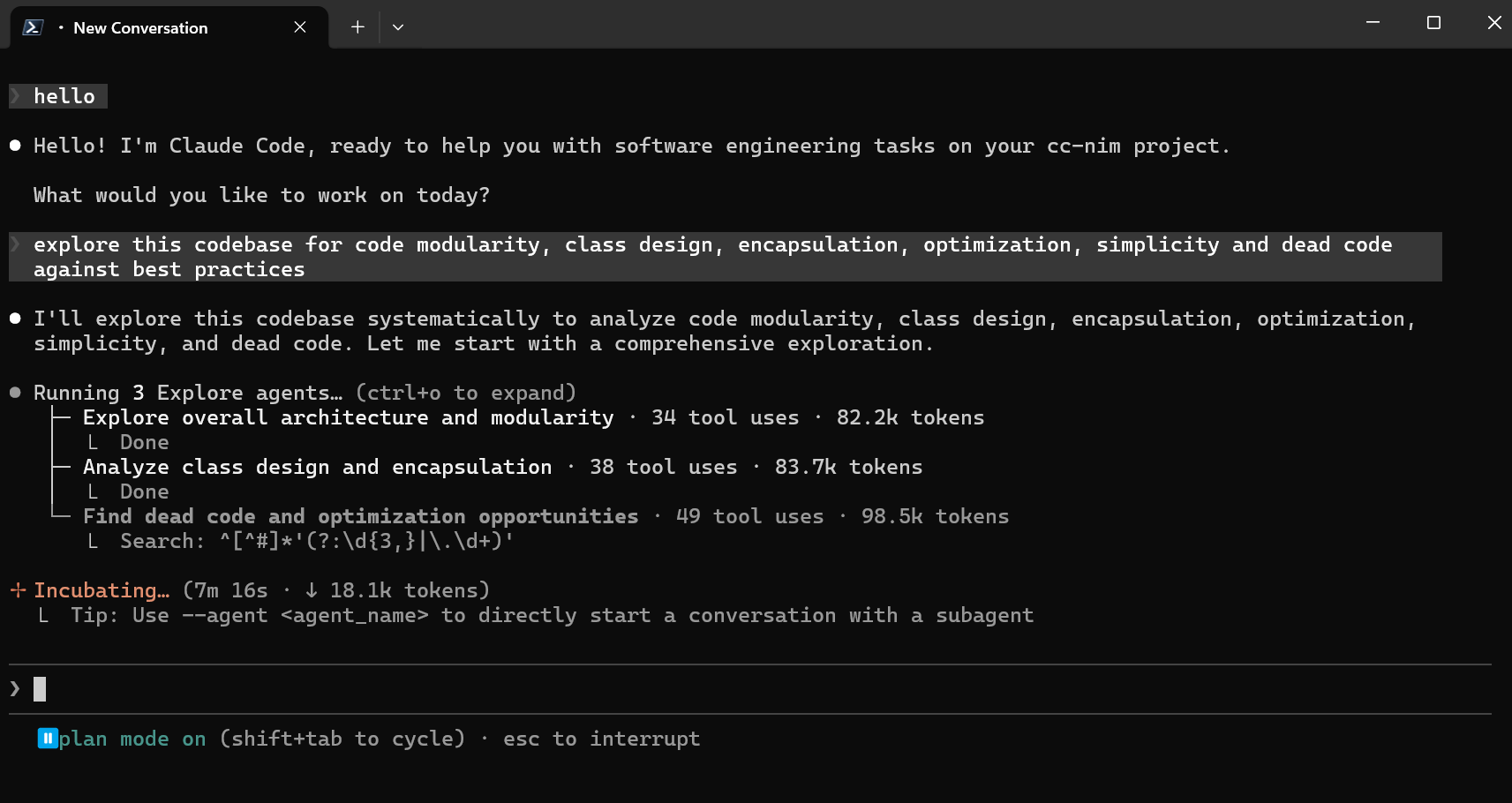
Claude Code running with FCC.
Quick Start
1. Install Or Update
macOS/Linux:
curl -fsSL "https://raw.githubusercontent.com/Alishahryar1/free-claude-code/main/scripts/install.sh" | sh
Windows PowerShell:
& ([scriptblock]::Create((irm "https://raw.githubusercontent.com/Alishahryar1/free-claude-code/main/scripts/install.ps1")))
Re-run the same command to update. When prompted, choose at least one coding agent and optionally RTK. You can review the installers before running them: install.sh and install.ps1.
2. Start FCC
Windows
Open Free Claude Code from your desktop or Start menu.
macOS
Open Free Claude Code from your desktop or Applications folder.
Linux
Run:
fcc-server
FCC opens the Admin UI after starting. On Windows and macOS, use the tray or
menu-bar icon to open Admin, restart, or quit. When using fcc-server, keep its
terminal open.
3. Configure NVIDIA NIM
- Create an API key at build.nvidia.com/settings/api-keys.
- Open the Admin UI URL from the server log.
- Paste the key into
NVIDIA_NIM_API_KEY. - Leave
MODELon the defaultnvidia_nim/nvidia/nemotron-3-super-120b-a12b, or search the model dropdown and select another model. - Click Validate, then Apply.
To protect the local proxy with a bearer token, enable Proxy Authentication in Admin.
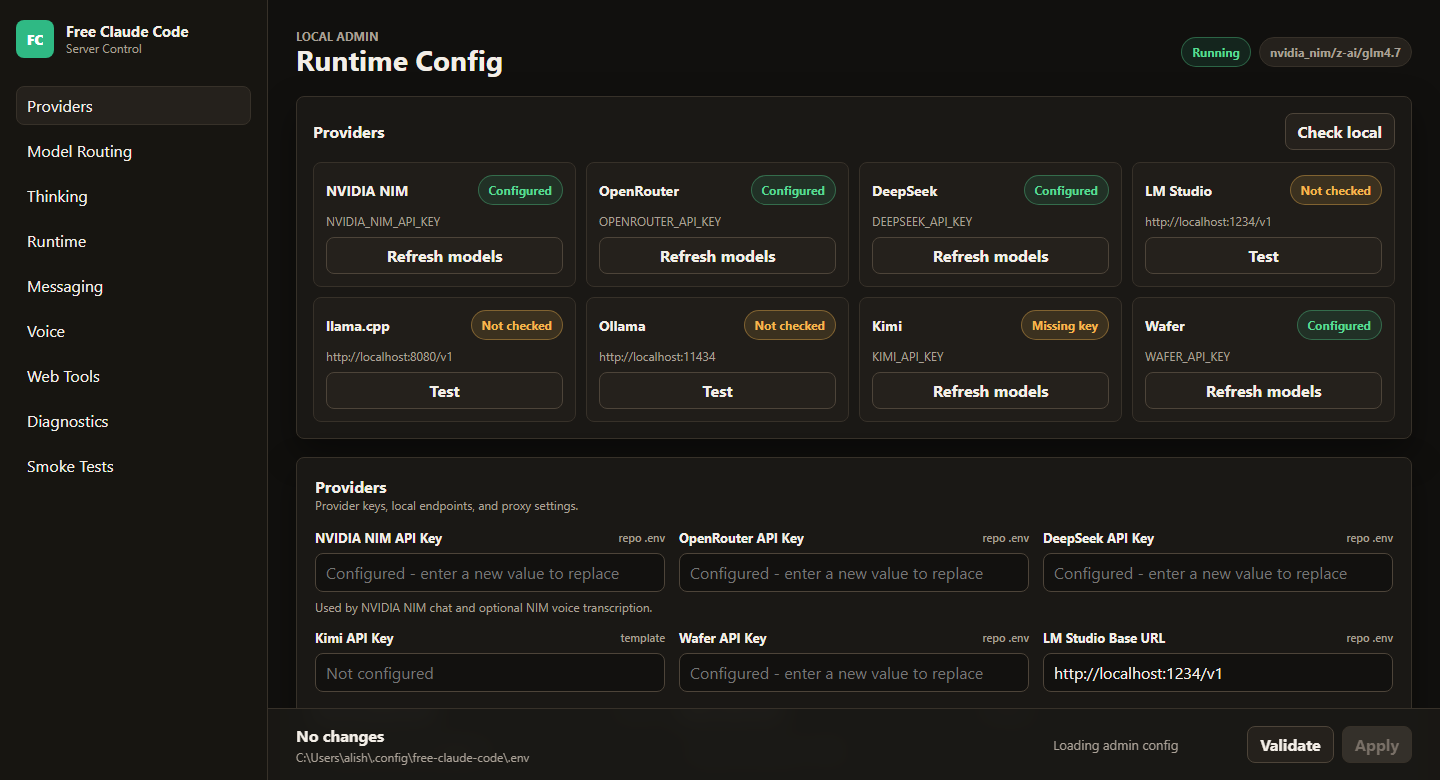
4. Run Your Coding Agent
Claude Code:
fcc-claude
Codex:
fcc-codex
Pi:
fcc-pi
OpenCode:
fcc-opencode
Cline:
fcc-cline
All five launchers use the current Admin UI settings. Use the agent's model picker to choose from the models FCC exposes. Normal CLI arguments still work, for example:
fcc-codex exec "hello"
FCC launchers leave your existing agent settings, sessions, credentials, and extensions unchanged.
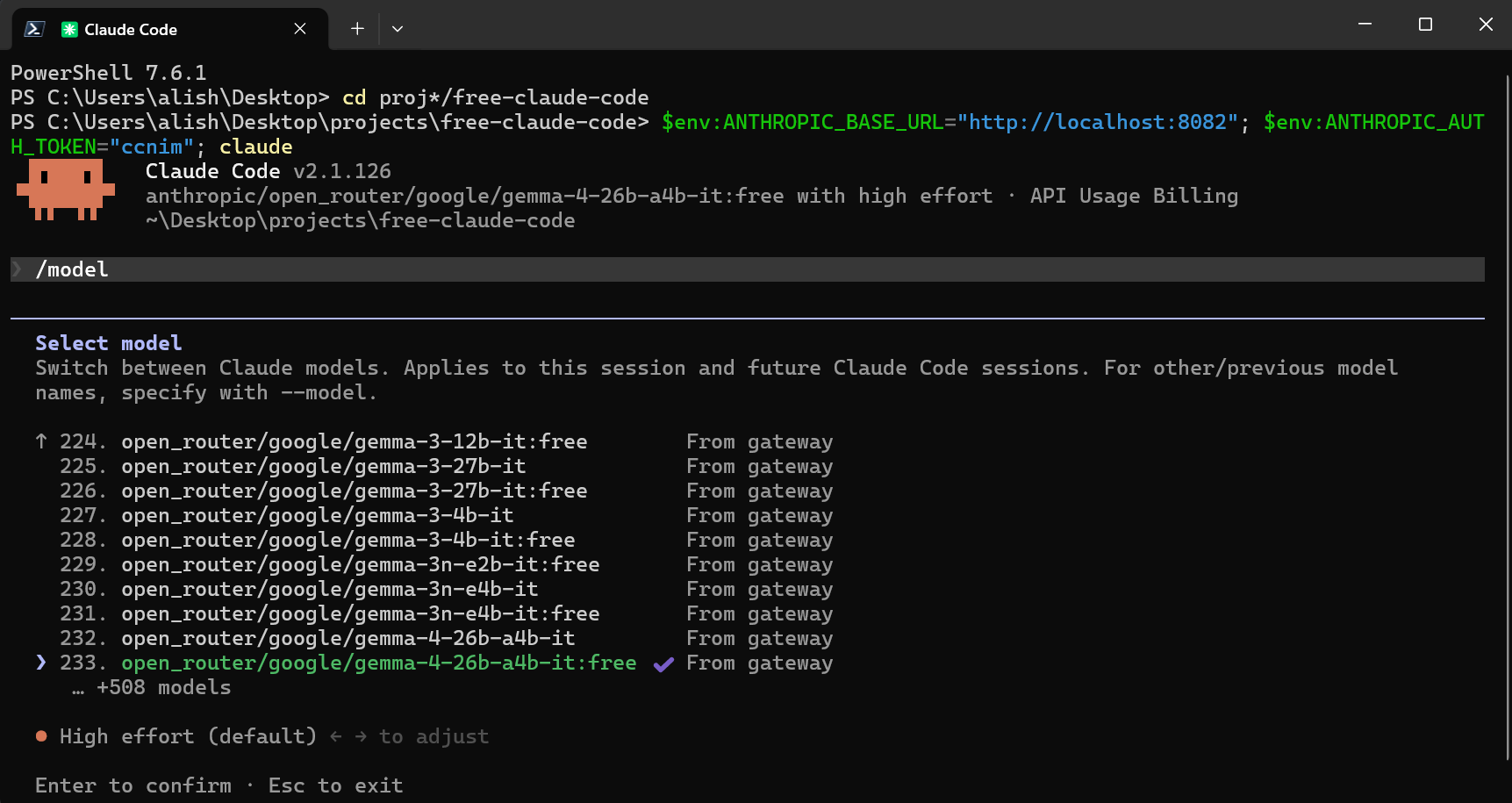
Select an FCC model from Claude Code's native /model picker.
Choose A Provider
- Open a provider link below for its key, models, or setup instructions.
- In the Admin UI, configure the listed setting. For OpenAI, use Providers → Connected accounts instead.
- Search the
MODELdropdown and select a model. If the provider cannot list models, enter<provider-id>/<exact-provider-model-id>manually. - Click Validate, then Apply.
Optional: add an ordered Fallback Models list under Model Config. It applies to every connected client. A failed request may reach and consume usage from more than one provider before succeeding.
Provider catalog
| Provider | Admin UI setting | Example MODEL |
|---|---|---|
| NVIDIA NIM | NVIDIA_NIM_API_KEY | nvidia_nim/nvidia/nemotron-3-super-120b-a12b |
| OpenRouter | OPENROUTER_API_KEY | open_router/openrouter/free |
| Groq | GROQ_API_KEY | groq/llama-3.3-70b-versatile |
| ClinePass | CLINE_API_KEY | cline_pass/cline-pass/kimi-k3 |
| OpenAI / ChatGPT | Connect ChatGPT in the Admin UI | openai/<model-id> |
| xAI (Grok) | XAI_API_KEY | xai/grok-4.5 |
| QwenCloud Token Plan | QWENCLOUD_API_KEY | qwencloud/qwen3.7-plus |
| QwenCloud Coding Plan | QWENCLOUD_CODING_API_KEY | qwencloud_coding/qwen3.7-plus |
| Together AI | TOGETHER_API_KEY | together/zai-org/GLM-5.2 |
| DeepInfra | DEEPINFRA_API_KEY | deepinfra/deepseek-ai/DeepSeek-V4-Flash |
| SiliconFlow | SILICONFLOW_API_KEY | siliconflow/Qwen/Qwen3-32B |
| Nebius Token Factory | NEBIUS_API_KEY | nebius/Qwen/Qwen3-30B-A3B |
| Chutes | CHUTES_API_KEY | chutes/Qwen/Qwen3-32B-TEE |
| Featherless AI | FEATHERLESS_API_KEY | featherless/Qwen/Qwen3-32B |
| Agnes AI | AGNES_API_KEY | agnes/agnes-2.0-flash |
| ZenMux | ZENMUX_API_KEY | zenmux/deepseek/deepseek-v4-flash-free |
| W&B Inference | WANDB_API_KEY | wandb/openai/gpt-oss-20b |
| Azure OpenAI | AZURE_OPENAI_API_KEY and AZURE_OPENAI_BASE_URL | azure_openai/<deployment-name> |
| Google AI Studio (Gemini) | GEMINI_API_KEY | gemini/models/gemini-3.1-flash-lite |
| Google Vertex AI | VERTEX_PROJECT_ID + ADC | vertex/google/gemini-3.5-flash |
| DeepSeek | DEEPSEEK_API_KEY | deepseek/deepseek-chat |
| Mistral La Plateforme | MISTRAL_API_KEY | mistral/devstral-small-latest |
| Mistral Codestral | CODESTRAL_API_KEY | mistral_codestral/codestral-latest |
| OpenCode Zen | OPENCODE_API_KEY | opencode_zen/gpt-5.3-codex |
| OpenCode Go | OPENCODE_API_KEY | opencode_go/minimax-m2.7 |
| Vercel AI Gateway | AI_GATEWAY_API_KEY | vercel/openai/gpt-5.5 |
| Amazon Bedrock | AWS_BEARER_TOKEN_BEDROCK | bedrock/openai.gpt-oss-120b |
| Hugging Face Inference Providers | HUGGINGFACE_API_KEY | huggingface/Qwen/Qwen3-Coder-480B-A35B-Instruct:fastest |
| Cohere | COHERE_API_KEY | cohere/command-a-plus-05-2026 |
| GitHub Models | GITHUB_MODELS_TOKEN | github_models/openai/gpt-4.1 |
| Wafer | WAFER_API_KEY | wafer/DeepSeek-V4-Pro |
| Kimi API | KIMI_API_KEY | kimi/kimi-k2.5 |
| Kimi Code | KIMI_CODE_API_KEY | kimi_code/k3 |
| MiniMax | MINIMAX_API_KEY | minimax/MiniMax-M3 |
| Cerebras Inference | CEREBRAS_API_KEY | cerebras/gpt-oss-120b |
| SambaNova | SAMBANOVA_API_KEY | sambanova/Meta-Llama-3.3-70B-Instruct |
| Kilo.ai | KILO_API_KEY | kilo/kilo-auto/free |
| Fireworks AI | FIREWORKS_API_KEY | fireworks/accounts/fireworks/models/llama-v3p3-70b-instruct |
| Novita AI | NOVITA_API_KEY | novita/deepseek/deepseek-v4-flash-0731 |
| Cloudflare Workers AI | CLOUDFLARE_API_TOKEN and CLOUDFLARE_ACCOUNT_ID | cloudflare/@cf/moonshotai/kimi-k2.6 |
| Z.ai Coding Plan | ZAI_API_KEY | zai/glm-5.2 |
| Z.ai API (pay as you go) | ZAI_API_KEY | zai_api/glm-4.7-flash |
| TokenRouter | TOKENROUTER_API_KEY | tokenrouter/moonshotai/kimi-k3-free |
| NaraRoute | NARAROUTE_API_KEY | nararoute/kimi-k3-free |
| Ollama Cloud | OLLAMA_API_KEY | ollama_cloud/qwen3-coder:480b |
| LM Studio | LM_STUDIO_BASE_URL | lmstudio/<model-id> |
| llama.cpp | LLAMACPP_BASE_URL | llamacpp/<model-id> |
| Ollama | OLLAMA_BASE_URL | ollama/<model-tag> |
Provider-specific setup
- OpenAI uses your ChatGPT subscription rather than an API key. Connect from Providers → Connected accounts in the Admin UI. Use device code on headless systems. Restart an already-running agent after connecting.
- Azure OpenAI uses the deployment names from your resource. Set
AZURE_OPENAI_BASE_URLto its complete v1 endpoint, such ashttps://YOUR-RESOURCE-NAME.openai.azure.com/openai/v1/, and select a deployment that supports Chat Completions. Enter the deployment name as a custom model slug if it does not appear in the model dropdown. - Mistral Codestral uses a separate key from Mistral La Plateforme.
- Kimi Code subscription keys use
kimi_code/; Kimi API credit keys usekimi/. Kimi Code plans are for personal interactive coding-agent use under Kimi's community guidelines. - QwenCloud Coding Plan keys use
qwencloud_coding/; QwenCloud Token Plan keys useqwencloud/. The keys and endpoints are not interchangeable. Coding Plan is for local, personal, interactive coding-agent use under the Coding Plan terms. - OpenCode Zen and OpenCode Go share
OPENCODE_API_KEYbut use the explicitopencode_zen/andopencode_go/model prefixes. - For Amazon Bedrock, set
BEDROCK_BASE_URLto the URL for the same region as the API key and select one of the listed models. - Vertex AI uses Google Application Default Credentials instead of an API key.
Locally, run
gcloud auth application-default loginonce; service-account files and attached service accounts also work. SetVERTEX_PROJECT_ID, and optionally changeVERTEX_LOCATIONfrom itsglobaldefault. - Cloudflare requires both its API token and account ID.
- For Ollama Cloud, use the exact model IDs shown in the model picker. Local
Ollama uses the separate
ollama/prefix. - Prefer tool-capable models for coding agents. Local models also need enough context for the agent's system prompt and tool definitions.
Local provider setup
LM Studio
Start LM Studio's local server, load a tool-capable model, and use the model identifier shown by LM Studio with the lmstudio/ prefix. The default URL is http://localhost:1234/v1.
llama.cpp
Start llama-server with its OpenAI-compatible Chat Completions API and enough context for the model. Use the local model ID with the llamacpp/ prefix. LLAMACPP_BASE_URL defaults to http://localhost:8080/v1; FCC accepts either the server root or an explicit /v1 suffix.
Ollama
ollama pull llama3.1
ollama serve
Use the tag shown by ollama list with the ollama/ prefix. OLLAMA_BASE_URL defaults to http://localhost:11434; FCC accepts either the root URL or an explicit /v1 suffix.
Optional model-tier routing
MODEL is the fallback for every request. Select a model for MODEL_FABLE, MODEL_OPUS, MODEL_SONNET, or MODEL_HAIKU to override an individual Claude Code tier; select None to use MODEL.
For example, route Opus to nvidia_nim/nvidia/nemotron-3-super-120b-a12b, Sonnet to open_router/openrouter/free, Haiku to lmstudio/qwen3.5-coder, and keep MODEL on zai/glm-5.2.
Reasoning control
Open Admin UI → Model Config → Reasoning and select the behavior you want.
| Selection | Behavior |
|---|---|
| From client (default) | Use the effort sent by Claude Code, Codex, Pi, OpenCode, or Cline. If none is sent, keep the provider default. |
| Off | Request reasoning to be disabled. |
| Low, Medium, High, X-High, or Max | Override the client with the selected reasoning level. |
| Inherit (Fable, Opus, Sonnet, and Haiku only) | Use the root Reasoning selection. |
Providers that do not support a selected control retain their own behavior.
Connect Your Client
For terminal use, start fcc-server, then run fcc-claude, fcc-codex,
fcc-pi, fcc-opencode, or fcc-cline. Use the guides below for editor integrations.
Claude Code in VS Code
Install the Claude Code extension. Open VS Code's user settings as JSON and add:
"claudeCode.disableLoginPrompt": true,
"claudeCode.environmentVariables": [
  { "name": "ANTHROPIC_BASE_URL", "value": "http://localhost:8082" },
  { "name": "ANTHROPIC_AUTH_TOKEN", "value": "freecc" },
  { "name": "CLAUDE_CODE_ENABLE_GATEWAY_MODEL_DISCOVERY", "value": "1" },
  { "name": "CLAUDE_CODE_AUTO_COMPACT_WINDOW", "value": "190000" },
  { "name": "DISABLE_AUTOUPDATER", "value": "1" },
  { "name": "DISABLE_FEEDBACK_COMMAND", "value": "1" },
  { "name": "DISABLE_ERROR_REPORTING", "value": "1" }
]
Match the port and authentication token to the Admin UI, then reload the extension.
Codex App
Start FCC, then edit your Codex configuration:
- Windows:
%USERPROFILE%\.codex\config.toml - macOS:
~/.codex/config.toml
Add the matching model-catalog path and replace YOUR_USERNAME.
Windows:
model_catalog_json = "C:/Users/YOUR_USERNAME/.fcc/codex-model-catalog.json"
macOS:
model_catalog_json = "/Users/YOUR_USERNAME/.fcc/codex-model-catalog.json"
Then add the shared FCC settings:
model_provider = "fcc"
model = "nvidia_nim/nvidia/nemotron-3-super-120b-a12b"

[model_providers.fcc]
name = "Free Claude Code"
base_url = "http://127.0.0.1:8082/v1"
wire_api = "responses"

[model_providers.fcc.auth]
command = "fcc-codex"
args = ["--print-proxy-auth-token"]
Match the model and port to the Admin UI. The auth command reads FCC's current proxy token automatically. Restart the Codex App after setup or model changes, then select an FCC model from its model picker.
Codex in VS Code
Install the Codex extension. Create or edit ~/.codex/config.toml (%USERPROFILE%\.codex\config.toml on Windows):
model_provider = "fcc"
model = "nvidia_nim/nvidia/nemotron-3-super-120b-a12b"

[model_providers.fcc]
name = "Free Claude Code"
base_url = "http://127.0.0.1:8082/v1"
wire_api = "responses"

[model_providers.fcc.auth]
command = "fcc-codex"
args = ["--print-proxy-auth-token"]
Match model and the port to the Admin UI. The auth command reads FCC's current
proxy token automatically. Restart VS Code after setup or model changes. For
WSL-backed Codex, edit the file inside WSL.
Claude Code in JetBrains ACP
Edit the installed Claude ACP configuration:
- Windows:
C:\Users\%USERNAME%\AppData\Roaming\JetBrains\acp-agents\installed.json - Linux/macOS:
~/.jetbrains/acp.json
Set the environment for acp.registry.claude-acp:
"env": {
  "ANTHROPIC_BASE_URL": "http://localhost:8082",
  "ANTHROPIC_AUTH_TOKEN": "freecc",
  "CLAUDE_CODE_ENABLE_GATEWAY_MODEL_DISCOVERY": "1",
  "CLAUDE_CODE_AUTO_COMPACT_WINDOW": "190000",
  "DISABLE_AUTOUPDATER": "1",
  "DISABLE_FEEDBACK_COMMAND": "1",
  "DISABLE_ERROR_REPORTING": "1"
}
Match the port and token to the Admin UI, then restart the IDE.
Claude Code still asks you to log in
If Claude Code asks you to log in after you configure the FCC URL and token, open its state file:
- Windows:
%USERPROFILE%\.claude.json - macOS/Linux/WSL:
~/.claude.json
Merge this property into the existing JSON without removing its other fields:
"hasCompletedOnboarding": true
If the file does not exist, create it with a complete JSON object:
{
  "hasCompletedOnboarding": true
}
Restart Claude Code or the IDE after saving the file.
Optional Integrations
Configure integrations from Admin UI → Messaging, then click Validate and Apply.
Discord bot
- Create a bot in the Discord Developer Portal.
- Enable Message Content Intent and invite it with read, send,
message-history, and Manage Messages permissions so
/clearcan remove user prompts. - Set Messaging Platform to discord.
- Enter Discord Bot Token, Allowed Discord Channels, and an absolute Allowed Directory.
- Apply the settings and restart the server if requested.
Telegram bot
- Create a bot with @BotFather.
- Get your numeric user ID from @userinfobot. In groups, grant the bot permission to delete messages.
- Set Messaging Platform to telegram.
- Enter Telegram Bot Token, Allowed Telegram User ID, and an absolute Allowed Directory.
- Apply the settings and restart the server if requested.
Messaging commands
| Usage | Behavior |
|---|---|
/stats | Show session state. |
Standalone /stop | Cancel all work. |
Reply with /stop | Cancel only the selected request while other queued requests continue. |
Standalone /clear | Reset all FCC state and remove every tracked message in that chat, including user prompts, voice notes, FCC replies, Telegram's online notice, and the clear command itself. |
Reply with /clear | Delete the selected message and its literal platform reply subtree while preserving its ancestors and siblings. |
Voice notes
Choose the voice backend you want, then re-run the installer with its option.
| Voice backend | macOS/Linux option | Windows option |
|---|---|---|
| NVIDIA NIM transcription | --voice-nim | -VoiceNim |
| Local Whisper on CPU or CUDA | --voice-local | -VoiceLocal |
| Both backends | --voice-all | -VoiceAll |
| Local Whisper with CUDA 13.0 | --voice-local --torch-backend cu130 | -VoiceLocal -TorchBackend cu130 |
The examples below install NVIDIA NIM transcription. To use another backend, replace the final option with the matching one from the table.
macOS/Linux:
curl -fsSL "https://raw.githubusercontent.com/Alishahryar1/free-claude-code/main/scripts/install.sh" | sh -s -- --voice-nim
Windows PowerShell:
& ([scriptblock]::Create((irm "https://raw.githubusercontent.com/Alishahryar1/free-claude-code/main/scripts/install.ps1"))) -VoiceNim
Restart fcc-server. In Admin UI → Messaging → Voice, enable voice notes, select cpu, cuda, or nvidia_nim, and choose the Whisper model. Local gated models need HUGGINGFACE_API_KEY; NVIDIA NIM transcription needs NVIDIA_NIM_API_KEY.
Manage Your Installation
Run fcc-server --version to check the installed version without starting FCC.
Update
Re-run the matching command from Install Or Update.
Uninstall
Stop every running FCC command before uninstalling.
Removes
- Free Claude Code, including its desktop launcher and commands
~/.fcc/
Keeps
- uv and Python
- Claude Code, Codex, Pi, OpenCode, Cline, and RTK
- Shared PATH entries
macOS/Linux:
curl -fsSL "https://raw.githubusercontent.com/Alishahryar1/free-claude-code/main/scripts/uninstall.sh" | sh
Windows PowerShell:
& ([scriptblock]::Create((irm "https://raw.githubusercontent.com/Alishahryar1/free-claude-code/main/scripts/uninstall.ps1")))
Project Links
- Report bugs or request features
- Architecture and extension guide
- Contributing guide
License
MIT License. See LICENSE for details.
Repo liên quan
Superpowers is an open-source (MIT) skills library and bootstrap instruction set that turns a coding agent's ad-hoc habits into a fixed pipeline: brainstorm a spec, write a plan, build under TDD, review, then close out the branch. Skills trigger automatically once installed, and the same methodology works across eleven different agent harnesses, each requiring its own install step.
TensorFlow is Google's open-source, end-to-end platform for machine learning, hosted at tensorflow/tensorflow under the Apache-2.0 license. It was originally built within Google Brain's Machine Intelligence team for ML and neural network research, and today it ships stable Python and C++ APIs alongside GPU, CPU-only, and Docker install paths. The README positions it as covering both research work and shipping ML-powered applications.
Free domain registration and practical DNS learning resources for everyone.
AutoGPT is an open-source platform designed for building, deploying, and running AI agents that can carry out complete workflows. Users can define tasks in plain English or use a visual builder to shape each step. The project offers two primary paths: a managed, hosted AutoGPT Platform that handles infrastructure and model access for a fee, and a self-hosting option that is free but requires users to provide their own infrastructure and model API keys. Agents can run on demand, on schedules, or from triggers, connecting to over 45 platforms and hundreds of AI models. It's presented as a tool to automate various functions, from executive operations and sales research to marketing campaign drafts and incident triage in engineering.
Trả lời nhanh
Alishahryar1/free-claude-code có phải mã nguồn mở không?
Có — Alishahryar1/free-claude-code phát hành theo license MIT, nghĩa là mã nguồn mở để đọc, fork và (tùy license) tái sử dụng. Mã: github.com/Alishahryar1/free-claude-code.
Alishahryar1/free-claude-code có tag gì không?
Bản đồng bộ chưa ghi nhận topic GitHub nào cho Alishahryar1/free-claude-code. GitHub topics hiển thị ở thanh bên phải trang repo — đó là nơi đáng kiểm tra nhất.
Alishahryar1/free-claude-code có website riêng không?
TopGit chưa ghi nhận URL trang chủ cho Alishahryar1/free-claude-code. Phần README ở tab phía trên thường có link demo, hoặc xem mô tả GitHub của repo.
Alishahryar1/free-claude-code còn đang phát triển không?
Commit gần nhất trên Alishahryar1/free-claude-code là 5 ngày trước (theo timestamp GitHub). Repo có 7.6k fork — một chỉ báo về mức độ quan tâm của cộng đồng.
Alishahryar1/free-claude-code dùng license gì?
Alishahryar1/free-claude-code phát hành theo license MIT. Nên mở file LICENSE trên GitHub để xác nhận — license metadata đôi khi lệch với thực tế dự án.
Đọc thêm về Alishahryar1/free-claude-code ở đâu?
Trang TopGit này là một snapshot — tab "Readme" hiển thị nguyên văn README của repo (đã bỏ link, giữ ảnh). Repo GitHub ở github.com/Alishahryar1/free-claude-code là nguồn chính thức.
Đọc đầy đủ README ở tab phía trên.
Muốn nghe thêm một ý kiến về free-claude-code?
Hỏi một AI đọc được trang này — một cú bấm là có ngay nhận định về free-claude-code.