Snapshot của anishathalye/obfuscated-gradients: 912★ · Jupyter Notebook. Obfuscated Gradients Give a False Sense of Security: Circumventing Defenses to Adversarial Examples
Tóm tắt dựng từ metadata GitHub của chính dự án — chưa có bài review TopGit. Trang sẽ tự động cập nhật khi bài review đầy đủ được xuất bản.
VÌ SAO CHƯA CÓ REVIEW
TopGit viết bài đầy đủ cho repo có nhiều sao nhất và được yêu cầu nhiều nhất. Trang này là snapshot trong thời gian chờ — xem README gốc ở tab READ ME.
Obfuscated Gradients Give a False Sense of Security: Circumventing Defenses to Adversarial Examples
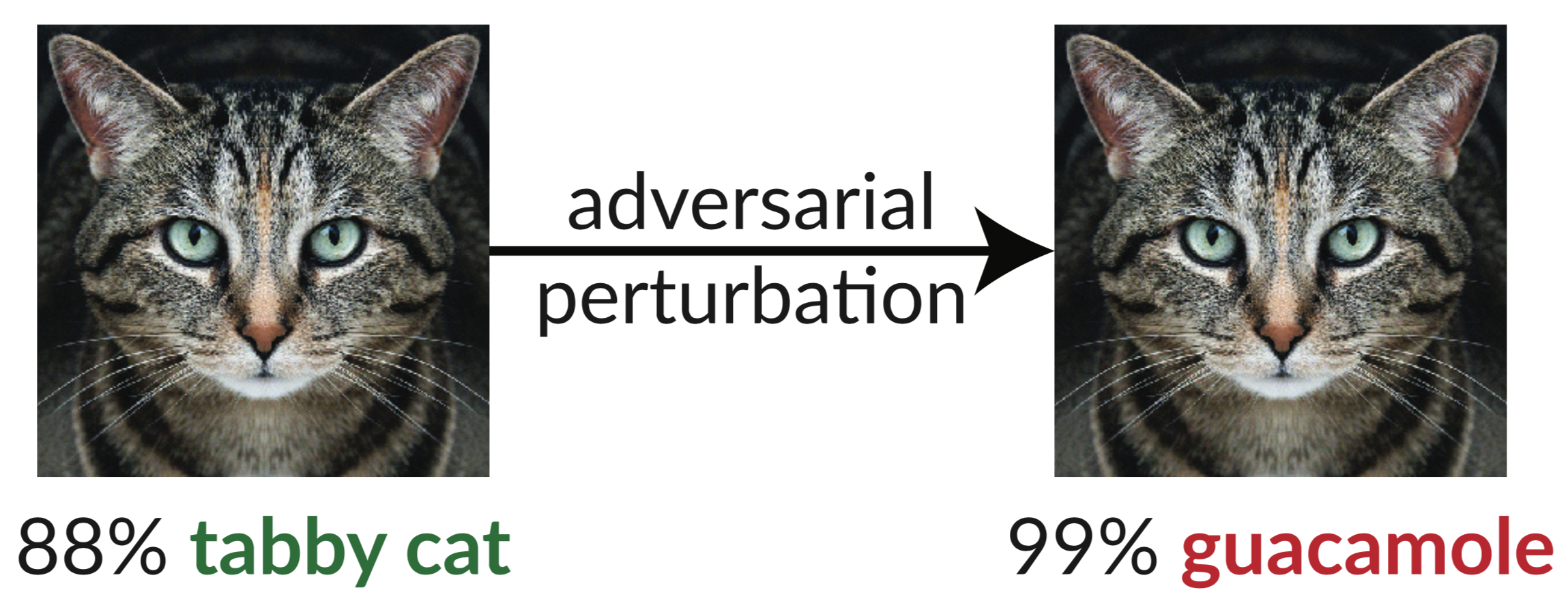
Above is an adversarial example: the slightly perturbed image of the cat fools an InceptionV3 classifier into classifying it as "guacamole". Such "fooling images" are easy to synthesize using gradient descent (Szegedy et al. 2013).
In our recent paper, we evaluate the robustness of nine papers accepted to ICLR 2018 as non-certified white-box-secure defenses to adversarial examples. We find that seven of the nine defenses provide a limited increase in robustness and can be broken by improved attack techniques we develop.
Below is Table 1 from our paper, where we show the robustness of each accepted defense to the adversarial examples we can construct:
Defense
Dataset
Distance
Accuracy
Buckman et al. (2018)
CIFAR
0.031 (linf)
0%*
Ma et al. (2018)
CIFAR
0.031 (linf)
5%
Guo et al. (2018)
ImageNet
0.05 (l2)
0%*
Dhillon et al. (2018)
CIFAR
0.031 (linf)
0%
Xie et al. (2018)
ImageNet
0.031 (linf)
0%*
Song et al. (2018)
CIFAR
0.031 (linf)
9%*
Samangouei et al. (2018)
MNIST
0.005 (l2)
55%**
Madry et al. (2018)
CIFAR
0.031 (linf)
47%
Na et al. (2018)
CIFAR
0.015 (linf)
15%
(Defenses denoted with * also propose combining adversarial training; we report here the defense alone. See our paper, Section 5 for full numbers. The fundemental principle behind the defense denoted with ** has 0% accuracy; in practice defense imperfections cause the theoretically optimal attack to fail, see Section 5.4.2 for details.)
The only defense we observe that significantly increases robustness to adversarial examples within the threat model proposed is "Towards Deep Learning Models Resistant to Adversarial Attacks" (Madry et al. 2018), and we were unable to defeat this defense without stepping outside the threat model. Even then, this technique has been shown to be difficult to scale to ImageNet-scale (Kurakin et al. 2016). The remainder of the papers (besides the paper by Na et al., which provides limited robustness) rely either inadvertently or intentionally on what we call obfuscated gradients. Standard attacks apply gradient descent to maximize the loss of the network on a given image to generate an adversarial example on a neural network. Such optimization methods require a useful gradient signal to succeed. When a defense obfuscates gradients, it breaks this gradient signal and causes optimization based methods to fail.
We identify three ways in which defenses cause obfuscated gradients, and construct attacks to bypass each of these cases. Our attacks are generally applicable to any defense that includes, either intentionally or or unintentionally, a non-differentiable operation or otherwise prevents gradient signal from flowing through the network. We hope future work will be able to use our approaches to perform a more thorough security evaluation.
Paper
Abstract:
We identify obfuscated gradients, a kind of gradient masking, as a phenomenon that leads to a false sense of security in defenses against adversarial examples. While defenses that cause obfuscated gradients appear to defeat iterative optimization-based attacks, we find defenses relying on this effect can be circumvented. We describe characteristic behaviors of defenses exhibiting the effect, and for each of the three types of obfuscated gradients we discover, we develop attack techniques to overcome it. In a case study, examining non-certified white-box-secure defenses at ICLR 2018, we find obfuscated gradients are a common occurrence, with 7 of 9 defenses relying on obfuscated gradients. Our new attacks successfully circumvent 6 completely, and 1 partially, in the original threat model each paper considers.
For details, read our paper.
Source code
This repository contains our instantiations of the general attack techniques
described in our paper, breaking 7 of the ICLR 2018 defenses. Some of the
defenses didn't release source code (at the time we did this work), so we had
to reimplement them.
Citation
@inproceedings{obfuscated-gradients,
  author = {Anish Athalye and Nicholas Carlini and David Wagner},
  title = {Obfuscated Gradients Give a False Sense of Security: Circumventing Defenses to Adversarial Examples},
  booktitle = {Proceedings of the 35th International Conference on Machine Learning, {ICML} 2018},
  year = {2018},
  month = jul,
  url = {https://arxiv.org/abs/1802.00420},
}
anishathalye/obfuscated-gradients có bao nhiêu sao?
anishathalye/obfuscated-gradients có 912 sao GitHub — tải lại trang để xem số mới nhất, hoặc xem trực tiếp github.com/anishathalye/obfuscated-gradients. TopGit phản chiếu số sao của GitHub nhưng không cam kết đến từng phút.
anishathalye/obfuscated-gradients có tag gì không?
Bản đồng bộ chưa ghi nhận topic GitHub nào cho anishathalye/obfuscated-gradients. GitHub topics hiển thị ở thanh bên phải trang repo — đó là nơi đáng kiểm tra nhất.
anishathalye/obfuscated-gradients còn đang phát triển không?
Commit gần nhất trên anishathalye/obfuscated-gradients là 3.4 năm trước (theo timestamp GitHub). Repo có 172 fork — một chỉ báo về mức độ quan tâm của cộng đồng.
anishathalye/obfuscated-gradients là gì?
anishathalye/obfuscated-gradients (anishathalye/obfuscated-gradients) là dự án Jupyter Notebook trên GitHub. Theo mô tả gốc: Obfuscated Gradients Give a False Sense of Security: Circumventing Defenses to Adversarial Examples
anishathalye/obfuscated-gradients viết bằng ngôn ngữ gì?
anishathalye/obfuscated-gradients chủ yếu viết bằng Jupyter Notebook. Trường "language" của GitHub dựa trên phần lớn byte ở nhánh mặc định.
Đọc đầy đủ README ở tab phía trên.
Muốn nghe thêm một ý kiến về obfuscated-gradients?
Hỏi một AI đọc được trang này — một cú bấm là có ngay nhận định về obfuscated-gradients.

 /obfuscated-gradients