Trên GitHub, apache/apisix đã đạt 17.0k sao, nhóm Developer Tools, ngôn ngữ Lua. The Cloud-Native API Gateway and AI Gateway
Tóm tắt dựng từ metadata GitHub của chính dự án — chưa có bài review TopGit. Trang sẽ tự động cập nhật khi bài review đầy đủ được xuất bản.
VÌ SAO CHƯA CÓ REVIEW
TopGit viết bài đầy đủ cho repo có nhiều sao nhất và được yêu cầu nhiều nhất. Trang này là snapshot trong thời gian chờ — xem README gốc ở tab READ ME.
Apache APISIX is a dynamic, real-time, high-performance API Gateway.
APISIX API Gateway provides rich traffic management features such as load balancing, dynamic upstream, canary release, circuit breaking, authentication, observability, and more. You can use it to handle traditional north-south traffic, as well as east-west traffic between services. It can also be used as a Kubernetes ingress controller.
Table of Contents
Why APISIX
AI Gateway
Get Started
Features
Benchmark
Community
User Stories
Who Uses APISIX API Gateway?
Logos
Acknowledgments
License
Why APISIX
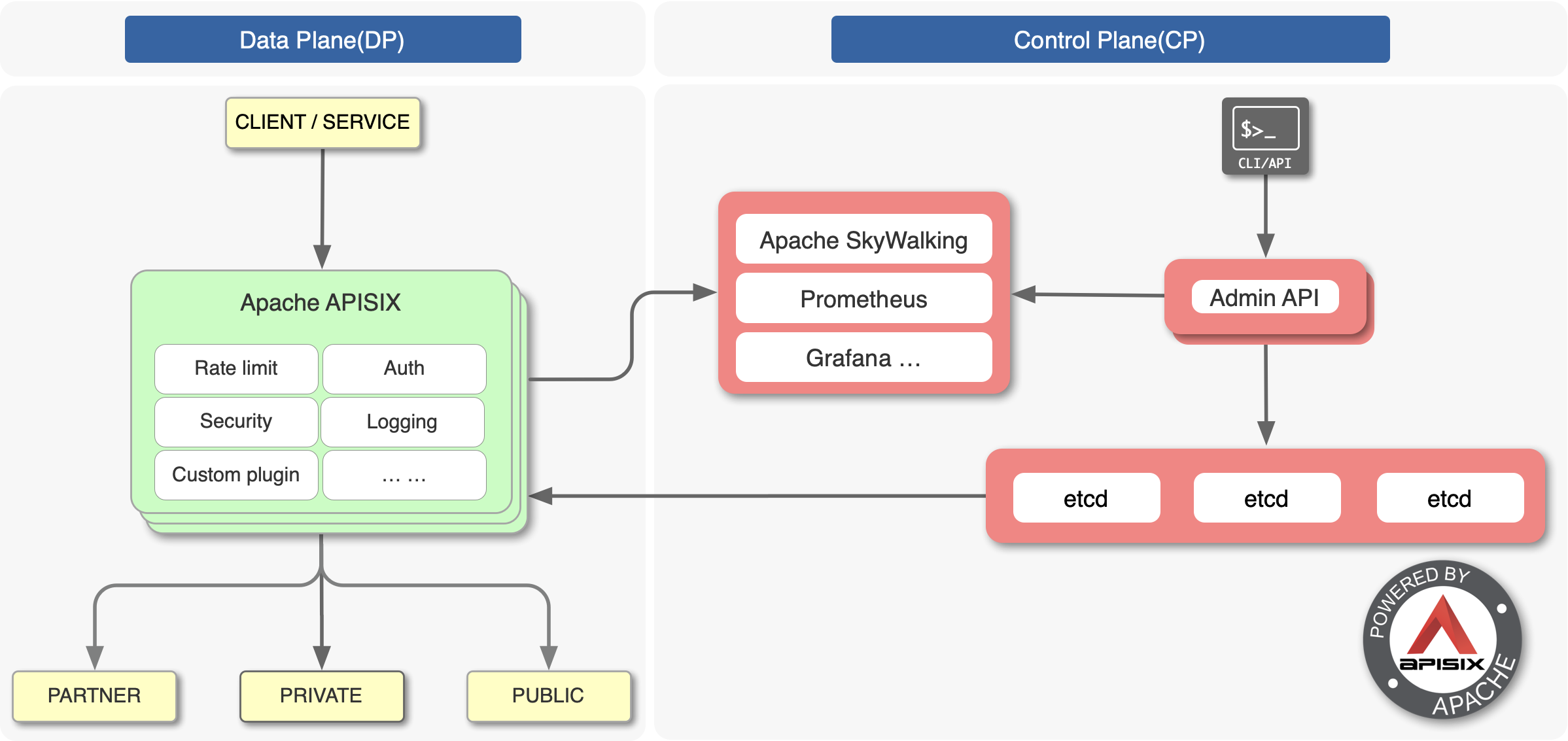
APISIX is built on top of NGINX and etcd. Compared with traditional API gateways, APISIX has dynamic routing and hot-loading of plugins, which is especially suitable for API management under a microservice architecture.
The technical architecture of Apache APISIX:
AI Gateway
APISIX can serve as an AI Gateway through its flexible plugin system, providing:
AI proxying to route traffic to different LLM providers through a unified interface.
Load balancing, retries, and fallbacks across multiple LLMs to ensure the efficiency and reliability of AI agents.
Token-based rate limiting to control cost and protect upstream models.
Robust security for authentication, authorization, and traffic control on AI workloads.
APISIX also provides the mcp-bridge plugin to seamlessly convert stdio-based MCP servers to scalable HTTP SSE services.
Get Started
Install and run APISIX with a single command using the quickstart script (requires Docker):
curl -sL https://run.api7.ai/apisix/quickstart | sh
This starts APISIX (listening on port 9080) together with its etcd configuration store. Verify it is running:
curl "http://127.0.0.1:9080" --head | grep Server
Create your first route via the Admin API (port 9180) to proxy requests to an upstream service:
Send a request through APISIX to confirm the route works:
curl "http://127.0.0.1:9080/get"
To learn more, follow the Getting Started guide and the installation documentation for other deployment methods. To extend APISIX, see the plugin development guide, the plugin concept, and the REST Admin API reference.
For more documents, please refer to the Apache APISIX Documentation site.
Features
You can use APISIX API Gateway as a traffic entrance to process all business data, including dynamic routing, dynamic upstream, dynamic certificates,
A/B testing, canary release, blue-green deployment, limit rate, defense against malicious attacks, metrics, monitoring alarms, service observability, service governance, etc.
All platforms
Cloud-Native: Platform agnostic, No vendor lock-in, APISIX API Gateway can run from bare-metal to Kubernetes.
Supports ARM64: Don't worry about the lock-in of the infra technology.
Multi protocols
TCP/UDP Proxy: Dynamic TCP/UDP proxy.
Dubbo Proxy: Dynamic HTTP to Dubbo proxy.
Dynamic MQTT Proxy: Supports to load balance MQTT by client_id, both support MQTT 3.1.*, 5.0.
gRPC proxy: Proxying gRPC traffic.
gRPC Web Proxy: Proxying gRPC Web traffic to gRPC Service.
gRPC transcoding: Supports protocol transcoding so that clients can access your gRPC API by using HTTP/JSON.
Proxy Websocket
Proxy Protocol
HTTP(S) Forward Proxy
SSL: Dynamically load an SSL certificate
HTTP/3 with QUIC
Full Dynamic
Hot Updates And Hot Plugins: Continuously updates its configurations and plugins without restarts!
Proxy Rewrite: Support rewrite the host, uri, schema, method, headers of the request before send to upstream.
Response Rewrite: Set customized response status code, body and header to the client.
Dynamic Load Balancing: Round-robin load balancing with weight.
Hash-based Load Balancing: Load balance with consistent hashing sessions.
Health Checks: Enable health check on the upstream node and will automatically filter unhealthy nodes during load balancing to ensure system stability.
Circuit-Breaker: Intelligent tracking of unhealthy upstream services.
Proxy Mirror: Provides the ability to mirror client requests.
Traffic Split: Allows users to incrementally direct percentages of traffic between various upstreams.
Fine-grained routing
Supports full path matching and prefix matching
Support all Nginx built-in variables as conditions for routing, so you can use cookie, args, etc. as routing conditions to implement canary release, A/B testing, etc.
Support various operators as judgment conditions for routing, for example {"arg_age", ">", 24}
Support custom route matching function
IPv6: Use IPv6 to match the route.
Support TTL
Support priority
Support Batch Http Requests
Support filtering route by GraphQL attributes
Security
Rich authentication & authorization support:
key-auth
JWT
basic-auth
wolf-rbac
casbin
keycloak
casdoor
IP Whitelist/Blacklist
Referer Whitelist/Blacklist
IdP: Support external Identity platforms, such as Auth0, okta, etc..
Limit-req
Limit-count
Limit-concurrency
Anti-ReDoS(Regular expression Denial of Service): Built-in policies to Anti ReDoS without configuration.
CORS Enable CORS(Cross-origin resource sharing) for your API.
URI Blocker: Block client request by URI.
Request Validator
CSRF Based on the Double Submit Cookie way, protect your API from CSRF attacks.
OPS friendly
Zipkin tracing: Zipkin
Open source APM: support Apache SkyWalking
Works with external service discovery: In addition to the built-in etcd, it also supports Consul, Consul_kv, Nacos, Eureka and Zookeeper (CP).
Monitoring And Metrics: Prometheus
Clustering: APISIX nodes are stateless, creates clustering of the configuration center, please refer to etcd Clustering Guide.
High availability: Support to configure multiple etcd addresses in the same cluster.
Dashboard
Version Control: Supports rollbacks of operations.
CLI: start\stop\reload APISIX through the command line.
Standalone: Supports to load route rules from local YAML file, it is more friendly such as under the kubernetes(k8s).
Global Rule: Allows to run any plugin for all request, eg: limit rate, IP filter etc.
High performance: The single-core QPS reaches 18k with an average delay of fewer than 0.2 milliseconds.
Fault Injection
REST Admin API: Using the REST Admin API to control Apache APISIX, which only allows 127.0.0.1 access by default, you can modify the allow_admin field in conf/config.yaml to specify a list of IPs that are allowed to call the Admin API. Also, note that the Admin API uses key auth to verify the identity of the caller.
Datadog: push custom metrics to the DogStatsD server, comes bundled with Datadog agent, over the UDP protocol. DogStatsD basically is an implementation of StatsD protocol which collects the custom metrics for Apache APISIX agent, aggregates it into a single data point and sends it to the configured Datadog server.
Helm charts
HashiCorp Vault: Support secret management solution for accessing secrets from Vault secure storage backed in a low trust environment. Currently, RS256 keys (public-private key pairs) or secret keys can be linked from vault in jwt-auth authentication plugin using APISIX Secret resource.
Highly scalable
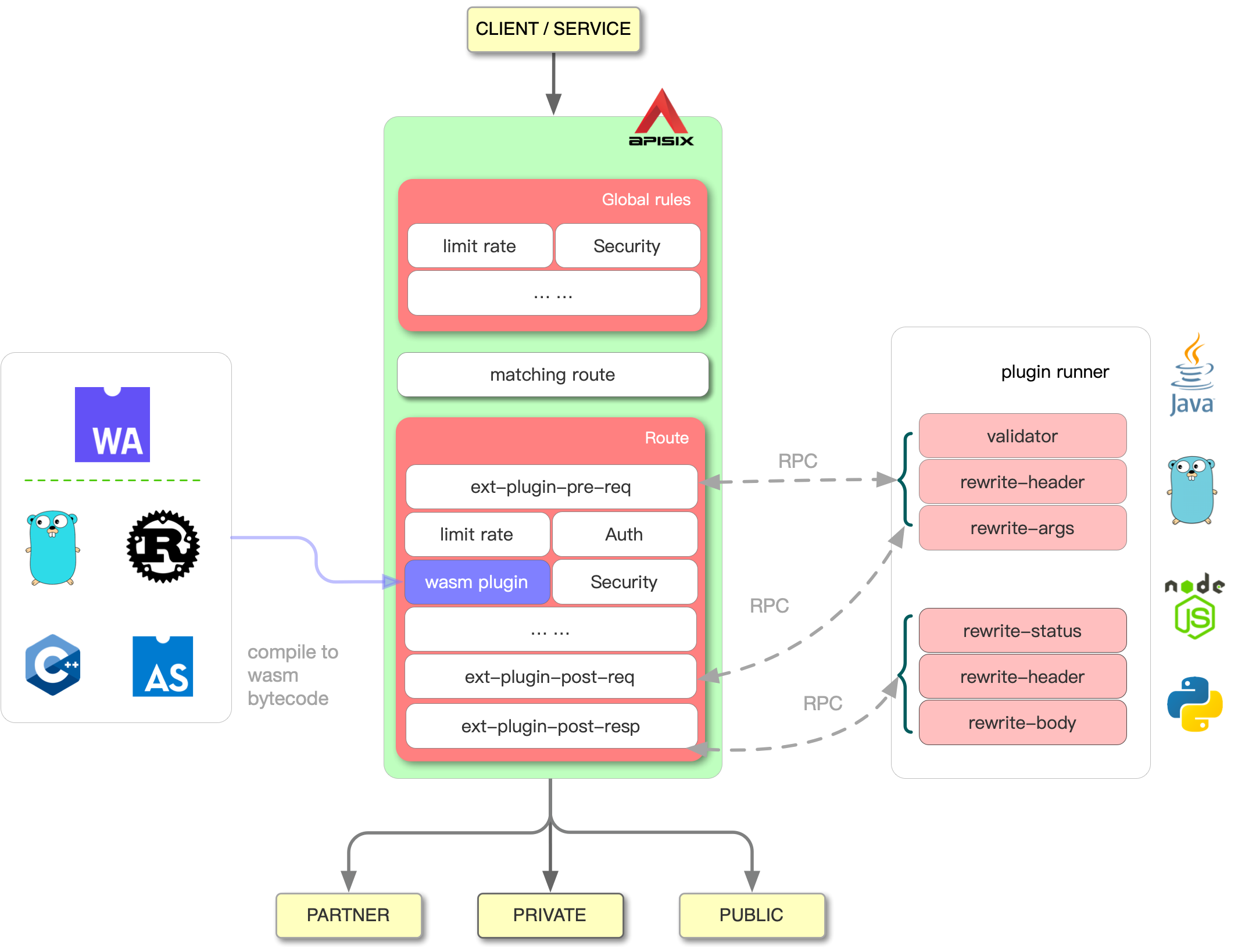
Custom plugins: Allows hooking of common phases, such as rewrite, access, header filter, body filter and log, also allows to hook the balancer stage.
Plugin can be written in Java/Go/Python
Plugin can be written with Proxy Wasm SDK
Custom load balancing algorithms: You can use custom load balancing algorithms during the balancer phase.
Custom routing: Support users to implement routing algorithms themselves.
Multi-Language support
Apache APISIX is a multi-language gateway for plugin development and provides support via RPC and Wasm.
The RPC way, is the current way. Developers can choose the language according to their needs and after starting an independent process with the RPC, it exchanges data with APISIX through local RPC communication. Till this moment, APISIX has support for Java, Golang, Python and Node.js.
The Wasm or WebAssembly, is an experimental way. APISIX can load and run Wasm bytecode via APISIX wasm plugin written with the Proxy Wasm SDK. Developers only need to write the code according to the SDK and then compile it into a Wasm bytecode that runs on Wasm VM with APISIX.
Serverless
Lua functions: Invoke functions in each phase in APISIX.
AWS Lambda: Integration with AWS Lambda function as a dynamic upstream to proxy all requests for a particular URI to the AWS API gateway endpoint. Supports authorization via api key and AWS IAM access secret.
Azure Functions: Seamless integration with Azure Serverless Function as a dynamic upstream to proxy all requests for a particular URI to the Microsoft Azure cloud.
Apache OpenWhisk: Seamless integration with Apache OpenWhisk as a dynamic upstream to proxy all requests for a particular URI to your own OpenWhisk cluster.
Benchmark
Using AWS's eight-core server, APISIX's QPS reaches 140,000 with a latency of only 0.2 ms.
Benchmark script has been open sourced, welcome to try and contribute.
APISIX also works perfectly in AWS graviton3 C7g.
Community
Kindly Write a Review for APISIX in G2.
Mailing List: Mail to [email protected], follow the reply to subscribe to the mailing list.
Slack Workspace - invitation link (Please open an issue if this link is expired), and then join the #apisix channel (Channels -> Browse channels -> search for "apisix").
- follow and interact with us using hashtag #ApacheAPISIX
Documentation
Discussions
Blog
User Stories
European eFactory Platform: API Security Gateway – Using APISIX in the eFactory Platform
Copernicus Reference System Software
More Stories
Who Uses APISIX API Gateway?
A wide variety of companies and organizations use APISIX API Gateway for research, production and commercial product, below are some of them:
apache/apisix có 17.0k sao GitHub — tải lại trang để xem số mới nhất, hoặc xem trực tiếp github.com/apache/apisix. TopGit phản chiếu số sao của GitHub nhưng không cam kết đến từng phút.
apache/apisix có phải mã nguồn mở không?
Có — apache/apisix phát hành theo license Apache-2.0, nghĩa là mã nguồn mở để đọc, fork và (tùy license) tái sử dụng. Mã: github.com/apache/apisix.
apache/apisix còn đang phát triển không?
Commit gần nhất trên apache/apisix là 23 ngày trước (theo timestamp GitHub). Repo có 2.9k fork — một chỉ báo về mức độ quan tâm của cộng đồng.
apache/apisix dùng license gì?
apache/apisix phát hành theo license Apache-2.0. Nên mở file LICENSE trên GitHub để xác nhận — license metadata đôi khi lệch với thực tế dự án.
apache/apisix là gì?
apache/apisix (apache/apisix) là dự án Lua trên GitHub. Theo mô tả gốc: The Cloud-Native API Gateway and AI Gateway
apache/apisix viết bằng ngôn ngữ gì?
apache/apisix chủ yếu viết bằng Lua. Trường "language" của GitHub dựa trên phần lớn byte ở nhánh mặc định.
Cùng nhóm Developer Tools còn repo nào?
apache/apisix thuộc nhóm Developer Tools trên TopGit, cùng 19 topic GitHub. Trang Trending và Topics liệt kê các repo cùng số sao và cùng ngôn ngữ để so sánh.
Đọc thêm về apache/apisix ở đâu?
Trang TopGit này là một snapshot — tab "Readme" hiển thị nguyên văn README của repo (đã bỏ link, giữ ảnh). Repo GitHub ở github.com/apache/apisix là nguồn chính thức.
Đọc đầy đủ README ở tab phía trên.
Vẫn đang phân vân về apisix?
Một cú bấm sẽ gửi câu hỏi kèm trang này cho AI — xem AI nói gì về apisix.
 /apisix








 - follow and interact with us using hashtag