apache/fory


4.4k sao GitHub và vẫn tăng — apache/fory là dự án Java mà TopGit đang theo dõi trên nền tảng. A blazingly fast multi-language serialization framework for idiomatic domain objects, schema IDL, and cross-language data exchange.
Tóm tắt dựng từ metadata GitHub của chính dự án — chưa có bài review TopGit. Trang sẽ tự động cập nhật khi bài review đầy đủ được xuất bản.
TopGit viết bài đầy đủ cho repo có nhiều sao nhất và được yêu cầu nhiều nhất. Trang này là snapshot trong thời gian chờ — xem README gốc ở tab READ ME.
Snapshot
Cộng tác viên hàng đầu
Xem cộng tác viên hàng đầu










Apache Fory™ is a blazingly fast multi-language serialization framework for idiomatic domain objects, schema IDL, and cross-language data exchange.
https://fory.apache.org
Why Fory
Fory is built for fast, compact serialization across languages and implementations. It works with idiomatic objects in each language, supports shared schemas when you need a contract, and preserves object features such as shared and circular references.
- Efficient Cross-Language Encoding: Exchange payloads across supported languages with compact binary encoding, metadata packing, schema evolution, shared/circular references, and polymorphic runtime types.
- Domain Objects First: Serialize Java classes, Python dataclasses, Go structs, Rust/C++ structs, and generated or annotated model types directly. Preserve shared and circular references when object identity matters.
- Reference-Aware Schema IDL: Support shared and circular references directly in the schema, alongside numbers, strings, lists, maps, arrays, enums, structs, and unions. Define schemas once, then generate native domain objects for each language without forcing wrapper types into user code.
- Optimized Implementations: Java JIT serializers and generated/static serializers in other language implementations keep hot paths fast and payloads compact.
- Language And Platform Support: Java, Python, C++, Go, Rust, JavaScript/TypeScript, C#, Swift, Dart, Scala, and Kotlin, including GraalVM native image, Android, Dart VM/Flutter/web, and Node.js/browser JavaScript.
For same-language workloads, Fory provides native serialization modes that support broader language-specific object models:
- Java Native Serialization: A high-performance replacement for JDK serialization, Hessian, Kryo, and FST in Java-only systems. It supports JDK custom serialization semantics.
- Python Native Serialization: A faster and more compact replacement for
pickleandcloudpicklein Python-only systems. It supports classes, modules, functions, and custom object state, with fine-grained deserialization controls throughDeserializationPolicy.
Fory also provides specialized formats for other data-processing requirements:
- Row Format: Read fields, arrays, and nested values without rebuilding complete objects, with zero-copy access and partial reads.
- Fory JSON: A Java JSON serialization framework built for maximum throughput through runtime-generated codecs and optimized readers and writers. Supports Java 8 and later on standard JDKs, GraalVM native images, and Android, including Java 17 records.
Performance
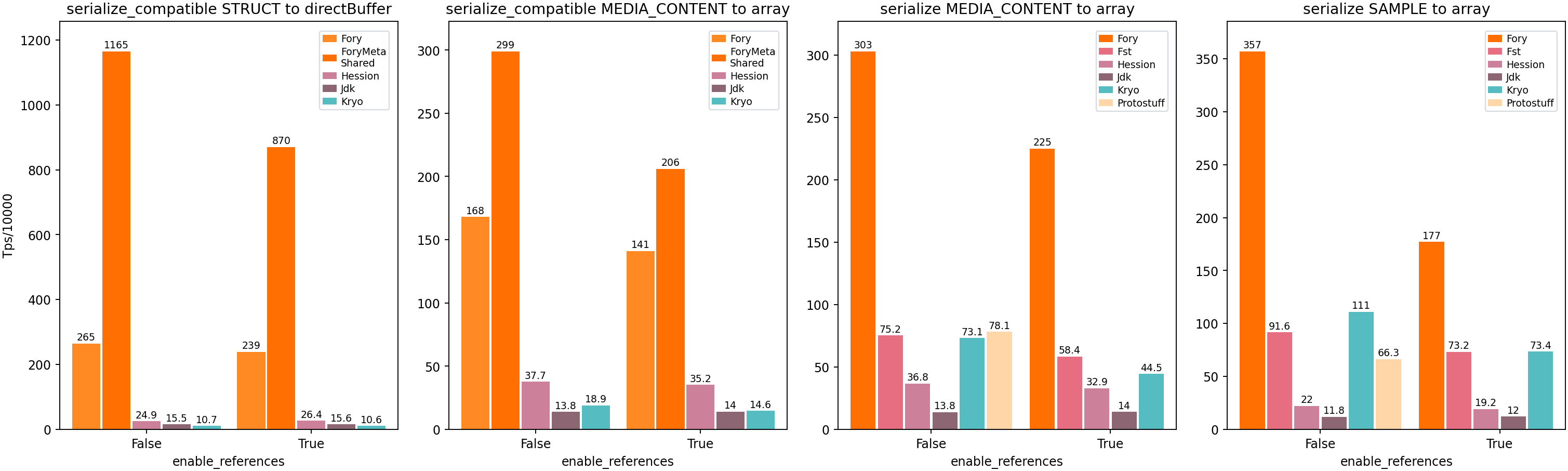
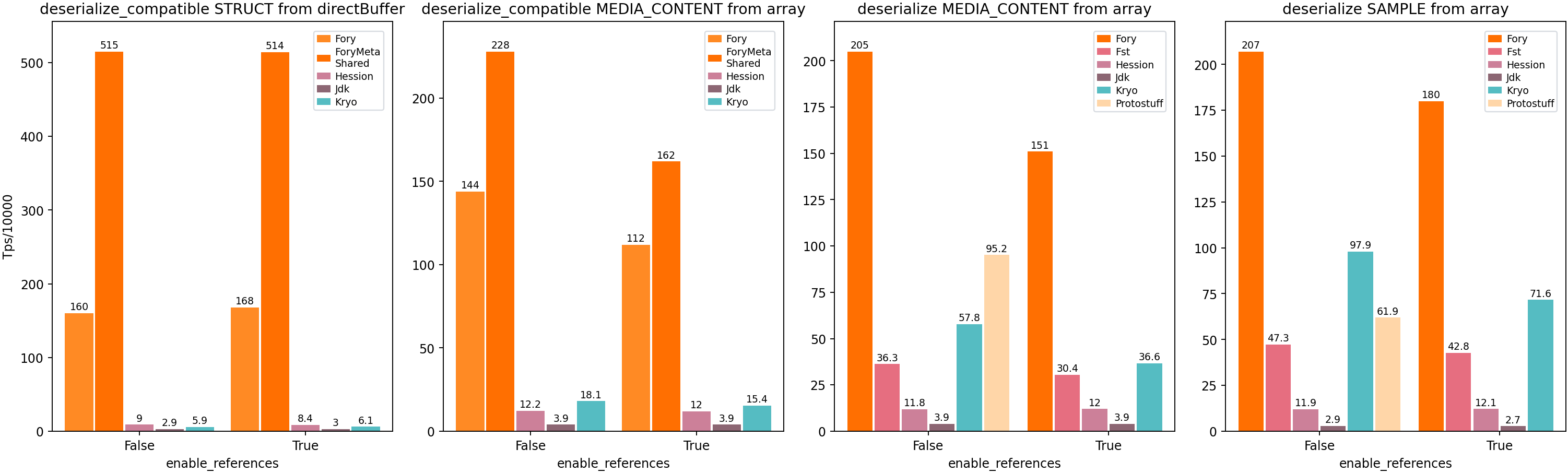
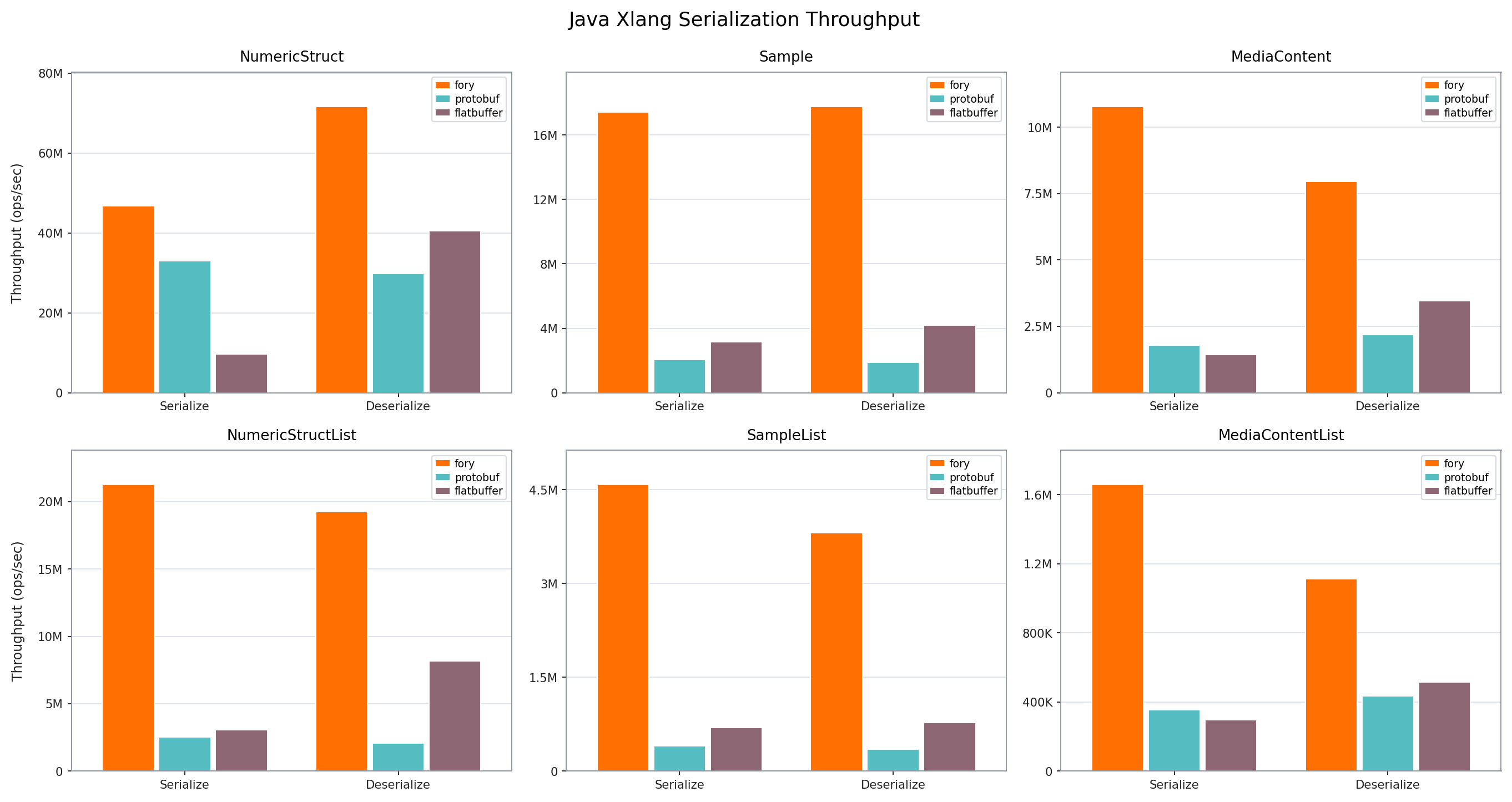
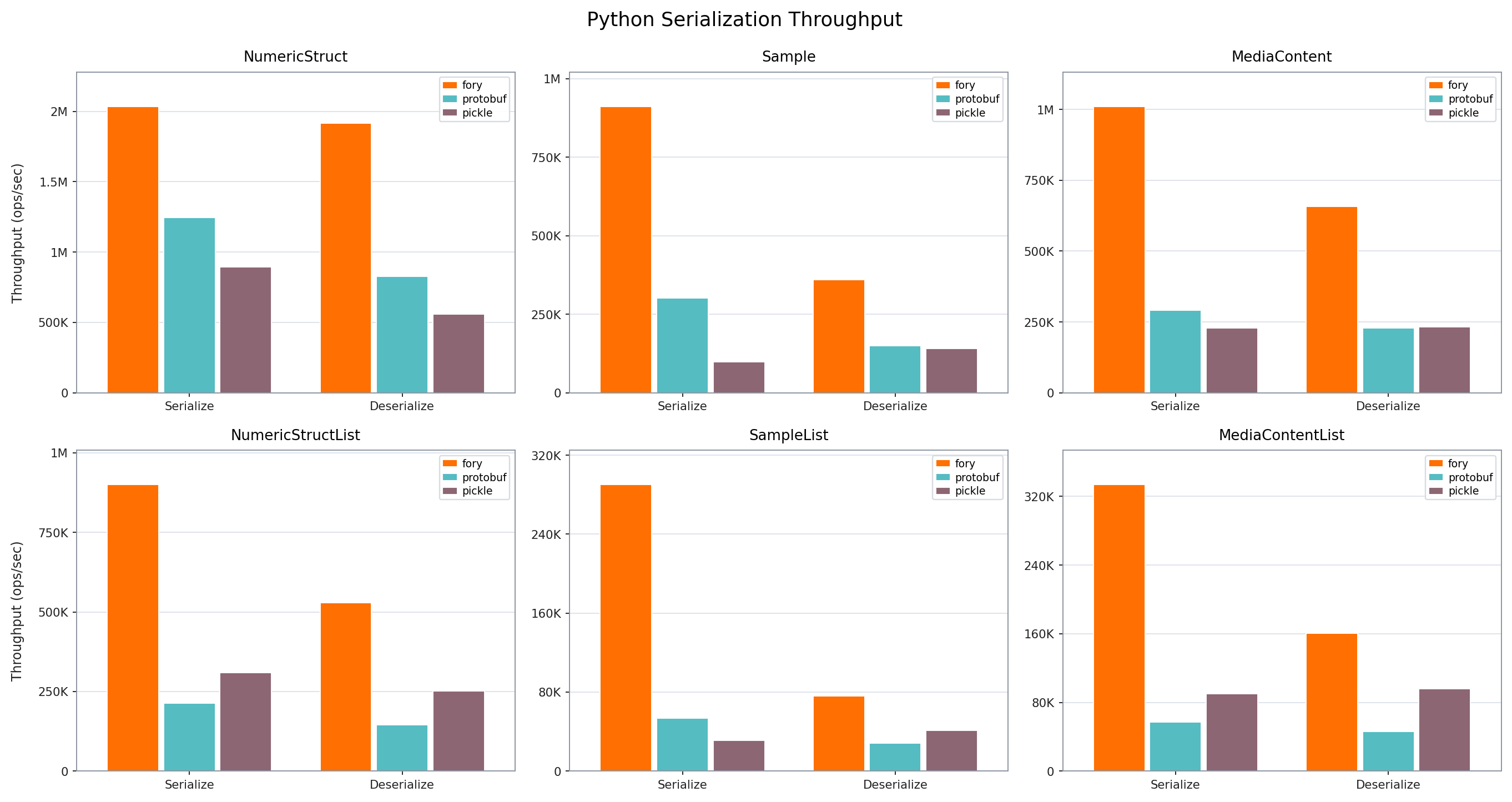
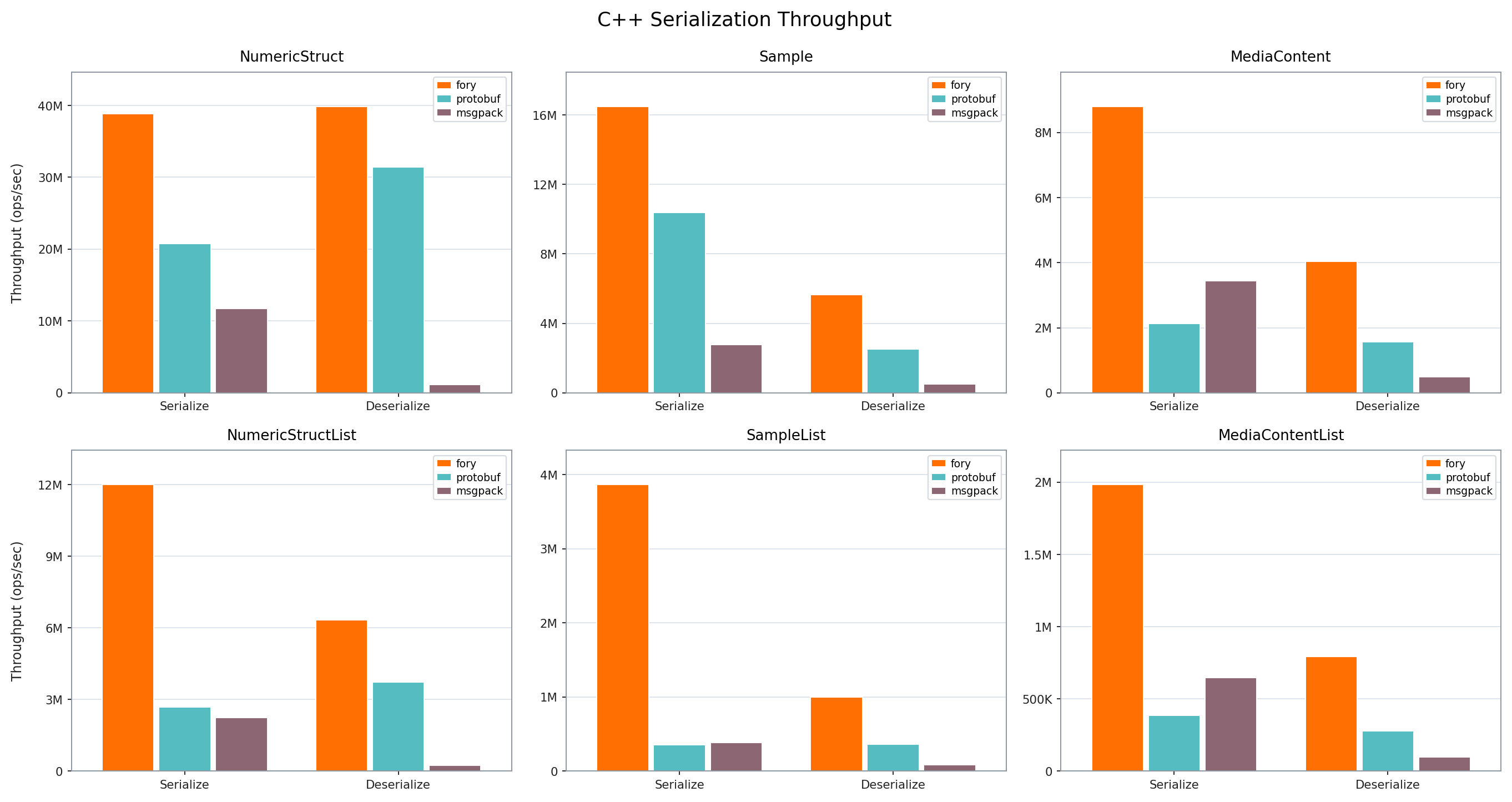
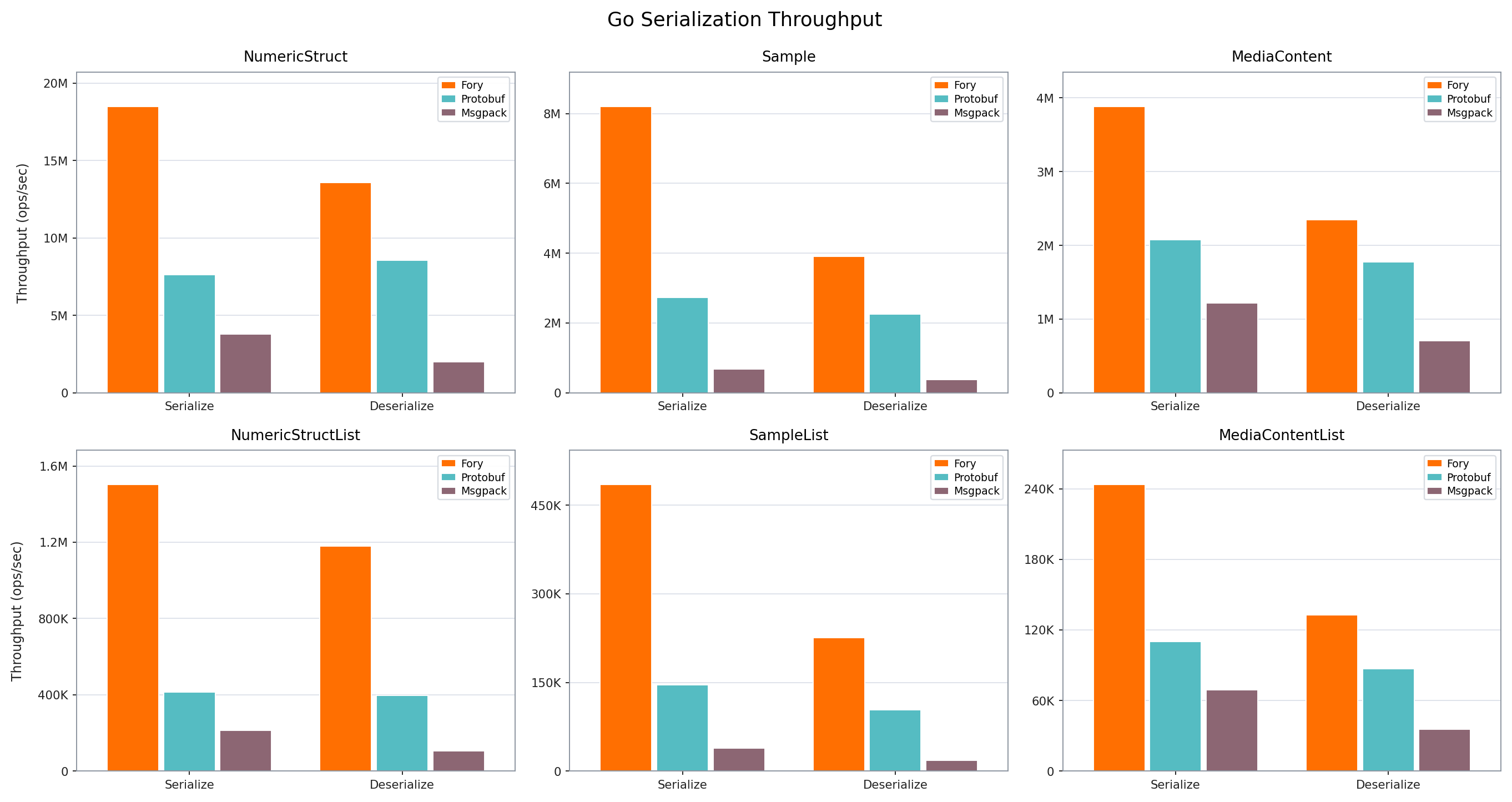
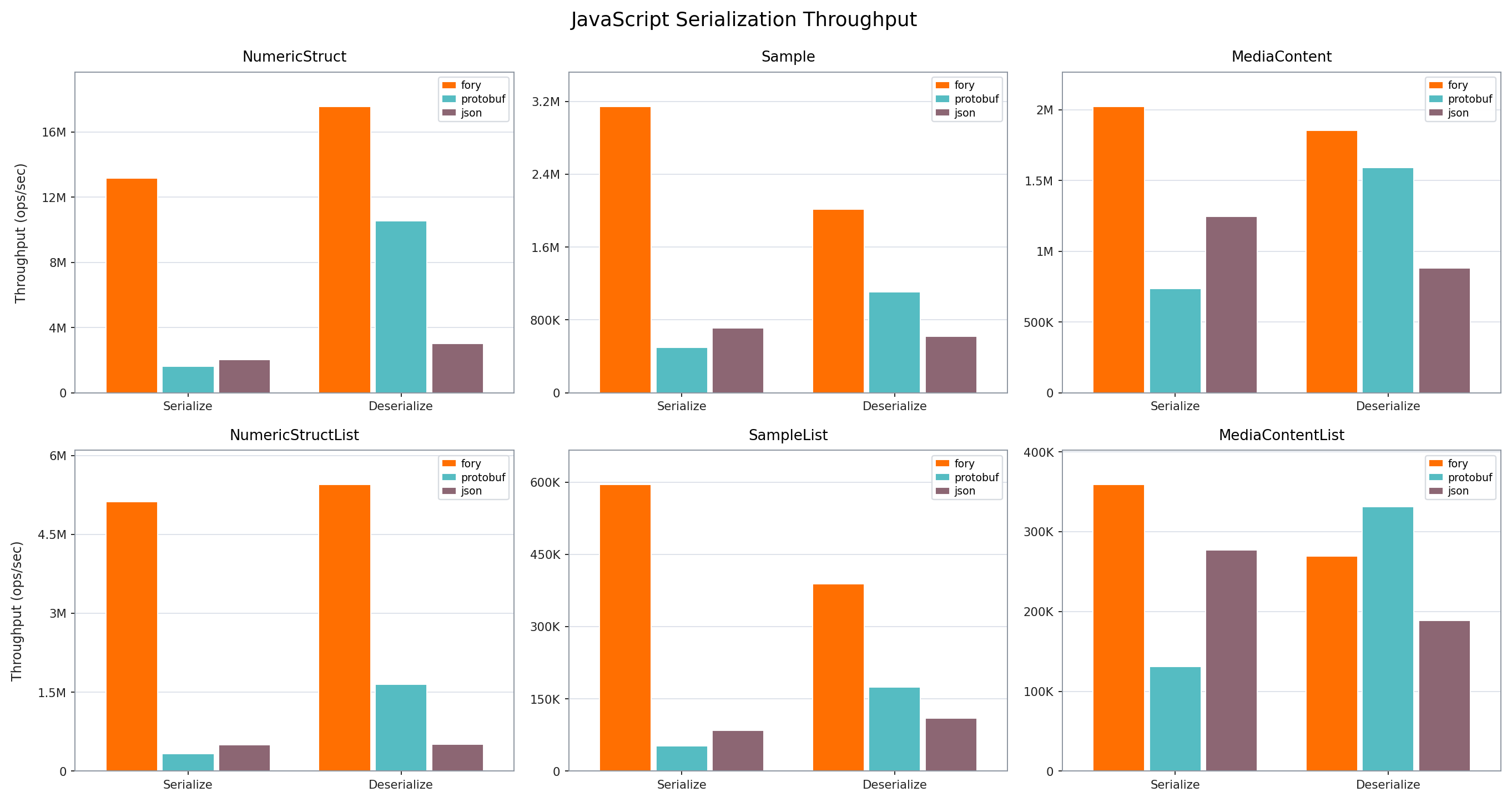
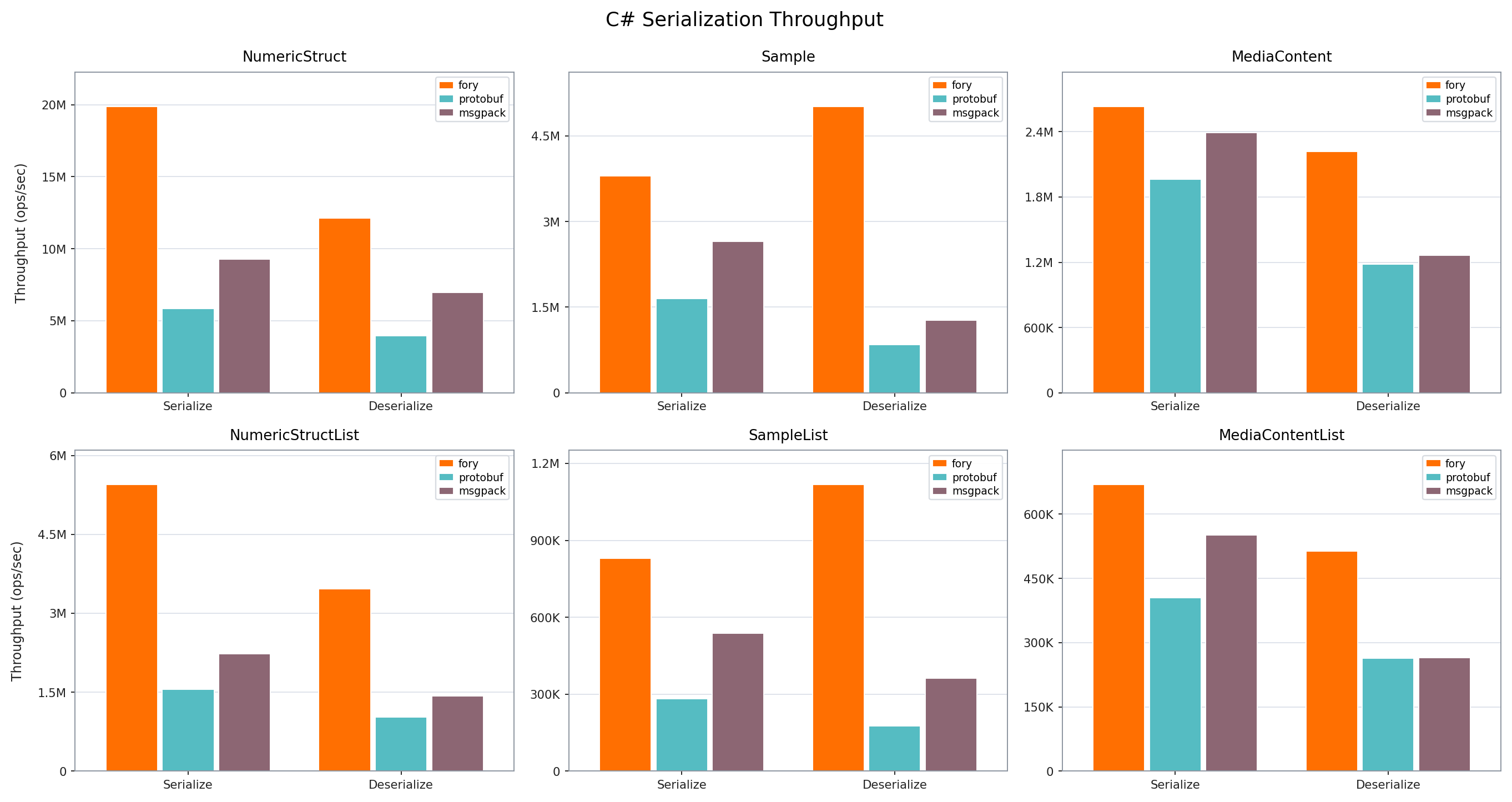
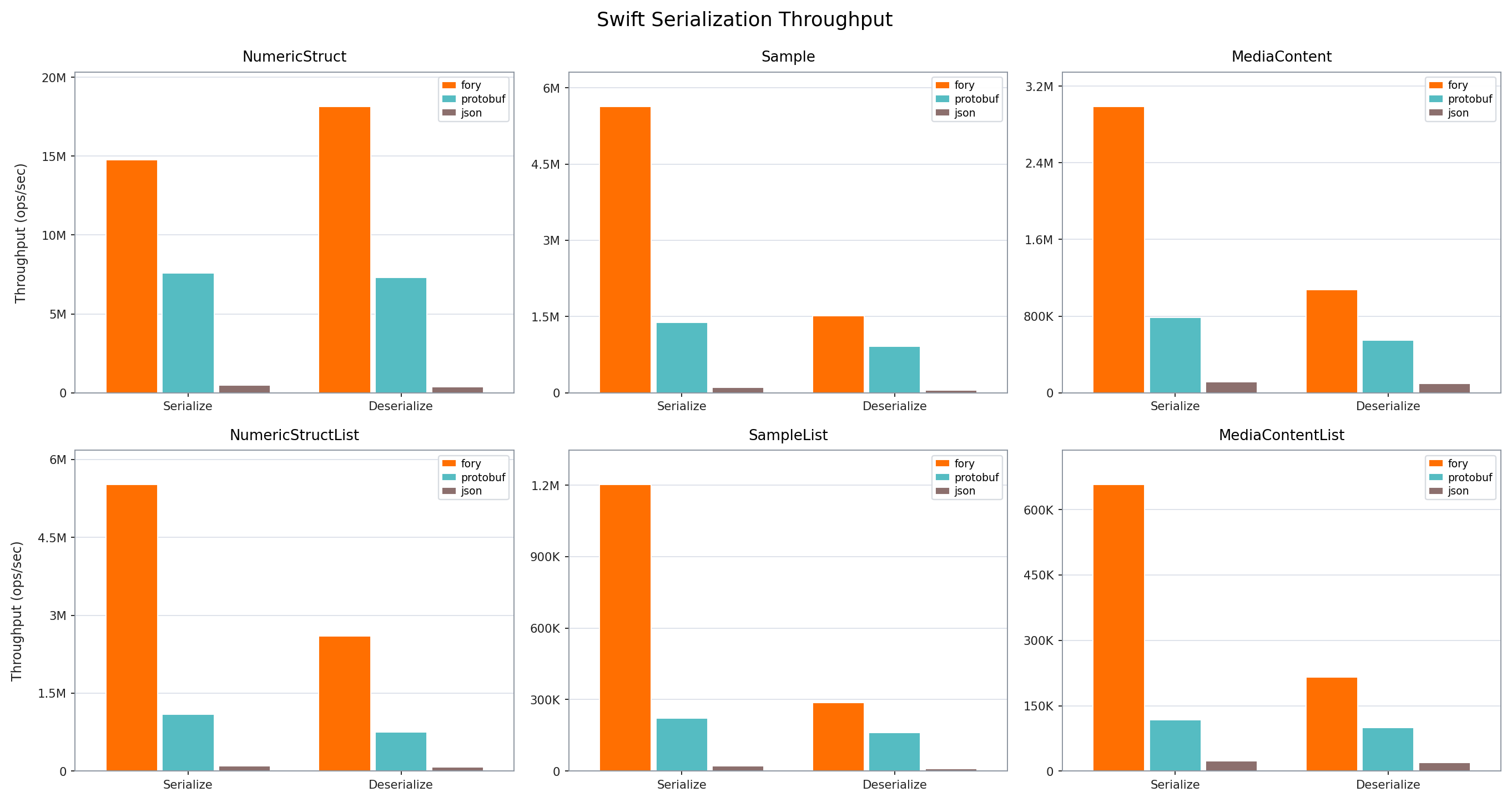
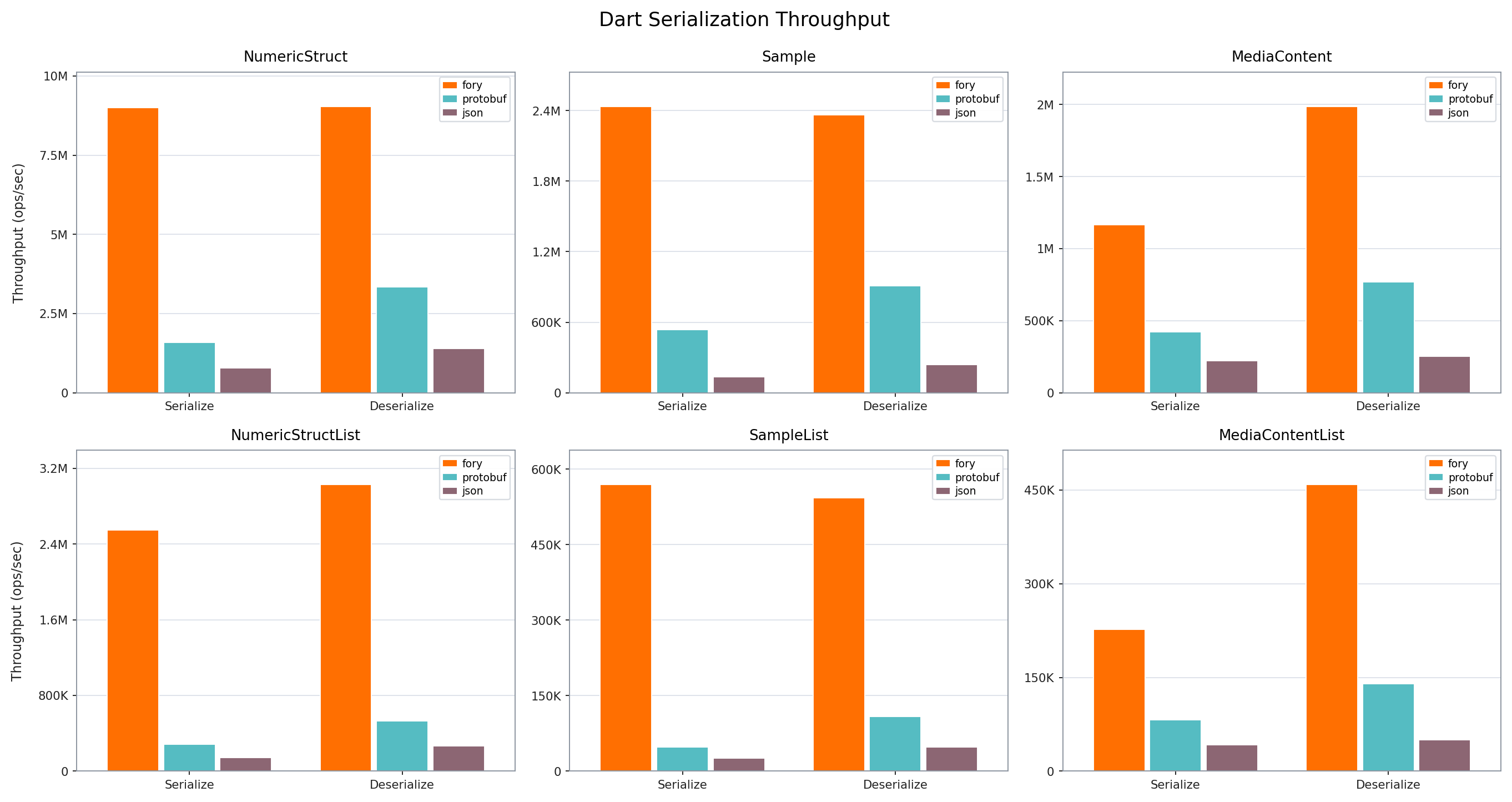
Benchmarks show Fory delivering higher throughput and smaller serialized payloads than common serialization frameworks on representative workloads. Java has the broadest comparison set; the other charts show language-specific results across supported languages.
Java Benchmarks
In Java serialization benchmarks, Fory reaches up to 170x the throughput of JDK serialization on selected workloads.
Python Benchmarks
Rust Benchmarks
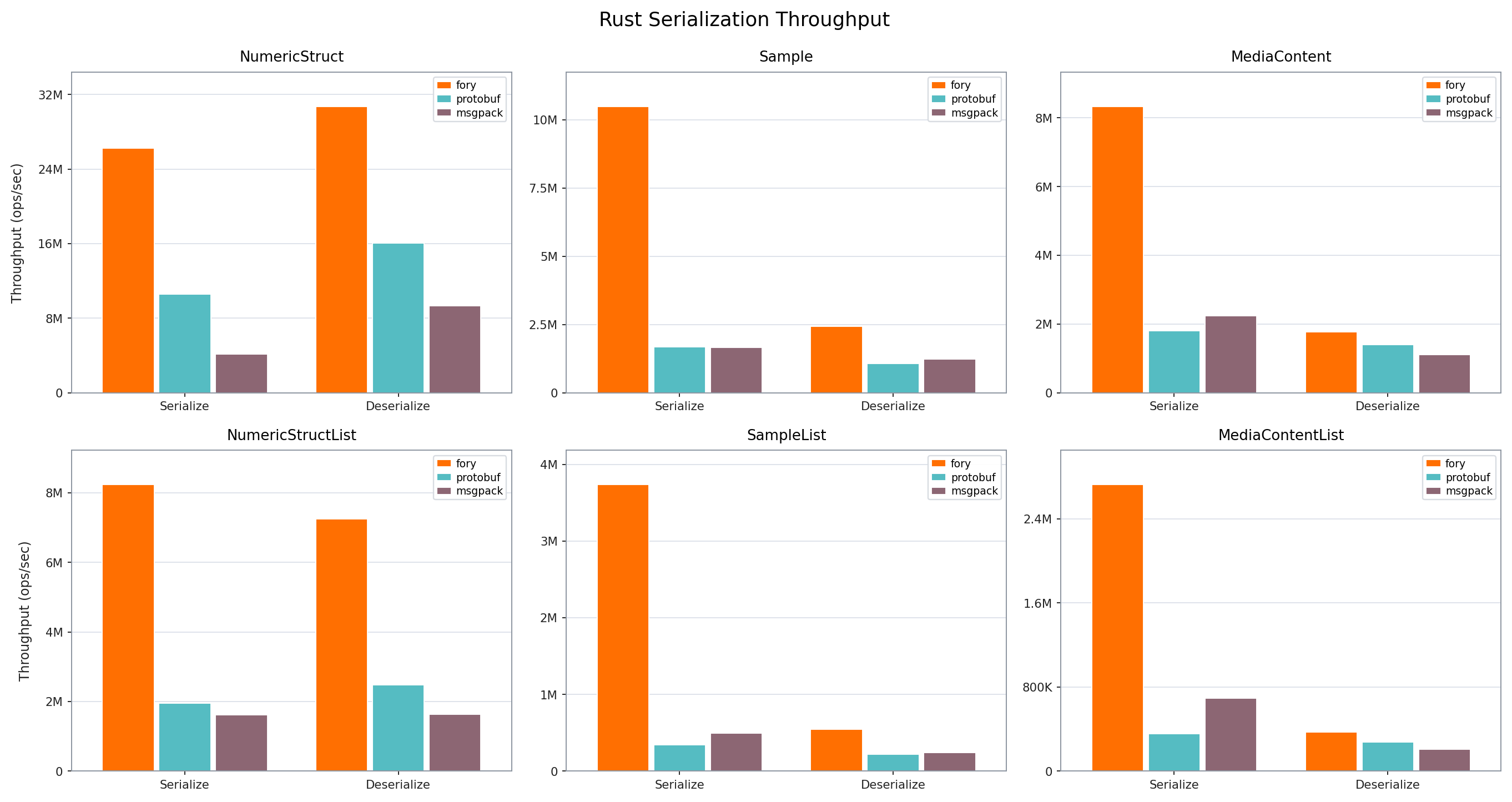
Benchmarks for C++, Go, JavaScript/TypeScript, C#, Swift, and Dart
C++ Benchmarks
Go Benchmarks
JavaScript/TypeScript Benchmarks
C# Benchmarks
Swift Benchmarks
Dart Benchmarks
Installation
Pick your language and run the package-manager command, or paste the dependency block into your build file.
Java
Maven:
<dependency>
  <groupId>org.apache.fory</groupId>
  <artifactId>fory-core</artifactId>
  <version>1.6.0</version>
</dependency>
Gradle:
implementation "org.apache.fory:fory-core:1.6.0"
On JDK25+, opening java.lang.invoke to Fory core is also recommended. It avoids the
current-JDK Unsafe fallback and is required when Unsafe access is disabled or unavailable, including
with --sun-misc-unsafe-memory-access=deny. Use ALL-UNNAMED when Fory is on the classpath:
--add-opens=java.base/java.lang.invoke=ALL-UNNAMED
Use the Fory core module name when Fory is on the module path:
--add-opens=java.base/java.lang.invoke=org.apache.fory.core
Scala
sbt:
libraryDependencies += "org.apache.fory" %% "fory-scala" % "1.6.0"
Kotlin
Gradle:
implementation("org.apache.fory:fory-kotlin:1.6.0")
Maven:
<dependency>
  <groupId>org.apache.fory</groupId>
  <artifactId>fory-kotlin</artifactId>
  <version>1.6.0</version>
</dependency>
Python
pip install pyfory
For row-format support:
pip install "pyfory[format]"
Rust
Cargo.toml:
[dependencies]
fory = "1.6.0"
C++
CMake:
include(FetchContent)
FetchContent_Declare(
  fory
  GIT_REPOSITORY https://github.com/apache/fory.git
  GIT_TAG v1.6.0
  SOURCE_SUBDIR cpp
)
FetchContent_MakeAvailable(fory)
target_link_libraries(my_app PRIVATE fory::serialization)
Bazel:
# MODULE.bazel
bazel_dep(name = "fory", version = "1.6.0")
git_override(module_name = "fory", remote = "https://github.com/apache/fory.git", commit = "v1.6.0")

# BUILD
deps = ["@fory//cpp/fory/serialization:fory_serialization"]
When building C++ with MSVC, enable the conforming preprocessor option
/Zc:preprocessor; see the C++ installation guide for setup details.
See the C++ installation guide for complete CMake, Bazel, and source-build details.
Go
go get github.com/apache/fory/go/fory
JavaScript/TypeScript
npm install @apache-fory/core
For the Node.js string fast path:
npm install @apache-fory/core @apache-fory/hps
C#
dotnet add package Apache.Fory --version 1.6.0
Dart
dart pub add fory:^1.6.0
dart pub add dev:build_runner
Swift
Add Fory to Package.swift:
dependencies: [
  .package(url: "https://github.com/apache/fory.git", exact: "1.6.0")
],
targets: [
  .target(
    name: "YourTarget",
    dependencies: [.product(name: "Fory", package: "fory")]
  )
]
See the Swift guide for generated serializer setup.
Development From Source
See docs/development/index.md.
Snapshots for Java, Scala, and Kotlin are available from
https://repository.apache.org/snapshots/ with the matching -SNAPSHOT version.
Choose a Serialization Format
| Format | Use it when | Start here |
|---|---|---|
| Xlang binary (default) | Data crosses language boundaries | Cross-language interoperability |
| Native binary | Producer and consumer are in the same runtime family | Native guide |
| Row format | You need random field access or analytics-style partial reads | Row Format |
| Fory JSON | Java applications need high-performance standard JSON | Fory JSON |
For Java, Scala, Kotlin, Python, C++, Go, and Rust, use native mode for same-language traffic. It avoids xlang's cross-language type mapping and metadata constraints, stays closer to each language's native type system, and supports broader language-specific object graphs. Use it when both producer and consumer are in the same language family and you want the native object model rather than a portable cross-language schema.
For Java/JVM-only systems, native mode is the replacement path for JDK serialization, Kryo, FST, Hessian, and Java-only Protocol Buffers payloads. For Python-only systems, native mode is the replacement path for pickle and cloudpickle.
Compatible mode is Fory's schema-evolution mode. It writes the metadata readers and writers need to tolerate schema differences. It is the default for xlang mode and native mode in implementations that expose the option.
Use compatible mode when services deploy independently or when fields may be
added or deleted over time. Set compatible mode to false only when every reader
and writer always uses the same schema and you want faster serialization and
smaller size. For xlang payloads, set compatible mode to false only after
verifying that every language uses the same schema, or when native types are
generated from Fory schema IDL.
For xlang, all peers must agree on type identity. Name-based registration is easier to read in examples. Numeric IDs are smaller and faster, but they require coordination across every reader and writer.
Cross-Language Serialization
Xlang mode writes the cross-language Fory wire format. Bytes produced by one language implementation can be read by another when every peer uses the same type identity, compatible mode setting, and field schema.
Java
import org.apache.fory.Fory;

public class Example {
  public static class Person {
    public String name;
    public int age;
  }

  public static void main(String[] args) {
    Fory fory = Fory.builder().withXlang(true).build();
    fory.register(Person.class, "example.Person");

    Person person = new Person();
    person.name = "Alice";
    person.age = 30;

    byte[] bytes = fory.serialize(person);
    Person decoded = (Person) fory.deserialize(bytes);
    System.out.println(decoded.name);
  }
}
Python
from dataclasses import dataclass

import pyfory

@dataclass
class Person:
    name: str
    age: pyfory.Int32

fory = pyfory.Fory(xlang=True)
fory.register_type(Person, name="example.Person")

data = fory.serialize(Person("Alice", 30))
person = fory.deserialize(data)
print(person.name)
Go
package main

import (
    "fmt"

    "github.com/apache/fory/go/fory"
)

type Person struct {
    Name string
    Age  int32
}

func main() {
    f := fory.New(fory.WithXlang(true))
    if err := f.RegisterStructByName(Person{}, "example.Person"); err != nil {
        panic(err)
    }

    data, _ := f.Serialize(&Person{Name: "Alice", Age: 30})
    var person Person
    if err := f.Deserialize(data, &person); err != nil {
        panic(err)
    }
    fmt.Println(person.Name)
}
Rust
use fory::{Error, Fory, ForyStruct};

#[derive(ForyStruct, Debug, PartialEq)]
struct Person {
    name: String,
    age: i32,
}

fn main() -> Result<(), Error> {
    let mut fory = Fory::builder().xlang(true).build();
    fory.register_by_name::<Person>("example.Person")?;

    let bytes = fory.serialize(&Person {
        name: "Alice".to_string(),
        age: 30,
    })?;
    let person: Person = fory.deserialize(&bytes)?;
    println!("{}", person.name);
    Ok(())
}
C++
#include "fory/serialization/fory.h"
#include <cstdint>
#include <iostream>
#include <string>

using namespace fory::serialization;

struct Person {
  std::string name;
  int32_t age;
};
FORY_STRUCT(Person, name, age);

int main() {
  auto fory = Fory::builder().xlang(true).build();
  fory.register_struct<Person>("example.Person");

  auto bytes = fory.serialize(Person{"Alice", 30}).value();
  Person person = fory.deserialize<Person>(bytes).value();
  std::cout << person.name << std::endl;
}
JavaScript/TypeScript
import Fory, { Type } from "@apache-fory/core";

const personType = Type.struct(
  { typeName: "example.Person" },
  {
    name: Type.string(),
    age: Type.int32(),
  },
);

const fory = new Fory();
const { serialize, deserialize } = fory.register(personType);

const bytes = serialize({ name: "Alice", age: 30 });
const person = deserialize(bytes);
console.log(person.name);
C#
using Apache.Fory;

[ForyStruct]
public sealed class Person
{
    public string Name { get; set; } = string.Empty;
    public int Age { get; set; }
}

Fory fory = Fory.Builder().Build();
fory.Register<Person>("example", "Person");

byte[] bytes = fory.Serialize(new Person { Name = "Alice", Age = 30 });
Person person = fory.Deserialize<Person>(bytes);
Console.WriteLine(person.Name);
C# always writes the xlang frame header, so there is no separate xlang builder flag.
Dart
import 'package:fory/fory.dart';

part 'person.fory.dart';

@ForyStruct()
class Person {
  Person();

  String name = '';

  @ForyField(type: Int32Type())
  int age = 0;
}

void main() {
  final fory = Fory();
  PersonFory.register(
    fory,
    Person,
    name: 'example.Person',
  );

  final bytes = fory.serialize(Person()
    ..name = 'Alice'
    ..age = 30);
  final person = fory.deserialize<Person>(bytes);
  print(person.name);
}
Dart uses the xlang wire format directly. Generate the companion file before running:
dart run build_runner build
Swift
import Fory

@ForyStruct
struct Person {
    var name: String = ""
    var age: Int32 = 0
}

let fory = Fory()
try fory.register(Person.self, name: "example.Person")

let bytes = try fory.serialize(Person(name: "Alice", age: 30))
let person: Person = try fory.deserialize(bytes)
print(person.name)
Scala
import org.apache.fory.scala.ForyScala

case class Person(name: String, age: Int)

val fory = ForyScala.builder().withXlang(true).build()
fory.register(classOf[Person], "example.Person")

val bytes = fory.serialize(Person("Alice", 30))
val person = fory.deserialize(bytes).asInstanceOf[Person]
println(person.name)
Kotlin
import org.apache.fory.kotlin.ForyKotlin

data class Person(val name: String, val age: Int)

fun main() {
    val fory = ForyKotlin.builder().withXlang(true).build()
    fory.register(Person::class.java, "example.Person")

    val bytes = fory.serialize(Person("Alice", 30))
    val person = fory.deserialize(bytes) as Person
    println(person.name)
}
For shared/circular references, polymorphism, numeric IDs versus names, and type-mapping rules, see the cross-language guide and type mapping specification.
Native Serialization
Use native mode when the writer and reader are in the same language. It is
optimized for each language's native type system and can cover language-specific
types, object graphs, and framework-replacement cases that xlang mode keeps out
of the portable wire format. The languages below expose an explicit
xlang=false or native-mode setting; implementations without that switch stay on their
documented default path.
Choose Java native mode for Java/JVM-only replacements of JDK serialization, Kryo, FST, Hessian, or Java-only Protocol Buffers payloads. Choose Python native mode when replacing pickle or cloudpickle for Python-only payloads.
Keep class/type registration enabled for untrusted input. See the language guides for language-specific security and compatibility settings.
Java
Fory fory = Fory.builder()
    .withXlang(false)
    .requireClassRegistration(true)
    .build();
// Register, serialize, and deserialize as in the xlang example above.
Python
fory = pyfory.Fory(xlang=False, ref=True)
# Register, serialize, and deserialize as in the xlang example above.
Go
f := fory.New(fory.WithXlang(false))
// Register, serialize, and deserialize as in the xlang example above.
Rust
let mut fory = Fory::builder().xlang(false).build();
// Register, serialize, and deserialize as in the xlang example above.
C++
auto fory = Fory::builder().xlang(false).build();
// Register, serialize, and deserialize as in the xlang example above.
Scala
import org.apache.fory.scala.ForyScala

val fory = ForyScala.builder()
  .withXlang(false)
  .requireClassRegistration(true)
  .build()
// Register, serialize, and deserialize as in the xlang example above.
Kotlin
import org.apache.fory.kotlin.ForyKotlin

val fory = ForyKotlin.builder()
    .withXlang(false)
    .requireClassRegistration(true)
    .build()
// Register, serialize, and deserialize as in the xlang example above.
Schema IDL
Fory IDL is Fory's schema-first path for shared data models. Use it when multiple languages need one explicit contract, stable field identities, and generated native domain objects instead of manually coordinating equivalent types in every implementation.
The schema supports primitive values, nullable fields, lists, maps, dense arrays, enums, messages, unions, imports, and first-class shared or circular references. The compiler generates idiomatic models and Fory integration for Java, Python, C++, Go, Rust, JavaScript/TypeScript, C#, Swift, Dart, Scala, and Kotlin. It can also generate Fory-backed gRPC service companions for supported languages.
Install the compiler from PyPI:
pip install fory-compiler
Define the shared model in tree.fdl:
package tree;

message TreeNode {
    string id = 1;
    string name = 2;

    list<ref TreeNode> children = 3;
    ref(weak=true) TreeNode parent = 4; // back-pointer
}
Generate native models for the languages used by your application:
foryc tree.fdl --lang java,python,rust --output ./generated
Generated types use each language's normal classes, structs, dataclasses, annotations, macros, or registration helpers, so application code works with native domain objects while all peers share the same Fory schema. See the Fory IDL and compiler guide for the complete type system, language-specific output options, schema evolution, and gRPC generation.
Row Format
Row format is for random access and partial reads. These examples encode an object with an integer array field, then read one array element from the binary row without rebuilding the object.
Python
from dataclasses import dataclass
from typing import List

import pyfory

@dataclass
class User:
    id: pyfory.Int32
    name: str
    scores: List[pyfory.Int32]

encoder = pyfory.encoder(User)
binary = encoder.to_row(User(1, "Alice", [98, 100, 95])).to_bytes()

row = pyfory.RowData(encoder.schema, binary)
print(row.name)
print(row.scores[1])
Java
public class User {
  public int id;
  public String name;
  public int[] scores;
}

RowEncoder<User> encoder = Encoders.bean(User.class);

User user = new User();
user.id = 1;
user.name = "Alice";
user.scores = new int[] {98, 100, 95};

BinaryRow row = encoder.toRow(user);

Schema schema = encoder.schema();
Schema.StringField nameField = schema.stringField("name");
Schema.ArrayField scoresField = schema.arrayField("scores");

String name = nameField.get(row);
ArrayData scores = scoresField.get(row);
int secondScore = scores.getInt32(1);
For Java imports, nested structs, arrays/maps, Arrow integration, and partial deserialization, see the Java row-format guide, Python row-format guide, C++ row-format guide, Rust row-format guide, and row-format specification.
Fory JSON
Fory JSON is a thread-safe JSON serialization framework for Java, extensively optimized for maximum performance across JSON encoding, decoding, and Java object mapping. It supports Java 8 and later on standard JDKs, GraalVM native images, and Android, with Java records supported on Java 17 and later.
Performance
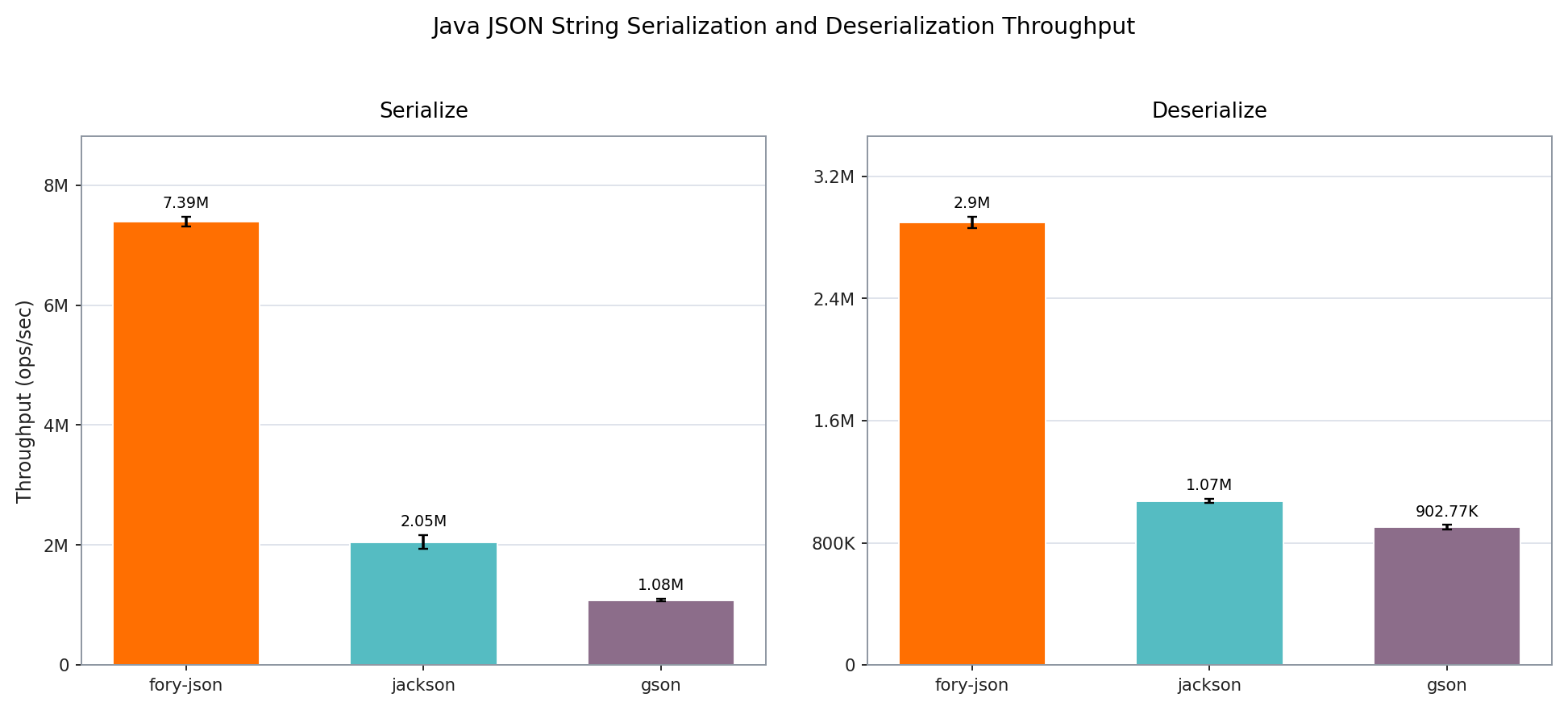
The benchmark compares fory-json with Jackson and Gson using String and UTF-8 byte APIs. The String group excludes UTF-8 conversion. Gson's byte results include its required String/UTF-8 conversion. Higher throughput is better. See the full benchmark report for more details.
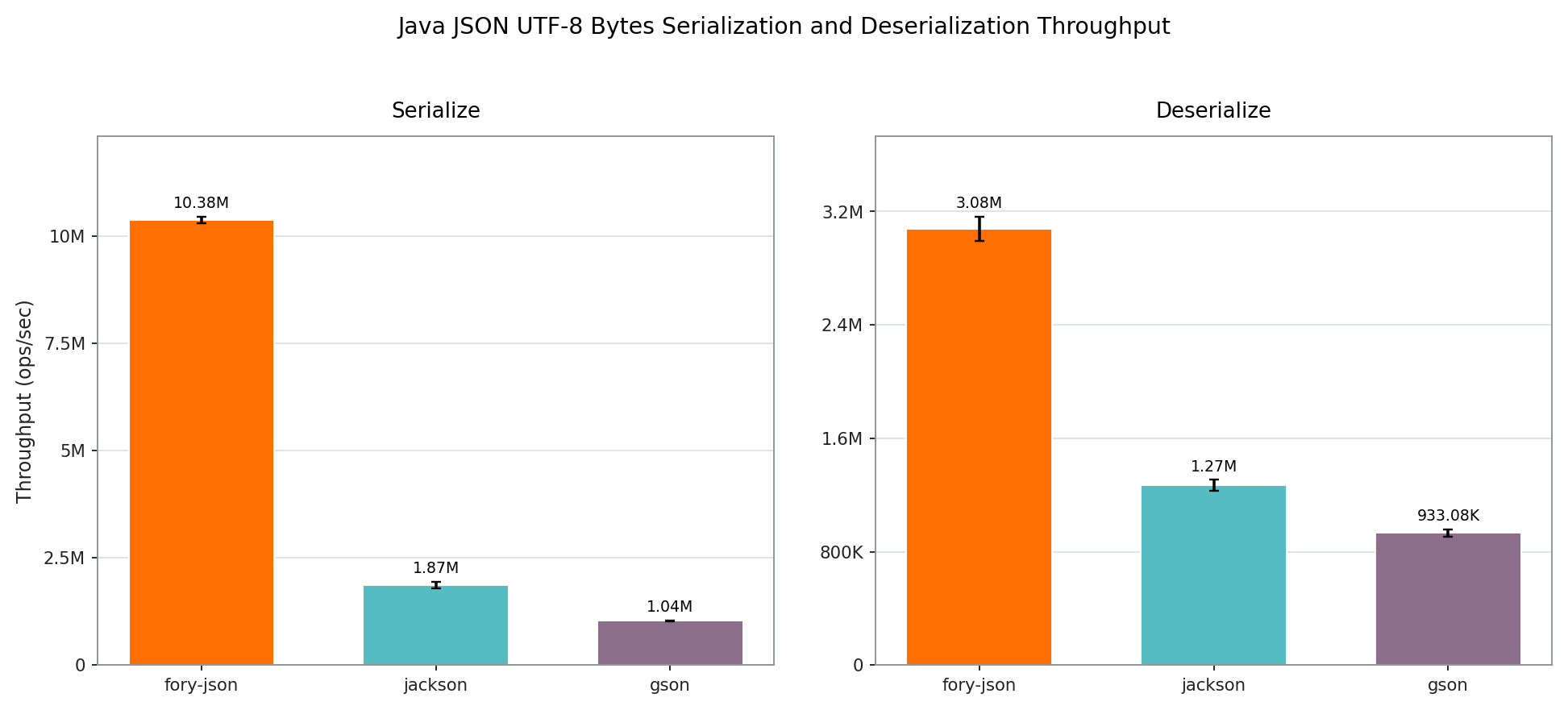
| Representation | Operation | fory-json ops/sec | Jackson ops/sec | Gson ops/sec |
|---|---|---|---|---|
| String | Serialize | 7,387,465 | 2,049,368 | 1,084,042 |
| String | Deserialize | 2,897,955 | 1,074,885 | 902,772 |
| UTF-8 bytes | Serialize | 10,375,498 | 1,868,614 | 1,037,211 |
| UTF-8 bytes | Deserialize | 3,077,158 | 1,268,397 | 933,079 |
Add Fory JSON to your project:
Maven
<dependency>
  <groupId>org.apache.fory</groupId>
  <artifactId>fory-json</artifactId>
  <version>1.6.0</version>
</dependency>
Gradle
implementation "org.apache.fory:fory-json:1.6.0"
Keep all Fory modules in the same application on the same version.
Quick Start
Build one ForyJson instance and reuse it across threads:
import org.apache.fory.json.ForyJson;

public final class JsonExample {
  private static final ForyJson JSON = ForyJson.builder().build();

  public static final class User {
    public long id;
    public String name;

    public User() {}

    public User(long id, String name) {
      this.id = id;
      this.name = name;
    }
  }

  public static void main(String[] args) {
    User input = new User(7, "Alice");

    String text = JSON.toJson(input);
    User fromText = JSON.fromJson(text, User.class);

    byte[] bytes = JSON.toJsonBytes(input);
    User fromBytes = JSON.fromJson(bytes, User.class);

    System.out.println(fromText.name + " / " + fromBytes.name);
  }
}
Start with the Fory JSON module README, then use the Fory JSON documentation for the complete mapping, annotation, codec, security, and platform guides.
Documentation
User Guides
| Guide | Source | Website |
|---|---|---|
| Java | docs/object-serialization/java | View |
| Python | docs/object-serialization/python | View |
| Rust | docs/object-serialization/rust | View |
| C++ | docs/object-serialization/cpp | View |
| Go | docs/object-serialization/go | View |
| JavaScript/TypeScript | docs/object-serialization/javascript | View |
| C# | docs/object-serialization/csharp | View |
| Swift | docs/object-serialization/swift | View |
| Dart | docs/object-serialization/dart | View |
| Scala | docs/object-serialization/scala | View |
| Kotlin | docs/object-serialization/kotlin | View |
| Cross-language xlang | docs/object-serialization/xlang.md | View |
| Schema IDL/compiler | docs/compiler | View |
| GraalVM native image | docs/object-serialization/java/graalvm.md | View |
| Android | docs/object-serialization/java/android.md | View |
| Development | docs/development/index.md | View |
Specifications
| Specification | Source | Website |
|---|---|---|
| Xlang serialization | xlang_serialization_spec.md | View |
| Java serialization | java_serialization_spec.md | View |
| Row format | row_format_spec.md | View |
| Cross-language mapping | xlang_type_mapping.md | View |
Community
- Slack workspace
- @ApacheFory on X
- GitHub issues
- Apache Fory mailing lists for development discussion
Contributing
Read CONTRIBUTING.md and docs/development/index.md before sending pull requests. Bug reports, docs fixes, tests, benchmarks, and implementation improvements are welcome.
License
Apache Fory™ is licensed under the Apache License 2.0.
Repo liên quan
CS-Notes is a GitHub repository maintained by CyC2018 that collects Chinese-language study notes across ten topic areas: algorithms, operating systems, networking, object-oriented design, databases, Java, system design, tools, coding practice, and an afterword. It links each topic to standalone markdown files instead of writing everything inline, and the README says most of the content is original work rather than material copied from elsewhere.
The Algorithms - Python is an open-source collection of algorithm implementations written in Python, maintained by the TheAlgorithms organization on GitHub. The README frames the whole project as a teaching resource: the code exists to illustrate concepts, can run slower than Python's built-in equivalents, and is indexed in DIRECTORY.md for browsing. It's MIT licensed and available on GitHub.
Awesome Go, maintained at avelino/awesome-go, groups Go frameworks, libraries, and software into topic categories including Actor Model, Artificial Intelligence, Audio and Music, Authentication and Authorization, Blockchain, Bot Building, and Build Automation. Every linked entry gets a short description instead of a bare URL. The repository carries an MIT license and takes new entries through pull requests reviewed against its own contribution guidelines, which makes it a common bookmark for day-to-day Go development.
Java Design Patterns is an open-source GitHub project by iluwatar that documents design patterns as commented, working Java code rather than diagrams or prose. The repository is organized so readers can find a pattern by name, by tag such as Gang of Four or Performance, or by category, with a companion site and an optional paid e-book alongside it.
Trả lời nhanh
apache/fory có bao nhiêu sao?
apache/fory có 4.4k sao GitHub — tải lại trang để xem số mới nhất, hoặc xem trực tiếp github.com/apache/fory. TopGit phản chiếu số sao của GitHub nhưng không cam kết đến từng phút.
apache/fory có những chủ đề gì?
GitHub topics của apache/fory: "compression", "cpp", "cross-language", "encoding", "fast", "golang", "hacktoberfest", "java", "javascript", "jit", "lightning", "marshalling", "multiple-language", "persistence", "python", "rpc", "rust", "serialization", "transfer", "zero-copy". TopGit xếp repo vào nhóm Backend.
apache/fory còn đang phát triển không?
Commit gần nhất trên apache/fory là 20 ngày trước (theo timestamp GitHub). Repo có 427 fork — một chỉ báo về mức độ quan tâm của cộng đồng.
apache/fory viết bằng ngôn ngữ gì?
apache/fory chủ yếu viết bằng Java. Trường "language" của GitHub dựa trên phần lớn byte ở nhánh mặc định.
Cùng nhóm Backend còn repo nào?
apache/fory thuộc nhóm Backend trên TopGit, cùng 20 topic GitHub. Trang Trending và Topics liệt kê các repo cùng số sao và cùng ngôn ngữ để so sánh.
Đọc thêm về apache/fory ở đâu?
Trang TopGit này là một snapshot — tab "Readme" hiển thị nguyên văn README của repo (đã bỏ link, giữ ảnh). Repo GitHub ở github.com/apache/fory là nguồn chính thức.
Vì sao apache/fory được xếp vào nhóm Backend?
TopGit xếp apache/fory vào nhóm Backend dựa trên GitHub topics và mô tả của repo (gắn thẻ: "compression", "cpp", "cross-language"). Việc phân loại dựa trên metadata thật của repo, không phải đoán theo cảm tính biên tập.
Đọc đầy đủ README ở tab phía trên.
Chưa chắc fory có hợp với bạn?
Để ChatGPT, Claude hoặc Perplexity tìm hiểu giúp — bấm bên dưới và xem AI nói gì về fory.