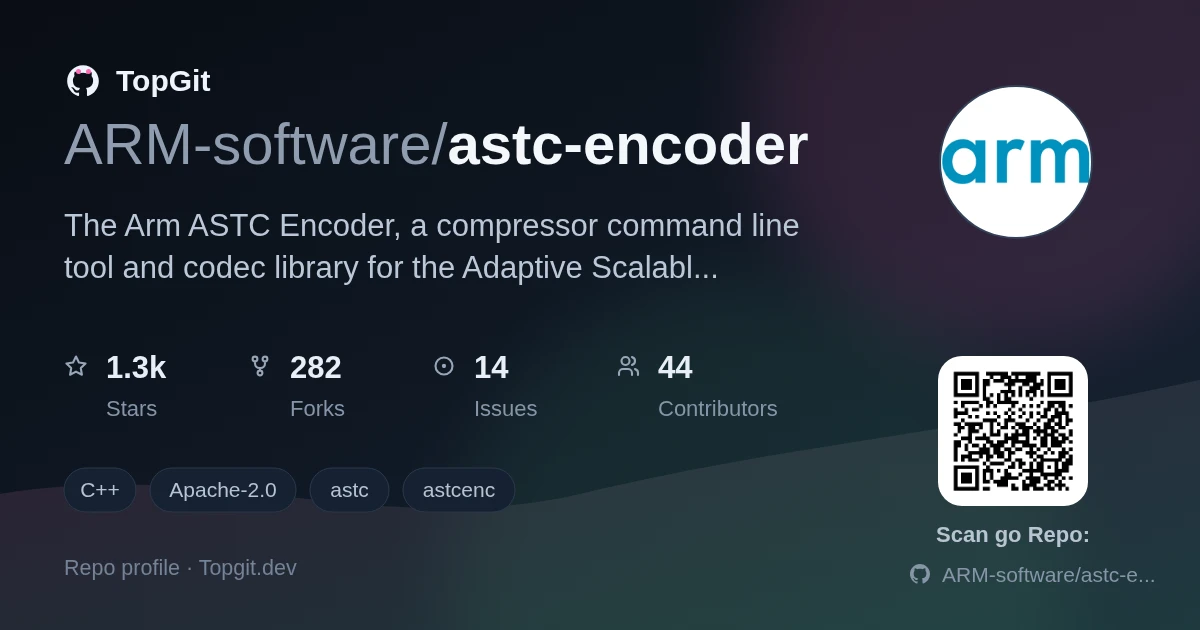
Một mục mã nguồn mở trong kho dữ liệu GitHub của TopGit: ARM-software/astc-encoder, 1.3k sao, C++. The Arm ASTC Encoder, a compressor command line tool and codec library for the Adaptive Scalable Texture Compression image format.
Tóm tắt dựng từ metadata GitHub của chính dự án — chưa có bài review TopGit. Trang sẽ tự động cập nhật khi bài review đầy đủ được xuất bản.
VÌ SAO CHƯA CÓ REVIEW
TopGit viết bài đầy đủ cho repo có nhiều sao nhất và được yêu cầu nhiều nhất. Trang này là snapshot trong thời gian chờ — xem README gốc ở tab READ ME.
The Arm® Adaptive Scalable Texture Compression (ASTC) Encoder, astcenc, is
a command-line tool for compressing and decompressing images using the ASTC
texture compression standard.
The ASTC format
The ASTC compressed data format, developed by Arm® and AMD, has been adopted as
an official extension to the OpenGL®, OpenGL ES, and Vulkan® graphics APIs. It
provides a major step forward in terms of both the image quality at a given
bitrate, and the format and bitrate flexibility available to content creators.
This allows more assets to use compression, often at a reduced bitrate compared
to other formats, reducing memory storage and bandwidth requirements.
Read the ASTC Format Overview for a quick introduction to the format, or
read the full Khronos Data Format Specification for all the details.
License
This project is licensed under the Apache 2.0 license. By downloading any
component from this repository you acknowledge that you accept terms specified
in the LICENSE.txt file.
Encoder feature support
The encoder supports compression of low dynamic range (BMP, JPEG, PNG, TGA) and
high dynamic range (EXR, HDR) images, as well as a subset of image data wrapped
in the DDS and KTX container formats, into ASTC or KTX format output images.
The decoder supports decompression of ASTC or KTX format input images into low
dynamic range (BMP, PNG, TGA), high dynamic range (EXR, HDR), or DDS and KTX
wrapped output images.
The encoder allows control over the compression time/quality tradeoff with
exhaustive, verythorough, thorough, medium, fast, and fastest
encoding quality presets.
The encoder allows compression time and quality analysis by reporting the
compression time, and the Peak Signal-to-Noise Ratio (PSNR) between the input
image and the compressed output.
ASTC format support
The astcenc compressor supports generation of images for all three profiles
allowed by the ASTC specification:
2D Low Dynamic Range (LDR profile)
2D LDR and High Dynamic Range (HDR profile)
2D and 3D, LDR and HDR (Full profile)
It also supports all of the ASTC block sizes and compression modes, allowing
content creators to use the full spectrum of quality-to-bitrate options ranging
from 0.89 bits/pixel up to 8 bits/pixel.
Prebuilt binaries
Release build binaries for the astcenc stable releases are provided in the
GitHub Releases page.
Change log: 5.x series
Binaries are provided for 64-bit builds on Windows, macOS, and Linux.
Windows and Linux
For Windows and Linux, the builds of astcenc are provided as multiple binaries,
each tuned for a specific SIMD instruction set.
For x86-64 we provide, in order of increasing performance:
astcenc-sse2 - uses SSE2
astcenc-sse4.1 - uses SSE4.1 and POPCNT
astcenc-avx2 - uses AVX2, SSE4.2, POPCNT, and F16C
The x86-64 SSE2 builds will work on all x86-64 machines, but it is the slowest
of the three. The other two require extended CPU instruction set support which
is not universally available, but each step gains ~15% more performance.
For Arm we provide, in order of increasing performance:
astcenc-sve_256 - uses 256-bit SVE
astcenc-sve_128 - uses 128-bit SVE
astcenc-neon - uses NEON
Note: The Arm Scalable Vector Extensions (SVE) allow CPUs to have a variable
vector length. The astcenc implementation is not written in a length-agnostic
style and requires the binary to match the vector length on the host CPU.
macOS
For macOS, we provide a single universal binary astcenc, which allows the OS
to automatically use the correct binary variant for the current host machine.
Support is provided for three architecture slices:
x86_64 - uses the astcenc-sse4.1 build defined above.
x86_64h - uses the astcenc-avx2 build defined above.
arm64 - uses the astcenc-neon build defined above.
Repository branches
The main branch is an active development branch for the compressor. It aims
to be a stable branch for the latest major release series, but as it is used
for ongoing development expect it to have some volatility. We recommend using
the latest stable release tag for production development.
The 4.x branch is a stable branch for the older 4.x release series. It is no
longer under active development, but is a supported branch that continues to
get back-ported bug fixes.
Older releases are no longer available as a release branch, but any official
releases are still available via their git tag. We recommend that developers
using an older version migrate to the latest 5.x series stable release tag.
Any other branches you might find are development branches for new features or
optimizations, so might be interesting to play with but should be considered
transient and unstable.
Getting started
Open a terminal, change to the appropriate directory for your system, and run
the astcenc encoder program, like this on Linux or macOS:
./astcenc
... or like this on Windows:
astcenc
Invoking astcenc -help gives an extensive help message, including usage
instructions and details of all available command line options. A summary of
the main encoder options is shown below.
Compressing an image
Compress an image using the -cl \ -cs \ -ch \ -cH modes. For example:
astcenc -cl example.png example.astc 6x6 -medium
This compresses example.png using the LDR color profile and a 6x6 block
footprint (3.56 bits/pixel). The -medium quality preset gives a reasonable
image quality for a relatively fast compression speed, so is a good starting
point for compression. The output is stored to a linear color space compressed
image, example.astc.
The modes available are:
-cl : use the linear LDR color profile.
-cs : use the sRGB LDR color profile.
-ch : use the HDR color profile, tuned for HDR RGB and LDR A.
-cH : use the HDR color profile, tuned for HDR RGBA.
If you intend to use the resulting image with the decode mode extensions to
limit the decompressed precision to UNORM8, it is recommended that you also
specify the -decode_unorm8 flag. This will ensure that the compressor uses
the correct rounding rules when choosing encodings.
Decompressing an image
Decompress an image using the -dl \ -ds \ -dh \ -dH modes. For example:
astcenc -dh example.astc example.tga
This decompresses example.astc using the full HDR feature profile, storing
the decompressed output to example.tga.
The modes available mirror the options used for compression, but use a d
prefix. Note that for decompression there is no difference between the two HDR
modes, they are both provided simply to maintain symmetry across operations.
Measuring image quality
Review the compression quality using the -tl \ -ts \ -th \ -tH modes.
For example:
astcenc -tl example.png example.tga 5x5 -thorough
This is equivalent to using the LDR color profile and a 5x5 block size to
compress the image, using the -thorough quality preset, and then immediately
decompressing the image and saving the result. This can be used to enable a
visual inspection of the compressed image quality. In addition this mode also
prints out some image quality metrics to the console.
The modes available mirror the options used for compression, but use a t
prefix.
Experimenting
Efficient real-time graphics benefits from minimizing compressed texture size,
as it reduces memory footprint, reduces memory bandwidth, saves energy, and can
improve texture cache efficiency. However, like any lossy compression format
there will come a point where the compressed image quality is unacceptable
because there are simply not enough bits to represent the output with the
precision needed. We recommend experimenting with the block footprint to find
the optimum balance between size and quality, as the finely adjustable
compression ratio is one of the major strengths of the ASTC format.
The compression speed can be controlled from -fastest, through -fast,
-medium and -thorough, up to -exhaustive. In general, the more time the
encoder has to spend looking for good encodings the better the results, but it
does result in increasingly small improvements for the amount of time required.
There are many other command line options for tuning the encoder parameters
which can be used to fine tune the compression algorithm. See the command line
help message for more details.
Documentation
The ASTC Format Overview page provides a high level
introduction to the ASTC texture format, how it encodes data, and why it is
both flexible and efficient.
The Effective ASTC Encoding page looks at some of the
guidelines that should be followed when compressing data using astcenc.
It covers:
How to efficiently encode data with fewer than 4 channels.
How to efficiently encode normal maps, sRGB data, and HDR data.
Coding equivalents to other compression formats.
The ASTC Developer Guide document (external link) provides a more detailed
guide for developers using the astcenc compressor.
The .astc File Format page provides a light-weight
specification for the .astc file format and how to read or write it.
The Building ASTC Encoder page provides instructions on
how to build astcenc from the sources in this repository.
The Testing ASTC Encoder page provides instructions on
how to test any modifications to the source code in this repository.
Support
If you have issues with the astcenc encoder, or questions about the ASTC
texture format itself, please raise them in the GitHub issue tracker.
If you have any questions about Arm GPUs, application development for Arm GPUs,
or general mobile graphics development or technology please submit them on the
Arm Community graphics forums.
ARM-software/astc-encoder có 1.3k sao GitHub — tải lại trang để xem số mới nhất, hoặc xem trực tiếp github.com/ARM-software/astc-encoder. TopGit phản chiếu số sao của GitHub nhưng không cam kết đến từng phút.
ARM-software/astc-encoder có những chủ đề gì?
GitHub topics của ARM-software/astc-encoder: "astc", "astcenc", "compression", "image-compression". TopGit xếp repo vào nhóm mã nguồn mở.
ARM-software/astc-encoder còn đang phát triển không?
Commit gần nhất trên ARM-software/astc-encoder là 22 ngày trước (theo timestamp GitHub). Repo có 282 fork — một chỉ báo về mức độ quan tâm của cộng đồng.
ARM-software/astc-encoder viết bằng ngôn ngữ gì?
ARM-software/astc-encoder chủ yếu viết bằng C++. Trường "language" của GitHub dựa trên phần lớn byte ở nhánh mặc định.
Đọc thêm về ARM-software/astc-encoder ở đâu?
Trang TopGit này là một snapshot — tab "Readme" hiển thị nguyên văn README của repo (đã bỏ link, giữ ảnh). Repo GitHub ở github.com/ARM-software/astc-encoder là nguồn chính thức.
Đọc đầy đủ README ở tab phía trên.
astc-encoder có đáng để bạn bỏ thời gian?
ChatGPT, Claude và Perplexity đều đọc được trang này. Hỏi thử xem họ nghĩ gì về astc-encoder.
 /astc-encoder