AtsushiSakai/PythonRobotics hiện có 30.7k sao trên GitHub, viết chủ yếu bằng Python. Python sample codes and textbook for robotics algorithms.
Tóm tắt dựng từ metadata GitHub của chính dự án — chưa có bài review TopGit. Trang sẽ tự động cập nhật khi bài review đầy đủ được xuất bản.
VÌ SAO CHƯA CÓ REVIEW
TopGit viết bài đầy đủ cho repo có nhiều sao nhất và được yêu cầu nhiều nhất. Trang này là snapshot trong thời gian chờ — xem README gốc ở tab READ ME.
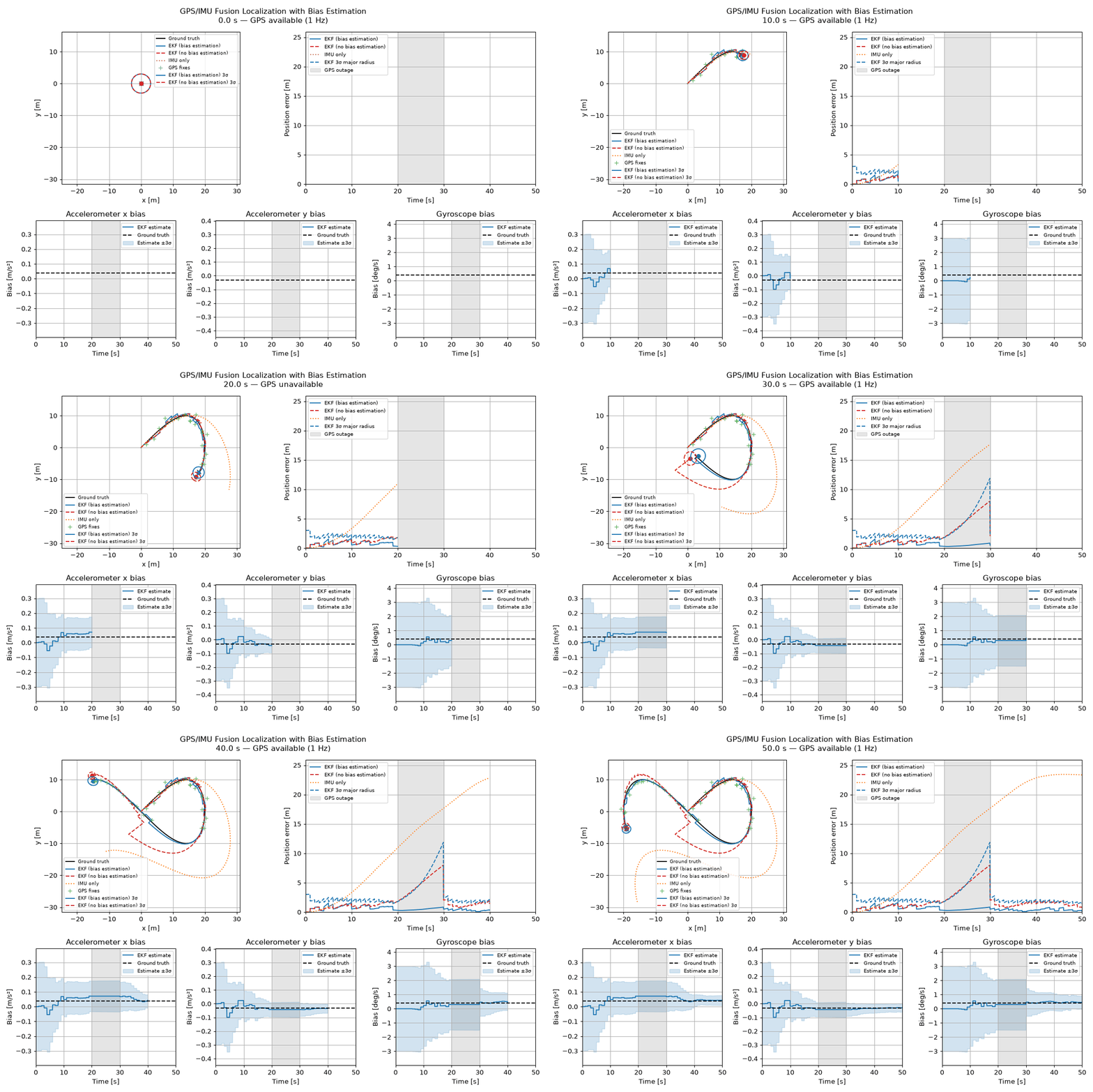
An extended Kalman filter fuses body-frame accelerometer and gyroscope readings
with lower-rate GPS positions, estimates sensor biases, and continues inertial
prediction during a temporary GPS outage. The animation compares it with an
EKF without bias estimation and IMU-only dead reckoning using the same sensor
measurements. It also plots the accelerometer and gyroscope bias estimates
against their true values, with covariance-derived 3σ position ellipses and
bias uncertainty bands.
documentation
sample code
Particle filter localization
This is a sensor fusion localization with Particle Filter(PF).
The blue line is true trajectory, the black line is dead reckoning trajectory,
and the red line is an estimated trajectory with PF.
It is assumed that the robot can measure a distance from landmarks (RFID).
These measurements are used for PF localization.
Reference
PROBABILISTIC ROBOTICS
Histogram filter localization
This is a 2D localization example with Histogram filter.
The red cross is true position, black points are RFID positions.
The blue grid shows a position probability of histogram filter.
In this simulation, x,y are unknown, yaw is known.
The filter integrates speed input and range observations from RFID for localization.
Initial position is not needed.
Reference
PROBABILISTIC ROBOTICS
Mapping
Gaussian grid map
This is a 2D Gaussian grid mapping example.
Ray casting grid map
This is a 2D ray casting grid mapping example.
Lidar to grid map
This example shows how to convert a 2D range measurement to a grid map.
k-means object clustering
This is a 2D object clustering with k-means algorithm.
Rectangle fitting
This is a 2D rectangle fitting for vehicle detection.
SLAM
Simultaneous Localization and Mapping(SLAM) examples
Iterative Closest Point (ICP) Matching
This is a 2D ICP matching example with singular value decomposition.
It can calculate a rotation matrix, and a translation vector between points and points.
Reference
Introduction to Mobile Robotics: Iterative Closest Point Algorithm
FastSLAM 1.0
This is a feature based SLAM example using FastSLAM 1.0.
The blue line is ground truth, the black line is dead reckoning, the red line is the estimated trajectory with FastSLAM.
The red points are particles of FastSLAM.
Black points are landmarks, blue crosses are estimated landmark positions by FastSLAM.
Reference
PROBABILISTIC ROBOTICS
SLAM simulations by Tim Bailey
Path Planning
Dynamic Window Approach
This is a 2D navigation sample code with Dynamic Window Approach.
The Dynamic Window Approach to Collision Avoidance
Grid based search
Dijkstra algorithm
This is a 2D grid based the shortest path planning with Dijkstra's algorithm.
In the animation, cyan points are searched nodes.
A* algorithm
This is a 2D grid based the shortest path planning with A star algorithm.
In the animation, cyan points are searched nodes.
Its heuristic is 2D Euclid distance.
D* algorithm
This is a 2D grid based the shortest path planning with D star algorithm.
The animation shows a robot finding its path avoiding an obstacle using the D* search algorithm.
Reference
D* Algorithm Wikipedia
D* Lite algorithm
This algorithm finds the shortest path between two points while rerouting when obstacles are discovered. It has been implemented here for a 2D grid.
The animation shows a robot finding its path and rerouting to avoid obstacles as they are discovered using the D* Lite search algorithm.
Refs:
D* Lite
Improved Fast Replanning for Robot Navigation in Unknown Terrain
Potential Field algorithm
This is a 2D grid based path planning with Potential Field algorithm.
In the animation, the blue heat map shows potential value on each grid.
Reference
Robotic Motion Planning:Potential Functions
Grid based coverage path planning
This is a 2D grid based coverage path planning simulation.
Particle Swarm Optimization (PSO)
This is a 2D path planning simulation using the Particle Swarm Optimization algorithm.
PSO is a metaheuristic optimization algorithm inspired by bird flocking behavior. In path planning, particles explore the search space to find collision-free paths while avoiding obstacles.
The animation shows particles (blue dots) converging towards the optimal path (yellow line) from start (green area) to goal (red star).
References
Particle swarm optimization - Wikipedia
Kennedy, J.; Eberhart, R. (1995). "Particle Swarm Optimization"
State Lattice Planning
This script is a path planning code with state lattice planning.
This code uses the model predictive trajectory generator to solve boundary problem.
Reference
Optimal rough terrain trajectory generation for wheeled mobile robots
State Space Sampling of Feasible Motions for High-Performance Mobile Robot Navigation in Complex Environments
Biased polar sampling
Lane sampling
Probabilistic Road-Map (PRM) planning
This PRM planner uses Dijkstra method for graph search.
In the animation, blue points are sampled points,
Cyan crosses means searched points with Dijkstra method,
The red line is the final path of PRM.
Reference
Probabilistic roadmap - Wikipedia
Rapidly-Exploring Random Trees (RRT)
RRT*
This is a path planning code with RRT*
Black circles are obstacles, green line is a searched tree, red crosses are start and goal positions.
Reference
Incremental Sampling-based Algorithms for Optimal Motion Planning
Sampling-based Algorithms for Optimal Motion Planning
RRT* with reeds-shepp path
Path planning for a car robot with RRT* and reeds shepp path planner.
LQR-RRT*
This is a path planning simulation with LQR-RRT*.
A double integrator motion model is used for LQR local planner.
Reference
LQR-RRT*: Optimal Sampling-Based Motion Planning with Automatically Derived Extension Heuristics
MahanFathi/LQR-RRTstar: LQR-RRT* method is used for random motion planning of a simple pendulum in its phase plot
Quintic polynomials planning
Motion planning with quintic polynomials.
It can calculate a 2D path, velocity, and acceleration profile based on quintic polynomials.
Reference
Local Path Planning And Motion Control For Agv In Positioning
Reeds Shepp planning
A sample code with Reeds Shepp path planning.
Reference
15.3.2 Reeds-Shepp Curves
optimal paths for a car that goes both forwards and backwards
ghliu/pyReedsShepp: Implementation of Reeds Shepp curve.
LQR based path planning
A sample code using LQR based path planning for double integrator model.
Optimal Trajectory in a Frenet Frame
This is optimal trajectory generation in a Frenet Frame.
The cyan line is the target course and black crosses are obstacles.
The red line is the predicted path.
Reference
Optimal Trajectory Generation for Dynamic Street Scenarios in a Frenet Frame
Optimal trajectory generation for dynamic street scenarios in a Frenet Frame
Path Tracking
move to a pose control
This is a simulation of moving to a pose control
Reference
P. I. Corke, "Robotics, Vision and Control" | SpringerLink p102
Stanley control
Path tracking simulation with Stanley steering control and PID speed control.
Reference
Stanley: The robot that won the DARPA grand challenge
Automatic Steering Methods for Autonomous Automobile Path Tracking
Rear wheel feedback control
Path tracking simulation with rear wheel feedback steering control and PID speed control.
Reference
A Survey of Motion Planning and Control Techniques for Self-driving Urban Vehicles
Linear–quadratic regulator (LQR) speed and steering control
Path tracking simulation with LQR speed and steering control.
Reference
Towards fully autonomous driving: Systems and algorithms - IEEE Conference Publication
Model predictive speed and steering control
Path tracking simulation with iterative linear model predictive speed and steering control.
Reference
documentation
Real-time Model Predictive Control (MPC), ACADO, Python | Work-is-Playing
Nonlinear Model predictive control with C-GMRES
A motion planning and path tracking simulation with NMPC of C-GMRES
Reference
documentation
Arm Navigation
N joint arm to point control
N joint arm to a point control simulation.
This is an interactive simulation.
You can set the goal position of the end effector with left-click on the plotting area.
In this simulation N = 10, however, you can change it.
Arm navigation with obstacle avoidance
Arm navigation with obstacle avoidance simulation.
Aerial Navigation
drone 3d trajectory following
This is a 3d trajectory following simulation for a quadrotor.
rocket powered landing
This is a 3d trajectory generation simulation for a rocket powered landing.
Reference
documentation
Bipedal
bipedal planner with inverted pendulum
This is a bipedal planner for modifying footsteps for an inverted pendulum.
You can set the footsteps, and the planner will modify those automatically.
License
MIT
Use-case
If this project helps your robotics project, please let me know with creating an issue.
Your robot's video, which is using PythonRobotics, is very welcome!!
This is a list of user's comment and references:users_comments
Contribution
Any contribution is welcome!!
Please check this document:How To Contribute — PythonRobotics documentation
Citing
If you use this project's code for your academic work, we encourage you to cite our papers
If you use this project's code in industry, we'd love to hear from you as well; feel free to reach out to the developers directly.
Supporting this project
If you or your company would like to support this project, please consider:
Sponsor @AtsushiSakai on GitHub Sponsors
Become a backer or sponsor on Patreon
One-time donation via PayPal
If you would like to support us in some other way, please contact with creating an issue.
Sponsors
JetBrains
They are providing a free license of their IDEs for this OSS development.
1Password
They are providing a free license of their 1Password team license for this OSS project.
AtsushiSakai/PythonRobotics có 30.7k sao GitHub — tải lại trang để xem số mới nhất, hoặc xem trực tiếp github.com/AtsushiSakai/PythonRobotics. TopGit phản chiếu số sao của GitHub nhưng không cam kết đến từng phút.
AtsushiSakai/PythonRobotics còn đang phát triển không?
Commit gần nhất trên AtsushiSakai/PythonRobotics là 2 tháng trước (theo timestamp GitHub). Repo có 7.4k fork — một chỉ báo về mức độ quan tâm của cộng đồng.
AtsushiSakai/PythonRobotics là gì?
AtsushiSakai/PythonRobotics (AtsushiSakai/PythonRobotics) là dự án Python trên GitHub. Theo mô tả gốc: Python sample codes and textbook for robotics algorithms.
AtsushiSakai/PythonRobotics so với các dự án UI / UX khác thế nào?
AtsushiSakai/PythonRobotics được TopGit xếp vào nhóm UI / UX, với 30.7k sao GitHub và viết bằng Python. Xem trang chủ đề UI / UX trên TopGit để so sánh với các dự án tương tự theo số sao và mức độ hoạt động.
AtsushiSakai/PythonRobotics viết bằng ngôn ngữ gì?
AtsushiSakai/PythonRobotics chủ yếu viết bằng Python. Trường "language" của GitHub dựa trên phần lớn byte ở nhánh mặc định.
Vì sao AtsushiSakai/PythonRobotics được xếp vào nhóm UI / UX?
TopGit xếp AtsushiSakai/PythonRobotics vào nhóm UI / UX dựa trên GitHub topics và mô tả của repo (gắn thẻ: "algorithm", "animation", "autonomous-driving"). Việc phân loại dựa trên metadata thật của repo, không phải đoán theo cảm tính biên tập.
Đọc đầy đủ README ở tab phía trên.
PythonRobotics có đáng để bạn bỏ thời gian?
ChatGPT, Claude và Perplexity đều đọc được trang này. Hỏi thử xem họ nghĩ gì về PythonRobotics.
 /PythonRobotics