
baidu/uid-generator

baidu/uid-generator là dự án mã nguồn mở trên GitHub với 5.5k sao, viết chủ yếu bằng Java. UniqueID generator
Tóm tắt dựng từ metadata GitHub của chính dự án — chưa có bài review TopGit. Trang sẽ tự động cập nhật khi bài review đầy đủ được xuất bản.
TopGit viết bài đầy đủ cho repo có nhiều sao nhất và được yêu cầu nhiều nhất. Trang này là snapshot trong thời gian chờ — xem README gốc ở tab READ ME.
Snapshot
Cộng tác viên hàng đầu
Xem cộng tác viên hàng đầu
UidGenerator
In Chinese 中文版
UidGenerator is a Java implemented, Snowflake based unique ID generator. It works as a component, and allows users to override workId bits and initialization strategy. As a result, it is much more suitable for virtualization environment, such as docker. Besides these, it overcomes concurrency limitation of Snowflake algorithm by consuming future time; parallels UID produce and consume by caching UID with RingBuffer; eliminates CacheLine pseudo sharing, which comes from RingBuffer, via padding. And finally, it can offer over 6 million QPS per single instance.
Requires:Java8+, MySQL(Default implement as WorkerID assigner; If there are other implements, MySQL is not required)
Snowflake

** Snowflake algorithm:** An unique id consists of worker node, timestamp and sequence within that timestamp. Usually,
it is a 64 bits number(long), and the default bits of that three fields are as follows:
-
sign(1bit)
The highest bit is always 0. -
delta seconds (28 bits)
The next 28 bits, represents delta seconds since a customer epoch(2016-05-20). The maximum time will be 8.7 years. -
worker id (22 bits)
The next 22 bits, represents the worker node id, maximum value will be 4.2 million. UidGenerator uses a build-in database basedworker id assignerwhen startup by default, and it will dispose previous work node id after reboot. Other strategy such like 'reuse' is coming soon. -
sequence (13 bits)
the last 13 bits, represents sequence within the one second, maximum is 8192 per second by default.
The parameters above can be configured in spring bean
CachedUidGenerator
RingBuffer is an array,each item of that array is called 'slot', every slot keeps a uid or a flag(Double RingBuffer).
The size of RingBuffer is 2^n, where n is positive integer and equal or greater than bits of
sequence. Assign bigger value to boostPower if you want to enlarge RingBuffer to improve throughput.
Tail & Cursor pointer
-
Tail Pointer
Represents the latest produced UID. If it catches up with cursor, the ring buffer will be full, at that moment, no put operation should be allowed, you can specify a policy to handle it by assigning property
rejectedPutBufferHandler. -
Cursor Pointer
Represents the latest already consumed UID. If cursor catches up with tail, the ring buffer will be empty, and any take operation will be rejected. you can also specify a policy to handle it by assigning property
rejectedTakeBufferHandler.
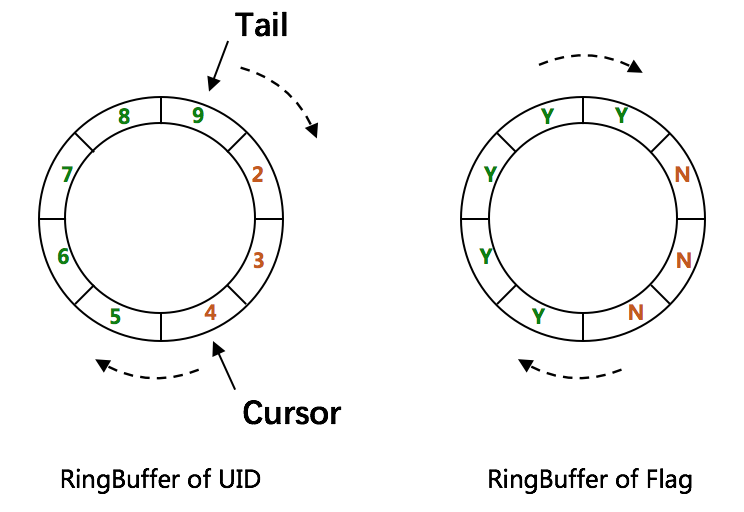
CachedUidGenerator used double RingBuffer,one RingBuffer for UID, another for status(if valid for take or put)
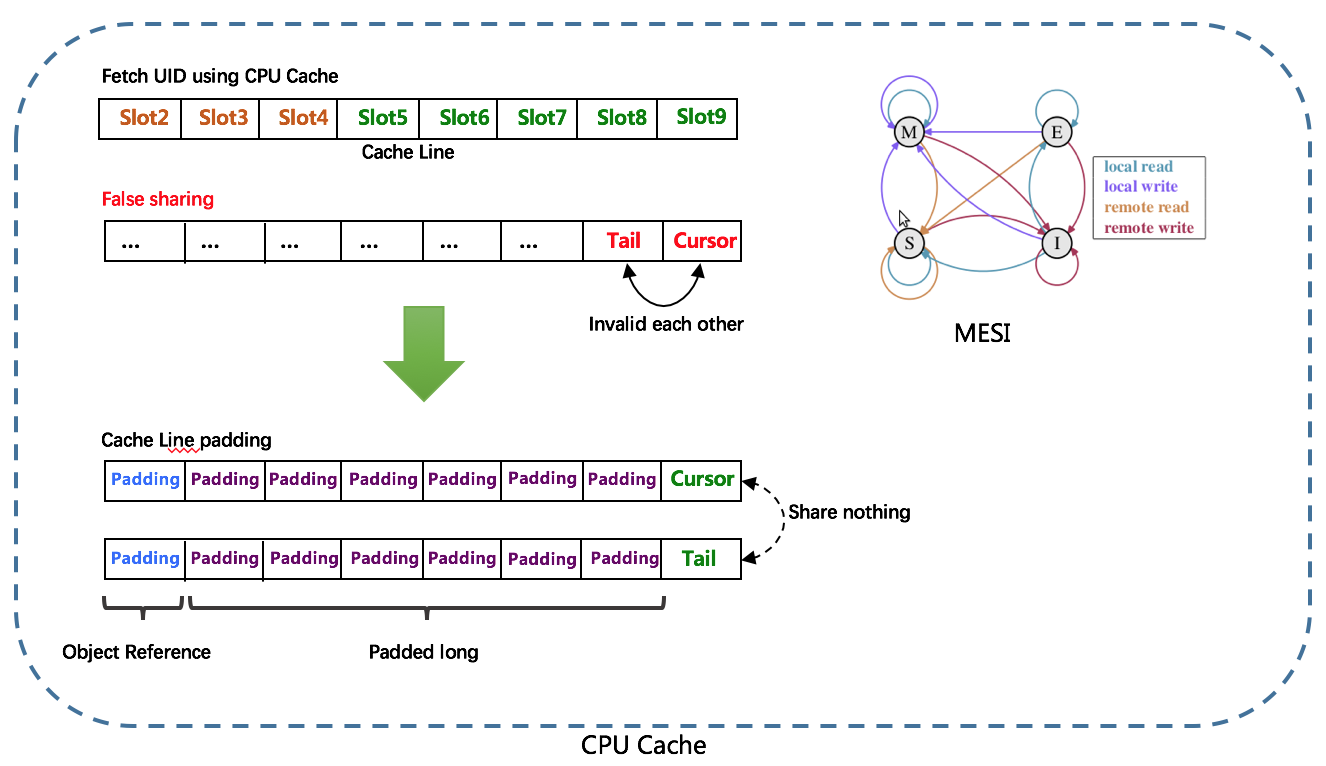
Array can improve performance of reading, due to the CUP cache mechanism. At the same time, it brought the side effect of 「False Sharing」, in order to solve it, cache line padding is applied.
RingBuffer filling
-
Initialization padding During RingBuffer initializing,the entire RingBuffer will be filled.
-
In-time filling Whenever the percent of available UIDs is less than threshold
paddingFactor, the fill task is triggered. You can reassign that threshold in Spring bean configuration. -
Periodic filling Filling periodically in a scheduled thread. The
scheduleIntervalcan be reassigned in Spring bean configuration.
Quick Start
Here we have a demo with 4 steps to introduce how to integrate UidGenerator into Spring based projects.
Step 1: Install Java8, Maven, MySQL
If you have already installed maven, jdk8+ and Mysql or other DB which supported by Mybatis, just skip to next.
Download Java8,
MySQL and Maven,
and install jdk, mysql. For maven, extracting and setting MAVEN_HOME is enough.
Set JAVA_HOME & MAVEN_HOME
Here is a sample script to set JAVA_HOME and MAVEN_HOME
export MAVEN_HOME=/xxx/xxx/software/maven/apache-maven-3.3.9
export PATH=$MAVEN_HOME/bin:$PATH
JAVA_HOME="/Library/Java/JavaVirtualMachines/jdk1.8.0_91.jdk/Contents/Home";
export JAVA_HOME;
Step 2: Create table WORKER_NODE
Replace xxxxx with real database name, and run following script to create table,
DROP DATABASE IF EXISTS `xxxx`;
CREATE DATABASE `xxxx` ;
use `xxxx`;
DROP TABLE IF EXISTS WORKER_NODE;
CREATE TABLE WORKER_NODE
(
ID BIGINT NOT NULL AUTO_INCREMENT COMMENT 'auto increment id',
HOST_NAME VARCHAR(64) NOT NULL COMMENT 'host name',
PORT VARCHAR(64) NOT NULL COMMENT 'port',
TYPE INT NOT NULL COMMENT 'node type: ACTUAL or CONTAINER',
LAUNCH_DATE DATE NOT NULL COMMENT 'launch date',
MODIFIED TIMESTAMP NOT NULL COMMENT 'modified time',
CREATED TIMESTAMP NOT NULL COMMENT 'created time',
PRIMARY KEY(ID)
)
 COMMENT='DB WorkerID Assigner for UID Generator',ENGINE = INNODB;
Reset property of 'jdbc.url', 'jdbc.username' and 'jdbc.password' in mysql.properties.
Step 3: Spring configuration
DefaultUidGenerator
There are two implements of UidGenerator: DefaultUidGenerator, CachedUidGenerator.
For performance sensitive application, CachedUidGenerator is recommended.
<!-- DefaultUidGenerator -->
<bean id="defaultUidGenerator" class="com.baidu.fsg.uid.impl.DefaultUidGenerator" lazy-init="false">
    <property name="workerIdAssigner" ref="disposableWorkerIdAssigner"/>

    <!-- Specified bits & epoch as your demand. No specified the default value will be used -->
    <property name="timeBits" value="29"/>
    <property name="workerBits" value="21"/>
    <property name="seqBits" value="13"/>
    <property name="epochStr" value="2016-09-20"/>
</bean>

<!-- Disposable WorkerIdAssigner based on Database -->
<bean id="disposableWorkerIdAssigner" class="com.baidu.fsg.uid.worker.DisposableWorkerIdAssigner" />
CachedUidGenerator
Copy beans of CachedUidGenerator to 'test/resources/uid/cached-uid-spring.xml'.
<!-- CachedUidGenerator -->
<bean id="cachedUidGenerator" class="com.baidu.fsg.uid.impl.CachedUidGenerator">
    <property name="workerIdAssigner" ref="disposableWorkerIdAssigner" />

    <!-- The config below is option -->
    <!-- Specified bits & epoch as your demand. No specified the default value will be used -->
    <property name="timeBits" value="29"/>
    <property name="workerBits" value="21"/>
    <property name="seqBits" value="13"/>
    <property name="epochStr" value="2016-09-20"/>
    <!-- RingBuffer size, to improve the throughput. -->
    <!-- Default as 3. Sample: original bufferSize=8192, after boosting the new bufferSize= 8192 << 3 = 65536 -->
    <property name="boostPower" value="3"></property>

    <!-- In-time padding, available UIDs percentage(0, 100) of the RingBuffer, default as 50 -->
    <!-- Sample: bufferSize=1024, paddingFactor=50 -> threshold=1024 * 50 / 100 = 512. -->
    <!-- When the rest available UIDs < 512, RingBiffer will be padded in-time -->
    <property name="paddingFactor" value="50"></property>

    <!-- Periodic padding -->
    <!-- Default is disabled. Enable as below, scheduleInterval unit as Seconds. -->
    <property name="scheduleInterval" value="60"></property>

    <!-- Policy for rejecting put on RingBuffer -->
    <property name="rejectedPutBufferHandler" ref="XxxxYourPutRejectPolicy"></property>

    <!-- Policy for rejecting take from RingBuffer -->
    <property name="rejectedTakeBufferHandler" ref="XxxxYourTakeRejectPolicy"></property>

</bean>

<!-- Disposable WorkerIdAssigner based on Database -->
<bean id="disposableWorkerIdAssigner" class="com.baidu.fsg.uid.worker.DisposableWorkerIdAssigner" />

<!-- Mybatis config... -->
Mybatis config
mybatis-spring.xml shows as below:
<!-- Spring annotation scan -->
<context:component-scan base-package="com.baidu.fsg.uid" />

<bean id="sqlSessionFactory" class="org.mybatis.spring.SqlSessionFactoryBean">
    <property name="dataSource" ref="dataSource" />
    <property name="mapperLocations" value="classpath:/META-INF/mybatis/mapper/M_WORKER*.xml" />
</bean>

<!-- transaction -->
<tx:annotation-driven transaction-manager="transactionManager" order="1" />

<bean id="transactionManager" class="org.springframework.jdbc.datasource.DataSourceTransactionManager">
	<property name="dataSource" ref="dataSource" />
</bean>

<!-- Mybatis Mapper scan -->
<bean class="org.mybatis.spring.mapper.MapperScannerConfigurer">
	<property name="annotationClass" value="org.springframework.stereotype.Repository" />
	<property name="basePackage" value="com.baidu.fsg.uid.worker.dao" />
	<property name="sqlSessionFactoryBeanName" value="sqlSessionFactory" />
</bean>

<!-- datasource config -->
<bean id="dataSource" parent="abstractDataSource">
	<property name="driverClassName" value="${mysql.driver}" />
	<property name="maxActive" value="${jdbc.maxActive}" />
	<property name="url" value="${jdbc.url}" />
	<property name="username" value="${jdbc.username}" />
	<property name="password" value="${jdbc.password}" />
</bean>

<bean id="abstractDataSource" class="com.alibaba.druid.pool.DruidDataSource" destroy-method="close">
	<property name="filters" value="${datasource.filters}" />
	<property name="defaultAutoCommit" value="${datasource.defaultAutoCommit}" />
	<property name="initialSize" value="${datasource.initialSize}" />
	<property name="minIdle" value="${datasource.minIdle}" />
	<property name="maxWait" value="${datasource.maxWait}" />
	<property name="testWhileIdle" value="${datasource.testWhileIdle}" />
	<property name="testOnBorrow" value="${datasource.testOnBorrow}" />
	<property name="testOnReturn" value="${datasource.testOnReturn}" />
	<property name="validationQuery" value="${datasource.validationQuery}" />
	<property name="timeBetweenEvictionRunsMillis" value="${datasource.timeBetweenEvictionRunsMillis}" />
	<property name="minEvictableIdleTimeMillis" value="${datasource.minEvictableIdleTimeMillis}" />
	<property name="logAbandoned" value="${datasource.logAbandoned}" />
	<property name="removeAbandoned" value="${datasource.removeAbandoned}" />
	<property name="removeAbandonedTimeout" value="${datasource.removeAbandonedTimeout}" />
</bean>

<bean id="batchSqlSession" class="org.mybatis.spring.SqlSessionTemplate">
	<constructor-arg index="0" ref="sqlSessionFactory" />
	<constructor-arg index="1" value="BATCH" />
</bean>
Step 4: Run UnitTest
Run CachedUidGeneratorTest, shows how to generate / parse UniqueID:
@Resource
private UidGenerator uidGenerator;

@Test
public void testSerialGenerate() {
    // Generate UID
    long uid = uidGenerator.getUID();

    // Parse UID into [Timestamp, WorkerId, Sequence]
    // {"UID":"180363646902239241","parsed":{    "timestamp":"2017-01-19 12:15:46",    "workerId":"4",    "sequence":"9"        }}
    System.out.println(uidGenerator.parseUID(uid));

}
Tips
For low concurrency and long term application, less seqBits but more timeBits is recommended. For
example, if DisposableWorkerIdAssigner is adopted and the average reboot frequency is 12 per node per day, with the
configuration {"workerBits":23,"timeBits":31,"seqBits":9}, one project can run for 68 years with 28 nodes
and entirely concurrency 14400 UID/s.
For frequent reboot and long term application, less seqBits but more timeBits and workerBits is
recommended. For example, if DisposableWorkerIdAssigner is adopted and the average reboot frequency is 24 * 12 per node
per day, with the configuration {"workerBits":27,"timeBits":30,"seqBits":6}, one project can run for 34 years
with 37 nodes and entirely concurrency 2400 UID/s.
Experiment for Throughput
To figure out CachedUidGenerator's UID throughput, some experiments are carried out.
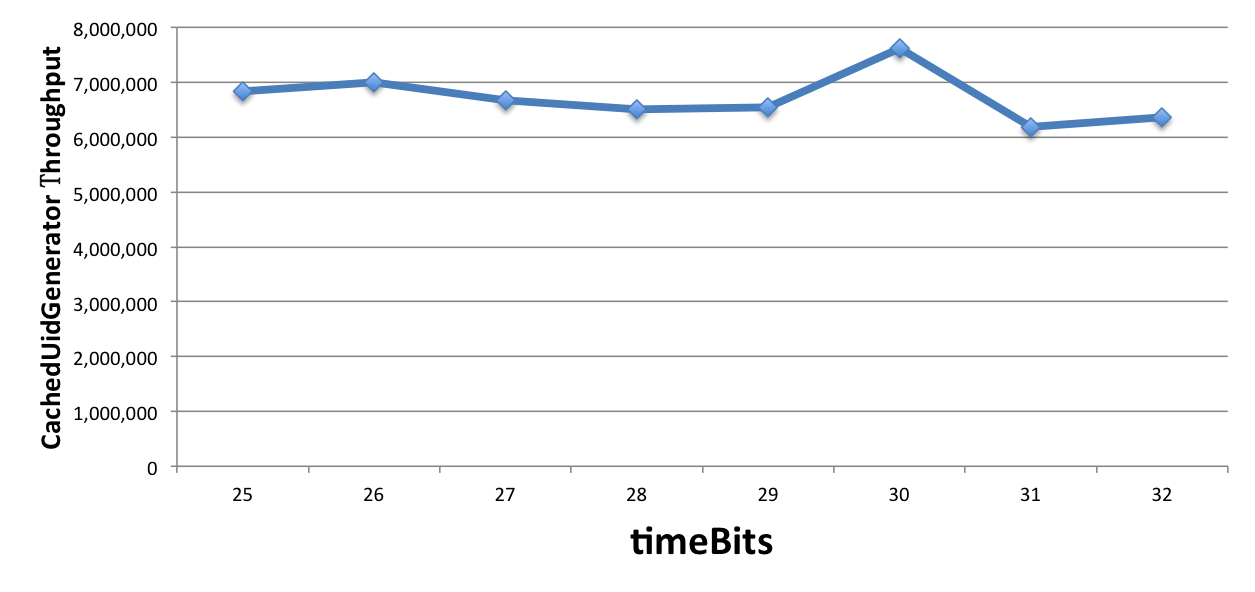
Firstly, workerBits is arbitrarily fixed to 20, and change timeBits from 25(about 1 year) to 32(about 136 years),
| timeBits | 25 | 26 | 27 | 28 | 29 | 30 | 31 | 32 |
|---|---|---|---|---|---|---|---|---|
| throughput | 6,831,465 | 7,007,279 | 6,679,625 | 6,499,205 | 6,534,971 | 7,617,440 | 6,186,930 | 6,364,997 |
Then, timeBits is arbitrarily fixed to 31, and workerBits is changed from 20(about 1 million total reboots) to 29(about
500 million total reboots),
| workerBits | 20 | 21 | 22 | 23 | 24 | 25 | 26 | 27 | 28 | 29 |
|---|---|---|---|---|---|---|---|---|---|---|
| throughput | 6,186,930 | 6,642,727 | 6,581,661 | 6,462,726 | 6,774,609 | 6,414,906 | 6,806,266 | 6,223,617 | 6,438,055 | 6,435,549 |
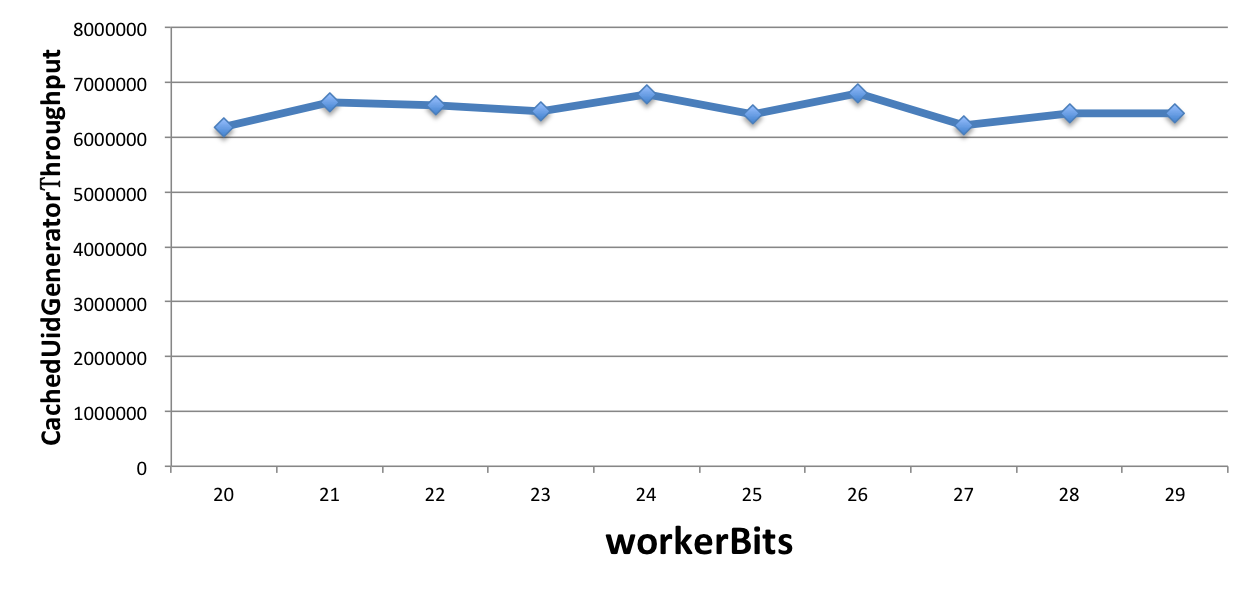
It is obvious that whatever the configuration is, CachedUidGenerator always has the ability to provide 6 million stable throughput, what sacrificed is just life expectancy, this is very cool.
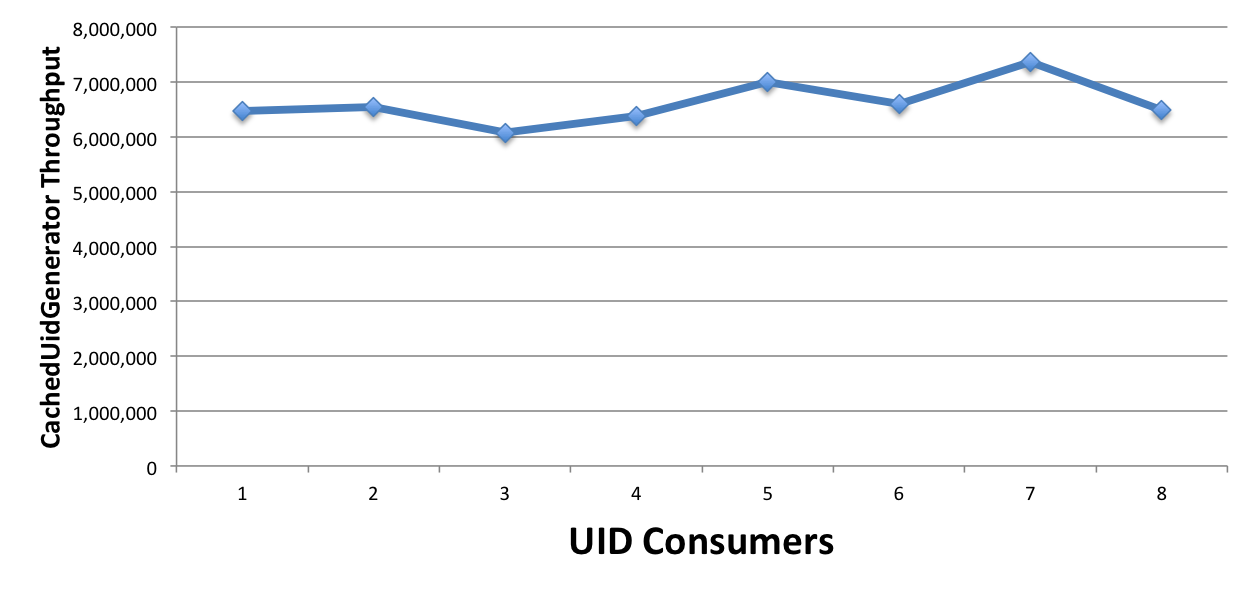
Finally, both timeBits and workerBits are fixed to 31 and 23 separately, and change the number of CachedUidGenerator
consumer. Since our CPU only has 4 cores, [1, 8] is chosen.
| consumers | 1 | 2 | 3 | 4 | 5 | 6 | 7 | 8 |
|---|---|---|---|---|---|---|---|---|
| throughput | 6,462,726 | 6,542,259 | 6,077,717 | 6,377,958 | 7,002,410 | 6,599,113 | 7,360,934 | 6,490,969 |
Repo liên quan
Master programming by recreating your favorite technologies from scratch.
A curated meta-list of curated lists organized by technology domain. The repository acts as a directory pointing to hundreds of specialized awesome lists covering programming languages, platforms, frameworks, and tooling. All content is community-contributed under the CC0 public domain dedication.
Public APIs is a community-curated GitHub repository listing free, publicly accessible APIs across a wide range of categories, with auth type, HTTPS, and CORS noted for each entry. It's a browsable reference, not a library to install.
REA is an MCP server and CLI that gives AI coding agents the ability to reverse engineer binaries, JavaScript apps, .NET assemblies, and websites. It hooks into Hopper, Ghidra, or IDA Pro for native binary work, or runs static JavaScript analysis with just Node.js. Every investigation returns an Evidence bundle that includes what was found, what was not, and the reasoning path. Setup registers REA with supported agents and walks you through connecting an analysis engine. The CLI also works standalone for terminal-first workflows.
Trả lời nhanh
baidu/uid-generator có bao nhiêu sao?
baidu/uid-generator có 5.5k sao GitHub — tải lại trang để xem số mới nhất, hoặc xem trực tiếp github.com/baidu/uid-generator. TopGit phản chiếu số sao của GitHub nhưng không cam kết đến từng phút.
baidu/uid-generator có phải mã nguồn mở không?
Có — baidu/uid-generator phát hành theo license Apache-2.0, nghĩa là mã nguồn mở để đọc, fork và (tùy license) tái sử dụng. Mã: github.com/baidu/uid-generator.
baidu/uid-generator có website riêng không?
TopGit chưa ghi nhận URL trang chủ cho baidu/uid-generator. Phần README ở tab phía trên thường có link demo, hoặc xem mô tả GitHub của repo.
baidu/uid-generator là gì?
baidu/uid-generator (baidu/uid-generator) là dự án Java trên GitHub. Theo mô tả gốc: UniqueID generator
Đọc thêm về baidu/uid-generator ở đâu?
Trang TopGit này là một snapshot — tab "Readme" hiển thị nguyên văn README của repo (đã bỏ link, giữ ảnh). Repo GitHub ở github.com/baidu/uid-generator là nguồn chính thức.
Đọc đầy đủ README ở tab phía trên.
Muốn nghe thêm một ý kiến về uid-generator?
Hỏi một AI đọc được trang này — một cú bấm là có ngay nhận định về uid-generator.