bee-san/pyWhat

Một mục tập trung bảo mật trong kho dữ liệu GitHub của TopGit: bee-san/pyWhat, 7.3k sao, nhóm Security, Python. 🐸 Identify anything. pyWhat easily lets you identify emails, IP addresses, and more. Feed it a .pcap file or some text and it'll tell you what it is! 🧙♀️
Tóm tắt dựng từ metadata GitHub của chính dự án — chưa có bài review TopGit. Trang sẽ tự động cập nhật khi bài review đầy đủ được xuất bản.
TopGit viết bài đầy đủ cho repo có nhiều sao nhất và được yêu cầu nhiều nhất. Trang này là snapshot trong thời gian chờ — xem README gốc ở tab READ ME.
Snapshot
Cộng tác viên hàng đầu
Xem cộng tác viên hàng đầu

➡️ Discord ⬅️
The easiest way to identify anything
pip3 install pywhat && pywhat --help




🤔 What is this?
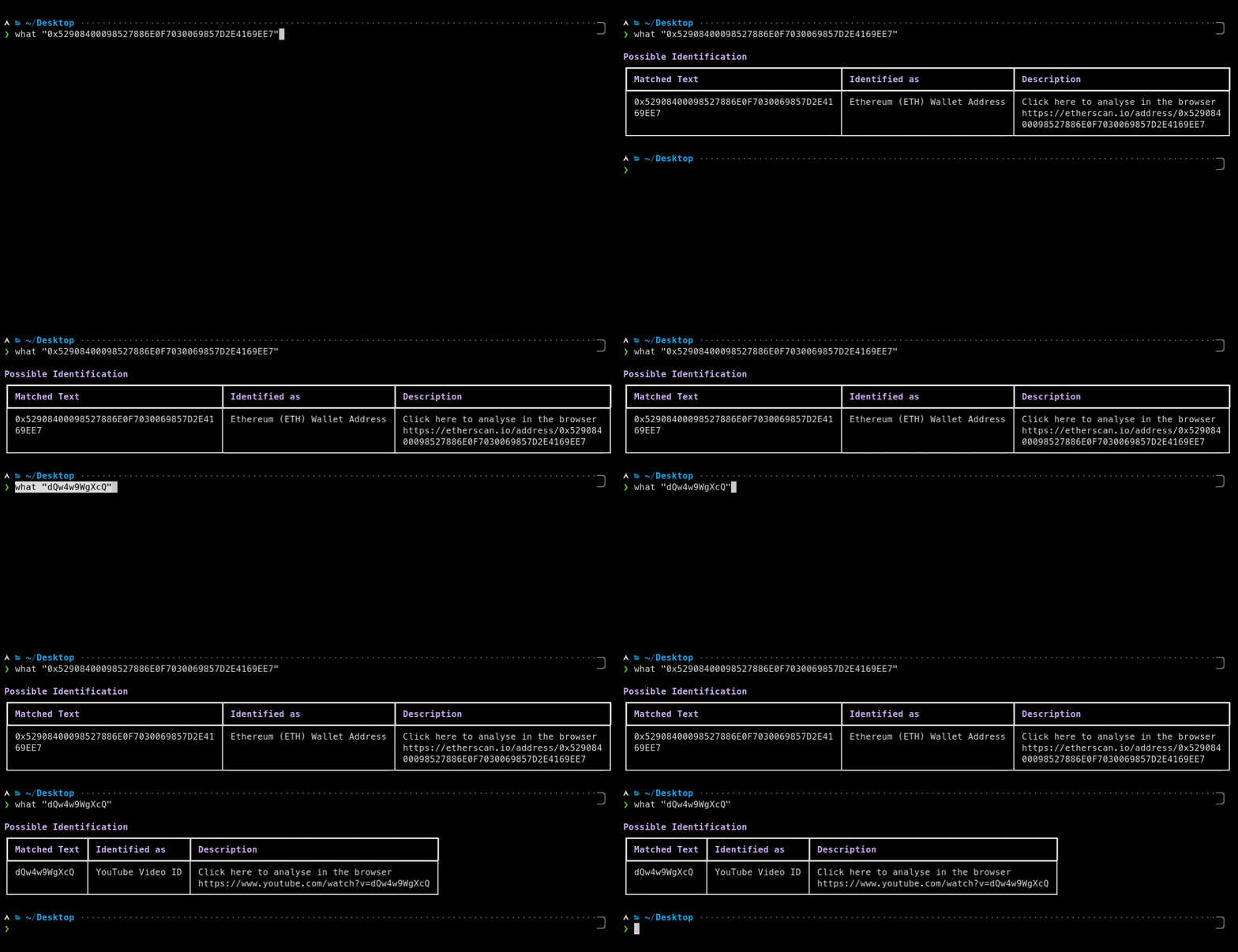
Imagine this: You come across some mysterious text 🧙♂️ 0x52908400098527886E0F7030069857D2E4169EE7 or dQw4w9WgXcQ and you wonder what it is. What do you do?
Well, with what all you have to do is ask what "0x52908400098527886E0F7030069857D2E4169EE7" and what will tell you!
what's job is to identify what something is. Whether it be a file or text! Or even the hex of a file! What about text within files? We have that too! what is recursive, it will identify everything in text and more!
Installation
🔨 Using pip
$ pip3 install pywhat
or
# installs optional dependencies that may improve the speed
$ pip3 install pywhat[optimize]
🔨 On Mac?
$ brew install pywhat
Or for our MacPorts fans:
$ sudo port install pywhat
⚙ Use Cases
🦠 Wannacry
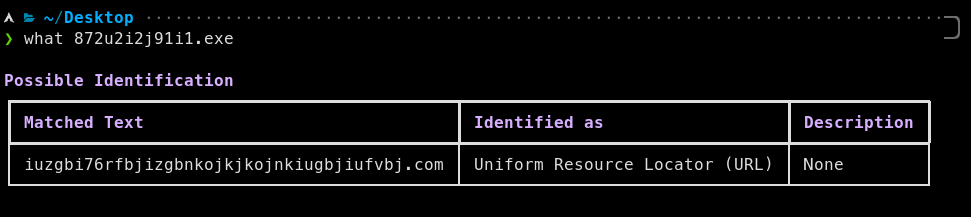
You come across a new piece of malware called WantToCry. You think back to Wannacry and remember it was stopped because a researcher found a kill-switch in the code.
When a domain, hardcoded into Wannacry, was registered the virus would stop.
You use What to identify all the domains in the malware, and use a domain registrar API to register all the domains.
🦈 Faster Analysis of Pcap files
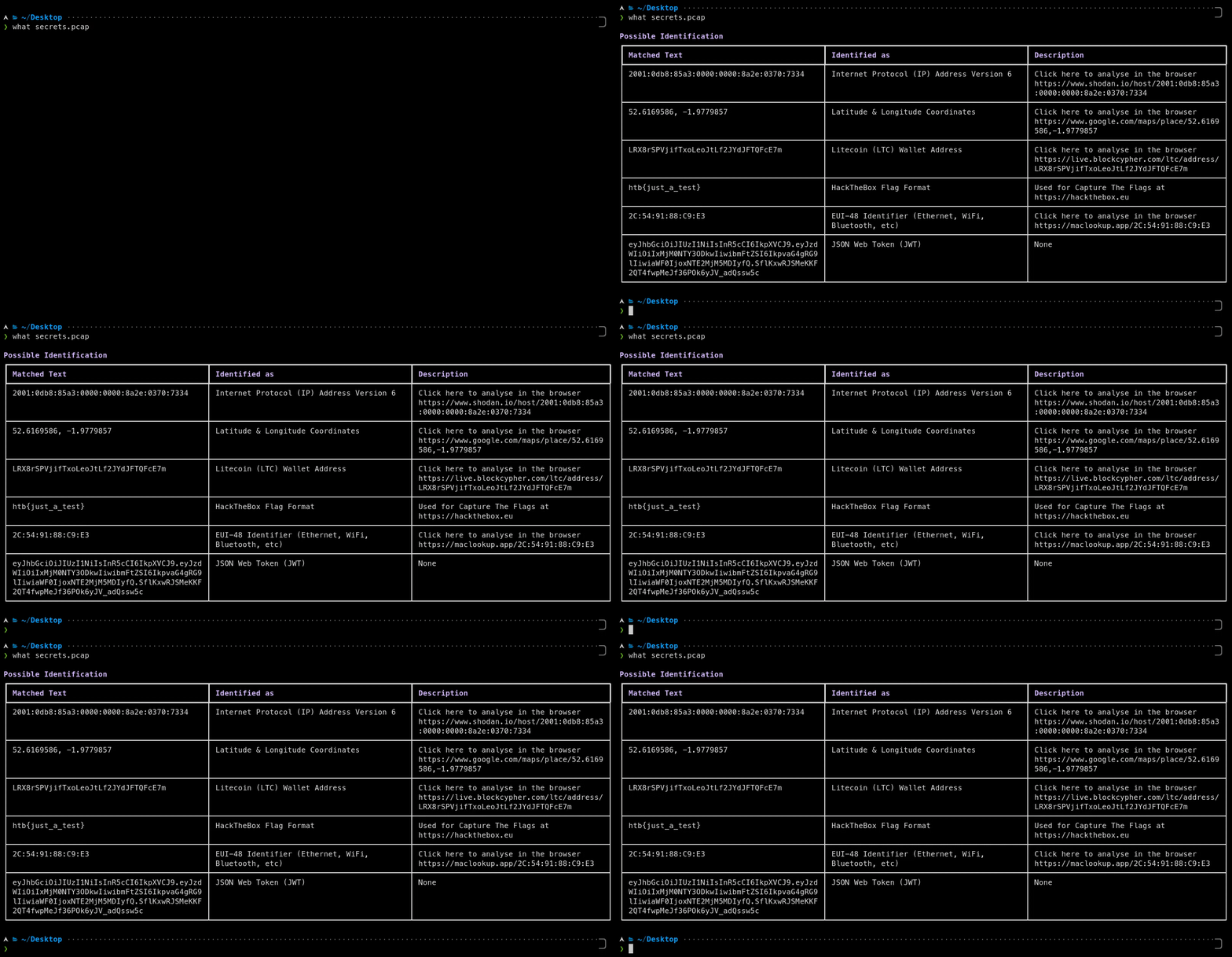
Say you have a .pcap file from a network attack. What can identify this and quickly find you:
- All URLs
- Emails
- Phone numbers
- Credit card numbers
- Cryptocurrency addresses
- Social Security Numbers
- and much more.
With what, you can identify the important things in the pcap in seconds, not minutes.
🐞 Bug Bounties
You can use PyWhat to scan for things that'll make you money via bug bounties like:
- API Keys
- Webhooks
- Credentials
- and more
Run PyWhat with:
pywhat --include "Bug Bounty" TEXT
To do this.
Here are some examples 👇
🐙 GitHub Repository API Key Leaks
- Download all GitHub repositories of an organisation
- Search for anything that you can submit as a bounty, like API keys
# Download all repositories
GHUSER=CHANGEME; curl "https://api.github.com/users/$GHUSER/repos?per_page=1000" | grep -o 'git@[^"]*' | xargs -L1 git clone

# Will print when it finds things.
# Loops over all files in current directory.
find . -type f -execdir pywhat --include 'Bug Bounty' {} \;
🕷 Scan all web pages for bounties
# Recursively download all web pages of a site
wget -r -np -k https://skerritt.blog

# Will print when it finds things.
# Loops over all files in current directory.
find . -type f -execdir pywhat --include 'Bug Bounty' {} \;
PS: We support more filters than just bug bounties! Run pywhat --tags
🌌 Other Features
Anytime you have a file and you want to find structured data in it that's useful, What is for you.
Or if you come across some piece of text and you don't know what it is, What will tell you.
📁 File & Directory Handling
File Opening You can pass in a file path by what 'this/is/a/file/path'. What is smart enough to figure out it's a file!
What about a whole directory? What can handle that too! It will recursively search for files and output everything you need!
Multiple inputs You can pass several files, directories or texts at once, like what file1 file2 this/is/a/directory 'some text' or find . -name '*.log' -exec what {} +. What shows the file of every match, the matches in text are under text, and --json returns everything in one JSON object.
Unicode Files and text piped into What can be UTF-8, or UTF-16 or UTF-32 with a byte order mark, like the "Unicode" text files that Windows saves. What also searches the UTF-16 strings in binary files (like strings -el), which is how Windows programs store most of their text. Characters that your terminal cannot show are printed as escape sequences such as \u20bf instead of crashing.
🔍 Filtering your output
Sometimes, you only care about seeing things which are related to AWS. Or bug bounties, or cryptocurrencies!
You can filter output by using what --rarity 0.2:0.8 --include Identifiers,URL https://skerritt.blog. Use what --help to get more information.
By default, what only shows matches with a rarity of 0.1 or more, as matches with a lower rarity are often false positives. For example, a YouTube video ID on its own, like dQw4w9WgXcQ, could be any 11 random characters, so what dQw4w9WgXcQ finds nothing, but what --rarity 0: dQw4w9WgXcQ shows it. YouTube links, like https://youtu.be/dQw4w9WgXcQ or youtube.com/watch?v=dQw4w9WgXcQ&t=42s, are shown by default.
To see all filters, run pywhat --tags! You can also combine them, for example to see all cryptocurrency wallets minus Ripple you can do:
pywhat --include "Cryptocurrency Wallet" --exclude "Ripple Wallet" 1KFHE7w8BhaENAswwryaoccDb6qcT6DbYY
The names of the regexes work like tags, and many regexes have shorter alternative names too, such as BTC Wallet for Bitcoin (₿) Wallet Address or ARN for Amazon Resource Name (ARN). To only see Bitcoin and Ethereum wallets:
pywhat --include "BTC Wallet,ETH Wallet" TEXT
Run pywhat --names to see the name of every regex with its alternative names.
👽 Sorting, Exporting, and more!
Sorting You can sort the output by using what -k rarity --reverse TEXT. Use what --help to get more information.
Top matches Found too much? what --top 10 TEXT only shows the 10 most likely matches, most likely first, and what --top 5% TEXT the most likely 5% of them. For a directory or several inputs, these are the most likely matches of all of them. The most likely matches have the highest rarity, but fragments of a longer word or match, which boundaryless mode finds, are less likely: what --top 1 0x52908400098527886E0F7030069857D2E4169EE7 shows the Ethereum address, not the card and social security numbers in it. what -k likely TEXT shows all matches in this order. In the API, pywhat.ranking.top_matches(identified, 10) keeps the 10 most likely matches of what Identifier.identify() returns, and the "Fragment" key of a match says whether it is a fragment.
Exporting You can export to json using what --json and results can be sent directly to a file using what --json > file.json. The JSON is printed on one line, so it can be piped to other programs too, like what --json TEXT | jq.
Progress and streaming When a search takes a while, like on a big file or directory, progress bars show how far What is: how many of the regexes it has searched the file for, with the one it is searching for now, and for a directory or several inputs how many of the files it has searched. They are only shown on a terminal (on stderr if the output is redirected to a file) and go away once the search is complete, --no-progress turns them off. With --stream, What prints every match as soon as it finds it, instead of once the search is complete: what --stream big.log, or what --stream --json big.log > matches.jsonl for a JSON object per match, one per line. As it does not wait for all the matches, --stream cannot sort them (--key) or only show the most likely ones (--top), and its JSON has no "Fragment" key.
Boundaryless mode What has a special mode to match identifiable information within strings. By default, it is enabled in CLI but disabled in API. Use what --help or refer to API Documentation for more information.
Processing Once a regex has found something, What can process it further, beyond what a regex can do. For example, the date of a Unix timestamp is added to its description: what --rarity 0: --include "UNIX Timestamp" 1637093119 shows Date: November 16, 2021 8:05:19 PM UTC. Bitcoin wallet addresses have a checksum, so a match whose checksum is wrong, like 3F3F3F3F3F3F3F3F3F3F3F3F3F3F3F3F3F, is filtered out. Use what --disable-processing to turn this off.
Verifying keys what --verify asks the services whether the keys it finds are valid, and adds the answer to their description. For now it verifies Google API keys: what --verify AIzaSyA00000000000000000000000000000000 shows Verification: invalid, Google rejected the key (API_KEY_INVALID). A key that is valid but cannot use the API it was tested with (e.g. SERVICE_DISABLED) is reported as valid. Verification is off by default because it sends the keys to the services (over HTTPS, once per key), so only use it for keys you are allowed to test. The Exploit of a key also contains the curl command to verify it yourself.
Maps Coordinates link to Google Maps. Use what --map osm to link them to OpenStreetMap instead: what --map osm '52.6169586, -1.9779857' shows Link: https://www.openstreetmap.org/search?query=52.6169586,-1.9779857.
💬 Interactive mode
Analysing something big? Load it into memory once with --interactive, then search through what What found as often as you like, without scanning it again:
$ pywhat --interactive .
pywhat> tags
pywhat> include Bug Bounty
pywhat> top 10
pywhat> more
pywhat> location:"/src", include:"Bug Bounty", exclude:"Credit Card", rarity:"0.1:0.6"
pywhat> load another/directory
tags shows the tags of the current matches and how many matches have each of them, include TAG and exclude TAG narrow the search down. top 10 only shows the 10 most likely matches of a search (--top 10 does this from the start) and more the next 10. A search combines location:, include:, exclude:, rarity: and text to look for, and every part of it has to match. Where readline is available, Tab completes commands, search keys, tags, rarities and paths. Type help in interactive mode to see all commands.
🍕 API
PyWhat has an API! Click here https://github.com/bee-san/pyWhat/wiki/API to read about it.
You can also process the matches with your own code, for example to filter out false positives. A processor gets every match of the regexes named in names and returns it, possibly changed (its description, rarity, ...), or None to filter it out. It is an object, so it can keep state between matches:
from pywhat import Identifier, Processor
from pywhat.processors import default_processors


class URLProcessor(Processor):
    names = ["Uniform Resource Locator (URL)"]

    def process(self, match):
        if "trashurl.it" in match["Matched"]:
            return None
        return match


id = Identifier(processors=[*default_processors(), URLProcessor()])
id.identify("https://trashurl.it/page")
Identifier(processors=[]) or identify(text, processors=[]) turns processing off.
To verify keys with the API, like --verify, add the verifiers to the processors: Identifier(processors=[*default_processors(), *verifiers()]), with verifiers from pywhat.processors.
To link coordinates to OpenStreetMap, like --map osm, add OpenStreetMapProcessor() from pywhat.processors to the processors. The link of a match is then its "Link", and pywhat.printer.get_link(match) gives the link of any match.
To get the matches while a search goes on, iter_identify() is a generator which yields what identify() finds as soon as it is found, as (kind, location, value): kind is "File Signatures" or "Regexes", location is the file (or "text") and value is the file signature or the match. identify(), identify_inputs() and iter_identify() also call progress, if it is given, with a Progress before every regex they search for and once a file has been searched:
from pywhat import Identifier

id = Identifier()
for kind, location, value in id.iter_identify("big/directory", only_text=False):
    if kind == "Regexes":
        print(location, value["Matched"], value["Regex Pattern"]["Name"])


def show(progress):
    # Which file (or "text"), how many of how many files are done, how many of
    # how many regexes, and the regex that is searched for (None once done)
    print(progress.location, progress.files_done, progress.files,
          progress.regexes_done, progress.regexes, progress.regex)


id.identify("big.log", only_text=False, progress=show)
👾 Contributing
what not only thrives on contributors, but can't exist without them! If you want to add a new regex to check for things, you can read our documentation here
If a regex is known by other names, such as an abbreviation, list them in its optional "Alternative Names" in regex.json rather than adding them as tags. Tags are for groups of regexes, like Bug Bounty.
Not sure which rarity to give your regex? python scripts/rarity_score.py 'REGEX' estimates it from the regex itself: the more specific characters a match has to contain, like the ghp_ of a GitHub token, the rarer it is. python scripts/rarity_score.py --database compares the rarities in regex.json with their estimates, and --help explains how the estimate works.
Every regex needs examples in regex.json, which are run as tests. See CONTRIBUTING.md for how to add fake API keys as examples.
We ask contributors to join the Discord for quicker discussions, but it's not needed:
🙏 Thanks
We would like to thank Dora for their work on a bug bounty specific regex database which we have used.
We would also like to thank tomnomnom for the patterns in gf, which some of our regexes are based on.
Some of our regexes, like cron schedules, browser user agents, ISO 8601 timestamps, UK postcodes and regex101 permalinks, are based on the community library of regex101.
Repo liên quan
x64dbg is an open-source debugger for Windows built to inspect executables you don't have source code for, aimed squarely at reverse engineering and malware analysis. It ships as separate 32-bit and 64-bit builds, bundles disassembly, assembly patching, and import reconstruction into one download, and can be extended through a documented plugin system.
Payloads All The Things is an open-source GitHub repository maintained by swisskyrepo that collects payloads and bypass techniques for web application security testing. The README describes it as organized by vulnerability class, with each section containing a README.md write-up, example payloads, and often files for Burp Intruder.
SpiderFoot is a mature open-source OSINT automation tool written in Python 3 that orchestrates over 200 modules in a publisher/subscriber model to pull data from virtually every public-facing data source. It targets domains, IPs, subdomains, ASN, emails, phone numbers, usernames, people names, Bitcoin addresses, and even social media accounts, feeding everything into a SQLite backend for querying. You can run it via a web UI or entirely from the CLI, with CSV/JSON/GEXF export for downstream analysis. The correlation engine ships 37 pre-defined YAML rules for pattern-matching findings into actionable leads. It has been in active development since 2012, giving it a depth of module coverage that newer tools struggle to match, though the sheer volume of output can be overwhelming without careful scoping.
🔒 A compiled checklist of 300+ tips for protecting digital security and privacy in 2026
Trả lời nhanh
bee-san/pyWhat có những chủ đề gì?
GitHub topics của bee-san/pyWhat: "cyber", "cybersecurity", "hacking", "hacktoberfest", "malware", "malware-analysis", "malware-research", "pcap", "python", "re", "security", "tryhackme". TopGit xếp repo vào nhóm Security.
bee-san/pyWhat có phải mã nguồn mở không?
Có — bee-san/pyWhat phát hành theo license MIT, nghĩa là mã nguồn mở để đọc, fork và (tùy license) tái sử dụng. Mã: github.com/bee-san/pyWhat.
bee-san/pyWhat có website riêng không?
TopGit chưa ghi nhận URL trang chủ cho bee-san/pyWhat. Phần README ở tab phía trên thường có link demo, hoặc xem mô tả GitHub của repo.
bee-san/pyWhat còn đang phát triển không?
Commit gần nhất trên bee-san/pyWhat là 3.0 năm trước (theo timestamp GitHub). Repo có 392 fork — một chỉ báo về mức độ quan tâm của cộng đồng.
bee-san/pyWhat dùng license gì?
bee-san/pyWhat phát hành theo license MIT. Nên mở file LICENSE trên GitHub để xác nhận — license metadata đôi khi lệch với thực tế dự án.
Đọc thêm về bee-san/pyWhat ở đâu?
Trang TopGit này là một snapshot — tab "Readme" hiển thị nguyên văn README của repo (đã bỏ link, giữ ảnh). Repo GitHub ở github.com/bee-san/pyWhat là nguồn chính thức.
Đọc đầy đủ README ở tab phía trên.
Muốn nghe thêm một ý kiến về pyWhat?
Hỏi một AI đọc được trang này — một cú bấm là có ngay nhận định về pyWhat.