can1357/pon là dự án Rust với 573 sao trong nhóm Backend. Python 3.14, compiled to metal — JIT & AoT native compiler and runtime in Rust. Cranelift backend, ruff parser, Green Tea GC, byte-exact differential testing against CPython.
Tóm tắt dựng từ metadata GitHub của chính dự án — chưa có bài review TopGit. Trang sẽ tự động cập nhật khi bài review đầy đủ được xuất bản.
VÌ SAO CHƯA CÓ REVIEW
TopGit viết bài đầy đủ cho repo có nhiều sao nhất và được yêu cầu nhiều nhất. Trang này là snapshot trong thời gian chờ — xem README gốc ở tab READ ME.
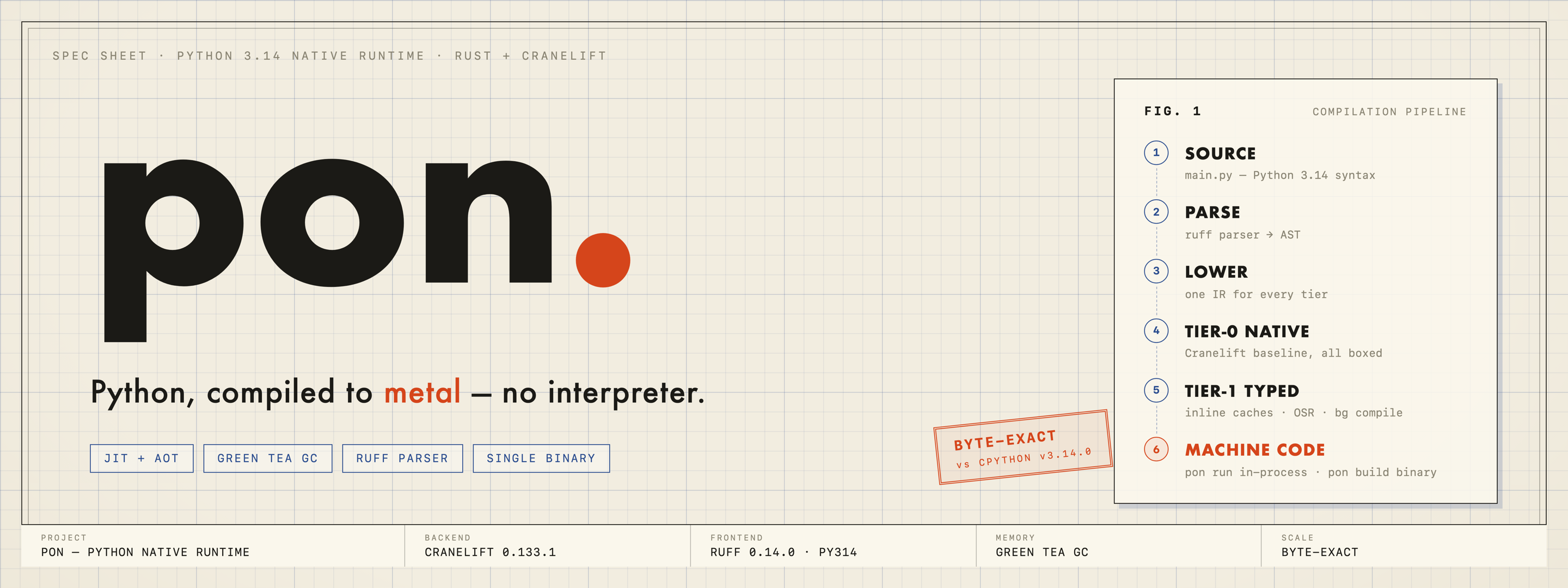
pon is a JIT & AoT native compiler and runtime for Python 3.14, written in Rust. There is no interpreter and no bytecode: every module is parsed with the ruff parser, lowered to one shared IR, and compiled to machine code through Cranelift — either just-in-time inside the process (pon run) or ahead-of-time into a standalone native executable (pon build). Memory is managed by a Green Tea garbage collector instead of reference counting, and correctness is enforced by a byte-exact differential harness against CPython v3.14.0.
The end goal is the bun/v8 of Python: a runtime that passes the CPython test suite, runs a multi-tier JIT well past CPython, ships single-binary executables, and includes batteries (package manager, tooling) out of the box. The project is under heavy active development — see Status for what is true today versus where it is going.
Quickstart
# JIT: parse → IR → Cranelift → run, in-process
printf 'def add(a, b):\n    return a + b\n\nprint("hello, world")\nprint(add(2, 3))\n' > hello.py
cargo run -p pon -- run hello.py

# AoT: same IR through cranelift-object, linked into a native executable
cargo run -p pon -- build hello.py -o hello
./hello
Both paths print the same bytes CPython would. That property is not aspirational — it is the exit gate of the conformance suite (see Conformance).
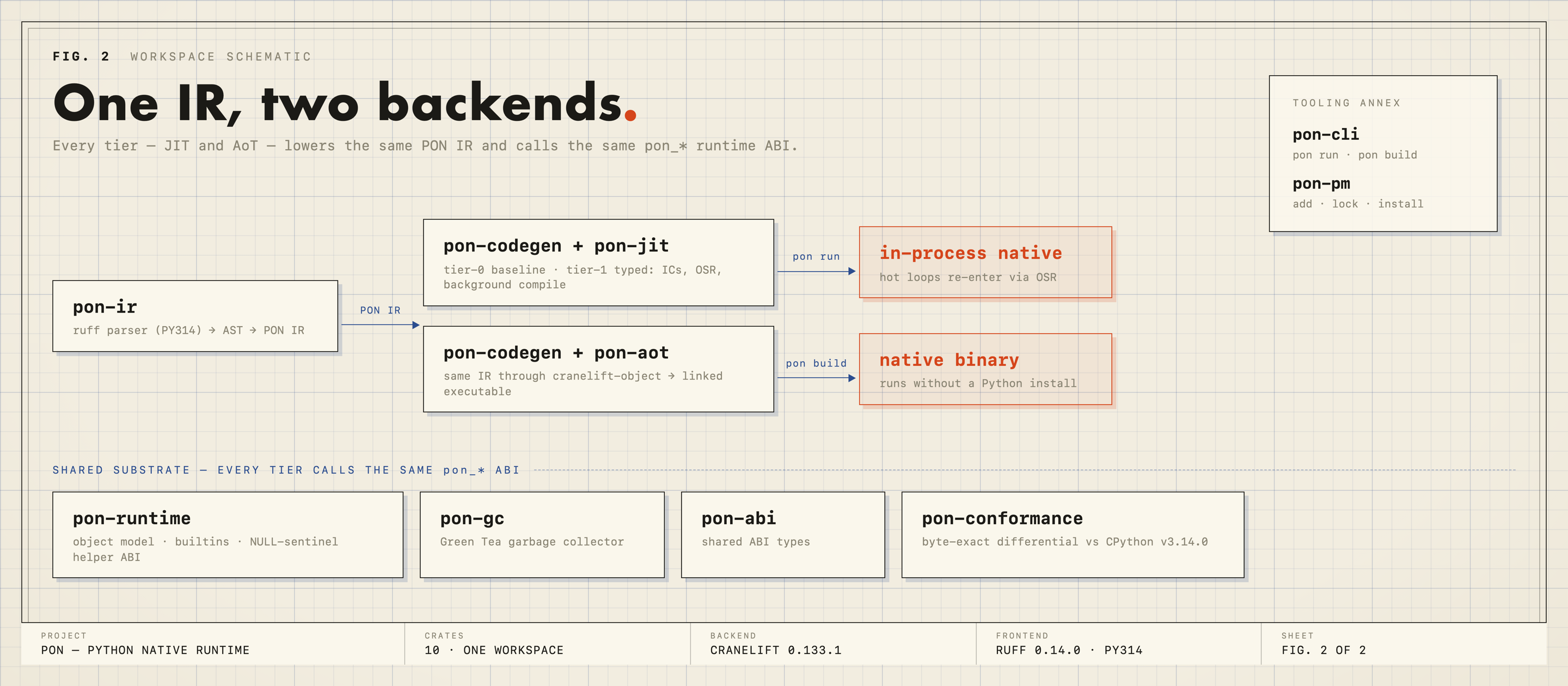
One IR, two backends, one runtime ABI. Every tier — baseline JIT, optimizing JIT, and AoT — lowers the same IR and calls the same pon_* helper functions:
source.py
   │ ruff parser (pinned 0.14.0, PythonVersion::PY314)
AST ──> PON IR (pon-ir, one IR for every tier)
   │
   ├── pon run:   pon-codegen ──> cranelift-jit ──> native code in process
   │                 tier-0 baseline (all boxed)
   │                 tier-1 typed: inline caches, OSR, background compile
   │
   └── pon build: pon-codegen ──> cranelift-object ──> object file ──> linked executable
   │
pon-runtime  (object model, builtins, NULL-sentinel pon_* ABI)
pon-gc       (Green Tea garbage collector)
Object model: CPython's heap object layout minus the refcount header. Errors cross the ABI as NULL sentinels, not unwinding. Integers are arbitrary-precision (num-bigint behind PyLong); a tagged small-int fast path is landing in the typed tier.
Tiering: tier-0 compiles everything boxed with no type feedback and is the correctness baseline (PON_TIER0_ONLY=1 forces it). Runtime helpers feed FeedbackCell type profiles from the first execution; hot functions recompile on a background thread and running loops enter the optimized code via on-stack replacement.
GC: the Green Tea collector owns all Python objects. Tier-0 uses conservative stack scanning with a register-flush trampoline at safepoints; the typed tier upgrades to precise Cranelift user stack maps.
Workspace
Crate
Role
pon-ir
ruff-based frontend: parse Python 3.14, lower to the shared PON IR
pon-codegen
IR → Cranelift CLIF, shared by every backend and tier
All dependencies are declared once in the root Cargo.toml under [workspace.dependencies]; member crates only inherit (see AGENTS.md).
Conformance & testing
The correctness contract is differential: a corpus module passes only if pon produces byte-identical output to CPython v3.14.0 (TZ=UTC, PYTHONHASHSEED=0). Passing sets are ratcheted into committed floor files, and CI fails on any regression below the floor.
Suite
What it measures
Committed floor
cpython
corpus modules, JIT, byte-exact vs CPython 3.14
244 modules (conformance-floor.json)
cpython-aot-subset
same corpus compiled AoT and executed as native binaries
206 modules (aot-parity-floor.json)
cpython-full
CPython's own test suite (Lib/test), run under pon
being brought up (conformance-full-floor.json)
fuzz
differential fuzzing vs CPython; must stay at zero divergences
—
ft-stress
no-GIL/threading stress in the default runtime
—
The standing gate is scripts/gate.sh; only its output counts as a gate claim:
Corpus files are immutable once landed: new coverage is a new module, verified byte-identical against python3.14 before it enters the manifest. Divergences that are CPython's problem (not pon's) are recorded in pon-conformance/divergence-ledger.toml rather than papered over.
Package manager
pon includes a uv-style package manager built on pubgrub resolution and the standard pyproject.toml, targeting the PyPI simple index, wheels, sdists, editable installs, and VCS requirements. Its run command executes through the same runtime path as direct script dispatch while adding managed import roots. It is under active development and not yet integrated into the runtime gates.
pon init | add | remove | install | lock | run | list | freeze | show | download | check | cache | env
Pinned toolchain
These pins are settled workspace-wide and enforced by Cargo.lock / rust-toolchain.toml; do not drift them casually.
CPython v3.14.0, pinned in pon-conformance/vendor/cpython-3.14/REVISION
Status
What is verified today (all behind ratcheted, CI-checked floors):
pon run and pon build work end to end; the quickstart above is a smoke-tested example.
209 differential corpus modules byte-identical to CPython 3.14 under the JIT; 172 of them also pass compiled AoT.
The perf substrate is in place: background compilation, OSR, inline caches, type feedback.
What is explicitly not done yet — this is the active roadmap, in order:
CPython test suite (cpython-full): the standing grind; failures are clustered and burned down per wave.
Stdlib build-out: _io/os, math/struct/random, collections/itertools/json, datetime, importlib parity — each lands as a native module plus a differential corpus module.
AoT parity growth toward the full corpus, plus single-binary product polish.
No-GIL/free-threaded runtime hardening: thread/GC/signal stress is now on the default runtime path, with remaining gaps tracked by the ratcheted suites.
Known gaps at the language level are burned down through the ratcheted floors above — the committed floor files, not this README, are the authoritative compatibility baseline.
Có — can1357/pon phát hành theo license MIT, nghĩa là mã nguồn mở để đọc, fork và (tùy license) tái sử dụng. Mã: github.com/can1357/pon.
can1357/pon có website riêng không?
TopGit chưa ghi nhận URL trang chủ cho can1357/pon. Phần README ở tab phía trên thường có link demo, hoặc xem mô tả GitHub của repo.
can1357/pon dùng license gì?
can1357/pon phát hành theo license MIT. Nên mở file LICENSE trên GitHub để xác nhận — license metadata đôi khi lệch với thực tế dự án.
can1357/pon là gì?
can1357/pon (can1357/pon) là dự án Rust trên GitHub. Theo mô tả gốc: Python 3.14, compiled to metal — JIT & AoT native compiler and runtime in Rust. Cranelift backend, ruff parser, Green Tea GC, byte-exact differential testing against CPython.
Cùng nhóm Backend còn repo nào?
can1357/pon thuộc nhóm Backend trên TopGit, cùng 9 topic GitHub. Trang Trending và Topics liệt kê các repo cùng số sao và cùng ngôn ngữ để so sánh.
Đọc thêm về can1357/pon ở đâu?
Trang TopGit này là một snapshot — tab "Readme" hiển thị nguyên văn README của repo (đã bỏ link, giữ ảnh). Repo GitHub ở github.com/can1357/pon là nguồn chính thức.
Vì sao can1357/pon được xếp vào nhóm Backend?
TopGit xếp can1357/pon vào nhóm Backend dựa trên GitHub topics và mô tả của repo (gắn thẻ: "aot", "compiler", "cranelift"). Việc phân loại dựa trên metadata thật của repo, không phải đoán theo cảm tính biên tập.
Đọc đầy đủ README ở tab phía trên.
Chưa chắc pon có hợp với bạn?
Để ChatGPT, Claude hoặc Perplexity tìm hiểu giúp — bấm bên dưới và xem AI nói gì về pon.
 /pon
/pon